Anthropic: The Ideal 'Rebel'
 08/21 2026
 401
401

Author/Vincent
Editor/Jiajia
Recently, it was disclosed that Anthropic had confidentially filed IPO-related documents with the U.S. Securities and Exchange Commission, aiming to go public in October this year with a valuation surpassing $2 trillion. If successful, Anthropic would not only outpace OpenAI but also potentially become the first AI large model company to list on the U.S. stock market, claiming the title of the largest IPO in history.
Achieving all this in just seven years, Anthropic was founded in 2021 by siblings Dario Amodei and Daniela Amodei after they parted ways with Sam Altman. They aimed to challenge their former employer, OpenAI, which they believed was pursuing commercial interests, by focusing on 'safe and controllable' technology.
Ultimately, this AI company, established during OpenAI's heyday, outperformed OpenAI in terms of technology, revenue, and capital. Anthropic can be seen as a 'rebel'—breaking free from OpenAI's shadow, enduring skepticism, and ultimately rewriting its destiny through a commitment to 'safety' and 'focus'.
【1】Differing Philosophies, Parting Ways
'If we extrapolate the future from GPT-3's outstanding performance, the answers to life, the universe, and everything would be just 4.398 trillion parameters,' Geoffrey Hinton, the father of deep learning, highly praised OpenAI's GPT-3 in June 2020, believing that this product signaled the imminent arrival of the 'singularity'.
GPT-3 left humanity in awe—capable of writing articles, creating stories, and answering questions, it surpassed all previous language large models. However, amid industry acclaim, Dario Amodei, then Vice President of Research and the lead behind GPT-3, fell into anxiety.
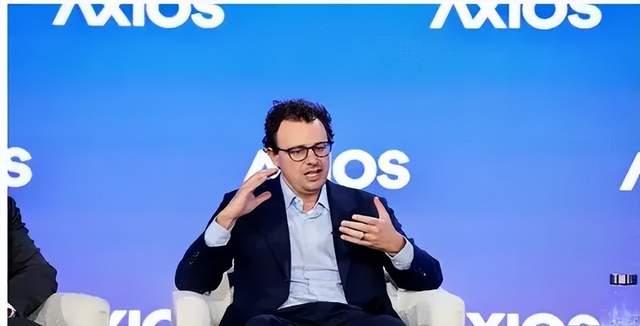
'Our pace of development has outstripped our ability to manage risks. Most people underestimate both the potential and the risks of AI.'
For Amodei, AI needed to tangibly benefit humanity—such as collaborating with biotech and pharmaceutical companies to cure previously incurable diseases; working with energy companies to make energy cheaper and more efficient; partnering with universities to provide better educational resources to people in remote areas... This was the vision shared by Amodei and some members of OpenAI's research team.
(Source: Internet)
However, OpenAI at the time took a completely different path due to the costly computational demands—commercializing AI applications just as they were beginning to emerge.
For example, in September of that year, Altman facilitated a deep partnership with Microsoft, which gained exclusive licensing rights to GPT-3's underlying code. This meant Microsoft could directly integrate and modify the core technology into its own products, giving them an exclusive advantage.
One side hoped to solve concrete human problems on a macro scale, while the other continuously pushed for deep integration with corporate giants to achieve commercialization. This led to a clash of philosophies between the technical leaders and the company's decision-makers within OpenAI.
Ultimately, in early 2021, a helpless Amodei submitted his resignation to Altman: 'Why continue arguing? The solution is: you do your thing, they do theirs, and we'll see who comes out on top in the market and in public opinion.'
In the battle for control over OpenAI's direction, idealists lost to commercial realities and were forced to strike out on their own. Two months after resigning, Amodei, along with some OpenAI research colleagues, founded Anthropic, hoping to 'place human interests and values at the center of AI development'.
【2】Suppression and Struggle to Keep Up
Because its early members were all GPT-3 researchers, Anthropic was dubbed OpenAI's 'strongest challenger' from its inception—securing $124 million in Series A funding right away.
With significant capital infusion and experience in developing AI large model products, everyone hoped Anthropic could replicate or even surpass GPT-3's AI products, becoming a safer version of OpenAI.
But reality dealt Anthropic a harsh blow. After losing core members like Amodei, OpenAI successively rolled out heavyweight products:
In November 2022, OpenAI released ChatGPT, a new-generation large model that reached 100 million monthly active users in just two months, becoming the fastest-growing consumer application in history. In March of the following year, OpenAI struck again with GPT-4, dominating the charts for a year and becoming the strongest AI large model.
In comparison, Anthropic, which aimed to change the world, didn't release its first large model product, Claude, until March 2023. Compared to GPT-4 at the time, Claude's performance gap was significant, akin to an old man playing with a child.
In comprehensive ability tests, GPT-4 scored 95.5, while Claude scored only 87.2, approaching GPT-4 only in ethical and literary tasks while lagging in all other areas.
With GPT-4 and ChatGPT as its ace cards, OpenAI became the shining star of the AI large model era:
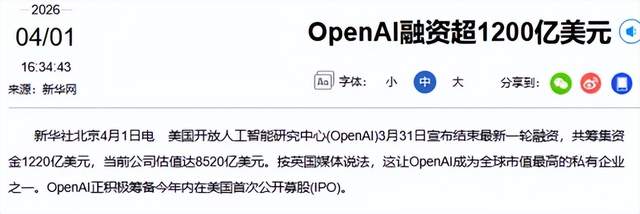
In terms of financing, OpenAI secured excess financing of $10.3 billion, $6.6 billion, and $40 billion in 2023, 2024, and 2025, respectively, and an additional $122 billion in March 2026.
(Source: Xinhua Net)
In terms of revenue, OpenAI's full-year revenue was only $28 million in 2022 but surged to $2 billion in 2023, reaching $28 billion over the two years from 2023 to 2025.
In contrast, Anthropic fell from being highly anticipated to hitting a low point.
From 2023 to 2025, Anthropic completed multiple financing rounds, raising a total of $17 billion, just 30% of OpenAI's total financing during the same period; its three-year revenue totaled $10.1 billion, about 36% of OpenAI's revenue during the same period.
Whether measured by capital recognition, large model product performance, or commercialization progress, Anthropic's gap with OpenAI in its quest to change AI's direction only widened.
【3】Sudden Surge, Dramatic Comeback
At the time, both within Anthropic's management and in the outside world, OpenAI was seen as synonymous with AI innovation, with no one expecting to shake the 'king's' position anytime soon—after all, OpenAI not only had money, talent, and products but, more importantly, was deeply integrated with giants like NVIDIA and Microsoft, becoming part of their ecosystems.
But entering 2026, Anthropic, long suppressed, staged a dramatic reversal, evident in the following ways:
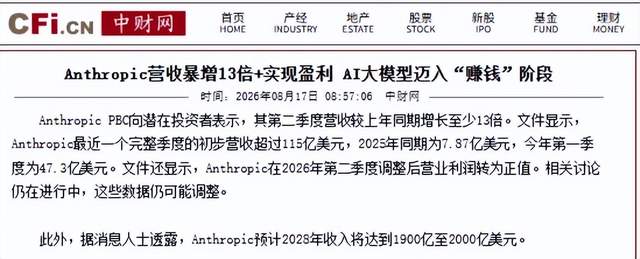
First, in terms of revenue, Anthropic had previously lagged far behind OpenAI in commercialization, earning just a fraction of OpenAI's revenue. However, in the second quarter of this year, Anthropic's revenue reached $14 billion, up 140% year-on-year, while OpenAI's revenue was only $6.7 billion, up 18% year-on-year.
More importantly, Anthropic reported a profit of $560 million, while OpenAI remained mired in a massive $12.3 billion loss.
(Source: China Finance Online)
Second, in terms of listing progress, Anthropic submitted its IPO application in June this year and is expected to become the first AI large model company to be listed in the United States in October, while OpenAI's listing date is set for mid-2027.
Third, in terms of products, Claude's initial performance lagged far behind GPT's, but the two alternated in leading positions thereafter. In May this year, Claude Opus 4.8 surpassed GPT-5.5 to top the Artificial Analysis Intelligence Index rankings; in July, Claude Opus 5 was released, outperforming OpenAI's GPT-5.6 Sol in key benchmark tests like coding.
Why did Anthropic manage to rewrite its destiny in 2026, surpassing OpenAI in product performance, capital progress, and even commercialization?
The reason is simple: during the commercialization phase of AI large models, users care not just about functionality but also safety—and in this regard, Anthropic has a natural advantage.
When developing Claude, Anthropic embedded an 'AI constitution' at its core, requiring Claude to first ensure no harm, second to avoid lying, and only then to meet user needs.
How significant is this difference? Take capital market merger contracts as an example—when a company wants to acquire another, Anthropic requires all AI inferences to be verifiable, without fabricating terms; in clinical trials, any AI inferences must be supported by data.
It is precisely this logic of 'safety first, functionality second' that has made Claude popular among many enterprises. By the second quarter of 2026, Anthropic's market share in enterprise large language models had reached 32%, surpassing OpenAI's 25%; eight of the Fortune 10 companies had become its paying customers.
In 2021, when Dario Amodei left OpenAI, he left behind a remark: 'We'll see who comes out on top in the market and in public opinion.'
At the time, it sounded more like the reluctant monologue of a loser. Everyone sided with OpenAI, believing it an unbeatable king.
Five years later, as he stood on the threshold of an IPO, with over $65 billion in annualized revenue, a 32% enterprise market share, and the crown of 'the first AI large model company to be listed in the United States,' that remark finally echoed back.
END
-
![]()
BYD Executive: BYD's Intelligent Driving is Actually Stronger Than Huawei's. Netizens: Watch Out for Yu Chengdong's 'Meltdown.' Wow
-
![]()
Amidst the Wave of Unemployment, Will Big Companies Focus Solely on AI Talent Next Year?
-
![]()
The Launch of AITO G9 is Truly Lively! Yu Chengdong: My 'Nervous Tongue' Didn't Explain Well; Shen Teng: My 'Slip of the Tongue' Was Miscommunicated
-
![]()
AI Agents Keep Crossing Boundaries and Causing Trouble? Actually, They’re Just Overeager to Please Humans
-
![]()
Anthropic: The Ideal 'Rebel'
-
The Investment Insight Behind Kuaishou's 11% Share Price Drop: Steer Clear of ByteDance
-
![]()
To Truly Live Up to Its Cantonese Moniker ‘Wealthy,’ Volvo Must Elevate Its Game
-
![]()
Optical Industry Chain's 'Little Giant' Faces the Listing Challenge! Yuanli Optoelectronics Set for BSE IPO Review Tomorrow