BYD Executive: BYD's Intelligent Driving is Actually Stronger Than Huawei's. Netizens: Watch Out for Yu Chengdong's 'Meltdown.' Wow
 08/21 2026
 431
431
The automotive circle never lacks drama, but this time, the conflict is unusually blunt.
Zhang Zhuo, General Manager of BYD's Ocean Network, dropped a bold claim in an interview: BYD's assisted driving is already stronger than Huawei's, but outsiders are unwilling to believe it.
The comment immediately sparked an uproar in the industry. Netizens urged caution: 'Mr. Zhang, be careful not to invite backlash. Your Divine Eye is no match for ADS.' A rational analysis reveals two sides: On one hand, BYD has millions of vehicles on the road, continuously feeding real-world data to its Divine Eye B system, with this year's real-world performance vastly improved over last year. On the other hand, Yu Chengdong has repeatedly declared Qiankun Intelligent Driving the industry leader with a generational advantage. When news reached social media, onlookers began stoking the flames, joking that if Yu Chengdong heard this, a public debate would be inevitable.
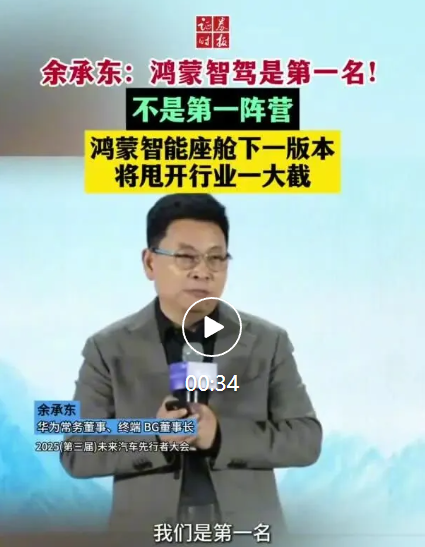 Image Source: WeChat Channel
In the End-to-End Era, Data is the Core of Intelligent Driving Competition
Many in the industry know that as the entire field shifts toward end-to-end large models, the underlying logic of intelligent driving competition has quietly changed. Zhang Zhuo's assessment is blunt: whoever has more data will dominate.
As of July 31, 2026, BYD models equipped with Divine Eye and Huawei's Qiankun Intelligent Driving have sold a cumulative 3.52 million units, with Divine Eye generating 220 million kilometers of data daily. Millions of new vehicles hitting the roads each year form BYD's unique data closed loop (closed loop). This massive real-world data continuously trains models, enabling the leapfrog upgrade of Divine Eye B. He also noted that after the widespread adoption of end-to-end architectures, iteration speeds across all players have significantly accelerated, narrowing the gap between top contenders.
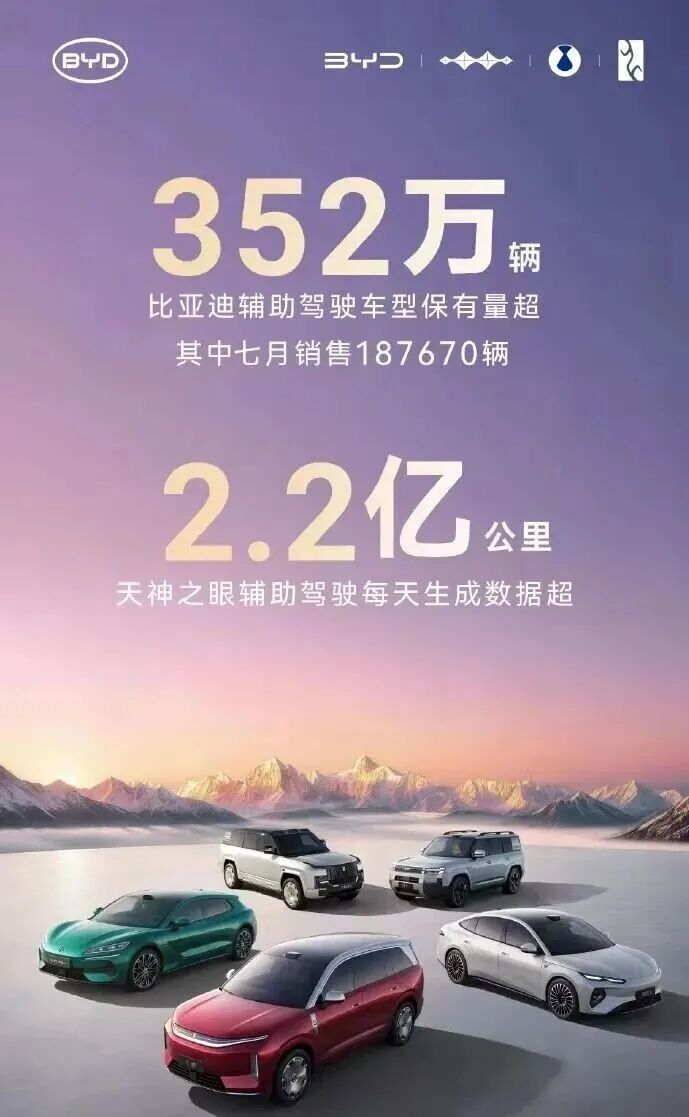 Image Source: Weibo
Of course, data is not the only decisive factor. Hardware specifications, computational power reserves, underlying algorithms, and safety fallback mechanisms collectively determine real-world performance. Many BYD owners have noticed visible improvements in the smoothness and emergency response of the new Divine Eye system. However, A calm observer (dispassionate observers) question whether simply accumulating mileage equates to stronger algorithms, arguing that real-world testing is the most convincing metric.
After multiple industry benchmarks, Divine Eye 5.0, powered by an end-to-end large model, demonstrated significant improvements in urban navigation capabilities. Combined with the launch of its self-developed 4nm Xuanji A3 chip and the optional laser version of Divine Eye B, BYD's self-developed intelligent driving trajectory is clear for the entire industry to see.
Former Allies Turned Rivals: The RMB 150,000-200,000 Segment Becomes the 'Verdun of Intelligent Driving'
Few know this anecdote: In 2014, when Denza delivered its first model, Wang Chuanfu personally handed the keys to its first owner—Yu Chengdong. The two Anhui natives could not have predicted that over a decade later, their companies would engage in a protracted tug-of-war in the RMB 150,000-200,000 mass-market segment, akin to the 'Verdun of intelligent driving.'
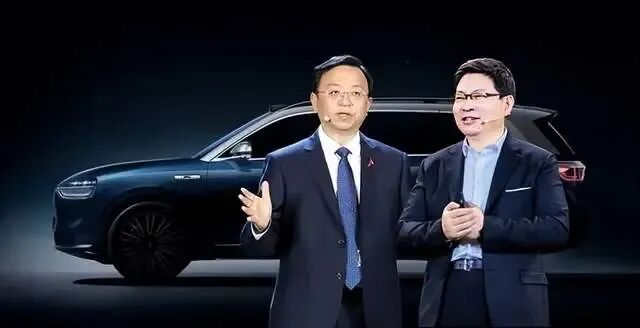 Left: BYD's Wang Chuanfu; Right: Huawei's Yu Chengdong. Image Source: Weibo
At the Beijing Auto Show, BYD occupied the entire E3 pavilion, dedicating a special experience zone for Divine Eye. This self-developed system comes in three tiers: C-tier for volume models priced RMB 70,000-200,000, tasked with popularization; A- and B-tiers for mid-to-high-end models like Yangwang, Denza, Fang Cheng Bao, Han, and Tang. During the show, BYD announced a price hike for the Divine Eye B high-tier package, raising it from RMB 9,900 to RMB 12,000—a move reflecting its massive ongoing investment in self-developed high-tier intelligent driving.
BYD's serious push into intelligent driving began in 2021, with R&D intensity peaking from late 2024 to 2025. Leveraging vertical integration across its entire automotive supply chain and production scales in the tens of millions, BYD pursues a self-developed route that relies on scale to dilute costs.
Meanwhile, Huawei's Qiankun Intelligent Driving is accelerating its penetration into the mainstream market. Shangjie targets the RMB 150,000-250,000 price band, with the Deepal S07 equipped with Qiankun ADS Pro starting at RMB 149,900; Dongfeng Fengxing Xinghai V6 comes standard with Huawei's system, with industry estimates placing its pricing between RMB 80,000-150,000.
This means BYD's Divine Eye C will directly clash with Huawei's Qiankun Intelligent Driving in China's fiercely competitive RMB 150,000-200,000 segment. Currently, the model count stands at 4 (BYD) vs. 3 (Huawei), with new products continuously entering the fray, intensifying competition.
In this price range, joint ventures and luxury brands defend their turf while domestic brands strive to break through. Cost, hardware, and brand reputation conflicts intertwine. With two giants vying for dominance, this intelligent driving war promises to be prolonged and grueling. Some rational netizens note that their positioning differs fundamentally: BYD develops in-house systems for its vehicles, while Huawei positions itself as an enabler for automakers, making direct comparisons unnecessary. However, more BYD users admit: 'BYD's Divine Eye is no match for Huawei's ADS.'
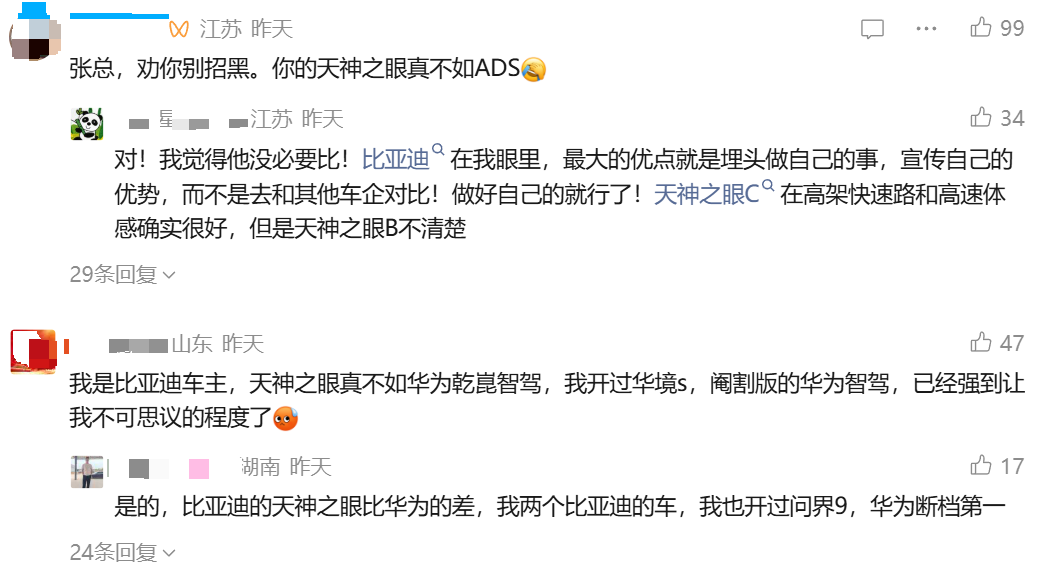 Image Source: WeChat Channel
Two Unavoidable Questions, Two Opposing Technical Routes
Entering the RMB 150,000-200,000 market, BYD and Huawei each face an unavoidable challenge.
BYD's hurdle is brand upscaling. Below RMB 100,000, BYD holds pricing power; in the RMB 100,000-150,000 range, it dominates sales. However, its long-term focus on affordability means models above RMB 150,000 remain underrepresented in its portfolio. Despite launching Yangwang, Fang Cheng Bao, and Denza as premium brands, the 'budget automaker' label persists. The industry generally believes BYD's pragmatic approach is to steadily raise average selling prices through incremental premiumization. Whether Divine Eye can stabilize its position in this segment will determine its brand upscaling success.
Huawei, meanwhile, must deliver on its promise of 'not building cars, but empowering automakers.' In the premium market, Qiankun Intelligent Driving has secured its foothold. By April 2026, it captured 53.2% of the urban navigation-assisted driving market for models priced above RMB 350,000, partnering with over 35 automakers. However, models above RMB 300,000 account for just ~13% of the market, limiting growth potential. To fully prove its value as an enabler, Huawei must conquer the larger mainstream passenger car market.
With overlapping goals, the two companies have chosen diametrically opposed technical routes.
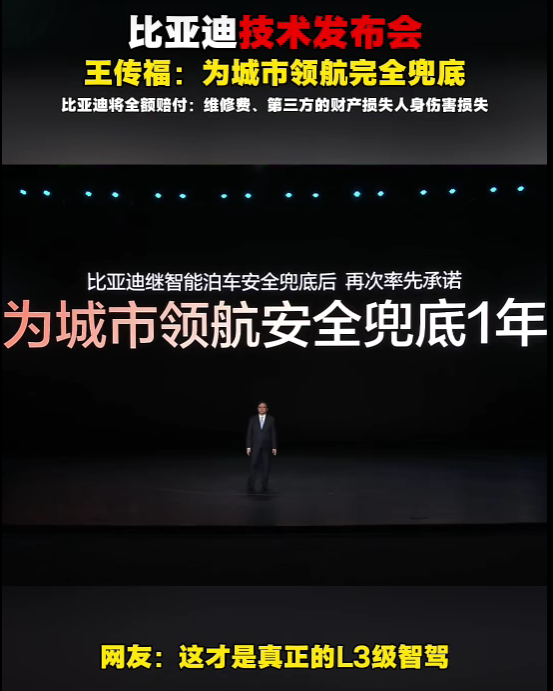 Image Source: Douyin (BYD)
At its launch event, Chairman Wang Chuanfu announced safety guarantees for BYD's 'Divine Eye' high-tier intelligent driving system. The coverage includes: full compensation (vehicle repairs, third-party property, and personal injury) with no upper limit and no impact on next-year's insurance premiums for accidents caused by the assisted driving system during urban navigation. Eligible users: all new Divine Eye A/B owners (1-year coverage from vehicle pickup) and existing owners who upgrade to version 5.0 via OTA.
BYD's Divine Eye C adopts a pure vision, lidar-free, low-cost mass-market approach. By leveraging massive installation volumes to dilute R&D and hardware costs, Divine Eye C's hardware costs just ~RMB 4,000, prioritizing accessibility and affordability. The trade-off is that the C-tier lacks urban NOA support; users needing full-scenario navigation must opt for the lidar-equipped Divine Eye B version. Many mass-market owners endorse this route: 'For daily commuting, 'good enough' is fine. There's no need to increase Purchase cost (vehicle costs). Bringing assisted driving to more ordinary families is true industry inclusion.'
Huawei's Qiankun Intelligent Driving insists on high-end synergy, hardware redundancy, and mature technology decentralization. The Shangjie H5's Qiankun ADS 4 shares the same underlying architecture as the Aito M9 and Enjoy S9; its 192-line lidar, originally standard in RMB 250,000-400,000 models, comes standard in high-end variants. Industry estimates place the Shangjie H5 Max's full intelligent driving hardware costs at ~RMB 16,000. This hardware investment enables full urban NCA and parking-to-parking navigation—the primary reason 75% of the model's initial 160,000 orders chose the lidar-equipped Max version. Huawei's supporters argue that lidar provides irreplaceable safety redundancy in complex scenarios like rain, glare, or sudden obstacles.
However, this strategy's shortcoming (shortcoming) is equally pronounced: high hardware costs raise entry barriers. Yu Chengdong admitted that Harmony Intelligent Mobility loses money on every model sold below RMB 200,000. Netizens joke that while BYD saves costs to drive volume, Huawei pours money into hardware to enter the market—two extremes.
Battle Projection: A Long-Term Duopoly, Pressure on Smaller Automakers
Recall the Battle of Verdun: after prolonged clashes, the frontlines remained largely unchanged. This intelligent driving war will likely replicate that pattern (pattern).
BYD holds scale and cost advantages; Huawei possesses mature high-tier algorithms and strong user loyalty. Both companies boast robust profitability to sustain long-term R&D investment and market competition. Future market dynamics may split: in the RMB 150,000 entry-level segment, BYD will dominate through cost efficiency; in the RMB 180,000-200,000 premium niche, Huawei will defend its turf with full high-tier capabilities. The mid-price band will become the primary battleground for years. In the long run, neither is likely to fully conquer the other's core market, resulting in a stable duopoly akin to Android and iOS.
As these giants escalate their arms race, the intelligent driving threshold for the RMB 150,000-200,000 mass-market segment will permanently rise.
The hardest hit will be automakers still promoting basic L2 assisted driving as their core selling point. Constrained by capital and vehicle volumes, they cannot build complete data closed loop s (closed loops) or keep pace with this technological iteration. Even without product flaws, their survival space will shrink under giant pressure. In today's hyper-competitive auto industry, failing to keep up is the greatest risk.
Executive Debates Benefit Ordinary Drivers
Behind the executives' public sparring lies a clash of two industrial strategies: prioritizing volume installations for continuous iteration via massive real-world data, or prioritizing high-end hardware to ensure full-scenario high-tier experiences.
End-to-end large models are narrowing foundational gaps among top players, but intelligent driving has never been a single-dimensional competition. Data, computational power, hardware redundancy, safety mechanisms, and cost balance are all indispensable.
Netizens' jokes about 'watching Yu Chengdong melt down' remain just industry gossip. More importantly, ordinary consumers are the biggest winners in this competition: high-tier assisted driving, once exclusive to premium models, is rapidly filtering down to RMB 100,000-level mass-market cars.
Rather than fixating on verbal debates between Divine Eye and Qiankun Intelligent Driving, real-world road testing will be the ultimate judge.
Interactive Topic: Given the same budget, would you choose BYD's pure vision mass-market intelligent driving or Huawei's lidar-equipped full-scenario system? Share your thoughts in the comments!
Disclaimer: This article is for financial commentary only and does not constitute investment advice. All corporate data and regulatory events mentioned are from public information and are for reference only; official announcements shall prevail. Image sources are network-based; please contact us for copyright removal if needed.
Hit 'Like,' 'Share,' and 'Favorite' in one click!
Share your thoughts in the comments!
Daily Insights on Intelligent Technology and Finance
-
![]()
BYD Executive: BYD's Intelligent Driving is Actually Stronger Than Huawei's. Netizens: Watch Out for Yu Chengdong's 'Meltdown.' Wow
-
![]()
Amidst the Wave of Unemployment, Will Big Companies Focus Solely on AI Talent Next Year?
-
![]()
The Launch of AITO G9 is Truly Lively! Yu Chengdong: My 'Nervous Tongue' Didn't Explain Well; Shen Teng: My 'Slip of the Tongue' Was Miscommunicated
-
![]()
AI Agents Keep Crossing Boundaries and Causing Trouble? Actually, They’re Just Overeager to Please Humans
-
![]()
Anthropic: The Ideal 'Rebel'
-
The Investment Insight Behind Kuaishou's 11% Share Price Drop: Steer Clear of ByteDance
-
![]()
To Truly Live Up to Its Cantonese Moniker ‘Wealthy,’ Volvo Must Elevate Its Game
-
![]()
Optical Industry Chain's 'Little Giant' Faces the Listing Challenge! Yuanli Optoelectronics Set for BSE IPO Review Tomorrow