Amidst the Wave of Unemployment, Will Big Companies Focus Solely on AI Talent Next Year?
 08/21 2026
 517
517
A screenshot of a private HR chat recently went viral in workplace circles, candidly revealing the current reality of internet job hunting and leaving countless workers feeling uneasy.
The hidden recruitment rules of an HR from a major company have been exposed:
"Resumes listing only Java, front-end, or back-end skills are directly filtered out in the first round. Without AI-related tags, you simply won't make it to the interview stage."
This is not just a special requirement of individual companies but a signal of talent transformation across the entire tech industry. The recently concluded layoff wave on June 30th has fully exposed the industry truth: This is not just an ordinary capital winter layoff but an AI-driven workplace transformation.
 Source: The Trend of Struggle 2030@WeChat Official Account
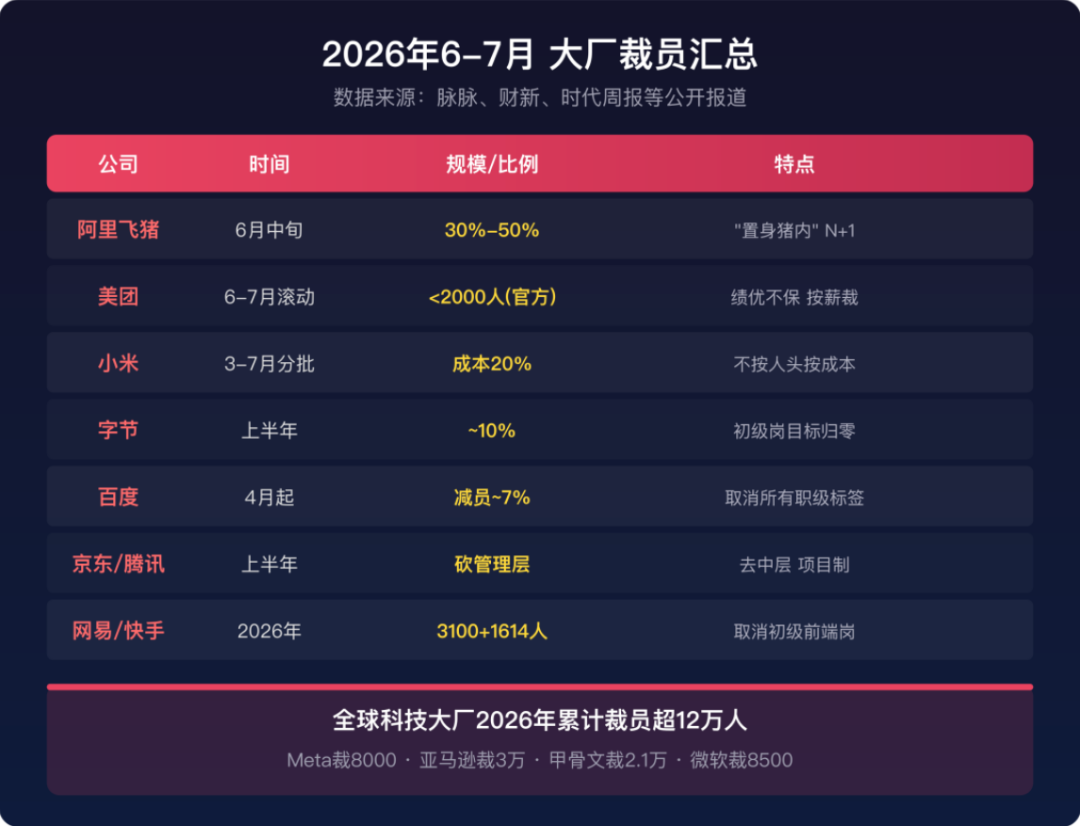
From June to July 2026, major domestic and foreign tech companies underwent concentrated personnel optimization. Unlike previous passive cost-cutting, the core of this round of layoffs was business restructuring: Companies are reducing traditional role headcounts, fully allocating human resources budgets and computing power to the AI sector, eliminating employees suited to old models, and absorbing new AI talent.
Nowadays, on the campus recruitment pages of big companies, AI algorithm, AI full-stack, and AI Agent roles firmly occupy the top spots, while traditionally popular technical roles have been completely marginalized. The recruitment platform Maimai has directly implemented new rules, launching a dedicated AI tag system in its talent pool, precisely categorizing job seekers into three types: AI technical foundation talent, AI application development talent, and AI business efficiency talent.
Currently, when HR screens resumes, they prioritize checking the 'AI talent' tag. Job seekers without AI-related experience are basically directly eliminated. This massive transformation in recruitment confirms one thing: The talent evaluation standards in the internet workplace have been completely rewritten.
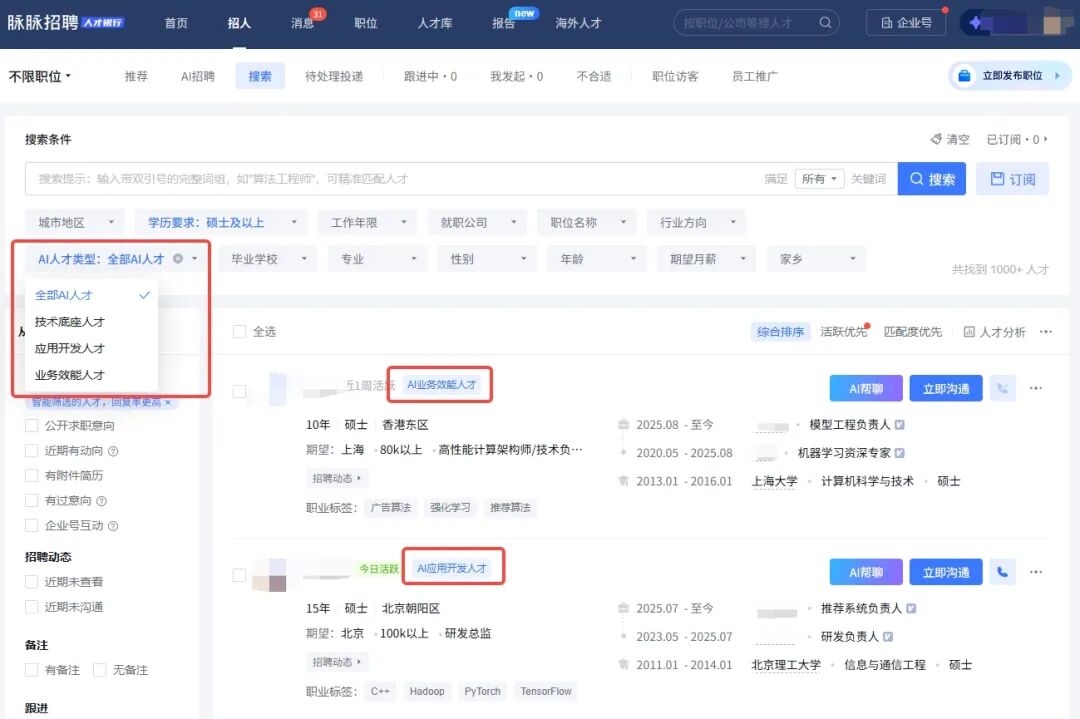
Source: Screenshot of Maimai's recruitment filtering interface
01 Extreme Industry Polarization: AI Surges 870%, Traditional Roles Batch Eliminated
Data from Maimai's '2026 Spring Recruitment Workplace Insights Report' directly hits at the industry truth: This year, AI job recruitment has surged by 870%, making AI the only core sector with rapid growth in the internet industry.
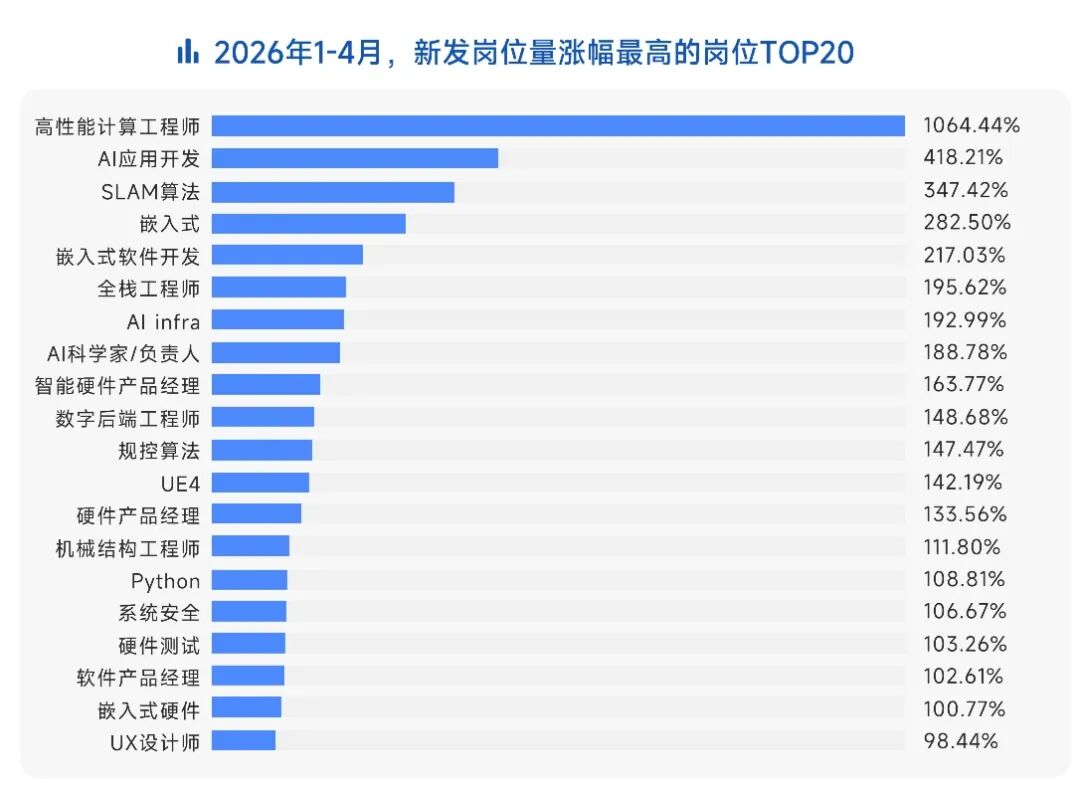
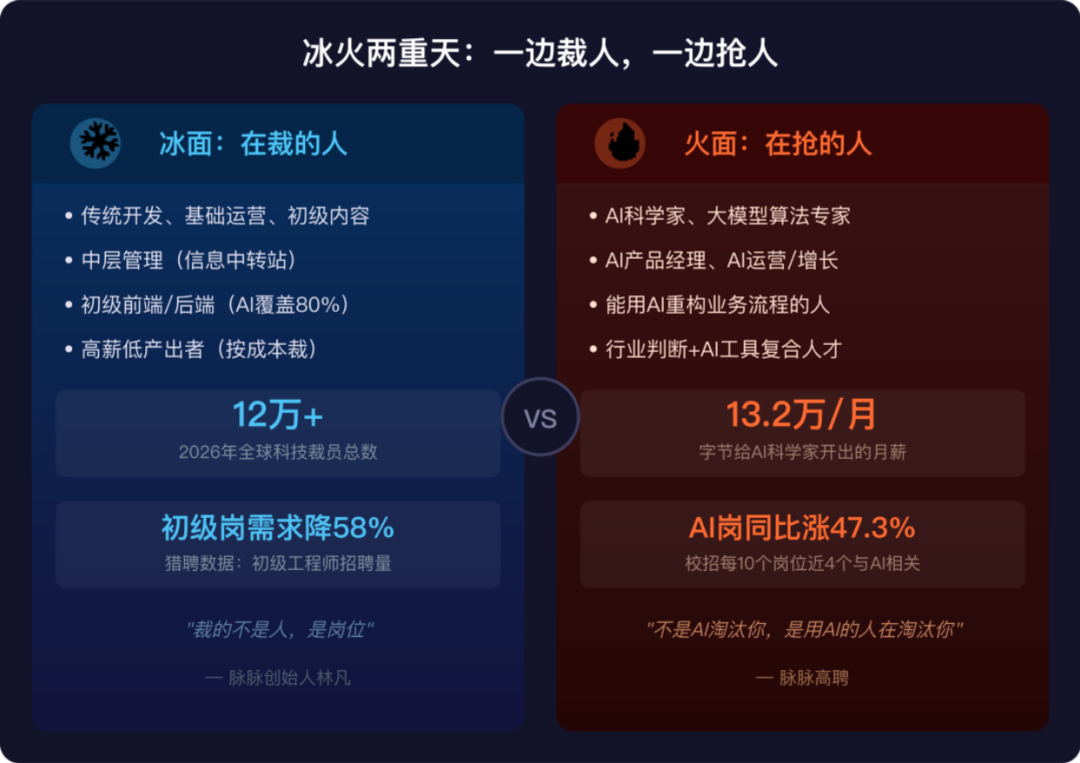
From January to April 2026, the top 20 growing roles in the industry are all concentrated in AI infrastructure, autonomous driving, and smart hardware fields, with high-performance computing engineer roles surging by 1064.44%. Overall campus recruitment roles only increased by 3.56% year-on-year, but AI campus recruitment roles surged to 47.30%, continuously widening the talent supply-demand gap.
 Source: The Trend of Struggle 2030@WeChat Official Account
The contrast in campus recruitment is equally striking: Overall campus recruitment roles only increased by 3.56%, but AI-related campus recruitment roles surged by 47.30%. Now, when big companies compete for talent, they are basically all targeting AI directions.
Leading big companies are fully committing to AI, with unprecedented recruitment efforts:
• Ant Group's technical roles account for 85%, with 70% of roles tied to AI, focusing on competing for talent in large models, multimodal, and intelligent agent fields;
• Over 60% of the 7,000+ offers in Alibaba's autumn recruitment are for AI roles, with Alibaba Cloud and DingTalk's AI roles accounting for as high as 80%;
• Taotian Group is fully focused on AI, with AI penetration in technical roles exceeding 90%;
• Baidu's campus recruitment AI roles account for over 90%, covering core cutting-edge sectors such as large models, autonomous driving, and AI Infra.
Behind the frenzied expansion in the AI sector is the systematic elimination of traditional roles. The June 30th layoff wave has completely shattered the job security of internet professionals.
Many people cling to the old belief that 'profitable roles are safe,' but this is now completely ineffective. With industry growth capping, big companies are significantly reducing traditional labor costs, continuously investing funds into computing power and large model research and development. Meanwhile, AI coding tools are becoming increasingly mature, rapidly replacing standardized development, testing, and front-end work, continuously shrinking the survival space of traditional roles.
As growth in old businesses slows down, investing in large models and computing power requires massive amounts of money. Big companies are starting to allocate the wage budgets originally for traditional roles to computing power and AI infrastructure. Additionally, as AI coding tools become increasingly user-friendly, many repetitive development tasks can now be directly completed by AI, continuously squeezing the survival space of traditional roles.
Programmers have become the hardest hit in this adjustment. Alibaba and Tencent are forcibly promoting full-stack transformation for all employees, with primary developers possessing only single skills and traditional technical expertise being batch optimized. Multiple business lines have suspended non-urgent demands to fully focus on AI Agent research and development.
More cruelly, high salaries, high performance ratings, and high P-level positions have completely lost their immunity from layoffs. At major companies like Meituan and Ctrip, many senior employees responsible for core projects and exceeding performance expectations have also been included in the optimization list. Even high-value new hires from prestigious universities who have only been on the job for a year are not spared from elimination, completely bidding farewell to the era of 'seniority ensuring safety' in the workplace.
The top-down pressure for AI transformation has also spawned absurd 'performative AI' internal competition. Multiple companies have included AI efficiency improvements as a mandatory weekly report metric, even competing on token consumption. Middle managers, to meet transformation targets, proactively report aggressive layoff quotas; frontline employees use AI formally to cope with work without actual business benefits, trapping everyone in an ineffective arms race of internal competition.
This industry shock is global. Domestic companies like Meituan, Alibaba, ByteDance, Baidu, and Ctrip are all adjusting, significantly contracting marginal businesses; overseas companies like Meta, Amazon, and Oracle are simultaneously laying off and refreshing their workforce. Meta is a typical example, laying off 8,000 employees while arranging for 7,000 employees to transfer to AI departments, clearly signaling the replacement of 'traditional for AI.'


 Source: Maimai APP
Numerous exposures on the Maimai APP of real cases of employees from big companies confirm the industry status quo: Front-end engineers with years of top performance being batch optimized, ten-year senior engineers passively leaving, and multiple floors of office workstations largely vacant. Even profitable businesses receive mandatory optimization targets, with the core purpose being to adapt to a new AI-driven work mode.
The core logic of the current workplace is clear: Companies are no longer paying for traditional old technical stacks; all resources, headcounts, and salaries are fully tilted towards talent that can implement AI and create business increments. What is being eliminated is never just employees but old roles and abilities that cannot keep up with the AI era.
02 Big Companies' Core Talent Strategy: Externally Competing for Top AI Experts, Internally Transforming Existing Employees
Faced with an unprecedented AI talent gap, big companies' strategies are extremely clear: Offering high salaries to externally compete for top AI talent while batch transforming existing employees internally to complete a full AI upgrade for all staff.
Nowadays, the job market is highly homogenized, with most resumes listing AI-related experience, but real ability gaps are vast. To quickly screen high-quality talent and weed out the incompetent, Maimai has categorized AI talent into three tiers, precisely matching enterprise hiring needs.
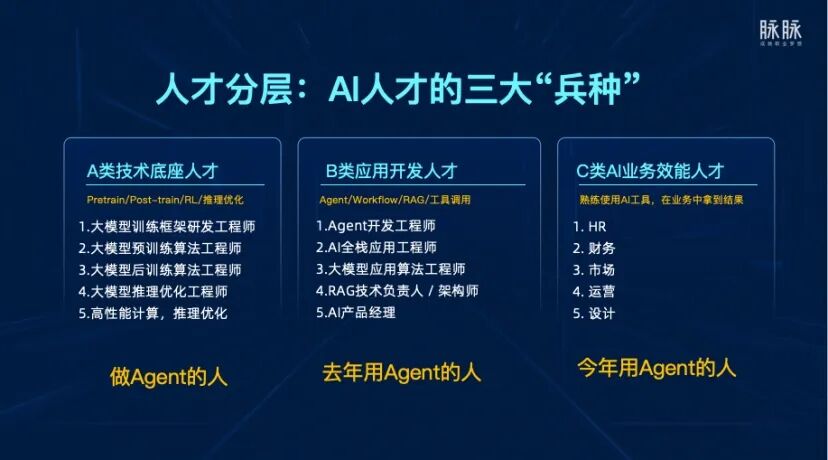
• Class A AI technical foundation talent: Deeply engaged in core underlying technologies such as large model pre-training, post-training, and inference optimization, these are rare hardcore talents in the industry, with salaries reaching 2.5 times those of traditional roles, extremely high thresholds, belonging to a select elite track.
• Class B AI application development talent: Proficient in mainstream technologies such as Agent, RAG, and Workflow, responsible for building AI tools and implementing products, these are the core main forces in enterprise AI transformation, with companies both aggressively poaching talent and focusing on internal cultivation.
• Class C AI business efficiency talent: The optimal track for ordinary people to make a comeback! No need to delve into complex algorithms and underlying logic; the core ability is using AI tools to implement business, improve efficiency, and produce results. All roles, including operations, marketing, finance, HR, and design, can transition into this field.
These three types of talent constitute a complete AI transformation system for enterprises, with hardcore foundation talent being externally introduced with high salaries and application and business efficiency talent being primarily internally cultivated. Alibaba has launched an AI competency certification system, and Tencent relies on its Hunyuan large model to conduct full-staff internal training, essentially batch transforming existing employees to adapt to the new AI work mode.
Simply put, companies are willing to give ordinary employees opportunities to transition, but those who lie flat and refuse AI upgrades will ultimately become the preferred targets for the next round of organizational optimization.
03 Ordinary People Don't Need to Hardcore Compete as AI Scientists! A Simple Three-Step Method for Practical Transition
After the June 30th layoff wave, workplace differentiation has become increasingly apparent: Some people are deeply mired in unemployment anxiety, feeling threatened from all sides; others see through the rules and proactively transition to AI to seize new opportunities. A labeled talent system makes practical and implementation-oriented talent more easily visible to enterprises.
Here, we clarify a core misunderstanding: To become AI talent, you don't need to be an AI scientist or obsess over obscure underlying algorithms. For most ordinary people, there's no need to compete for the high-threshold Class A foundation roles; aiming for Class B application development or the even lower-threshold Class C business efficiency talent is the most stable path.
For most ordinary people, there's no need to obsess over Class A foundation talent. A more realistic path is to aim for Class B AI application development or the even lower-threshold Class C AI business efficiency talent.
Here's a zero-threshold, implementable three-step method for workplace AI transition, requiring no career change and enabling rapid upgrading:
• Step 1: Stay grounded in your current role, reject performative AI use, and deliver real business results. No need to blindly devour professional algorithm books; start from daily work and use AI to solve actual business problems. Purely 'performative operations' of piling up AI usage records in weekly reports are meaningless; producing quantifiable work results is the core moat in the workplace.
• Step 2: Review and summarize, creating a reusable AI work methodology. Move beyond the shallow understanding of 'having used AI tools,' comprehensively review work processes, summarize experiences in AI efficiency improvements, problem-solving, and avoiding pitfalls, and accumulate your own standardized work methods, forming irreplaceable workplace abilities.
• Step 3: Build your personal AI label and update your workplace profile. Synchronize AI implementation projects and quantifiable business results to your resume, Maimai, and other workplace profiles, creating unique differentiated labels to help HR quickly identify your AI core competitiveness and stand out in job hunting and promotions.
The ultimate talent standard in the AI era has already been updated: True AI talent is not technical experts proficient in underlying research and development but practitioners who are good at using AI tools and continuously solving business problems.
The AI wave brings not just layoff crises but also a fair workplace reshuffle. Eliminating old abilities and supporting new talent, the crisis hides opportunities for ordinary people to make a comeback. The initiative in the workplace will always be in the hands of those who proactively change.
Interactive Topic: After experiencing the June 30th industry shock, have you felt the impact of AI on your own role? What is the biggest challenge for ordinary people transitioning to AI? Welcome to discuss in the comments section.
If this article is inspiring, please like + view, and forward it to fellow internet professionals who are job hunting or deeply engaged in the field.
Disclaimer: This article serves exclusively as a financial commentary focused on major corporations and is not intended to offer any form of investment advice. All enterprise data and regulatory events referenced in this article are derived from publicly available information, presented solely for reference purposes. In cases where discrepancies arise, the official releases should be considered authoritative. The images used in this article are sourced from the internet; should there be any copyright concerns, please contact us for prompt removal.
-
![]()
BYD Executive: BYD's Intelligent Driving is Actually Stronger Than Huawei's. Netizens: Watch Out for Yu Chengdong's 'Meltdown.' Wow
-
![]()
Amidst the Wave of Unemployment, Will Big Companies Focus Solely on AI Talent Next Year?
-
![]()
The Launch of AITO G9 is Truly Lively! Yu Chengdong: My 'Nervous Tongue' Didn't Explain Well; Shen Teng: My 'Slip of the Tongue' Was Miscommunicated
-
![]()
AI Agents Keep Crossing Boundaries and Causing Trouble? Actually, They’re Just Overeager to Please Humans
-
![]()
Anthropic: The Ideal 'Rebel'
-
The Investment Insight Behind Kuaishou's 11% Share Price Drop: Steer Clear of ByteDance
-
![]()
To Truly Live Up to Its Cantonese Moniker ‘Wealthy,’ Volvo Must Elevate Its Game
-
![]()
Optical Industry Chain's 'Little Giant' Faces the Listing Challenge! Yuanli Optoelectronics Set for BSE IPO Review Tomorrow