Alibaba's Aggressive Investments: Is It Aiming to Become the 'Chinese Google'?
 08/21 2026
 444
444
On the evening of August 20, Alibaba, often referred to as the 'Chinese Google,' released its Q2 financial results for the natural year (Q1 of FY27). Given that the company had recently updated its guidance to the market, the quarterly performance was largely in line with expectations.
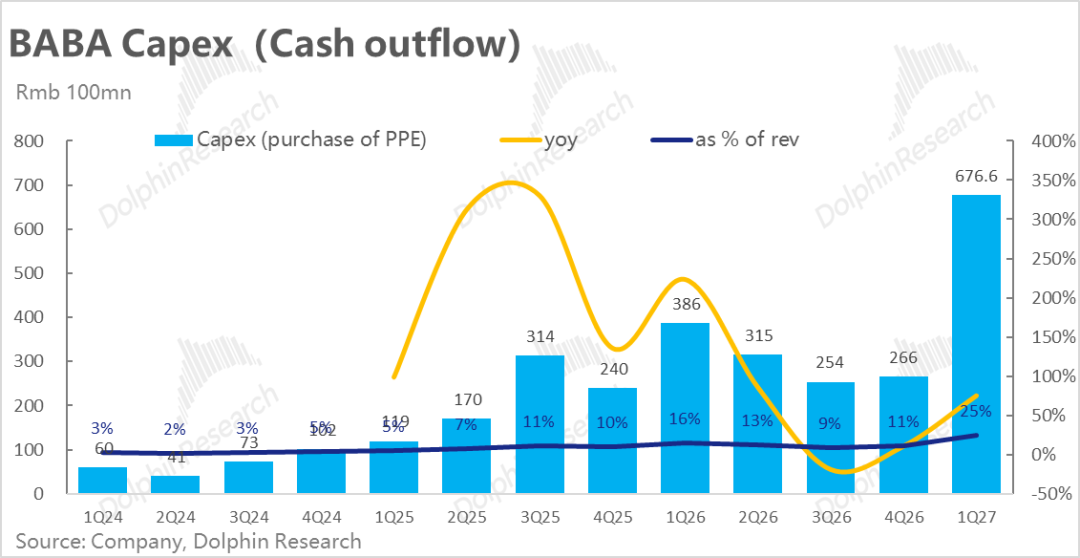
In summary, the pan-retail sector growth has bottomed out with profit recovery (loss reduction in food delivery), while the AI & cloud business has surged with both growth and profit margins on the rise. The only metric that significantly exceeded market expectations, similar to Tencent, was the surge in Capex spending to over 67 billion yuan, indicating accelerated investment in computing power among leading players.
1. Major Changes in Disclosure Structure: Before diving into the quarterly performance, it's worth noting that Alibaba has once again significantly altered its disclosure structure. Dolphin Research will briefly introduce the new structure and key changes.
a. Firstly, the original Chinese e-commerce, international e-commerce, and Hema segments under other segments have been merged into the Alibaba e-commerce segment. Notably, the direct sales business has been integrated into the corresponding Cainiao domestic supply chain business, while the instant retail business now includes the original Taobao Flash Sales, Hema, and Tmall Super's one-hour delivery services.
Less significant changes include the fact that CMR remains consistent with the previous definition. The new international e-commerce segment is essentially the former international retail segment, with minor adjustments to historical data. Global wholesale includes both domestic and international wholesale businesses.
b. The AI cloud and computing power segment combines Alibaba Cloud with the Pingtouge semiconductor business, previously under other segments. Since the vast majority of Pingtouge's revenue already comes from Alibaba Cloud sales, the impact on current revenue and profit is minimal.
c. The new AI labs and applications segment includes the AI model R&D department, Qianwen Consumer Business Division (Consumer Division), and Qianwen Office Business Division (Office Division), previously part of other business segments. This separation allows for a clearer view of the company's revenue and investment in AI models and applications.
d. The remaining business segments have been stripped of Cainiao's domestic supply chain business, Hema, Pingtouge, and the businesses now under the AI labs and applications segment.
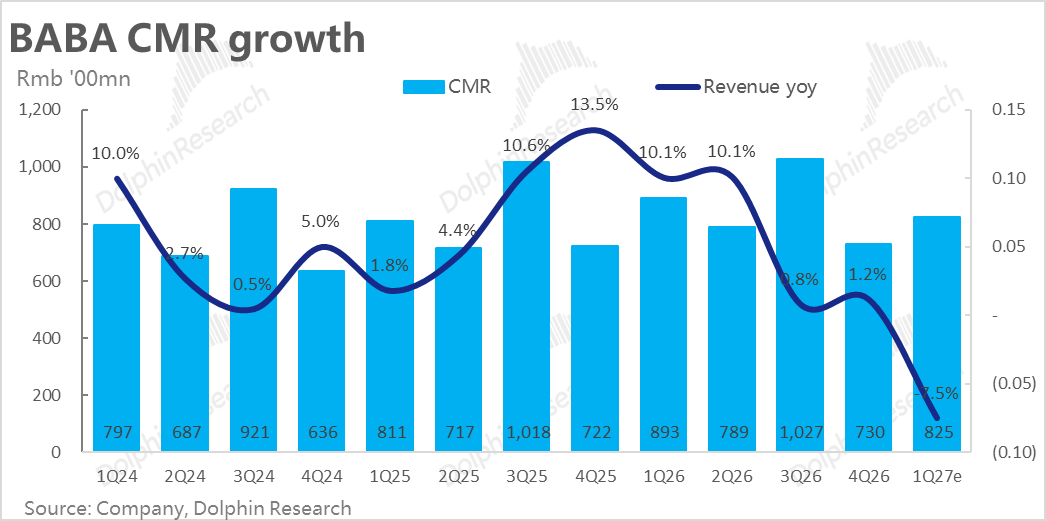
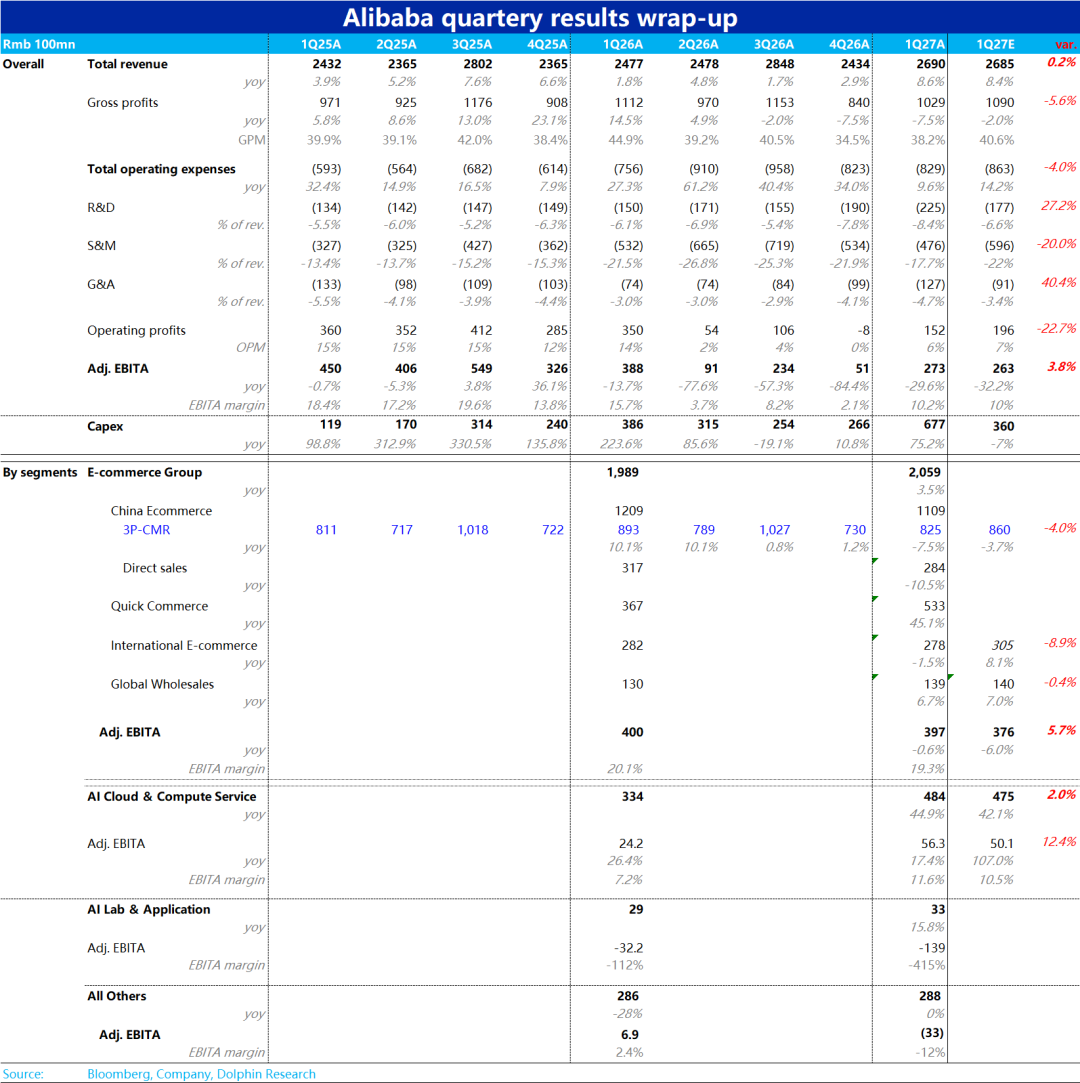
2. CMR Growth Bottoms Out: CMR, a key indicator for long-distance e-commerce, declined by 7.5% YoY this quarter, roughly in line with top-tier bank expectations of -8%. After adjusting for the impact of recognizing some subsidies as revenue deductions, the true comparable growth rate is approximately +1%.
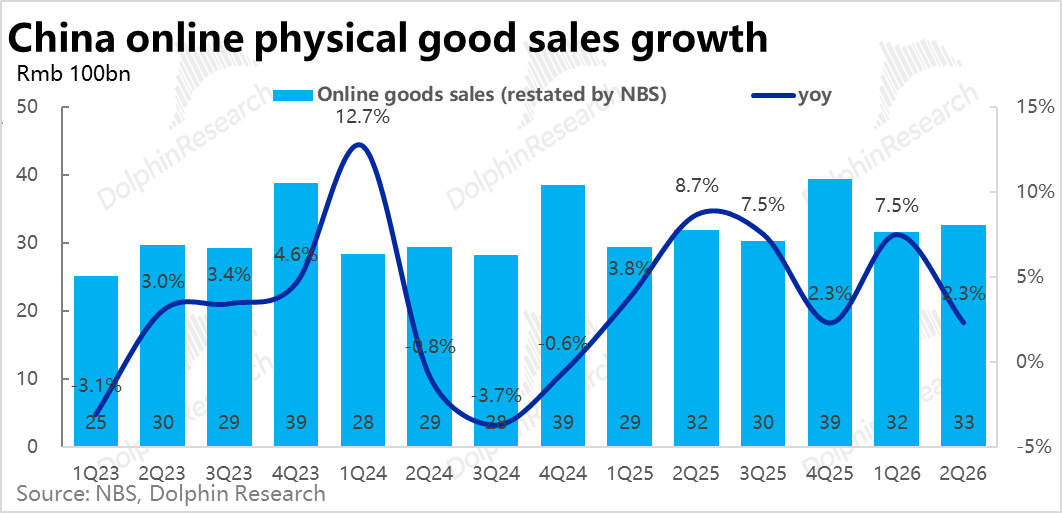
While the growth rate declined significantly this quarter (slowing by about 7 percentage points), the market had already anticipated slower growth for e-commerce platforms given the similarly weak online sales growth in social retail (slowing by about 5 percentage points QoQ). Maintaining positive growth is still commendable compared to JD.com, which was hit harder. The key question now is how much the growth rate can recover in the coming quarters.
3. New Instant Retail Growth Remains Robust: The new instant retail segment generated approximately 53.3 billion yuan in revenue this quarter, up 45% YoY. With the inclusion of Hema and Tmall Super's one-hour delivery services, revenue has expanded by about 1.5x compared to before.
Despite entering a high base period from last year's food delivery wars and incorporating two businesses with significantly slower revenue growth than Taobao Flash Sales, the revenue growth rate did not decline sharply (slowing by about 10 percentage points QoQ). This suggests that faster delivery services have indeed boosted sales for Hema and Tmall Super.
4. E-commerce Profitability Stabilizes, Funds Redirected to AI: Market consensus previously expected Alibaba's flash sales business to incur losses of around 10 billion yuan this quarter, a significant narrowing from the previous quarter. Profitability for domestic long-distance e-commerce was expected to remain largely stable or decline slightly, leading to an anticipated 3% YoY decline in profit for the original Chinese e-commerce segment.
The inclusion of the international e-commerce segment, which has been fluctuating around breakeven, should have a minimal impact on overall segment profitability due to its relatively small absolute loss or profit volume. Thus, previous market expectations remain relevant.
The new e-commerce segment reported overall profits of 39.7 billion yuan, with the YoY decline narrowing to less than 1%, slightly better than expected. This marks a stabilization in Alibaba's e-commerce profitability, with a shift in focus towards AI to free up more funds for AI initiatives.
5. Alibaba Cloud's Growth and Profitability Improve: Compared to the relatively stable pan-e-commerce business, the AI & cloud segment performed exceptionally well this quarter, with accelerated revenue growth and rising profit margins. Unfortunately, the actual performance was largely in line with previous guidance, offering no surprises.
Specifically, both Alibaba Cloud's overall and external revenue growth rates were 45% this quarter, significantly accelerating from the previous quarter.
AI-related revenue reached 12.4 billion yuan, up over 150% YoY, accounting for nearly 26% of total segment revenue. Combined with recent reports of widespread price increases for cloud leasing in China, it's evident that domestic demand for cloud computing power is robust and outstripping supply.
Additionally, as previously targeted by the company, profit margins surpassed 10%, approaching 12%, slightly higher than market expectations of around 10%-11%. This can be considered a small positive surprise. Similar to overseas trends, cloud profitability has not been dragged down by AI investments but is instead rising, further alleviating market concerns about AI's ROI.
6. Quarterly Capex Nears 67 Billion Yuan, Sharp Increase: Similar to Tencent, Alibaba's Capex surged this quarter to 67.7 billion yuan, up 75% YoY from an already high base, far exceeding market expectations of around 36 billion yuan. However, unlike Tencent, Alibaba's disclosed Capex is based on cash flow and naturally includes prepayments, making it lower than Tencent's combined prepayment and cash payments for plant and equipment, which exceeded 100 billion yuan.
While some of this increase can be attributed to upstream hardware price hikes, it also underscores the urgent domestic demand for computing power. Unlike overseas investments, which often involve significant long-term depreciable assets like factories, domestic tech giants primarily invest in servers and networking equipment with shorter depreciation periods when ramping up Capex. Such equipment typically takes 1-2 quarters from purchase to deployment, suggesting that this scale of Capex increase will primarily support internal business needs at Tencent but indicates accelerated growth for Alibaba Cloud at Alibaba.
However, this comes at a cost. With operating cash flow growing only modestly by about 11%, free cash flow has plunged to nearly -45 billion yuan, indicating significant pressure. This highlights the need for Alibaba to raise funds, potentially through bond issuances, securitization of computing power assets, or further asset sales (fortunately, Alibaba has substantial investment assets, with its stake in Changxin alone valued at nearly 170 billion yuan).
7. AI Applications 'Still Need Work': The newly separated AI models and applications segment reported revenue of about 3.3 billion yuan this quarter, up 16% YoY. Given the small revenue base, the growth rate is unimpressive, indicating average performance. Meanwhile, the segment incurred losses of 13.9 billion yuan, highlighting that the business model and monetization of AI applications have not yet proven successful, with poor ROI.
The actual losses this quarter were largely in line with expectations, meaning that aside from saving about 3-4 billion yuan in subsidies for the Qianwen App in Q1, investments and losses in AI models and applications remained largely unchanged from the previous quarter.
8. Performance of Other Businesses: Among the relatively minor businesses, international e-commerce revenue declined by 1.5% YoY this quarter, continuing to decelerate and falling short of expectations. This suggests that overseas operations are now prioritizing profitability, with Southeast Asia likely still performing poorly. However, AliExpress achieved positive operating profit this quarter, squeezing out some profit despite stagnant growth.
The 'thinning' other businesses segment reported revenue of 28.8 billion yuan this quarter, roughly flat YoY. After excluding the impact of divesting Intime and Sun Art, the remaining businesses have stabilized. Despite divesting AI investments, the segment still incurred losses of about 3.3 billion yuan, meeting market expectations but requiring further loss reduction. Normal businesses must either grow revenue or reduce losses; they cannot remain stagnant while continuing to incur losses.
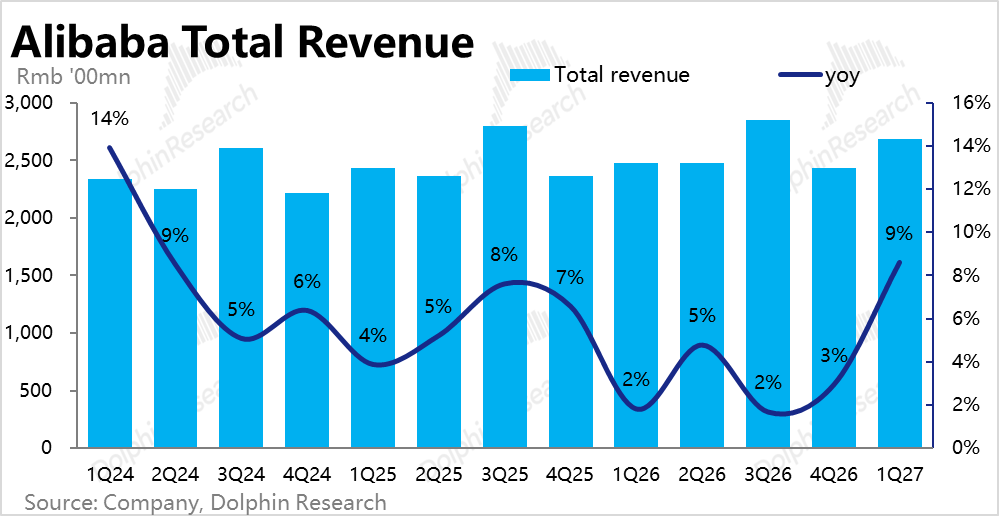
9. Overall, Alibaba's total revenue reached approximately 269 billion yuan, up 8.6% YoY, with growth accelerating. Adjusted EBITA profit totaled 27.3 billion yuan, with the YoY decline narrowing sharply from 84% last quarter to less than 30%, slightly better than expected. The era of 'food delivery e-commerce,' where heavy investments in food delivery nearly wiped out group profits, is largely over.
Now, Alibaba has entered the AI era, where heavy AI investments are consuming operating cash flow. While both involve investments, AI investments offer higher ROI expectations and greater future potential compared to the cutthroat competition in food delivery.
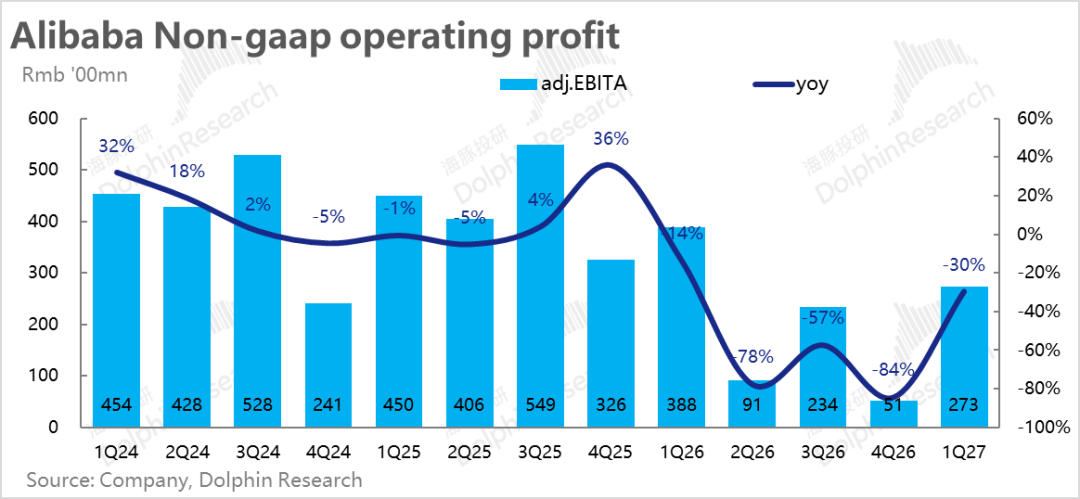
In terms of costs and expenses, on a non-GAAP basis, gross profit declined by 7.5% YoY this quarter, clearly inconsistent with the improvement in revenue growth. Gross margin contracted by nearly 7 percentage points YoY, with the decline widening compared to previous quarters.
Since instant retail has entered a loss-reduction phase, its drag on gross margin should be relatively stable, with the vast majority of the drag likely coming from AI-related investments. This reflects the increasing 'heaviness' of the mobile internet business model in the AI era. Notably, depreciation as a percentage of revenue increased by about 1.6 percentage points YoY this quarter.
At the expense level, marketing spending declined by 10% YoY (-5.4 billion yuan), while general and administrative (G&A) and R&D expenses accelerated. R&D spending surged by 56%, while the sharp increase in G&A expenses was due to the recognition of approximately 550 million euros in fines this quarter; excluding this, G&A expenses grew by about 17%.
Together, these trends clearly show that the company's investment focus is shifting rapidly from marketing subsidies to R&D spending and Capex, reflecting Alibaba's strategic shift towards AI in its resource allocation.
10. Overview of Key Financial Information
Dolphin Research Viewpoints
1. Performance Largely in Line, Capex Not as Daunting as It Seems
Alibaba's quarterly performance, as discussed earlier, offered no surprises in terms of expectations. However, trends indicate that with rapidly declining flash sales investments, profitability in the pan-e-commerce segment is nearing a reversal.
The truly standout segment—pan-AI—led by cloud business, saw improvements in both revenue growth and profit margins, marking a turning point in performance trends.
However, the market had largely priced in these developments. The true novelty in this earnings report was the 67 billion yuan in Capex and -45 billion yuan in free cash flow, which may cause some concern among risk-averse investors.
2. Future Outlook: E-commerce Stabilizes, Fully Committed to AI
Looking ahead, the past is behind us; what matters more is the future:
1) Long-distance e-commerce has weathered the toughest phase: Firstly, regarding Alibaba's core long-distance e-commerce business, Dolphin Research adopts a more cautious outlook. While we still believe this quarter marks the lowest growth point for the year, with H2 growth likely to recover, we are less confident in the extent of recovery.
Management confirmed during the earnings call that domestic e-commerce revenue and profit growth will recover next quarter. However, combined with the latest July social retail data, which shows gradual improvement only in categories heavily influenced by government subsidies (e.g., home appliances and smartphones), while most other categories continue to see declining sales growth, the rebound in e-commerce growth for platforms other than JD.com may not be as pronounced.
Moreover, given the still-high base in Q3 last year, a more significant rebound is likely to occur only in Q4. Thus, our overall assessment is that Alibaba's long-distance e-commerce will likely maintain its current 'low' position with slight improvements, with revenue and profit growth (excluding instant retail) largely remaining flat or growing at a low single-digit rate YoY. While this may not provide significant upward momentum for the group, it is unlikely to pose further significant drag under baseline scenarios.
2) Instant retail enters a ceasefire period: According to recent market research, competition in instant retail is intensifying further, with losses narrowing across the board. Market consensus expects overall losses in the flash sales business to be around 10 billion yuan this quarter, a significant narrowing from 17-18 billion yuan last quarter. Loss per order is estimated to have declined from over 3 yuan last quarter to about 1.7-1.8 yuan.
As a trade-off for loss reduction, recent research suggests that Alibaba's market share in instant retail orders may have declined slightly, which may disappoint long-term investors hoping for Alibaba to become a comprehensive platform for instant and pan-retail.
However, in the medium to short term, with overall cash flow under pressure from AI investments, the significant loss reduction in flash sales is clearly more beneficial than detrimental for the group, helping to conserve funds and support AI capabilities. We believe losses in instant retail will likely continue to decline in the coming quarters, albeit at a slower pace.
3) Chips + cloud + models: The future AI powerhouse for Alibaba: Given that the pan-retail segment is likely to stabilize at a 'low' level, the main drivers and volatility in Alibaba's future performance and stock price will come from AI and cloud businesses.
More specifically, this depends on 2+1 factors: the two primary ones are the acceleration of Alibaba Cloud's growth and the ranking of the Qwen flagship model in the industry, with the cost advantage brought by Pingtouge's self-developed chips being a relatively secondary factor.
Firstly, regarding the subsequent growth momentum of cloud revenue, since current demand is clearly higher than supply, the pace of revenue release actually depends primarily on the speed of computing power deployment.
Combining the nearly doubled quarter-on-quarter Capex of Alibaba this quarter, along with recent reports on the relaxation of chip imports such as H200, it can be anticipated that Alibaba Cloud's computing power deployment will significantly accelerate in the coming quarters, thereby driving further revenue growth.
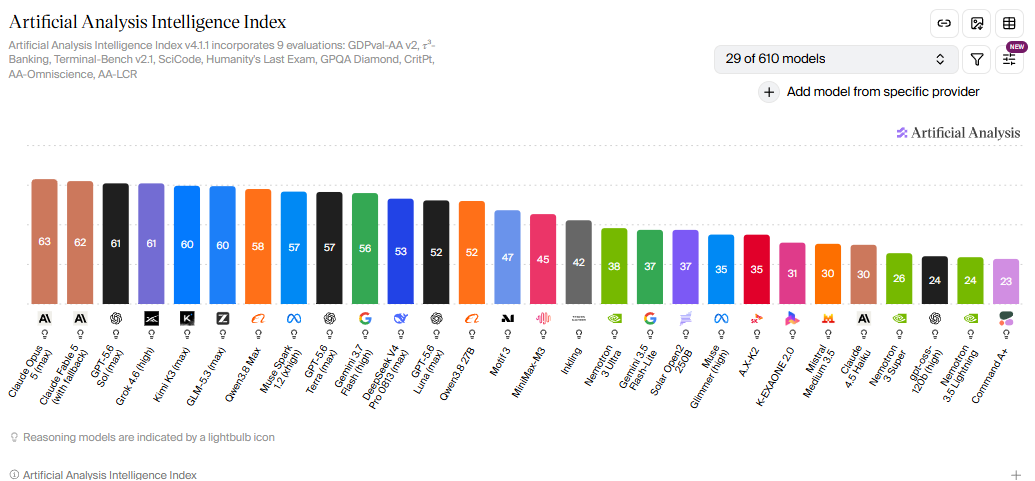
Another significant signal that has recently improved our perception of Alibaba is that the capability of its self-developed Qwen large model has regained its position in the near-top tier domestically. Previously, due to the departure of some R&D members, the performance ranking of the Qwen model was significantly left behind by unicorn companies such as Zhipu, Kimi, and DeepSeek.
However, after the release of Qwen 3.8, its performance ranking has reapproached domestic SOTA levels such as Kimi K3 and GLM 5.3. Although logically, Alibaba Cloud can sell any open-source model, the capability of its exclusive self-developed models remains a key differentiator when competing for customers.
Furthermore, self-developed models can be better optimized for hardware matching, providing relatively higher profit margins. In the long run, cost and efficiency differences are also core competitive barriers in the cloud industry.
4) The Key to Capex Lies in ROI: As seen from the preceding text, Alibaba, like Tencent, has also significantly increased its Capex this quarter, with free cash flow turning noticeably negative. In similar situations, the market's reaction to Tencent was relatively negative. So, what about Alibaba? The key here is that the level of Capex spending itself is not inherently good or bad; what matters is the return on investment (ROI) that the Capex can bring. For Tencent, its massive Capex investments are primarily used for the R&D of internal large models and internal products like WeChat AI Assistant and Workbuddy. However, the output from these investments is unclear, and their business models and monetization capabilities have not been fully validated. That is, substantial investments may not necessarily lead to visible revenue and profit growth but could instead drag down recent profits.
While Alibaba also allocates some of its investments to internal model R&D and usage, a larger proportion can be directly monetized through Alibaba Cloud, generating rapid returns. Moreover, the market has generally stopped questioning the ROI of cloud businesses recently, with overseas ROI potentially exceeding 30%, while domestic ROI, although slightly lower, can still reach around 15% to 20% according to estimates by a certain investment bank.
This time, management has clarified that they can recover Capex investments in about three years, with potential improvement to 2.5 years in the future. In other words, they are not concerned about the return on investment.
Under such circumstances, higher investments instead imply larger subsequent incremental revenue and profit potential. Therefore, as long as the company provides relatively optimistic guidance on the growth trend of its subsequent cloud business revenue, Dolphin Research believes that the market will not be bothered by the significantly increased Capex this time. At public conferences, the company has not yet provided clear guidance on Alibaba Cloud's subsequent growth rate, but we can monitor whether more explicit guidance is given later.
3. Since the market has already anticipated and priced in the performance benefits of accelerated growth and profit release for Alibaba Cloud, the real marginal increment in this earnings report is the surge in capital expenditures and massive negative free cash flow. Such somewhat negative information justifies a reactive market decline upon receipt.
However, Dolphin Research is more inclined to believe that such capital expenditures and resource allocation indicate that Alibaba has shifted from a dual focus on e-commerce and AI last year to a single, super-focused emphasis on AI, reflecting a better expectation of returns in terms of fund allocation.
Dolphin Research is not concerned. For value assessment, Dolphin Research adopts a step-by-step estimation: First, for Chinese e-commerce conglomerates, we conservatively expect profits from businesses other than flash sales to continue or decline by a low single-digit percentage year-on-year in FY27, amounting to approximately RMB 196 billion, while the total losses from instant retail narrow to just over RMB 30 billion, totaling approximately RMB 126 billion in profit after tax deductions.
Dolphin Research believes that if Alibaba still intends to maintain its scale in the instant retail business, the pace of loss reduction after 2027 may slow down, also depending on Alibaba's investment in AI.
If the overall domestic consumption sentiment remains generally stable without significant deterioration, Alibaba, as the only domestic company with full-stack AI capabilities (cloud + model + chips), and with recent strong momentum in cloud growth and Qwen model capabilities, is poised to regain its position as the strongest domestic AI company and attract funds bullish on domestic AI development.
- END -
// Reprint Authorization
This article is an original piece by Dolphin Research. Reprinting is prohibited without authorization.
// Disclaimer and General Disclosure
This report is intended solely for general comprehensive data purposes, designed for general reading and data reference by users of Dolphin Research and its affiliated institutions. It does not take into account the specific investment objectives, investment product preferences, risk tolerance, financial status, or special needs of any individual receiving this report. Investors must consult with independent professional advisors before making investment decisions based on this report. Any person making investment decisions based on or referring to the content or information mentioned in this report assumes their own risk. Dolphin Research shall not be liable for any direct or indirect responsibilities or losses that may arise from the use of the data contained in this report. The information and data contained in this report are based on publicly available sources and are intended for reference purposes only. Dolphin Research strives to ensure but does not guarantee the reliability, accuracy, and completeness of the relevant information and data.
The information or opinions mentioned in this report shall not, under any jurisdiction, be considered or construed as an offer to sell securities or an invitation to buy or sell securities, nor shall they constitute advice, solicitation, or recommendation regarding relevant securities or related financial instruments. The information, tools, and materials contained in this report are not intended for or proposed for distribution to jurisdictions where such distribution, publication, provision, or use of the relevant information, tools, and materials contradicts applicable laws or regulations, or to citizens or residents of jurisdictions where Dolphin Research and/or its subsidiaries or affiliated companies are required to comply with any registration or licensing requirements in such jurisdictions.
This report merely reflects the personal views, insights, and analytical methods of the relevant creators and does not represent the stance of Dolphin Research and/or its affiliated institutions.
This report is produced by Dolphin Research, and the copyright is solely owned by Dolphin Research. Without the prior written consent of Dolphin Research, no institution or individual shall (i) make, copy, reproduce, duplicate, forward, or create any form of copies or replicas in any manner, and/or (ii) directly or indirectly redistribute or transfer to other unauthorized persons. Dolphin Research reserves all relevant rights.
-
![]()
Shenzhen Speed Gets a New Version
-
When AI Becomes Too Powerful to Ignore: OpenAI Hits the Brakes for the First Time in History
-
![]()
Why Have Small Commuter Cars Priced Under 50,000 Yuan Seen a Slump in Sales?
-
![]()
When 'Li Shufu' and His Peers Begin to Relinquish the 'Reins'...
-
![]()
6.5 Trillion AI Unicorn: Generating $900 Million in Daily Revenue, Racing Toward the Largest IPO in History
-
![]()
Negative Influences Have Run Their Course: Three Key Questions Surrounding Seres' H1 Performance 'Dip' | Mirror Pro
-
![]()
Will China's Auto Exports Surpass 10 Million Units This Year?
-
![]()
Chinese Capital Surges into Europe: Emerging as the 'White Knight' for Local Auto Parts Companies?