Wang Jian's Vision: Paving a Pathway for Alibaba Through AI
 08/23 2026
 546
546

Quietly, milk tea sales on Taobao Flash Sales have rebounded to levels seen before the food delivery wars.
A cup of Luckin Coffee, even at a discounted price, now hovers near 10 yuan.
In Alibaba's latest earnings report, the term "instant retail"—a focal point last year—appeared only eight times, while "AI" was mentioned 70 times.
Alibaba has once again realigned its core business units, highlighting three primary sectors, with AI accounting for two. These two sectors are the only ones experiencing double-digit growth.
Undoubtedly, for the foreseeable future, Alibaba's strategic direction will be firmly rooted in AI.
Part.01 The Waning Influence of Instant Retail
Alibaba's business priorities are clearly delineated by its strategic segments.
In 2024, the focus was on Taotian, Alibaba International, Cloud Intelligence, Cainiao, Local Services, and Digital Media & Entertainment. The AI-related cloud business constituted just one-sixth of the total, while four other segments centered around e-commerce through the Taobao and Tmall apps.
In the second quarter of this year, Alibaba International, Cainiao, and instant retail were consolidated under the Alibaba E-commerce Group. Meanwhile, AI emerged as two distinct businesses, shifting from one-sixth to two-thirds of the strategic focus.
This transformation clearly demarcates traditional e-commerce from new AI-driven ventures.
Traditional businesses are undergoing streamlining, with e-commerce consolidated into a single, large department, eliminating excessive segmentation.
This strategy is rooted in practical considerations. With the exception of instant retail, nearly all of Alibaba's other e-commerce sectors are experiencing decline.
Revenue from China's e-commerce sector reached 110.9 billion yuan, down 8% year-on-year. Within this, direct sales and logistics revenue fell 10% to 28.35 billion yuan, while customer management revenue dropped 7% to 82.5 billion yuan.
Affected by the international environment and geopolitical factors, international e-commerce revenue in the second quarter was 27.76 billion yuan, down 1%.
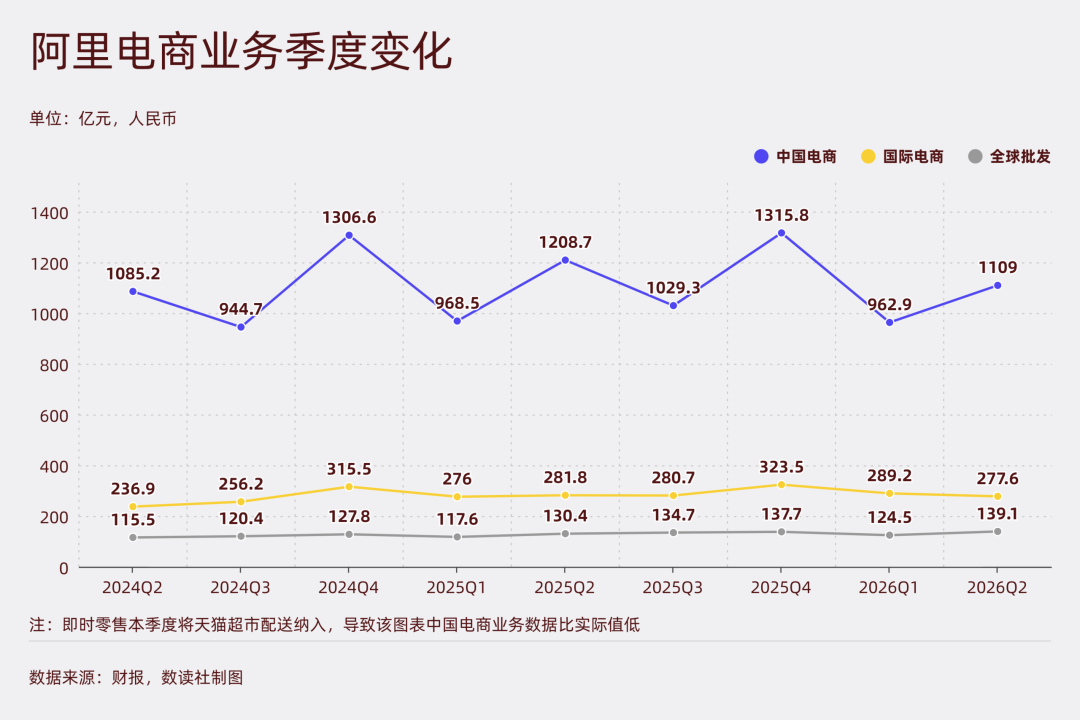
Instant retail stands out as the sole bright spot, with second-quarter revenue hitting 53.3 billion yuan (including Tmall Supermarket's instant delivery services), up a remarkable 45% year-on-year. However, this growth is partly attributed to the relatively small base from the same period last year, when Alibaba had just entered the food delivery wars and instant retail had not yet seen significant traction.
During the earnings call, Jiang Fan emphasized optimizing operations and reducing losses for instant retail, a departure from Alibaba's previous stance of prioritizing scale over short-term profitability. This shift signals that instant retail is now focused on sustainable development rather than unbridled expansion.
Consequently, Alibaba's instant retail growth has already begun to decelerate. Given the larger base in the coming quarters, this sector is likely to revert to low or even negative growth in the future.
From any perspective, traditional e-commerce does not justify heavy investment.
The tripartite e-commerce landscape is unlikely to shift, with Alibaba unable to fully suppress Pinduoduo and JD.com.
The instant retail battle has also demonstrated that Alibaba cannot fully overpower Meituan. Heavy investment yields diminishing returns and does not align with policy incentives, adding pressure to the commercial ecosystem.
In international e-commerce, geopolitical uncertainties and anti-globalization trends are beyond Alibaba's control. No amount of resource allocation can reverse this trend. Like other overseas ventures, Alibaba can benefit from industry growth, but human efforts have limited impact.
The wisest course of action is to adapt to the prevailing conditions, avoiding excessive resource consumption in stagnant markets. The real opportunity lies in AI.
Part.02 Wang Jian's Enduring Vision
In 2008, when Wang Jian proposed developing a proprietary cloud computing operating system, "Apsara," he faced significant internal skepticism. For years, whispers persisted within the group that "Wang Jian is a fraud."
Wang Jian, who majored in psychology and taught for a decade after graduation, focused his research on engineering psychology. His foray into cloud computing naturally raised doubts. Especially from 2010 to 2012, Alibaba Cloud consistently ranked last in group evaluations. At one point, 80% of engineers left, and annual spending yielded no visible results.
Ultimately, Jack Ma personally reassured the team, "I'll invest 1 billion yuan in Alibaba Cloud every year for ten years. We'll reassess if it doesn't yield results."
Thanks to Ma's persistence and Wang Jian's fulfillment of his promise, Alibaba Cloud officially launched in 2013, opening an independent front for Alibaba beyond e-commerce.
After enduring the early investments in cloud computing, Alibaba Cloud's growth momentum began to accelerate. By the first quarter of this year, Alibaba Cloud held a 32.8% share of China's IaaS market, up 2.7 percentage points, firmly ranking first—surpassing the combined share of the second and third players.
Alibaba Cloud's current success forms the bedrock for Alibaba's AI ambitions.
Facing industry upheaval driven by AI, Alibaba made a strategic adjustment this quarter, dividing AI into infrastructure and application layers. The infrastructure layer merges Cloud Intelligence with T-Head to form an AI Cloud and Computing Services business, providing the necessary infrastructure and computing power.
The application layer integrates the AI Model Lab, QianWen Consumer Business Group, and QianWen Office to form an AI Lab and Application Business, advancing AI model innovation, consumer applications, and enterprise productivity solutions.
At the infrastructure level, Alibaba has invested heavily for years.
In 2020, BAT announced efforts in new infrastructure. Alibaba pledged to invest 200 billion yuan over three years in core technology R&D (cloud OS, servers, chips, networks) and data center construction.
In recent quarters, Alibaba has continuously increased capital expenditures, reaching 67.678 billion yuan in the second quarter, up 75% year-on-year, primarily directed at AI infrastructure.
In the current AI industry, the real profit lies in "selling shovels"—the domain of Alibaba Cloud + T-Head.
According to Alibaba, the latest-generation AI processor, Zhenwu M890, has been commercialized through Alibaba Cloud in over 650 external clients across 20+ industries, including autonomous driving and the internet.
The previous generation of T-Head chips has produced and shipped over 500,000 units. The latest generation was deployed on Alibaba Cloud's AI Cloud platform in August, offering services in Supernode form. The "Zhen 5 M890" supernode, based on the new T-Head chip, has collaborated with Kimi K3 and QianWen 3.8 Max. Large-scale AI data center delivery cycles have been compressed to 100 days.
In the second quarter, AI Cloud and Computing Services generated 48.4 billion yuan in revenue, up 45% year-on-year. With strong profitability, EBITA (earnings before interest, taxes, depreciation, and amortization) reached 5.6 billion yuan, up 133% year-on-year—the sole profit pillar as Alibaba's core businesses face downturns and AI application layers require ongoing investment.
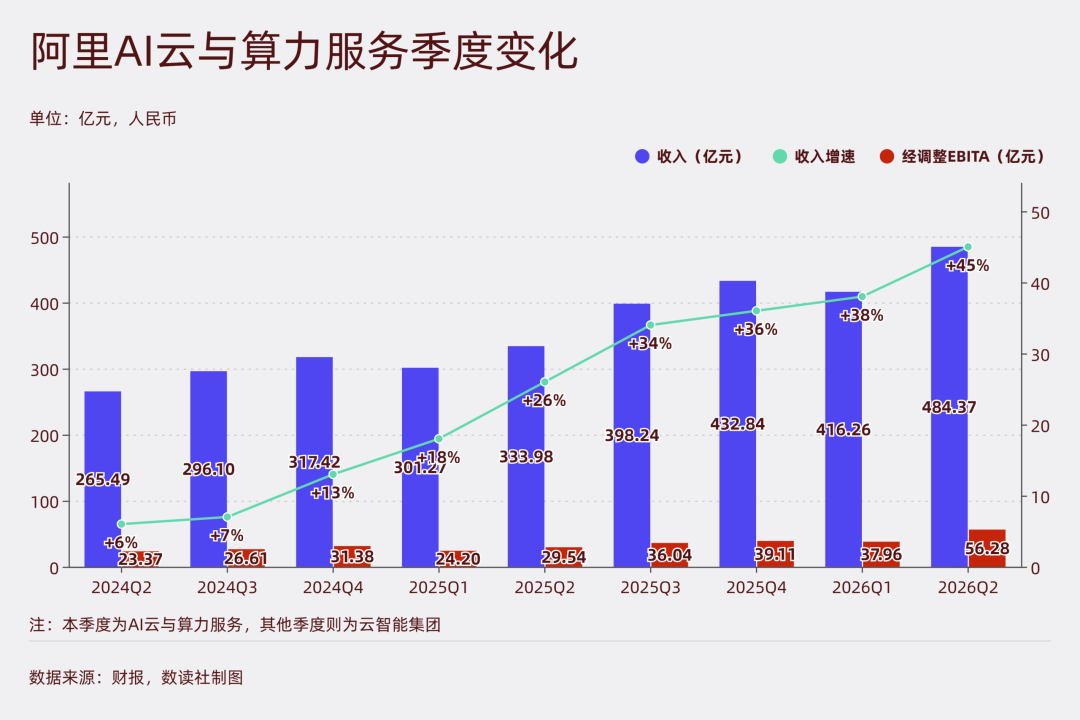
According to JPMorgan's projections, Alibaba Cloud's current profit margin of around 12% may not fully reflect its profitability once AI infrastructure matures. In other words, Alibaba Cloud is expected to maintain revenue and profit growth, providing significant confidence for Alibaba.
Compared to its e-commerce rivals, Alibaba is not the undisputed leader in the AI industry, but its ability to maintain competitiveness owes partly to Wang Jian, once labeled a "fraud."
However, while Alibaba dominates the "shovel-selling" business, it starts on equal footing with competitors in applications.
Part.03 The Challenge of User Acquisition
When it comes to the most competitive large models and agents today, QianWen can rival Kimi, Zhipu, and DeepSeek. However, in terms of user base, QianWen may lag behind Doubao, while its agent usage may not match WorkBuddy or KimiWork.
Early this year, Alibaba attempted to drive traffic to QianWen through the "Gather Five Blessings" campaign but ultimately lost to Doubao due to Douyin's massive traffic and Alibaba's distraction with e-commerce.
Currently, QianWen-related applications remain within Alibaba's ecosystem. According to earnings reports, the QianWen App has integrated with Taobao, Tmall, and Taobao Flash Sales, with 250 million users experiencing AI-driven shopping scenarios through smart agent features.
In the enterprise market, Alibaba launched QianWen Office, deeply integrating with Alibaba Cloud and DingTalk's ecosystem, aiming to enter enterprise productivity scenarios through AI models and agent capabilities.
Without breaking free from Alibaba's ecosystem, wider user adoption remains elusive—a longstanding issue for Alibaba that persists in the AI era.
In AI applications, Alibaba faces no guaranteed victory. Technologically, it is surrounded by competitors like Doubao and Yuanbao, as well as emerging large model firms like KIMI, Zhipu, and DeepSeek. While Alibaba once led the industry, recent months have seen Kimi K3, Zhipu GLM5.3, and DeepSeek V4 take center stage, with leading advantages lasting only about half a month.
In applications, Alibaba's user base is smaller than ByteDance's, making QianWen Office's breakthrough even more challenging.
Thus, the commercialization predicament of this segment is evident, yet investment cannot halt. In the second quarter, AI Lab and Application Business revenue reached 3.3 billion yuan, up 16% year-on-year. While growth continues, its scale and pace lag far behind infrastructure.
Moreover, the 3 billion yuan includes basic revenue from DingTalk, which, according to Caijing, generated 4 billion yuan in revenue in 2025, averaging around 1 billion yuan per quarter. This means Alibaba's AI application commercialization is far from achieving economies of scale.
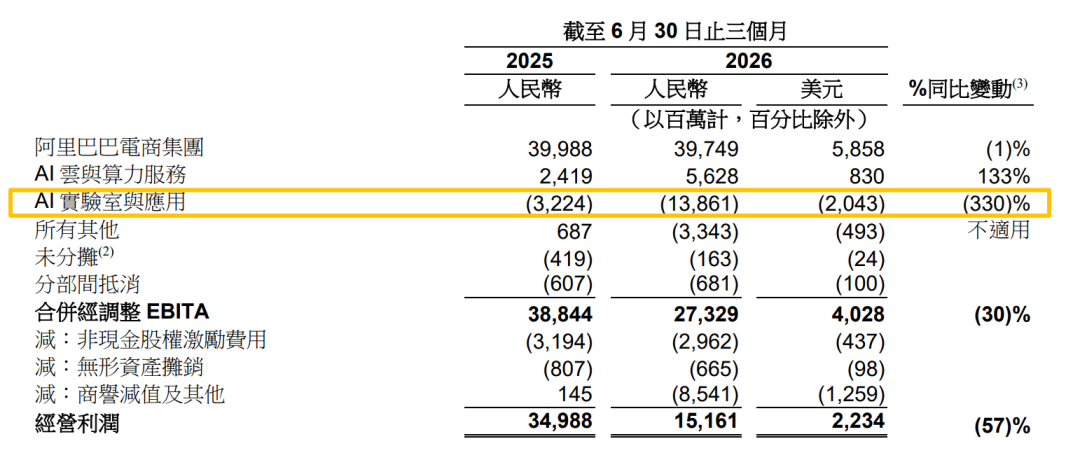
Break-even remains distant, with EBITA at a loss of 13.86 billion yuan, widening by 330% year-on-year. Heavy investment continues, with model training daring not to stop, yet no clear, broad commercialization scenarios are visible, making the short term very challenging.
Examining Alibaba's current state, Alibaba Cloud provides the foundation for AI infrastructure, with rapid revenue growth and break-even achieved. However, this segment requires advanced planning and sustained capital expenditures to maintain its edge. The AI application layer, meanwhile, needs exploration of commercialization while lacking traffic advantages. Achieving e-commerce-like dominance may be unrealistic. In e-commerce, overall growth follows macroenvironmental trends, and Alibaba cannot alter the landscape alone.
Alibaba will no longer overinvest in instant retail and e-commerce but will focus on infrastructure and large model capabilities, awaiting commercialization breakthroughs. From this quarter onward, AI is Alibaba's only path.
-
![]()
The AI Version of 'PayPal Mafia' Has Arrived: 20 AI Startups Raise Over $4.6 Billion in Funding
-
![]()
Wang Jian's Vision: Paving a Pathway for Alibaba Through AI
-
![]()
Hyundai Motor Workers Strike Today, Fearing Job Losses to Robots
-
![]()
Embracing 'Light': O-film Unveils Its 'Illuminating the Future' Strategy
-
![]()
SenseTime’s SenseNova U1.5 Lite Goes Open Source: Ushering in a New Era of Predictable AI Image Generation
-
![]()
Collaboration Initiated! Tesla Officially Welcomes Doubao Onboard
-
![]()
WPS: From Alternative to Leader, Kingsoft Software Bets on AI Office, H1 Revenue Nears 5 Billion
-
![]()
Can TECNO Mobile Expand Beyond Africa?