Hyundai Motor Workers Strike Today, Fearing Job Losses to Robots
 08/21 2026
 448
448
The World's First Case
Author|Wang Lei
Editor|Qin Zhangyong
Are workers on the brink of being replaced by robots?
South Koreans are not taking this lying down.
A strike is inevitable.
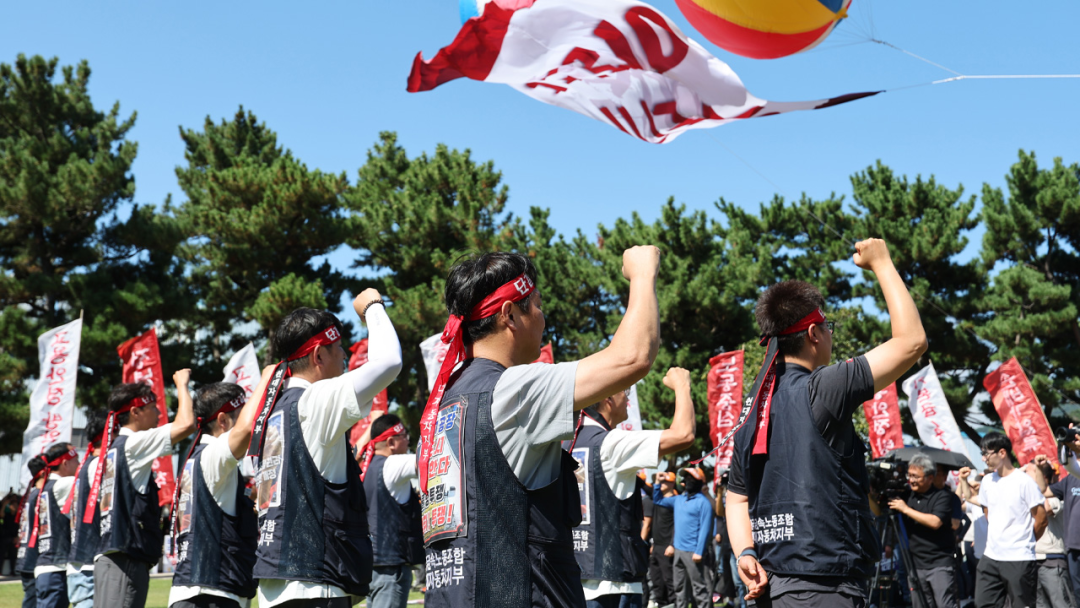
Today, after 16 rounds of fruitless negotiations between the union and management, the long-simmering strike at Hyundai Motor in South Korea finally erupted in full force.
Unlike previous minor disruptions, such as early departures two hours before the end of the shift, this time it is a genuine eight-hour comprehensive strike. This marks Hyundai Motor's first full-scale strike in a decade since 2016, involving over 39,000 union members.

Beyond the usual issues of wages and bonuses in labor negotiations, the potential income and job changes brought about by humanoid robots and automation have also been placed on the negotiating table this time.
Even before robots have taken up their posts, the employment paradox surrounding them has already begun to unfold.
01 Losses to Exceed 2.3 Trillion Won
First, let's examine the potential impact of this comprehensive strike.
According to the comprehensive strike directive issued by the Hyundai Motor union in South Korea, all early-shift production employees scheduled to start work at 6:45 a.m. on the 21st will be absent, and late-shift employees scheduled to start at 3:30 p.m. will also not report to work. Approximately 39,000 union members, including non-production staff, will participate in the strike and gather at the company's headquarters in Seoul for a protest.
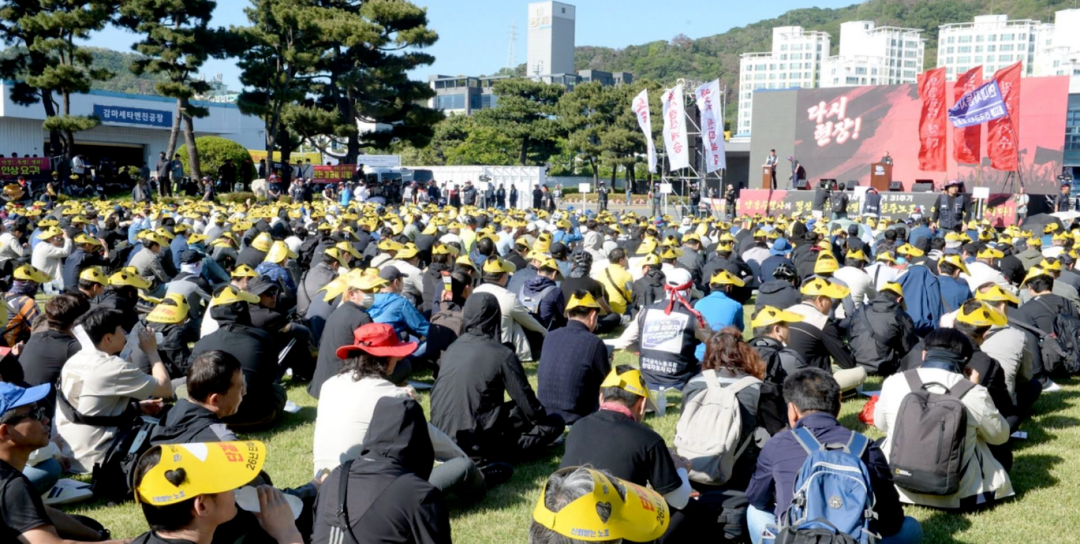
As a result, all production lines at the Ulsan, Jeonju, and Asan factories will halt operations for the day. With early and late shifts striking for eight hours each, the actual production halt will amount to 16 hours—effectively a paralysis.
Ulsan is Hyundai Motor's manufacturing hub and one of the largest single-site automobile factories globally, with tens of thousands of workers operating on the same production chain.
According to data from Yonhap News Agency, considering Hyundai Motor's hourly output of approximately 460 vehicles in South Korea, the cumulative production loss is expected to reach 55,200 units. Based on the average selling price, the cumulative sales loss will exceed 2.3 trillion won (approximately 11.17 billion yuan).
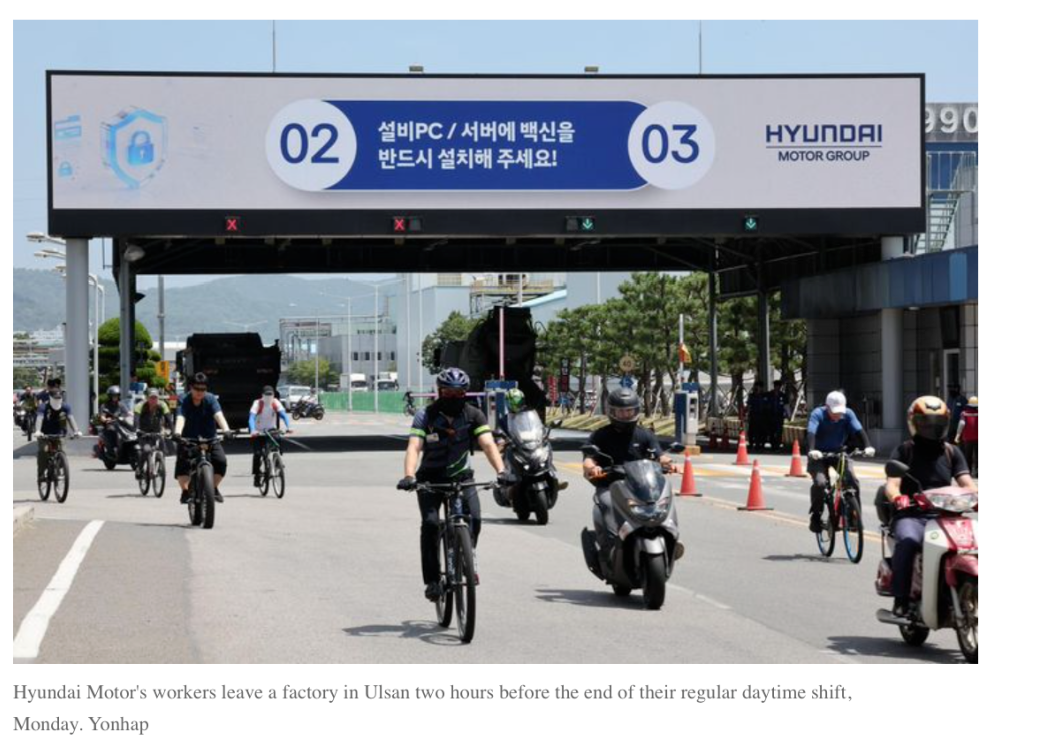
Furthermore, the Hyundai Motor union in South Korea has issued a new warning, stating that there will be additional four-hour strikes daily from August 24 to 25, meaning production losses will further increase.
Of course, this is not the first time the South Korean union has clashed head-on with management. Hyundai Motor and the union have a decades-long history of confrontation, with strikes, production halts, and negotiations being the norm in the company's labor relations.
Since the establishment of the union at Hyundai Motor in 1987, strike activities have been quite frequent. In 2012, a 44-day strike was initiated, resulting in a production reduction of 82,000 units and economic losses of 1.7 trillion won. In 2015, after the breakdown of labor negotiations, the union held a three-day partial strike, causing economic losses in the tens of billions of won. In 2016, the union launched another comprehensive strike, involving 50,000 participants and leading to a production reduction of 114,000 units.
However, this comprehensive strike after a decade is different from previous ones, with a new issue emerging: robots. This should be the first comprehensive strike in the global automotive industry history triggered by the intervention of "humanoid robots."
02 The First Intensification of Contradictions Between Humans and AI
The catalyst for this situation can be traced back to the robot named Atlas, which debuted at the Consumer Electronics Show (CES) in the United States earlier this year. Yes, it's the robot made by Boston Dynamics, the "grandmaster of robots."
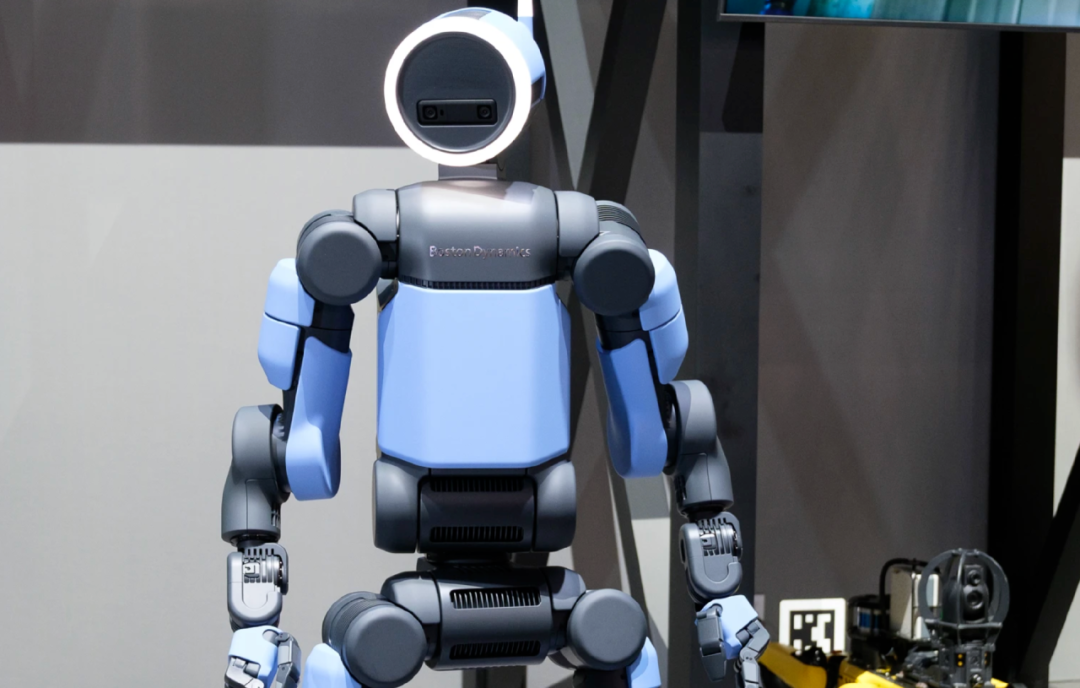
As Boston Dynamics' most famous product, Atlas was flipping in the lab a few years ago, but now its goal is directly aimed at mass production and factory deployment. This is because Boston Dynamics has become a wholly-owned subsidiary of Hyundai Motor.
A month ago, Hyundai Motor Group officially announced that it would acquire the remaining nearly 10% stake in Boston Dynamics held by SoftBank Group, with a transaction amount of approximately $325 million (nearly 500 billion won).
Additionally, Hyundai Group had invested about 1 trillion won in 2021 through a consortium of several subsidiaries to acquire approximately 80% of Boston Dynamics' equity. Furthermore, in subsequent rounds of financing, SoftBank did not follow up with proportional capital injections, diluting its stake.
Since then, Hyundai Motor Group has completed the full acquisition of Boston Dynamics over five years, transforming it into a wholly-owned subsidiary. With this relationship, it is evident that Hyundai Motor Group will significantly accelerate its decision-making speed in the robotics business.
In the past, what troubled Boston Dynamics was how to transform laboratory technology into factory productivity. Now, Hyundai Motor has the perfect industrial scenarios, making it natural for these robots to "start working in factories."
In fact, Hyundai Motor has already deployed a clear timeline for the humanoid robot Atlas:
Starting from 2028, Atlas robots will be gradually introduced into production sites such as Hyundai Motor Group Metaplant America (HMGMA) and Kia's Georgia factory in the United States. Initially, Atlas will be responsible for material logistics, including unloading and sorting incoming parts and completing material sequencing according to production orders. More than 25,000 Atlas robots are planned for deployment.
From 2030 onwards, the scope of robot operations will expand to assembly processes, provided that relevant technologies, operational safety, and economic benefits meet the standard requirements for mass production lines.
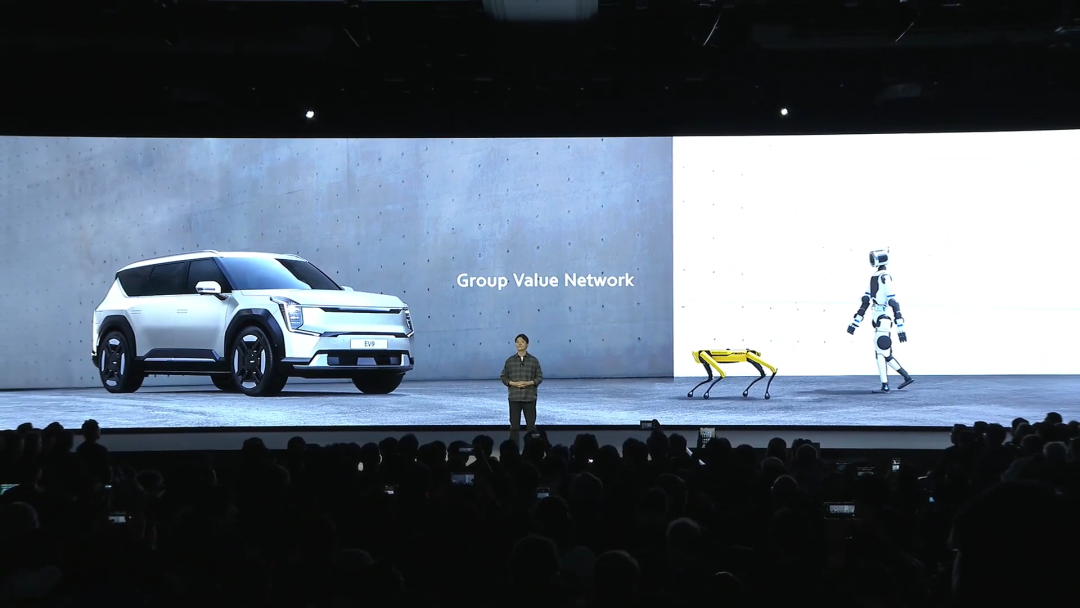
However, before the robots even entered the factories, the workers became anxious.
Although Hyundai Motor has stated that there is currently no deployment timeline for Korean factories, the union believes that once Atlas is successfully validated in the United States, its deployment to domestic factories in South Korea is only a matter of time.
Therefore, the union's stance is clear: "Before a labor agreement is reached, no humanoid robots adopting new technologies can enter the production site."
Union Secretary-General Byun Jun-hwan stated that before robots officially enter the factories, the company must first establish a comprehensive safeguard mechanism to ensure that employees' rights are not affected.
This is also related to South Korea's unique industrial background, as it is the country with the highest robot density globally. According to statistics released by the International Federation of Robotics based on 2024 data, there are 1,220 industrial robots per 10,000 manufacturing workers, six times the global average.
When large-scale humanoid robots take up positions, it means that the already limited human jobs will further narrow, leading to South Korean workers being the most sensitive to robots globally.
The Wall Street Journal also cited calculations by a South Korean official research institution, stating that the cost of one Atlas is approximately $130,000. Under ideal conditions, the labor cost savings over two years may cover the initial investment.
Since the average annual salary of Hyundai Motor employees is about $80,000, buying one Atlas is equivalent to paying one employee's salary for a year and a half. When humanoid robots enter factories at a cost of $130,000 and recoup the investment within two years, how much bargaining power will workers have left?
Moreover, robots do not require bonuses and will not go on strike. Therefore, the robots entering the factories this time pose a real threat to Hyundai Motor's workers.
03 The Core Issue Is Still Money
In fact, this strike has been brewing for a long time. Before this comprehensive strike erupted, the labor and management sides had already initiated 15 rounds of negotiations, accompanied by phased strike actions, but they were much milder.
Previously, from July 13 to 15, the union launched the first round of strikes, lasting only two hours. Shortly after, within half a month, the second and third rounds of strikes were initiated, with the duration increased to four hours per day.
This led to the 16th round of negotiations, which obviously still failed to reach a consensus, thus triggering the comprehensive strike.
Although this strike was directly triggered by the introduction of robots into factories, wages and workers' rights remain the main disputes. According to the union, the purpose is to protect workers' labor rights under automation.
The union has five main demands. Besides requiring that the deployment of Atlas must be approved by the union, production line workers should transition from hourly wages to fixed monthly salaries, and the retirement age limit should be extended to 65, linked to the national pension eligibility age. Additionally, jobs replaced by automation should be handled through internal transfers rather than layoffs.
These demands are not difficult to understand. The union is concerned that even if robots do not immediately replace on-the-job workers, they may reduce overtime and actual working hours, thereby lowering income dependent on working hours.
Therefore, the union hopes to change the income of some employees from being linked to working hours to relatively stable fixed salaries.
Although these demands seem reasonable, they are accompanied by "exorbitant" monetary requests. The union's specific demands include a monthly basic wage increase of 149,600 won, a fixed bonus increase from 750% of the monthly salary to 800%, and the most explosive demand—issuing 30% of the previous year's net profit as performance bonuses.
Based on Hyundai Motor's net profit of about 10.36 trillion won in 2025, 30% would amount to 3.1 trillion won, which is even more than the 2.6 trillion won in dividends Hyundai Motor Group paid to all shareholders last year.
However, for Hyundai Motor today, this is tantamount to a "death blow."
Although Hyundai Motor achieved a record-high sales volume in 2025, its operating profit fell sharply by 19.5% year-on-year due to tariff and incentive expenditure impacts, and net profit fell by 21.7% year-on-year to 10.36 trillion won. In the fourth quarter of 2025, net profit plummeted by 52.1% year-on-year.
In the first quarter of 2026, Hyundai Motor's profitability continued to deteriorate. Although revenue increased by 3.4% year-on-year to 45.94 trillion won, operating profit fell by 30.8% year-on-year to 2.51 trillion won, and net profit fell by 23.6% year-on-year to 2.58 trillion won.
Obviously, this requirement touches on the foundation of Hyundai Motor. However, Hyundai Motor has also proposed a compromise, including a monthly basic wage increase of 89,000 won, performance bonuses at 350% of the basic wage plus a one-time payment of 10 million won, and providing 15 shares of stock.
However, the union rejected this offer, citing that it did not meet employees' expectations.
-
![]()
Hyundai Motor Workers Strike Today, Fearing Job Losses to Robots
-
![]()
Embracing 'Light': O-film Unveils Its 'Illuminating the Future' Strategy
-
![]()
SenseTime’s SenseNova U1.5 Lite Goes Open Source: Ushering in a New Era of Predictable AI Image Generation
-
![]()
Collaboration Initiated! Tesla Officially Welcomes Doubao Onboard
-
![]()
WPS: From Alternative to Leader, Kingsoft Software Bets on AI Office, H1 Revenue Nears 5 Billion
-
![]()
Can TECNO Mobile Expand Beyond Africa?
-
![]()
A Sample of AI Breakthrough for a Company
-
![]()
Goldman Sachs Raises the Bar: China’s Global Expansion Steps into the '3.0 Era,' Now Exporting AI Industrial Prowess