Workplace Transformations Amidst AI Influence: Ensnared in Involution, Yet Struggling to Discover Work’s True Value
 08/26 2026
 327
327
Why Do Tech Professionals Find Themselves in an Emotional Quagmire?
Have you ever noticed that numerous intellectual workers are now ensnared in a mental quandary?
An increasing number of individuals privately express a yearning to break free from the workplace and embrace a simpler life, far removed from the rat race.
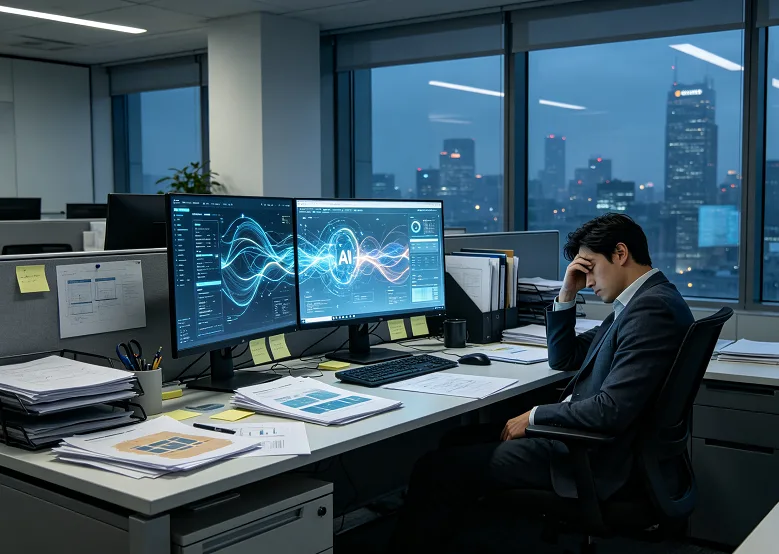
Image Source: Generated by Doubao AI
This sentiment is not merely wishful thinking; it is rooted in genuine anxiety. Many are suddenly questioning the significance of their daily intellectual pursuits.
Seated at their desks, they may experience an inexplicable wave of melancholy.
This sense of disillusionment is highly contagious. People can't help but ponder: What is the purpose of toiling so hard every day?
In the past, we have witnessed economic downturns, job outsourcing, and technological upheavals. The challenges faced by graduates in securing employment and a generation grappling with prolonged economic instability are no longer novel phenomena.
However, the current predicament is distinct. The issue transcends mere income and job security; it delves deeper into spiritual turmoil.
Numerous well-paid tech professionals are even contemplating abandoning their careers in pursuit of a radically different lifestyle.
Even executives and senior employees, who possess stronger risk resilience, are riddled with doubts about their professional futures amidst industry disruptions.
Of course, some may argue that these white-collar workers do not warrant sympathy. They once flocked to emerging industries and enjoyed the stability of remote work during the pandemic, while frontline workers braved the risks.
Now, the AI they helped develop poses a threat to many people's livelihoods, with only a select few reaping substantial profits.
Nevertheless, the widespread loss of faith in work among a significant number of intellectual workers merits our attention: What is the origin of this pervasive anxiety? What will become of society and the industry if an entire cohort no longer believes in the significance of work?
This brings us to the concept of 'workaholism'.
To put it simply, many modern white-collar workers no longer seek spiritual nourishment elsewhere; they directly view work as their life's creed.
Work transcends mere financial gain; it is also about discovering a sense of belonging and purpose in life.

Image Source: Generated by Doubao AI
Jobs driven by a true sense of mission, such as teaching, healthcare, and maintenance technicians, can tangibly assist others. Even if the work is demanding, one can still derive inner satisfaction and a sense of accomplishment.
However, a large number of young people are now gravitating towards finance, consulting, and the internet.
These positions are fiercely competitive, entail long working hours, complex interpersonal dynamics, and a constant fear of layoffs, yet they rarely yield tangible value in terms of helping others.
Thus, 'workaholism' fills this spiritual void, persuading workers to regard tasks like report writing and rebranding as of paramount importance.
But once this belief crumbles, everything trembles, and AI is expediting this process.
Intellectual work is inherently abstract.
Many roles within large corporations are nested within multiple layers, existing merely to support other roles, devoid of a clear core value.
Previously, at least these tasks were accomplished by humans; now, AI can handle the majority of them.
Many people envision a future where they merely need to direct AI, but in reality, to meet performance targets, employees directly have AI generate comprehensive business plans, marketing strategies, etc.
This results in a disconnect between individuals and their work.
Even if the original work held little value, at least it was accomplished manually; now, everything is entrusted to machines, leaving a lingering sense of unease.
In other words, in modern society, people rarely experience things firsthand; their experiences are filtered through media.
Without the need for brainstorming, one can simply input prompts, await AI output, and perform cursory checks, reducing work to a mere facade and exposing its inherent falsity.
Corporations find themselves in a paradoxical position. Shareholders and management both aspire to implement AI; the allure of short-term efficiency is irresistible.
However, AI's most enticing aspect for management lies in reducing collaboration and cutting staff, which precisely undermines the enterprise's foundation.
Many fail to recognize that the tedious adjustments and seemingly inefficient communications inherent in work are not flaws but rather sources of value.
Just as in sports, while zero misjudgments may be the objective, it is those controversial moments that create memorable highlights.
The same holds true for the workplace; what retains people is not the speed of producing plans but the relationships forged with colleagues and the experiences of overcoming challenges together.
Now, many companies attribute layoffs to AI, but currently, AI's capabilities do not warrant such extensive layoffs.
What we should truly be wary of is the collective abandonment of 'workaholism' by talented individuals.

Image Source: Generated by Doubao AI
Nowadays, many young people are not burdened by the pressures of purchasing a home or raising children, making it easier for them to switch careers and pursue their desired lifestyles.
However, completely escaping this system is no easy feat.
Even if one resigns and switches fields, they may still find themselves ensnared in the false illusions woven by commerce.
Many, constrained by reality, can only watch as the human elements of their work are gradually eroded.
But we can take small steps to restore balance.
When encountering problems, prioritize communicating with colleagues rather than immediately resorting to AI. Some tasks are best accomplished slowly and manually.
What truly lingers with us are often the moments spent with colleagues and the way we treat others.
Instead of expecting a single job to fulfill all the meaning in life, we can place these aspirations in our daily lives and genuinely contribute more to those around us.
This article is compiled by Leikeji from Noema Magazine.
Original Link: Why Are People in the Tech Circle So Unhappy?
Source: Leikeji
Images in this article are from the 123RF Authentic Library (123RF Royalty-Free Image Library). Source: Leikeji
-
![]()
Strategic Emphasis on Digital Photonics Gains Momentum! Optical Behemoth Reports RMB 12.4 Billion in H1 Revenue
-
![]()
In-depth | Li Shufu's "Turn at the Peak": Why Did Geely Choose to Change Leadership at Its Prime?
-
![]()
Has Xiaomi Weathered Its Toughest Times?", "Xiaomi, Financial Report, Chips, Automobiles, AI
-
![]()
Has Xiaomi Ridden Out the Storm?
-
![]()
Why Are Children Better at Learning Languages Than AI? MIT TR: Large Models Need to Burn Down an Entire Forest, While Kids Only Need 100 Million Words
-
![]()
Workplace Transformations Amidst AI Influence: Ensnared in Involution, Yet Struggling to Discover Work’s True Value
-
![]()
The Most Absurd Semi-Annual Report: Revenue Surges 20%, Yet Most Automakers Aren't Actually Making Money
-
![]()
The Dazzling Yet Impractical Internet-Famous Smart Driving Features