Hollywood and ByteDance Join Forces: Embracing the Unstoppable AI Video Trend for Mutual Prosperity
 08/28 2026
 561
561
Copyright has emerged as the bedrock of AI-generated videos.
Back in February, when Seedance 2.0 made its debut, the Motion Picture Association (MPA) took a rather hostile stance towards ByteDance. Initially, they publicly called on ByteDance to cease all infringing activities associated with Seedance 2.0. A week later, they escalated the matter by issuing a cease-and-desist letter, demanding more robust copyright protection measures. It appeared that a legal showdown was imminent.
ByteDance swiftly recognized that its initial AI video model had neglected copyright considerations. In response, it promptly imposed content restrictions to curb infringing outputs, inadvertently affecting even non-copyrighted content, sparking complaints from numerous netizens.
Image source: Leikeji
ByteDance's reaction may seem extreme, but considering the MPA is backed by Hollywood behemoths like Disney, Sony, and Paramount—entities boasting the world's premier film and television assets—a direct clash would be unwise, given their vast IP resources and influence.
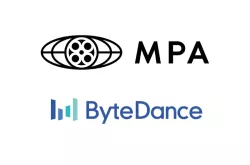
However, just as a courtroom battle seemed inevitable, ByteDance and the MPA unexpectedly announced the signing of a memorandum of understanding. They pledged to establish an intellectual property protection framework surrounding generative AI models such as Seedance and Seedream.
The MPA's official website even hailed this collaboration as a 'global agreement' between the two parties to safeguard intellectual property in AI videos and image models. Given that models like Seedance dominate the current AI video market, the MPA's assertion holds considerable merit.
What baffles many is the MPA's abrupt change of heart. Six months ago, they were quick to issue a 'lawyer's letter warning,' only to be ready for 'dialogue' six months later. Leikeji has observed that those following AI videos would notice a stark reality: AI videos are unstoppable.
Hollywood is compelled to embrace AI due to its unstoppable momentum.
From Disney's perspective, caution towards AI is understandable. After all, IP is their lifeblood. To prolong copyright lifespans, companies like Disney have invested heavily in lobbying the U.S. government to amend copyright laws in their favor.
Thus, they are meticulous about every authorization under their umbrella, fearing that any partner's misstep could devalue their IP. In this context, AI videos grant almost all users 'equal' creative capabilities, enabling them to effortlessly produce realistic visual effects for various videos, with content that is 'uncontrollable.'
Image source: pexels
Following Seedance 2.0's launch, the MPA noted a surge in generated content featuring well-known film characters and story elements on the platform, prompting them to demand increased protection measures from ByteDance. At this year's CinemaCon, MPA President Charles Rivkin maintained a tough stance on AI, emphasizing that while AI can be a creative tool, copyright protection must remain uncompromised.
Thus, Hollywood's resistance to AI videos generating content based on their IP has shifted to a desire to control IP content output, reverting to their familiar model: 'IP licensing—content output—review—release.'
Currently, if ByteDance and Hollywood continue to deepen their cooperation, they are likely to adopt a model similar to OpenAI's collaboration with Hollywood, involving separate licensing for character IP, related peripheral IP, and scene content. It seems IP can still be utilized, albeit with a price tag (however, less than a month after signing the cooperation agreement, OpenAI announced the suspension of Sora's development and even shut it down entirely this year, catching Hollywood off guard).
Reflecting on this, it's plausible that due to this 'precedent,' Hollywood has adopted a more cautious approach to ByteDance's 'olive branch.' During their previous collaboration with OpenAI, Disney even pledged to invest $1 billion. Such a deal, combining IP licensing with financial investment, is rare for Disney in recent decades (ultimately, the investment never materialized due to Sora's shutdown).
Image source: pexels
However, ByteDance's Seedance currently stands as a reliable and one of the few officially commercialized AI video models. In June this year, ByteDance's Volcano Engine launched the Volcano Ark copyright commercialization platform and reached a cooperation agreement with Stephen Chow's Bingo Group, securing the copyright to use three films—King of Comedy, The God of Cookery, and CJ7—in AI video creation scenarios.
Moreover, for content companies, as long as they can control video content and prevent it from straying too far 'off track,' licensing IP to AI video models is more beneficial than detrimental. Not only can they earn additional licensing fees, but they can also leverage creators' creativity, killing two birds with one stone.
Celebrities are exploring the sale of their 'younger selves' to AI.
While formal cooperation between Hollywood and ByteDance may still be in the works, ByteDance has already achieved a new breakthrough. Led by Volcano Engine, it has successfully secured image licensing from some celebrities. Personally, I believe this aspect warrants more attention.
I'm sure many readers have seen the AI short film 'Beautiful Shadow' released by NetEase's 'Fantasy Westward Journey' recently. The female lead's image in the film is sampled from the classic film image of Joey Wong (Wang Zuxian's portrayal of Xue Qianxun is truly a childhood goddess-level existence). Seeing a famous celebrity who retired from acting 22 years ago return to the screen in this manner evokes a sense of nostalgia.
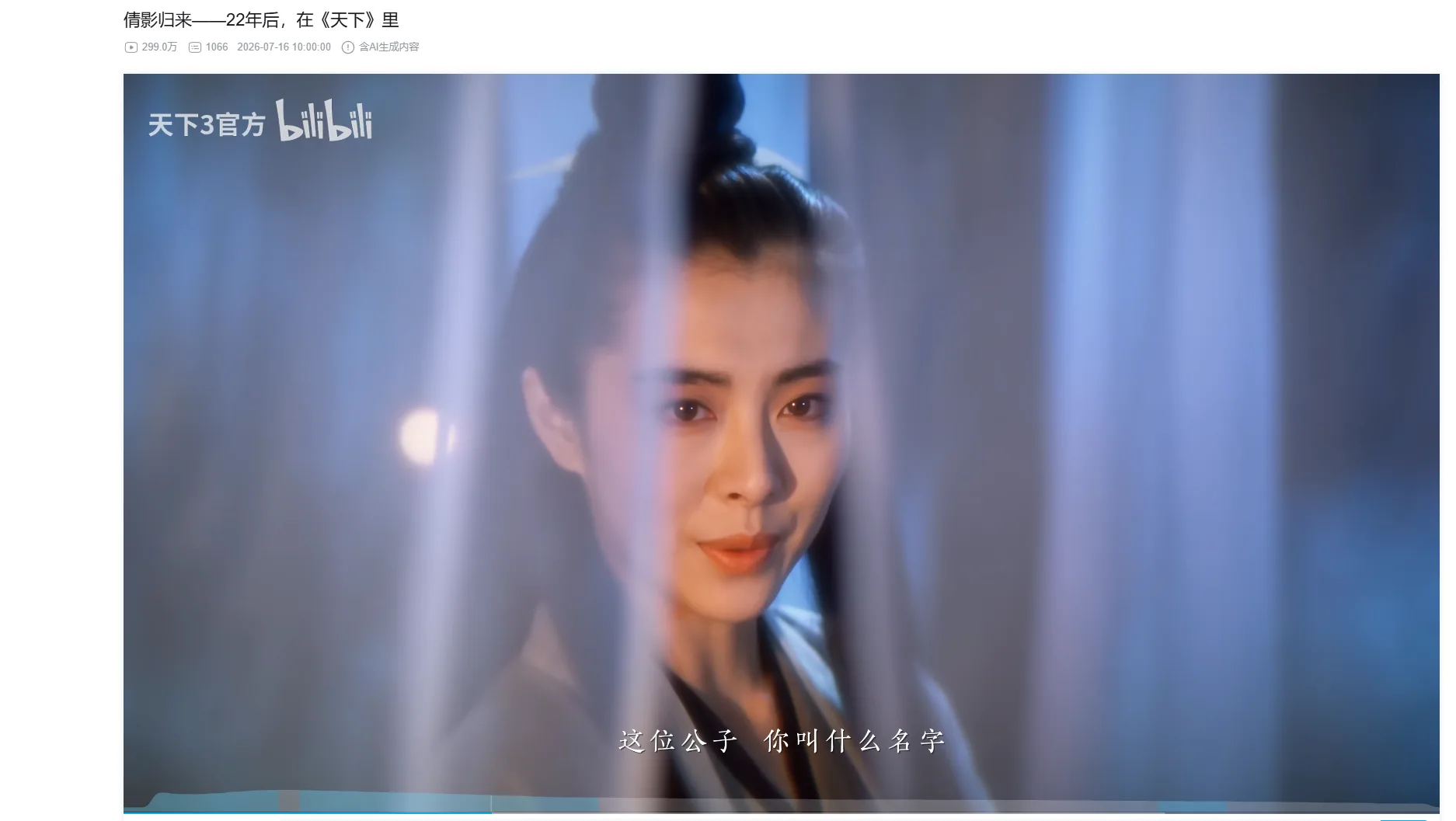
Image source: Bilibili
After officially confirming the licensing of her personal image to Volcano Engine, Joey Wong herself responded to the cooperation, stating, 'We use AI, not the other way around.'
I believe this statement perfectly encapsulates the difference between celebrity AI licensing and the previous 'AI face-swapping.' In the past, AI face-swapping was often viewed negatively, associated with 'fraud' or 'parody videos,' leading many celebrities to be cautious about licensing their AI images.
However, when someone ventures into this realm and reaps benefits, the situation changes. Take Joey Wong, for instance. Although she was a top-tier celebrity in the 1990s, her subsequent career development stalled. Logically, such a celebrity would struggle to find opportunities beyond live-streaming to capitalize on nostalgia.
But AI video models offer a different proposition. They can resurrect a celebrity's peak image, the one most recognized by fans, into the public eye. Even if it's just to cash in on nostalgia, it's undoubtedly more effective than appearing decades later with a face that even fans find 'unfamiliar,' and it might even attract new fans.
Thus, for these retired celebrities, granting AI image licensing poses no pressure. But besides Joey Wong, Ng Kai Wah has also announced his AI image licensing, surprising many industry insiders.
After all, compared to Joey Wong, who has been retired for years, Ng Kai Wah has remained active in the film and television industry, with his popularity surging in the past two years. For him, AI image licensing may stem from a desire to 'see his younger self reappear.'
Image source: pexels
From a personal standpoint, I don't mind this type of licensing. After all, it's a delightful experience to see beloved celebrities active on screen again, as long as it doesn't result in a plethora of abstract video content (suddenly, I understand Hollywood's concerns).
Moreover, from an industry perspective, if more actors start selling their AI image licensing in the future, it could directly transform the current state of the acting industry. In the past, if an actor created a classic image, they might only rely on it for a few months or a year or two before fading into obscurity. But in the future, a classic image might become an 'old IP' that remains active in various videos for decades.
However, some netizens have expressed concerns: AI technology is advancing too rapidly. Tasks previously impossible due to scheduling conflicts can now be delegated to AI as 'stunt doubles,' leading to AI images of top-tier celebrities occupying more and more screen time, making it difficult for newcomers to secure opportunities.
I won't delve too deeply into this, as I'm not well-versed in the entertainment industry. But from an IP perspective, AI videos also empower ordinary people to create their own personal IP. For instance, 'Gugu Gaga,' which is immensely popular on Douyin and Bilibili, was originally a derivative mascot from a comic but has become one of the hottest anime IPs this year with the help of AI videos.
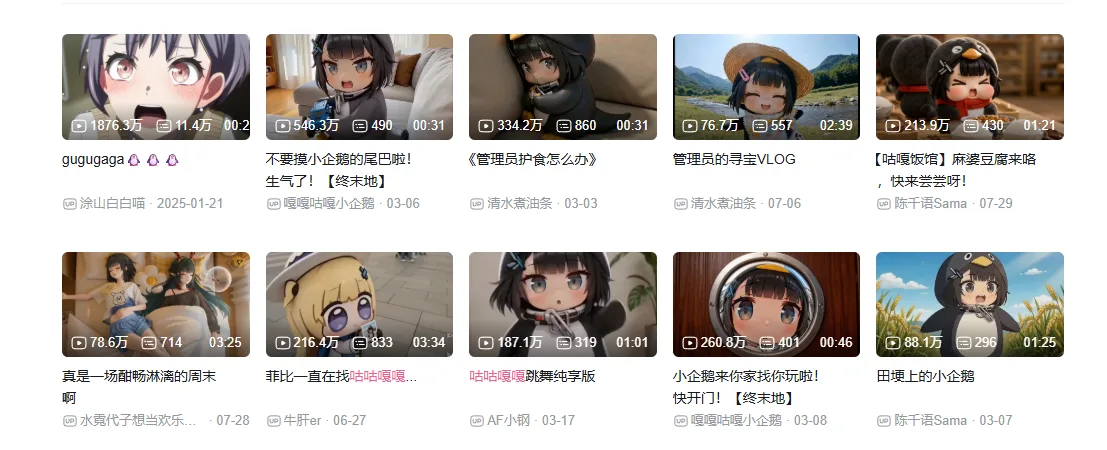
Image source: Bilibili
Moreover, netizens have even created an IP genealogy based on different creators' 'Gugu Gaga' images, with creators possessing strong technical skills and engaging plots receiving significantly more traffic than those who merely follow the trend. Thus, I personally believe this actually provides more opportunities for truly talented creators or actors to succeed, as we are now entering a true era of 'personal creation.'
Is ByteDance's copyright accumulation the cornerstone of AI video commercialization?
Returning to the copyright issue, you may have noticed that ByteDance has been actively pursuing copyright cooperation with content providers in recent months, becoming one of the AI video platforms with the largest copyright portfolio. So, why has ByteDance accelerated IP copyright negotiations?
The reason is straightforward: ByteDance needs copyrights as a competitive moat. For both platforms and creators, copyrights are the optimal tool to help them 'achieve more with less' in attracting audiences and are also the core of monetization. The more copyrights they possess, the more influence they will wield in the future competition among AI video platforms.

Image source: pexels
Moreover, in the past two months, open-source AI video models have garnered increasing attention. Previously, AI video models required professional computing cards to run, and the cost of such cards was prohibitive for ordinary individuals. However, after multiple iterations and repeated distillation and compression, even entry-level graphics cards costing two to three thousand yuan can now run AI video models.
Of course, the generation speed and quality cannot match professional models like Seedance, but the significant cost advantage partially offsets this issue. Therefore, legitimate AI video platforms must demonstrate distinct advantages over open-source models to continue attracting users, and this advantage naturally lies in 'copyright.'
For example, if a creator wishes to produce a commercial AI video for a company, they must have compliant copyright authorization; otherwise, the earnings may not cover the compensation. Thus, although everyone is currently just 'having fun' and may not feel the need for copyrights, when AI videos truly enter the commercialization stage, copyrights will be one of the core considerations for users when selecting a platform.
Moreover, when AI video platforms begin to aggressively acquire copyrights, it also signals that AI videos are on the verge of true commercialization. It remains to be seen who will be the first to break through this threshold: Kling? Or Jimeng?
ByteDance Jimeng Kling AI Video AIGC
Source: Leikeji
The images in this article come from: 123RF Royalty-Free Image Library Source: Leikeji
-
![]()
Great Wall Motors' Overseas Surge in H1, Yet Net Profit Dives Over 60%: Why?
-
![]()
MiniMax Initiates Valuation Restoration with US$800 Million ARR and Dual-Model Reserves
-
![]()
Insta360 Reports RMB 5.516 Billion in H1 Revenue, with R&D Investment Making Up 20% and Accumulating Over 1,200 Patents
-
OpenAI's 'Prodigal Son' Makes a Move: Why Did Harvey, Valued at $11 Billion, Switch to Kimi?
-
![]()
Hollywood and ByteDance Join Forces: Embracing the Unstoppable AI Video Trend for Mutual Prosperity
-
![]()
Cubic Sensors and Instruments Air Quality Sensor Module: Focusing on PM2.5 for Comprehensive Cabin Air Monitoring
-
![]()
Optical Components and Assemblies Surge 45.75% Year-on-Year! Yongxin Optics Reports 564 Million Yuan in First-Half Revenue
-
![]()
Sunny Optical’s Semi-Annual Report: Mobile Phone Profits Slide by RMB 280 Million, Robotics Business Surges to Mitigate Losses