Insta360 Reports RMB 5.516 Billion in H1 Revenue, with R&D Investment Making Up 20% and Accumulating Over 1,200 Patents
 08/28 2026
 395
395
On the evening of August 27, Insta360 Innovations (688775.SH) unveiled its 2026 semi-annual report, revealing RMB 5.516 billion in revenue for the first half of the year, marking a year-on-year surge of over 50%. During the same period, the company posted a net profit attributable to shareholders of RMB 30.40 million. Since the start of the year, Insta360 has launched several eagerly awaited products, including the world's first 8K Leica dual-camera gimbal camera, Luna Ultra; the inaugural 4K vertical shooting gimbal camera, Luna Pro; and the flagship 8K one-inch imaging panoramic camera, X6. These releases sparked long queues at stores across multiple cities worldwide shortly after their debut. According to the financial report, Insta360 has now shipped over 10 million cameras globally, cementing its industry-leading position. As a global leader in intelligent imaging technology, Insta360 is steadily expanding its international footprint. This August, it opened its first flagship store in Japan, located in Tokyo, and plans to launch its inaugural directly operated flagship store in North America in New York's Times Square in September, marking its first such venture outside Asia. Currently, Insta360 boasts over 10,000 global experience retail stores and more than 300 brand flagship stores.
Industry analysts highlight that the market for handheld smart cameras is still experiencing rapid growth. According to the International Data Corporation (IDC)'s Q1 2026 report, global shipments of handheld smart cameras increased by 33%, with Insta360's market share in shipments growing by 66% year-on-year. Additionally, the market penetration rate for handheld smart cameras remains low, suggesting significant potential for future growth. Amidst this industry landscape, Insta360 is fortifying its 'hardware + software + scenarios' ecosystem through substantial R&D investment, aiming to consolidate its advantages and potentially break through market growth barriers.
Consecutive Releases of Flagship New Products, Reaching 10 Million Camera Shipments
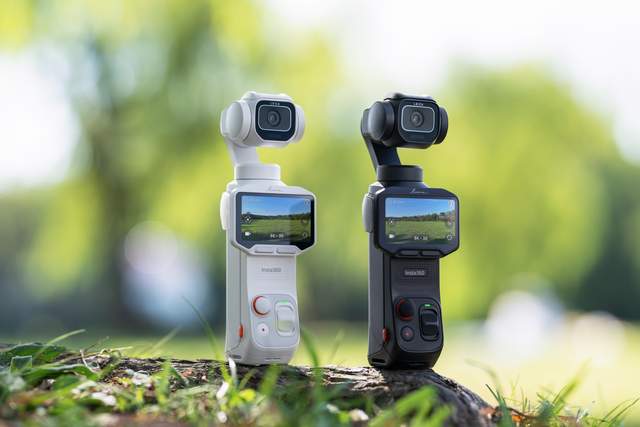
Since the beginning of the year, Insta360 has continuously rolled out multiple flagship products, capturing market attention. In the second quarter, the company launched the Luna Ultra, the world's first 8K Leica dual-camera gimbal camera, which immediately triggered long queues at numerous offline stores domestically and internationally. The trending search term 'Japanese citizens lining up to buy Chinese cameras' drew significant market attention.

It is reported that Insta360's flagship X-series panoramic camera also received an upgrade in August. On August 12, the latest panoramic camera, the X6, was officially launched, featuring comprehensive enhancements in image quality, design, and AI capabilities. Equipped with dual 1/1.1-inch custom large sensors, the sensor area increased by 33%, enabling 8K/50fps panoramic video and 120-megapixel photos. Its self-developed AI model facilitates automatic video production, while the 3D Gaussian splashing function allows for the creation of navigable spaces with a single click. The self-developed panoramic AI multimodal model, PanoMind, is trained on over 10,000 hours of specialized data across more than 30 scenarios, including travel, daily life, skiing, motorcycling, diving, and cycling. Market reports indicate that the X6 topped sales charts on major e-commerce platforms, including JD.com, Tmall, and Amazon, within three days of its launch. On August 20, Insta360 released the Luna Pro, the first 4K vertical shooting gimbal camera, further diversifying the handheld gimbal camera market.
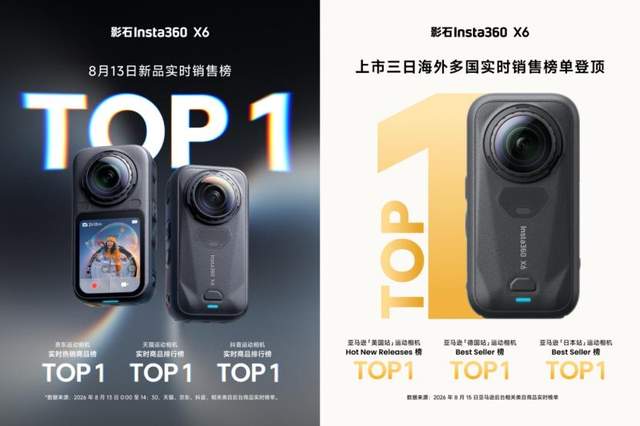
As new cameras enter the market, Insta360's camera sales have reached a significant milestone. To date, the company has shipped over 10 million cameras globally. The expansion of new product categories and enhancements to existing product lines continue to drive rapid revenue growth and enhance the company's reputation. On July 2, Kantar released the '2026 BrandZ Top 50 Chinese Globalization Brands' list, with Insta360 making the list for the fourth consecutive year, rising to 18th place, up six positions from the previous year.
Accelerated Overseas Expansion, Broadened Online and Offline Channels
As Insta360's product portfolio continues to grow, its global sales network is becoming increasingly comprehensive. According to the semi-annual report, overseas revenue now accounts for 63.40% of the company's total main business revenue, and Insta360 is accelerating its global channel expansion. The recent opening of its flagship store in Asakusa, Tokyo, drew market attention. Insta360 founder Liu Jingkang stated that the Asakusa flagship store serves not only as a sales outlet but also as an experiential space for users to engage with imaging technology and spark creativity.

It is also reported that Insta360's directly operated flagship store in New York's Times Square is slated to open in September, marking its first directly operated flagship store outside Asia and the first Chinese imaging brand to establish a presence in New York's Times Square. Currently, Insta360 operates over 10,000 global experience retail stores and more than 300 brand flagship stores.
Additionally, Insta360 is further refining its marketing cost management and expanding offline channels through collaborations with renowned brands like Apple. In July this year, Insta360 announced partnerships with smart terminal companies such as Apple China, resulting in its main popular products being featured in over 500 Apple-authorized specialty stores simultaneously. Furthermore, Insta360 has forged long-term partnerships with channels such as Costco, Sam's Club, Best Buy, B&H, and Suning.
'Hardware + Software + Data'
Insta360 continues to innovate in AI hardware and refine its imaging software, accumulating over 1,200 patents. In early August this year, Insta360 introduced an AI voice assistant on the thumb camera Go Ultra, integrating the QianWen large model and Google's Gemini model. The newly released panoramic camera X6 features a self-developed AI model for automatic video production, while the 3D Gaussian splashing function enables the creation of navigable spaces with a single click. According to the semi-annual report, Insta360 secured 141 new patents in the first half of the year, bringing the total number of patents to over 1,200. It is also reported that Insta360 has collaborated with leading embodied AI and spatial intelligence companies such as Zhiyuan Robotics and Qiyuan Robotics. As application scenarios continue to expand, Insta360's imaging technology is becoming a crucial component of the next-generation AI infrastructure.

'In the future, there will be a type of hardware that acts as a companion, helping people automate operations and executions in a scene. You can simply enjoy the performance and the scenery, like hiring a photographer to automatically capture everything for you,' said Insta360 founder Liu Jingkang at the World Artificial Intelligence Conference (WAIC) held in July. In the future, shooting and editing will be deeply integrated, and the industry will compete not solely on hardware but on the overall capability of 'hardware + software + data.' At its recent 11th-anniversary celebration, Insta360 announced plans to further integrate hardware with AI technology to create a new 'Cameraman' (photography robot). According to Insta360, the core capability of the photography robot is to automatically compose shots, capture moments, and complete video production for users, allowing them to fully immerse themselves in the present.
Insta360's in-depth software development has also garnered market attention and recognition. The total number of Insta360 app users and their activity has grown rapidly. As of June, the monthly user count increased by 67% year-on-year, and the total number of files exported by users increased by 126%. By the second quarter, the export rate of Insta360's cloud-based automatic editing feature, 'Moment Pro,' increased to 60%, and the number of cloud storage paying users increased by over 124% year-on-year.
Profit Under Pressure: Raw Material Costs + Phased Investments in New Business Categories
It is worth noting that Insta360 also mentioned in its semi-annual report that profits are under phased pressure due to the combined impact of raw material costs and phased investments in new business categories. According to the semi-annual report, Insta360 achieved a net profit attributable to shareholders of RMB 30.40 million in the first half of the year, a year-on-year decrease of 94.15%. On one hand, affected by fluctuations in the global supply and demand for memory chips, prices of DDR and other memory chips continued to rise and remained high during the reporting period, posing significant challenges to product costs and short-term profitability. Additionally, the company's strategic procurement of memory chips in the first half of the year amounted to nearly RMB 2 billion, resulting in significant cash outflows for procurement in the first half of the year. This proactive stockpiling is expected to secure a stable supply and cost of memory chips, providing strong support for subsequent development. On the other hand, as a new product category, panoramic drones are still in the market education phase, requiring substantial investments in R&D, production line construction, and market channel expansion. These phased investments have had a negative impact on overall profits without yet achieving economies of scale.
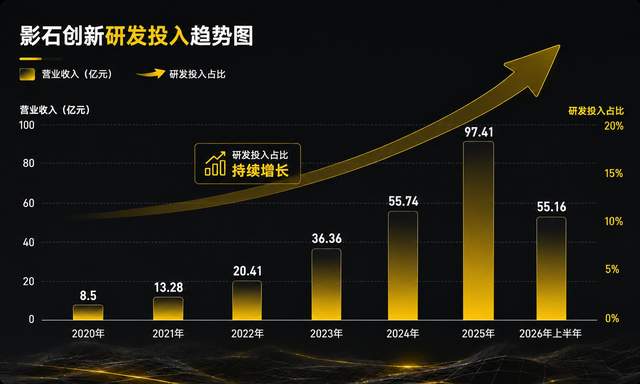
Furthermore, Insta360's continuous high-intensity R&D investment has further compressed profit margins. Financial reports indicate that R&D expenses in the first half of the year exceeded RMB 1 billion, a year-on-year increase of nearly 80%, with R&D investment accounting for approximately 20% of revenue. However, R&D investment has already yielded positive feedback in product iteration and new product sales. Since the start of the year, Insta360 has released multiple new flagship products covering panoramic cameras, gimbal cameras, microphones, and other fields, gaining global market recognition. Continuous innovation will also drive the company to deepen its technological moat, consolidate its advantages, and support long-term development. Through ongoing technological innovation and AI empowerment, Insta360 is transforming its hardware advantages into ecological barriers. Industry analysts note that while profit is an important indicator when evaluating tech companies, it is by no means the only standard. The tech industry is characterized by high investment, high growth potential, and long cycles, requiring a comprehensive assessment of factors such as revenue growth quality and R&D investment intensity. Sometimes, short-term profit compression may result from strategic increases in technological R&D or market expansion investments, which could instead indicate long-term competitiveness.
-
![]()
Great Wall Motors' Overseas Surge in H1, Yet Net Profit Dives Over 60%: Why?
-
![]()
MiniMax Initiates Valuation Restoration with US$800 Million ARR and Dual-Model Reserves
-
![]()
Insta360 Reports RMB 5.516 Billion in H1 Revenue, with R&D Investment Making Up 20% and Accumulating Over 1,200 Patents
-
OpenAI's 'Prodigal Son' Makes a Move: Why Did Harvey, Valued at $11 Billion, Switch to Kimi?
-
![]()
Hollywood and ByteDance Join Forces: Embracing the Unstoppable AI Video Trend for Mutual Prosperity
-
![]()
Cubic Sensors and Instruments Air Quality Sensor Module: Focusing on PM2.5 for Comprehensive Cabin Air Monitoring
-
![]()
Optical Components and Assemblies Surge 45.75% Year-on-Year! Yongxin Optics Reports 564 Million Yuan in First-Half Revenue
-
![]()
Sunny Optical’s Semi-Annual Report: Mobile Phone Profits Slide by RMB 280 Million, Robotics Business Surges to Mitigate Losses