MiniMax Initiates Valuation Restoration with US$800 Million ARR and Dual-Model Reserves
 08/28 2026
 558
558
Recently, the sentiment surrounding the AI sector on the Hong Kong stock market has been relatively subdued. The Hang Seng Tech Index experienced a decline of 4 points in August, exerting collective pressure on AI application stocks.
Amidst this prevailing chill, MiniMax has unveiled an impressive interim report. Its Annual Recurring Revenue (ARR) has surged to US$800 million, with revenue from the business (B) end skyrocketing sevenfold. The company has established dual-line technology reserves in large language and multimodal models, and is set to launch domestic computing power soon. With the imminent release of new models, MiniMax is well-positioned for valuation restoration.
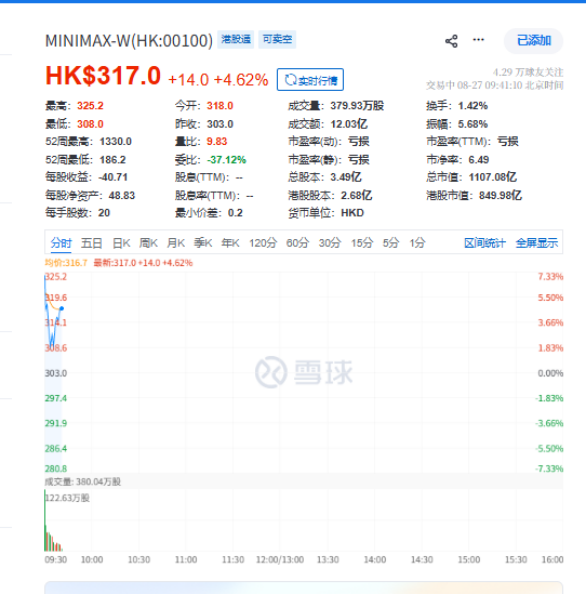
On the morning of August 27, MINIMAX-W (HK:00100) witnessed a 4% rise during intraday trading.
However, what truly motivates me to pen this article are two key figures: ARR exceeded US$800 million in August, with B-end revenue contributing 80%.
From US$150 million in February, it has more than quintupled in just half a year.
If you've been monitoring this company's progress over the past few months and observe this trajectory, you're likely to share my sentiment: inflection points don't arrive gradually; they hit you unexpectedly.
What message does the ARR curve, ascending from US$150 million to US$800 million, convey to the market?
Let's first dissect ARR.
Subscription-based and recurring revenue serve as the cornerstone pricing mechanisms in the Software as a Service (SaaS) industry. For large model companies, ARR gauges the sustainability of token consumption.
When ARR reached US$150 million in February, the market's reaction was, 'Not bad, but can it be sustained?'
Six months later, with ARR at US$800 million, the verdict has changed. This isn't a fleeting traffic dividend; it's genuine enterprise clients utilizing the model in their workloads.
What's driving this growth? Token consumption volume.
From January to July this year, it multiplied 20-fold in six months—an astonishing figure.
A phenomenon I've observed in recent months is that the growth in inference demand, spurred by Agents, has outpaced that of user numbers and message volumes, with token consumption per user rapidly increasing.
What does this imply? User stickiness is gradually taking shape.
The biggest fear for large model companies used to be 'users come, play around a bit, and leave.'
Now, the structural growth in token consumption indicates that users aren't just visiting; they're building, running tasks, and establishing processes on the platform. This is the true foundation for ARR to stabilize at US$800 million.
The B-end curve is steeper than anticipated
The B-end revenue share line represents the true structural transformation and the surprise in this financial report, surpassing revenue and gross profit.
It signifies a paradigm shift in MiniMax's business structure.
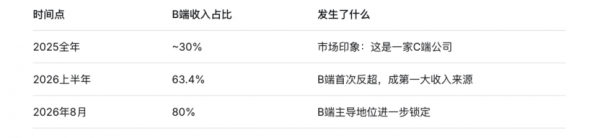
Throughout 2025, MiniMax's B-end revenue accounted for roughly 30%. In the first half of this year, this figure rose to 63.4%, with B-end revenue reaching US$73.9 million, a 703.1% year-on-year increase. By August, it further climbed to 80%.
What does this signify?
A company once perceived by the market as a C-end AI application provider has, in less than a year, redefined itself as a platform company with 80% B-end revenue.
Many may not fully grasp the significance of this.
C-end product revenue growth hinges on expanding the user base and improving paid conversion rates, with the ceiling depending on user acquisition.
B-end is different. Once enterprise clients integrate the model into their workflows, the call volume is continuous and incremental. You might handle 10,000 API requests today and 100,000 tomorrow, and switching it out is not easy due to the significant sunk costs in company-wide replacements.
Bear in mind, this is happening while C-end revenue doubles. In other words, it's not that C-end is faltering; C-end has already doubled, but B-end is simply surging ahead.
Gross profit surged by 464.8%, efficiency emerges
Gross profit soared from US$3.69 million to US$20.81 million, a 464.8% increase. Gross margin rose from 12.1% to 17.9%, a 5.8 percentage point improvement.
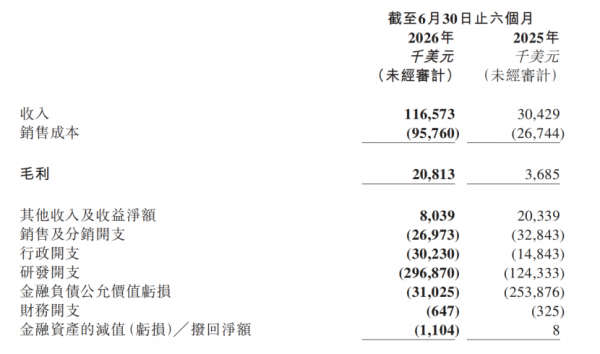
While this figure may not be high within the software industry, the trend is more intriguing. Infrastructure efficiency is improving, unit costs are being diluted, and the direction is correct.
During the earnings call, management revealed several noteworthy signals: text model throughput per unit of computing power has tripled over the past two months, with M3.1 aiming to reduce inference costs to about one-third of M3's initial launch level. As text model revenue share increases and inference costs decline, the company expects gross margins to continue improving in the second half of the year, with further room for improvement next year.
Gross profit is on the rise, and efficiency is improving—this trend matters more than the absolute figures.
R&D expenditure reached US$297 million, a 138.8% year-on-year increase. Compared to the 283.1% revenue growth, R&D growth is less than half of revenue growth. For every dollar spent on R&D, the revenue generated has more than doubled compared to last year. R&D efficiency is improving, a factor more noteworthy than the gross margin itself.
M3 and H3 are not just models; they are commercial accelerators
However, having clients willing to pay isn't enough. A healthy ecosystem requires continuously delivering value that clients deem 'worth it.'
M3, released in June, outperformed GPT-5.5 and Gemini 3.1 Pro on SWE-Bench Pro.
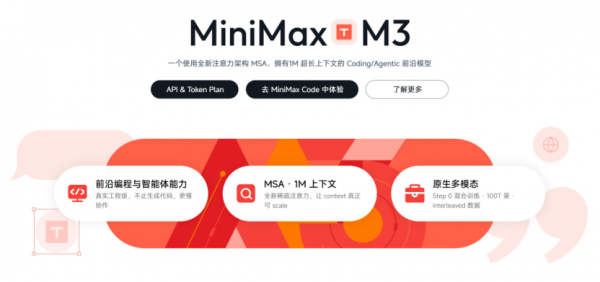
This benchmark measures programming capabilities, precisely one of the most API-intensive scenarios for enterprise clients. With M3's 1M context window, the computational load per token is reduced to one-twentieth of the previous generation, lowering inference costs and enabling enterprise clients to adopt it on a large scale.
H3, open-sourced on July 31, spawned over 300 derivative models and exceeded 24 million downloads within a month of release.
The significance of open-sourcing extends beyond industry goodwill; it fosters a developer ecosystem. The more people build on your model, the harder it becomes to replace.
This is the moat.
Connecting the dots: M3 and H3 not only address 'Is it powerful enough?' but also 'Is the barrier low enough?' They not only make enterprise clients willing to pay but also attract developers to join in.
As CEO Yan Junjie stated on the earnings call, 'H3's breakthrough performance, open-source strategy, and cost-effectiveness advantage have disrupted the notion that advanced models in this field belong solely to large corporations following a closed-route approach. The welcome from creators and the open-source community has far exceeded our expectations.'
MiniMax doesn't seek to compromise between intelligence and cost. Only by minimizing the cost per unit of intelligence can the highest level of intelligence be trained; only by reducing the cost per unit of intelligence supply can higher levels of intelligence permeate broader production and daily life.
This is precisely why MiniMax holds a significant advantage in overseas revenue.
The overseas market contributed US$70.83 million in the first half, accounting for 60.8% of total revenue. Among Chinese large model companies, this level of internationalization is quite rare.
This is highly significant.
Firstly, it diversifies revenue sources, naturally hedging against risks from geopolitics, domestic competition, and policy fluctuations in a single market.
Secondly, overseas clients' willingness to pay for model capabilities serves as an endorsement of technical strength. International market competition is more complex; if clients are willing to pay even when you're not cheaper, it further validates your technical prowess.
MiniMax's combination of globalization and high B-end revenue share has, at least from a revenue quality perspective, already charted a different course.
The market may still be using old maps to find new continents; MiniMax's stock is undervalued
On August 27, MiniMax's stock price rose over 4%, reaching HK$317, with a market capitalization of approximately HK$110.7 billion.
Viewed in isolation, this figure might seem barely adequate for a company with half-year revenue of US$117 million still incurring losses. However, when you overlay ARR, B-end share, token growth rate, and globalization, you'll find that the market may still be pricing it based on the valuation framework of a 'C-end AI application company.'
A simple horizontal comparison with DeepSeek:
According to The Information, DeepSeek achieved US$70.7 million in revenue in the first seven months of this year. Excluding the bustling July, MiniMax's first-half revenue is roughly double that of DeepSeek;
Although DeepSeek's net revenue is lower than MiniMax's, it achieved 10 times its 2025 annual revenue in the first seven months, with a growth rate far exceeding MiniMax's;
DeepSeek's net loss in the first seven months was US$106 million, with MiniMax's current net loss about 3.4 times that of DeepSeek.
The issue is, this company is no longer the same company.
Six months ago, it was a C-end-dominated AI company with B-end just starting. Now, B-end accounts for 80%, ARR has more than quintupled in half a year, and token consumption has multiplied 20-fold in six months.
The acceleration in revenue is steepening, and the center of gravity of the business structure is shifting.
CEO Yan Junjie also stated on the earnings call, 'By 'Minimizing the Inference Cost, Maximizing the Intelligence,' we aim to achieve 'Intelligence with Everyone.' This has been our consistent technical route.'
This may sound like a vision, but against the backdrop of US$800 million ARR and 80% B-end share, it's not just a vision; it's already in motion.
Prices in the large model sector can vary drastically month by month. For instance, MiniMax's B-end revenue share was 60% and C-end 40% from January to June, but by August, it surged to 80% B-end and 20% C-end—a significant shift in just one month.
The market often lags in pricing a company undergoing structural changes. By the time everyone sees it clearly, the price usually isn't what it is now.
-
![]()
Great Wall Motors' Overseas Surge in H1, Yet Net Profit Dives Over 60%: Why?
-
![]()
MiniMax Initiates Valuation Restoration with US$800 Million ARR and Dual-Model Reserves
-
![]()
Insta360 Reports RMB 5.516 Billion in H1 Revenue, with R&D Investment Making Up 20% and Accumulating Over 1,200 Patents
-
OpenAI's 'Prodigal Son' Makes a Move: Why Did Harvey, Valued at $11 Billion, Switch to Kimi?
-
![]()
Hollywood and ByteDance Join Forces: Embracing the Unstoppable AI Video Trend for Mutual Prosperity
-
![]()
Cubic Sensors and Instruments Air Quality Sensor Module: Focusing on PM2.5 for Comprehensive Cabin Air Monitoring
-
![]()
Optical Components and Assemblies Surge 45.75% Year-on-Year! Yongxin Optics Reports 564 Million Yuan in First-Half Revenue
-
![]()
Sunny Optical’s Semi-Annual Report: Mobile Phone Profits Slide by RMB 280 Million, Robotics Business Surges to Mitigate Losses