Great Wall Motors' Overseas Surge in H1, Yet Net Profit Dives Over 60%: Why?
 08/28 2026
 509
509
Produced by Leadar Auto Text by Zhou Hui Edited by Meng Shuai
Great Wall Motors reported a somewhat "paradoxical" performance for the first half of the year: export volumes soared, pushing revenue past the 100 billion yuan milestone, yet net profit attributable to shareholders plummeted by over 60%.
According to Great Wall Motors' latest financial report released on August 25, the company achieved revenue of 102.101 billion yuan in the first half of the year, up 10.58% year-on-year. This marks the first time its semi-annual revenue has exceeded 100 billion yuan.
Domestic sales revenue reached 45.814 billion yuan, down 18.83% year-on-year, while overseas revenue surged to 56.288 billion yuan, up a significant 56.83% year-on-year. This is the first time Great Wall Motors' overseas revenue has surpassed its domestic revenue.
However, as overseas operations increasingly become the core growth engine for the company, they also present certain challenges for Great Wall Motors.
The financial report revealed that in the first half of the year, Great Wall Motors recorded a net profit attributable to shareholders of 2.465 billion yuan, down 61.11% year-on-year. This decline was primarily attributed to deferred recovery of overseas tax policy subsidy benefits and exchange rate fluctuations.
Notably, in April, Great Wall Motors launched a naming campaign for its new SUV model under the Haval brand. After a nationwide vote, the new model was named "Great Wall H10," marking the first time a Great Wall Motors model has been named after the parent brand.
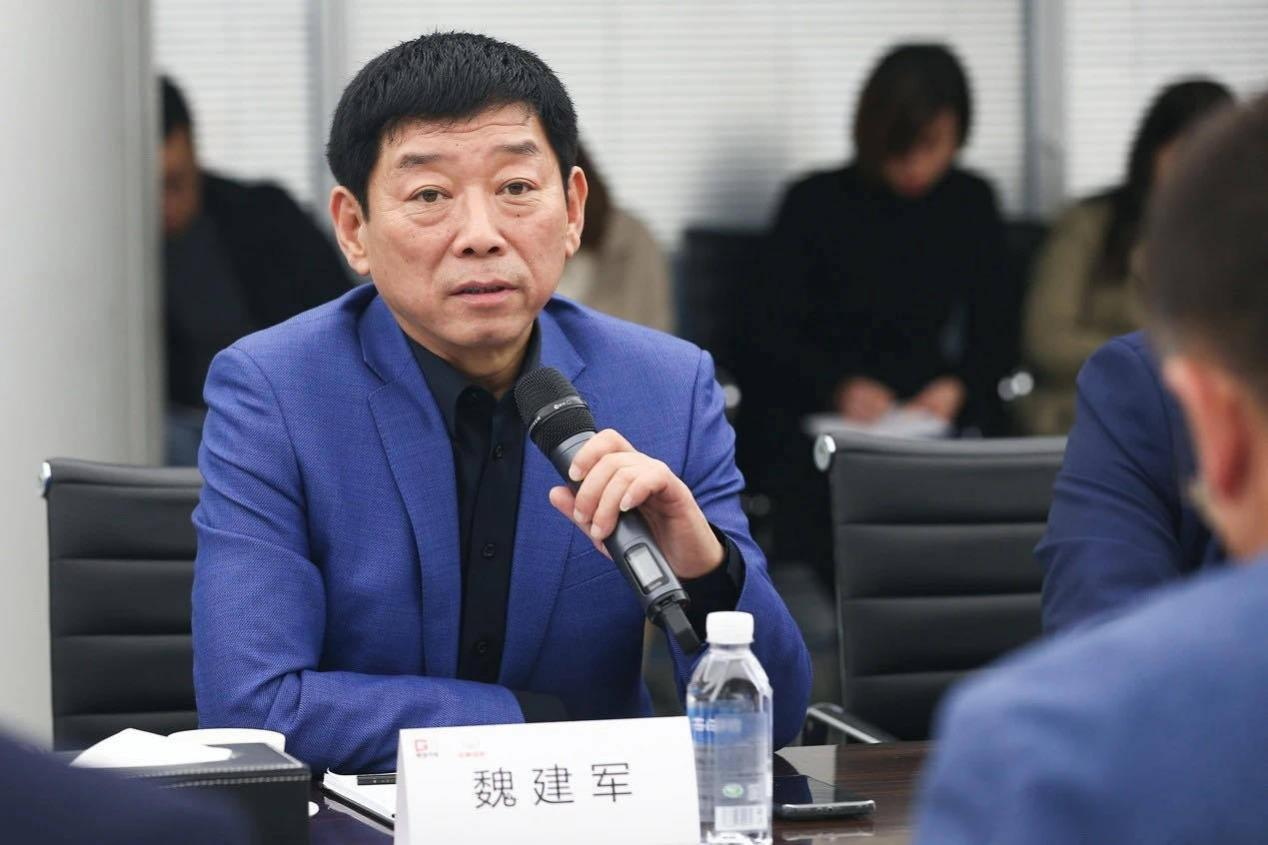
Great Wall Motors Chairman Wei Jianjun stated that while there was significant internal debate over the name, it was ultimately chosen through a public vote and aligns better with the "One Great Wall" globalization strategy.
At the 2025 Annual Shareholders' Meeting held earlier, Great Wall Motors President Mu Feng also announced that the company would integrate Haval, Ora, and Great Wall Cannon under the GWM brand to carry the mainstream product lineup, while Tank and WEY would continue to position themselves as higher-end independent brands.
Revenue Exceeds 100 Billion Yuan in H1, Domestic Revenue Declines Nearly 20%
On August 25, Great Wall Motors released its financial report for the first half of 2026, showing revenue of 102.101 billion yuan, up 10.58% year-on-year.
Revenue from complete vehicle sales reached 88.816 billion yuan, up 11.37% from 79.751 billion yuan in the same period last year. Revenue from parts and other sources reached 13.286 billion yuan, up 5.58% from 12.583 billion yuan in the same period last year.
Great Wall Motors stated that during the reporting period, the company's sales volume and revenue increased year-on-year, driven by overseas growth and domestic high-value model growth, which continuously enhanced the company's global brand strength.
Specifically, in the first half of the year, Great Wall Motors sold a total of 575,800 new vehicles, up 1.22% year-on-year.
The overseas market performed particularly well, with cumulative sales of 289,000 new vehicles in the first half, up a significant 45.46% year-on-year, accounting for a high 50.2% of total new vehicle sales.
The surge in new vehicle exports further drove growth in Great Wall Motors' overseas revenue. The financial report showed that in the first half of the year, Great Wall Motors' foreign transaction revenue from other countries (unaudited) reached 56.288 billion yuan, up 56.83% year-on-year.
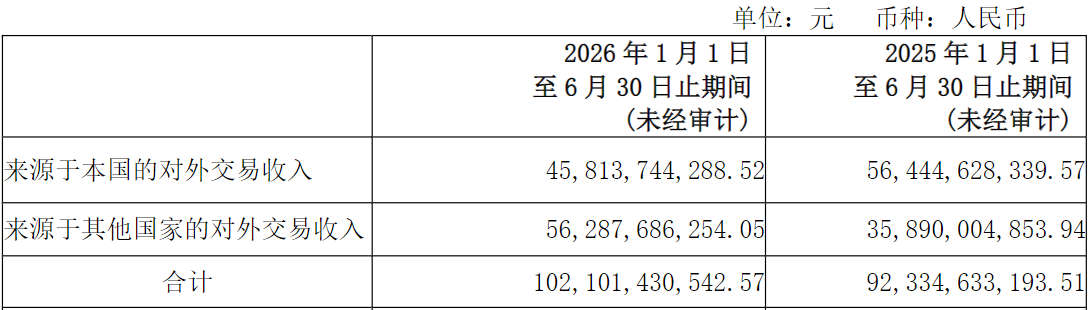
During the same period, Great Wall Motors' foreign transaction revenue from its home country (unaudited) declined 18.83% year-on-year to 45.814 billion yuan.
Notably, this marks the first time Great Wall Motors' domestic revenue has fallen below its overseas revenue. Great Wall Motors also stated that overseas operations have gradually become the core growth engine for the company.
By brand, Great Wall Motors currently owns Haval, Tank, WEY, Ora, Great Wall Pickup, Great Wall Soul Motorcycle, and Great Wall Commercial Vehicle brands, with products covering SUVs, sedans, pickups, MPVs, motorcycles, heavy trucks, and other categories.
Haval continues to optimize its fuel and new energy vehicle product mix, leveraging Great Wall Motors' technological reserves and global operational system. It achieved global sales of 327,700 units in the first half, with overseas sales contributing 205,400 units, up 45.04% year-on-year, driving profit structure optimization.
During the same period, the Tank brand achieved global sales of 90,200 units, with overseas sales of 34,500 units, up 57.64% year-on-year. Great Wall Pickup achieved global sales of approximately 90,200 units, with cumulative historical sales nearing 3 million units, maintaining the top market share for 28 consecutive years. The Ora brand's repositioning showed initial success, achieving four major outcomes: "customer base expansion," "technological labeling," "sales growth," and "overseas expansion."
As a strategic pioneer in Great Wall Motors' high-end market layout, WEY also saw steady sales growth in the first half, with cumulative deliveries of the Mountain model exceeding 30,000 units, up a staggering 186.04% year-on-year, topping the sales charts for new energy MPVs in the first half.
Great Wall Motors stated that in the second half of the year, WEY will leverage three core technologies—the Guiyuan S platform, 800V high-voltage systems, and fully self-developed intelligent driving—to launch new models such as the V8X and initiate an overseas expansion plan to solidify its position as a domestic high-end brand.
Why Does Net Profit Plummet by Over 60% Amid Soaring Overseas Operations?
While the booming overseas operations drove revenue growth, they also posed challenges to Great Wall Motors' profitability.
The financial report showed that in the first half of 2026, Great Wall Motors recorded a net profit attributable to shareholders of 2.465 billion yuan, down a sharp 61.11% from 6.337 billion yuan in the same period last year.
In its semi-annual performance forecast released in mid-July, Great Wall Motors mentioned that the year-on-year decline in net profit was primarily due to deferred recovery of overseas tax policy subsidy benefits (2.274 billion yuan received in the same period last year) and exchange rate fluctuations, which resulted in a comprehensive foreign exchange loss of approximately 266 million yuan (unaudited) after hedging and locking in exchange rate gains, with foreign exchange gains decreasing by approximately 1.759 billion yuan year-on-year (a gain of 1.493 billion yuan in the same period last year).
In terms of expenses, in the first half of this year, Great Wall Motors' selling expenses reached 5.998 billion yuan, up 19.11% year-on-year; administrative expenses reached approximately 2.05 billion yuan, up 8.22% year-on-year; and research and development expenses reached 4.568 billion yuan, up 7.74% year-on-year.
The growth in these three expense categories also squeezed the company's profit margins to a certain extent.
Notably, despite the significant decline in net profit attributable to shareholders in the first half, Great Wall Motors' core business profitability did not experience significant fluctuations.
The financial report showed that in the first half of the year, Great Wall Motors achieved a gross profit of 18.759 billion yuan, up 10.52% year-on-year; the gross profit margin was 18.37%, down only slightly by 0.01 percentage points year-on-year.
As of the end of the first half, Great Wall Motors' total assets reached 229.99 billion yuan, with total liabilities reaching 142.597 billion yuan, and the asset-liability ratio rising by approximately 1 percentage point to 62% from the end of last year.
Continuously Advancing the "One Great Wall" Strategy, Brand Integration May Become an Industry Trend
According to Tianyancha information, Great Wall Motor Co., Ltd. (abbreviated as "Great Wall Motors") was registered and established in 2001 and is an automaker listed on both the Hong Kong and A-share markets.
At last year's Shanghai Auto Show, Great Wall Motors launched its "ONE GWM" (i.e., "One Great Wall") global strategy, aiming to expand into overseas markets by integrating resources from six brands: Haval, WEY, Tank, Ora, Great Wall Cannon, and Soul Motorcycle.
Entering 2026, the "One Great Wall" strategy further took root domestically. In April this year, Great Wall Motors launched a global naming campaign for the new flagship model under its Haval brand, with the related topic trending on social media.
As the first square-box SUV model built on the Guiyuan platform, many netizens believed that this model should continue the classic symbol of the Haval brand and be named "Haval H10" in the form of "H+number."
However, in the subsequent nationwide vote, "Great Wall H10" narrowly won. Many netizens who supported Haval products were not satisfied with this outcome.
Great Wall Motors Chairman Wei Jianjun also bluntly stated, "There was significant internal debate over this name. Some said that Great Wall is the company name and should not be used for a single model. But we still listened to everyone and named it 'Great Wall H10,' which better aligns with the 'One Great Wall' globalization strategy."
With Wei Jianjun's decision, Haval's new flagship SUV was ultimately named "Great Wall H10," with the overseas version to be simultaneously named "GWM H10." This new model also marked the first time Great Wall Motors used its parent brand name for a model.
At the 2025 Annual Shareholders' Meeting held in June this year, Great Wall Motors President Mu Feng also mentioned that the company would integrate Haval, Ora, and Great Wall Cannon under the GWM brand to carry the mainstream product lineup, while Tank and WEY would continue to move upmarket as higher-end independent brands.
Notably, Great Wall Motors is not the only automaker advancing brand integration. In recent years, automakers such as Geely, SAIC, and NIO have all initiated internal integrations and consolidated their sub-brands.
Securities Daily pointed out that brand integration is a major trend for the healthy development of the automotive industry. The Chinese automotive industry no longer needs to prove market vitality through the number of brands; what the industry truly needs is a group of high-quality brands with technology, quality, service, and long-term operational capabilities.
In the future, automakers should replace extensive expansion with refined deep cultivation, continuously improving product quality, upgrading service systems, and building user loyalty and long-term trust.
-
![]()
Great Wall Motors' Overseas Surge in H1, Yet Net Profit Dives Over 60%: Why?
-
![]()
MiniMax Initiates Valuation Restoration with US$800 Million ARR and Dual-Model Reserves
-
![]()
Insta360 Reports RMB 5.516 Billion in H1 Revenue, with R&D Investment Making Up 20% and Accumulating Over 1,200 Patents
-
OpenAI's 'Prodigal Son' Makes a Move: Why Did Harvey, Valued at $11 Billion, Switch to Kimi?
-
![]()
Hollywood and ByteDance Join Forces: Embracing the Unstoppable AI Video Trend for Mutual Prosperity
-
![]()
Cubic Sensors and Instruments Air Quality Sensor Module: Focusing on PM2.5 for Comprehensive Cabin Air Monitoring
-
![]()
Optical Components and Assemblies Surge 45.75% Year-on-Year! Yongxin Optics Reports 564 Million Yuan in First-Half Revenue
-
![]()
Sunny Optical’s Semi-Annual Report: Mobile Phone Profits Slide by RMB 280 Million, Robotics Business Surges to Mitigate Losses