Doubao Mobile Assistant is Here! Suitable for Small Manufacturers like Nubia, but Unlikely to Be Adopted by Huawei and Xiaomi?
 12/02 2025
 776
776
Internet giants have long coveted smartphone entry points.
Hasn't everyone noticed that while the tech scene in 2025 is bustling, it still feels like something is missing?
Looking back at this year, AI large models have been popping up everywhere. The videos generated by Sora are almost indistinguishable from reality, and GPT-5 is said to have an IQ that surpasses the average human level. Even domestic models like Doubao, Qianwen, and DeepSeek are fiercely competitive.
However, brothers, have you noticed that most of these so-called high-tech advancements still seem to be confined to computer web pages or exist as chat apps on our phones?
When it comes to our daily use of smartphones, not much has changed. You still have to tap on App icons one by one and switch between WeChat, Taobao, and Xiaohongshu. Despite all the hype about large models, when you want to order takeout, you still have to manually swipe the screen.
Just when everyone thought 2025 would end on a rather uneventful note, ByteDance suddenly made a big splash.
On December 1st, ByteDance released a preview version of the Doubao Mobile Assistant.
(Image source: Doubao)
Simply put, this is a system-level service designed for smartphone manufacturers. It deeply integrates the Doubao large model into the operating system, allowing users to command their phones with just their voice (or a finger tap) to perform tedious operations that would normally require dozens of screen taps.
Unfortunately, Lei Technology didn't get our hands on the product in advance this time, and I was actually quite interested in that ZTE prototype.
However, that doesn't stop us from taking a closer look at what Doubao has to offer.
Nubia Launches First, Doubao Aims to Make Phones Self-Sufficient
Let me clarify for those who are unaware of the situation: the rumor circulating on Weibo today about 'ZTE and Doubao launching an AI-native smartphone' is a classic case of misinformation.
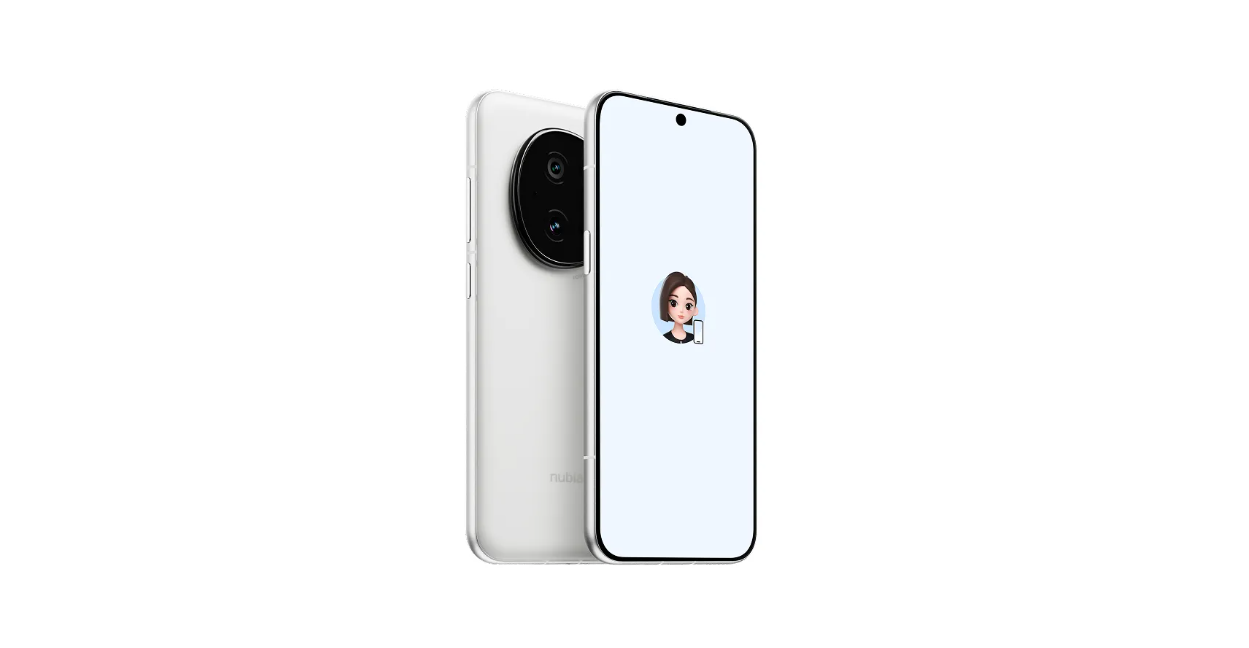
What Doubao released this time is not a smartphone but a mobile assistant loaded onto the nubia M153.
(Image source: Doubao)
Seeing this combination, many readers might find it strange: Why doesn't ByteDance make its own smartphone?
Well... we'll get to that later.
Getting back on track, according to the official demo video, the biggest selling point of the Doubao Mobile Assistant can be summed up in two words: full delegation.
Our current mobile assistants, like Siri or Xiao Ai, are fine for setting alarms or checking the weather. But if you say, 'Help me send a red packet to Lao Wang on WeChat and send him the photos I just took,'
most mobile assistants will either be stumped or simply open WeChat for you, leaving the rest to you.
But Doubao's assistant is different.
In the demo, the tester said to the phone, 'Help me compare prices for this bottle of shampoo across all my shopping apps and place an order for the cheapest one.'

(Image source: Doubao)
The phone screen came to life on its own. It automatically recognized the image, extracted the product name, and then proceeded to search for and compare prices on Taobao, JD.com, and Pinduoduo. Finally, it stopped at the payment page, requesting manual payment from the user.
Throughout this process, the tester's hands never touched the screen, and the entire operation took 3 minutes and 12 seconds.
This is quite remarkable.
Keep in mind that this involves cross-App operations. The Doubao Mobile Assistant not only has to understand your commands but also recognize buttons on the screen, distinguishing between products and search functions. It even has to simulate finger taps to operate apps like a human.
In tech circles, this is known as a GUI Agent, or Graphical User Interface Agent, essentially giving AI eyes and hands.
Another scene left a deep impression on me.
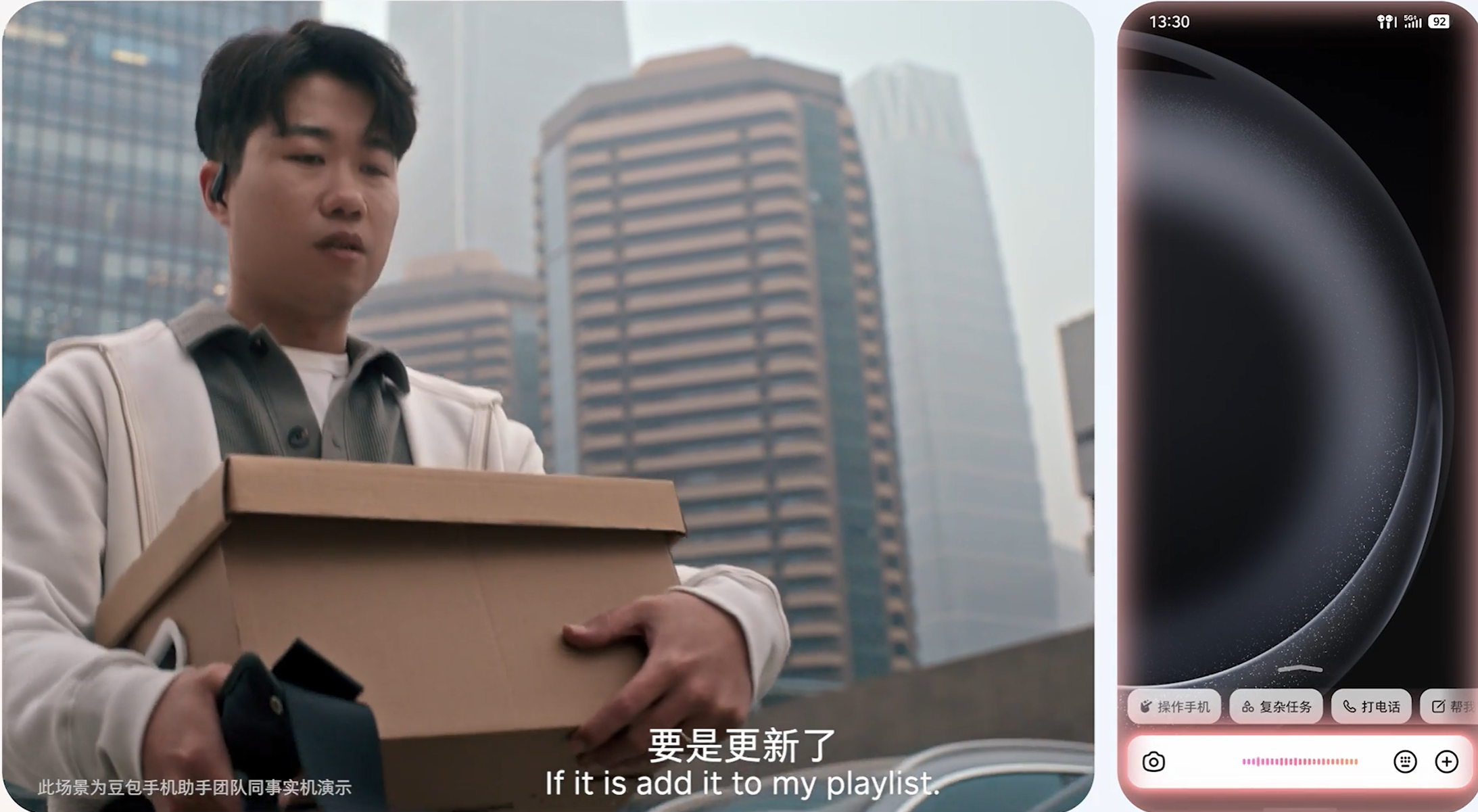
The tester, wearing smart earphones Ola Friend and too busy to use his hands, directly used voice commands to wake up Doubao and said, 'Check the weekly column on the blogging platform to see if it's been updated. If it has, add it to my playlist for listening on the way.'
(Image source: Doubao)
The phone immediately began performing tasks even while locked.
Even when the tester added new requests, such as opening the Tesla's front trunk or making a reservation at a Spanish restaurant, it didn't disrupt the previous tasks. Multiple tasks could run in parallel.
Such functionality is particularly useful during hectic moments.
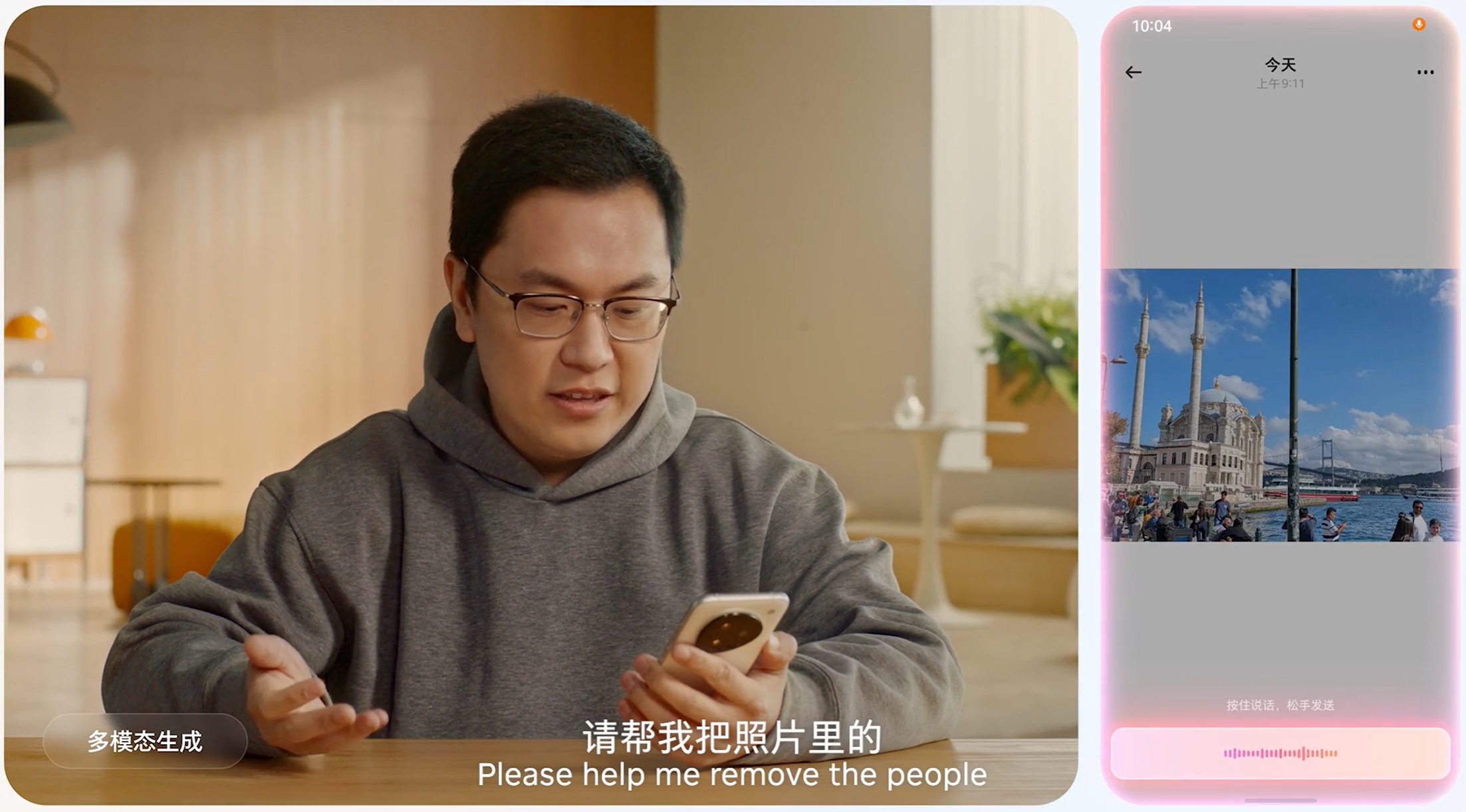
Basic features like text interaction, voice calls, video calls, and screen sharing are all included. Multimodal generation is deeply integrated with the phone's native gallery, allowing easy removal of people and clutter from photos, leaving only pure scenery.
(Image source: Doubao)
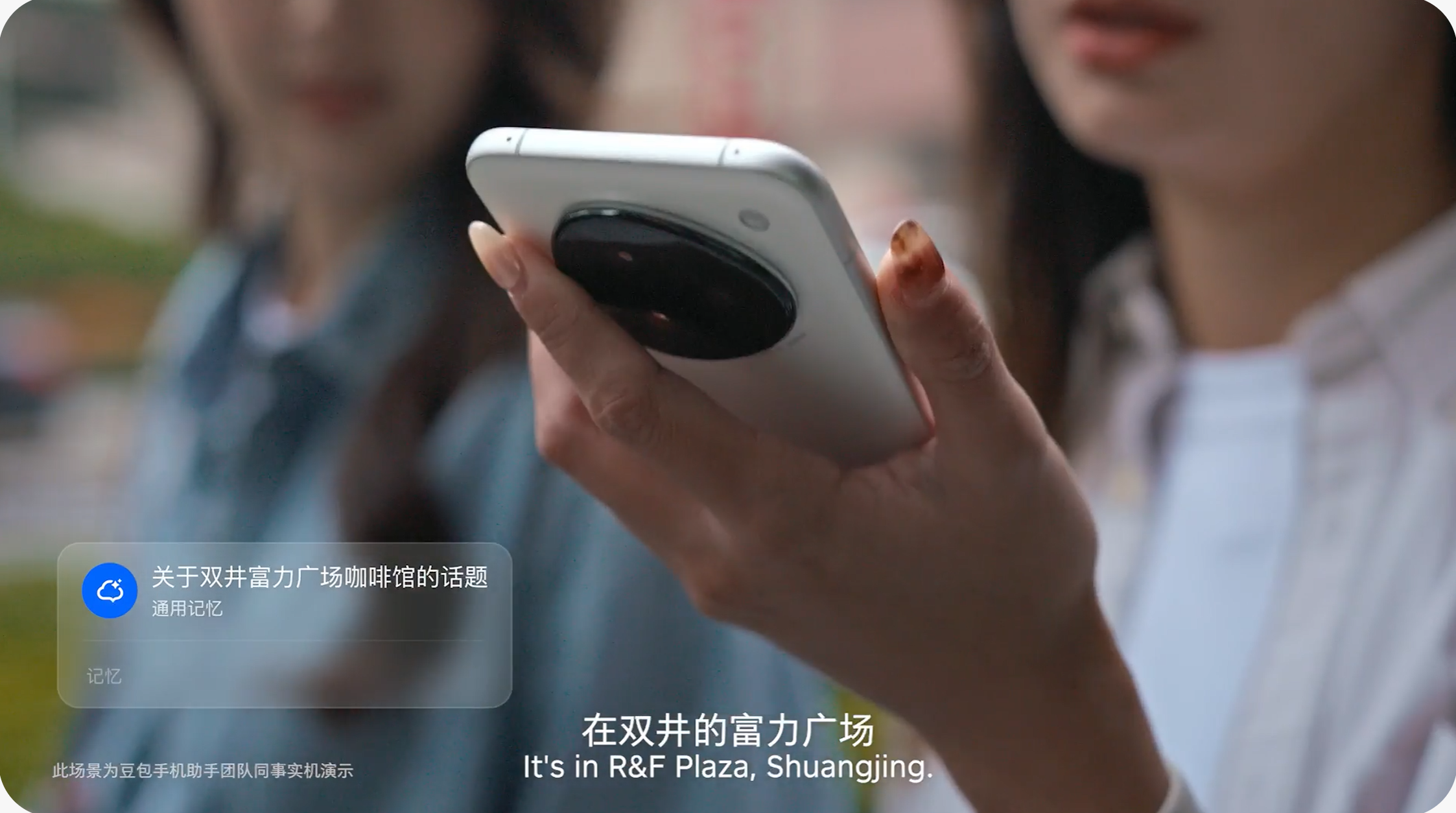
But that's not all. The global memory capability of the Doubao Mobile Assistant is what I believe will have the most significant impact on future phone system interactions.
The tester gave an example: in Pro mode, when the user says, 'Help me recommend a few gifts for my daughter and add them to the shopping cart,' if the assistant has stored information about the daughter's age and interests, it can directly query options that match her age and preferences without the user having to provide details one by one.
It's almost like the assistant knows you better than you know yourself.
Of course, the official emphasized at the end of the video that while the demo content was genuinely recorded, the uncertainty of large model technology means that related scenarios cannot be guaranteed to be replicated 100%.

(Image source: ZTE)
As for the price, since it's currently a technical preview engineering machine, the nubia M153 equipped with the Doubao Mobile Assistant is priced at 3499 yuan.
This price isn't expensive in the 2025 flagship phone market. However, considering it's mainly for developers and tech enthusiasts to try out, regular users might encounter numerous bugs, and future system updates remain to be seen. So, everyone should just take a look and not rush into buying it.
Suitable for Small Smartphone Manufacturers, Huawei and Xiaomi Won't Give Up Control
After discussing the product, let's talk about the underlying logic.
Many brothers might ask: This functionality sounds great, but why don't big manufacturers like Xiaomi and Huawei do it themselves? Why does ByteDance have to step in?
Well, it's a matter of specialization.
As we've discussed before, Xiaomi's Xiao Ai and Huawei's Xiao Yi, while evolving, are essentially gatekeepers.
(Image source: Huawei)
When smartphone manufacturers develop AI, their top priority is stability. They can't afford to make the phone overheat due to intelligence or have the AI accidentally tap on the user's apps, which could lead to awkward situations like sending the wrong message to the boss.
Therefore, the AI from big manufacturers tends to be conservative, mainly controlling Apps through interfaces (APIs), which limits the number of supported apps and results in a rigid user experience.
ByteDance's Doubao, on the other hand, is a pure offensive player.
The large model behind Doubao has native multimodal processing capabilities and is highly intelligent. It doesn't need Apps to provide special backdoors; it directly views the screen and simulates human logic to operate the phone, resulting in fewer limitations.
From teachers who have had early access, you can even see videos of Doubao playing WeChat mini-games on its own.
(Image source: Doubao)
This technical approach is highly aggressive, with low fault tolerance but extremely high potential.
So, why doesn't ByteDance make its own smartphones?
This brings us to a piece of internet history. After acquiring Hammer Mobile, ByteDance actually tried its hand at hardware, but as we all know, the results weren't great. Nowadays, the smartphone market is a red ocean, and new players simply can't break in. There's no point in ByteDance subjecting itself to such hardship.
Therefore, ByteDance chose to 'go public through a shell company.'
It needs a hardware carrier to implement its AI capabilities, and for second-tier smartphone brands like ZTE/Nubia, which have no issues with hardware but have long been criticized for their system experience, this is a perfect match. Nubia provides the hardware and system-level permissions, while ByteDance supplies the superbrain.
In fact, this provides a new thought process (literally 'thinking path,' but here it means 'new approach') for the industry: relying on AI to turn things around.
Just imagine, if brands with small market shares like Meizu and Motorola suddenly equipped their phones with the smarter Doubao Mobile Assistant, which could automatically order takeout, snatch train tickets, and edit photos for your social media, wouldn't you be tempted?
I think at least some tech enthusiasts would be willing to give it a try.
There's Nothing New Under the Sun: Internet Giants Have Always Coveted Entry Points
After seeing Doubao's move, I couldn't help but sigh with emotion (feelings/thoughts), that the internet is truly cyclical.
Old netizens should remember that around 2012 to 2014, it was the era of various smartphone ROMs flooding the market.
Back then, Tencent had TOS, Alibaba had YunOS, Baidu had Baidu YunOS, and even Facebook had Facebook Home. It seemed like almost every giant wanted to create a smartphone system to stuff their services into, thereby seizing the entry point to the mobile internet.
Believe it or not, Lei Technology did quite a few reviews back then.
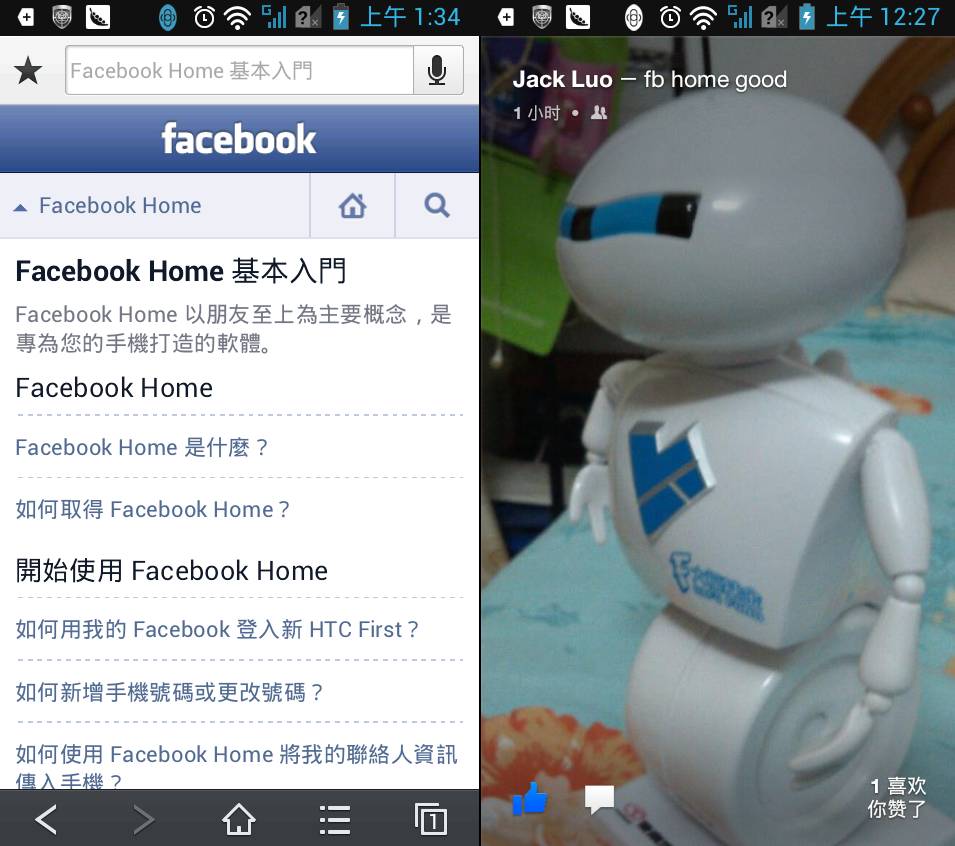
(Image source: Luo Chao's Channel)
And what happened? They all failed miserably.
Because back then, third-party systems didn't offer any core improvements to the user experience beyond changing skins and pre-installing a few full-suite Apps. In fact, they often made things worse by cramming in too many features, resulting in complex operation manuals and ultimately being abandoned due to poor adaptation and lag.
Now, a decade later, it seems like the script is being replayed.
Only this time, the weapon has changed from UI (User Interface) to AI (Artificial Intelligence). Besides Google, ByteDance, OpenAI, and various large model manufacturers all seem to be trying to seize the smartphone entry point.
But this time, the chances of success might be higher than a decade ago.
Because AI can truly save time.
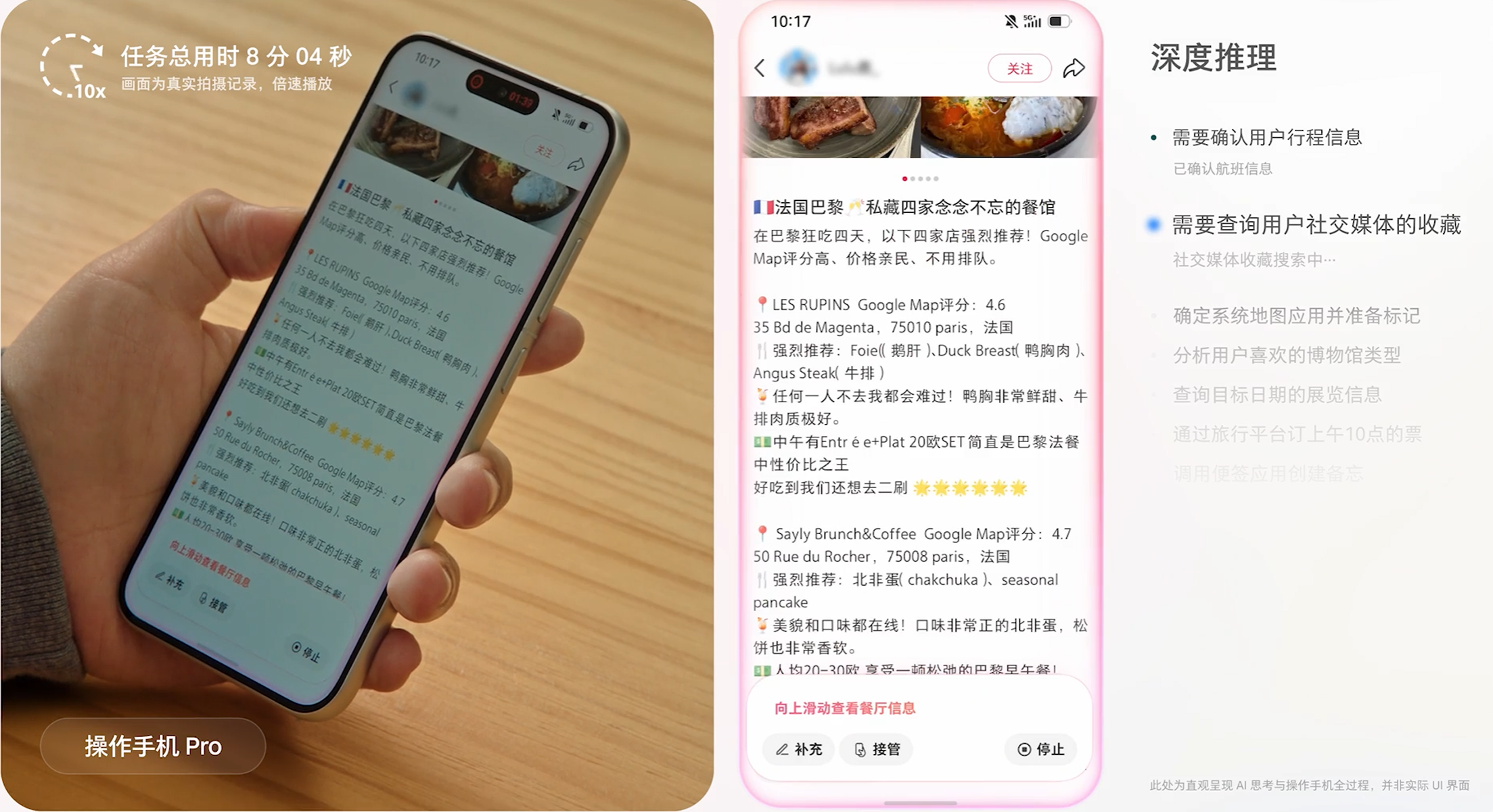
(Image source: Doubao)
If a mobile assistant can reduce the number of screen taps I have to make each day by hundreds and automatically handle tedious tasks like booking tickets, comparing prices, and filling out forms, I'm willing to tolerate the occasional small bug.
Most importantly, this could be a game-changer for the smartphone industry.
It might not immediately shake up the status quo, as the positions of Xiaomi, Huawei, and Apple are hard to Shake up (shake/displace). But it has opened a crack, showing us that future smartphones shouldn't just be communication tools with AI features; they should be intelligent assistants capable of solving problems for you.
Who knows, by 2026, when we talk about smartphones, we might not ask, 'How many megapixels does your phone's camera have?' but rather, 'Can your phone handle all these tedious tasks for me?'
If that's the case, the world would be a much better place.
Doubao ZTE Nubia AI Smartphone ByteDance
Source: Lei Technology
All images in this article are from the 123RF licensed image library.
-
![]()
Hardware is the skeleton, AI is the soul, and data integrates the two
-
![]()
China’s AI Industry: A Unified Pivot Towards Monetization?
-
![]()
New Progress! Infineon Completes Acquisition of ams OSRAM's Non-Optical Sensor Business
-
![]()
35 Million Bet on an Optical Future! Tengjing Technology Makes a Move in AR
-
![]()
Why World Models Get Stuck on Construction Roads in Autonomous Driving Applications
-
Alibaba Initiates Cultural Transformation: Is Jack Ma Making a Strategic Comeback?
-
Tianfeng Heads to Hong Kong for IPO with RMB 3.8 Billion in Funds: Xingyu's Cross-Border Foray into Embodied AI Faces Uncertain Future
-
![]()
Mengshi Auto’s High-End Aspirations Dashed: Huawei Partnership Fails to Revive Sales, New Model’s Entry Price Dips Below 300,000 Yuan