vivo Donates Its Self-Developed OS Kernel, BlueKernel, Breathing New Life into the Rust Ecosystem
 12/04 2025
 701
701
On November 21, 2025, at the 2025 OpenAtom Developers Conference, vivo officially contributed its self-developed Rust-language operating system kernel, BlueKernel, to the OpenAtom Open Source Foundation. This move formally established BlueKernel as an open-source incubation project.
From a broader perspective, this act could represent one of the most significant milestones in the history of domestic foundational software. It marks a rare instance where a company donates its core assets to bolster support for the operating system ecosystem in a 'reverse-engineering' manner.
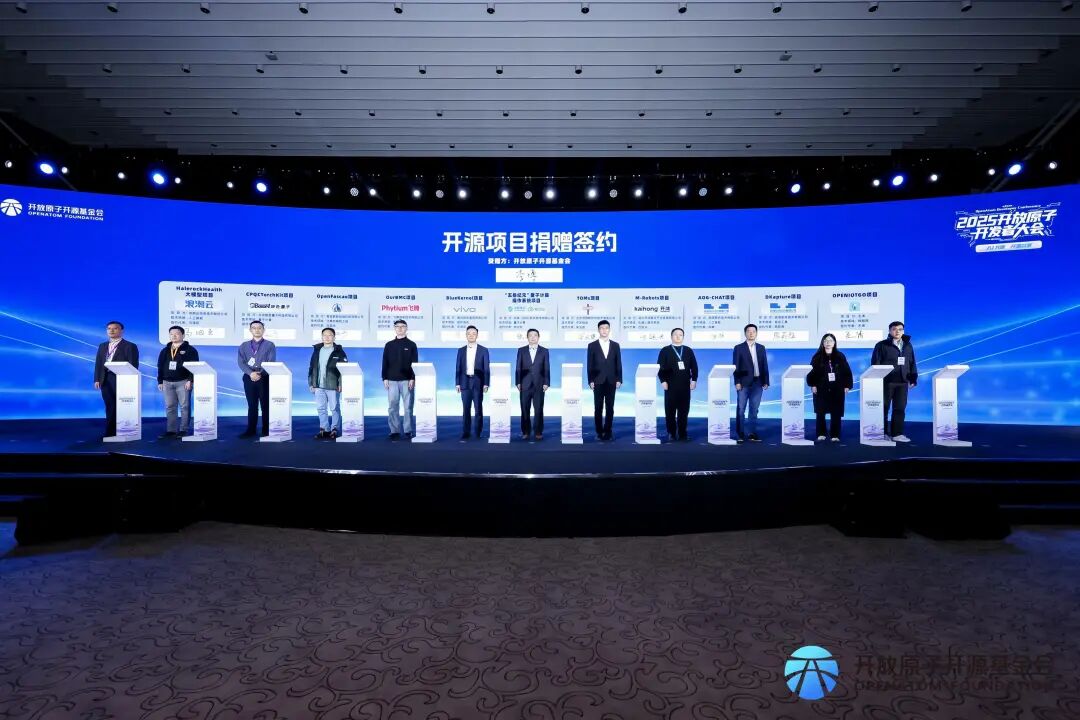
Image Source: OpenAtom Open Source Foundation
As an operating system entirely crafted in Rust, vivo's self-developed Blue River Operating System (BlueOS) has undergone steady development over eight years. Starting from its inception in 2018, it achieved official release and found application in smartwatches by 2023. In 2024, vivo unveiled its self-developed OS kernel, which was then open-sourced in July 2025 and donated in November. This early initiation, substantial investment, and sustained innovation have positioned vivo as a global leader in Rust technology. BlueKernel underwent continuous refinement within vivo before being introduced to the open-source community.
Undoubtedly, this reflects a commitment to long-term strategic planning. By laying a solid foundation before the winds of change arrived, vivo is now well-positioned to reap the benefits.
From Self-Development to Open Source: The Strategic Evolution of vivo
The history of domestic operating systems has always been marked by ambition but often lacked the patience for 'success beyond individual contributions'.
In reality, different devices today have vastly different operating system requirements. Consumer products prioritize rapid iteration and feature richness, while automotive, medical, and other scenarios emphasize safety and reliability. Attempting to meet all these needs with a single kernel is akin to using one key for all locks – technically feasible but compromising on user experience.
BlueKernel was developed to fill the 'new gaps' that are inevitable in the AGI era. It offers a lightweight, high-security, and broadly adaptable solution to explore a multi-kernel innovation path amidst existing mature solutions.
The decision to donate BlueKernel to the OpenAtom Open Source Foundation stems from vivo's recognition of a fundamental principle in operating system development: collaboration is key.
No matter how exceptional the kernel is, if only vivo uses it, it remains a 'company project' rather than an ecosystem-wide solution. Chip manufacturers need adaptation support, developers require comprehensive documentation, and third parties demand deep customization capabilities – none of which a single company can fully provide.
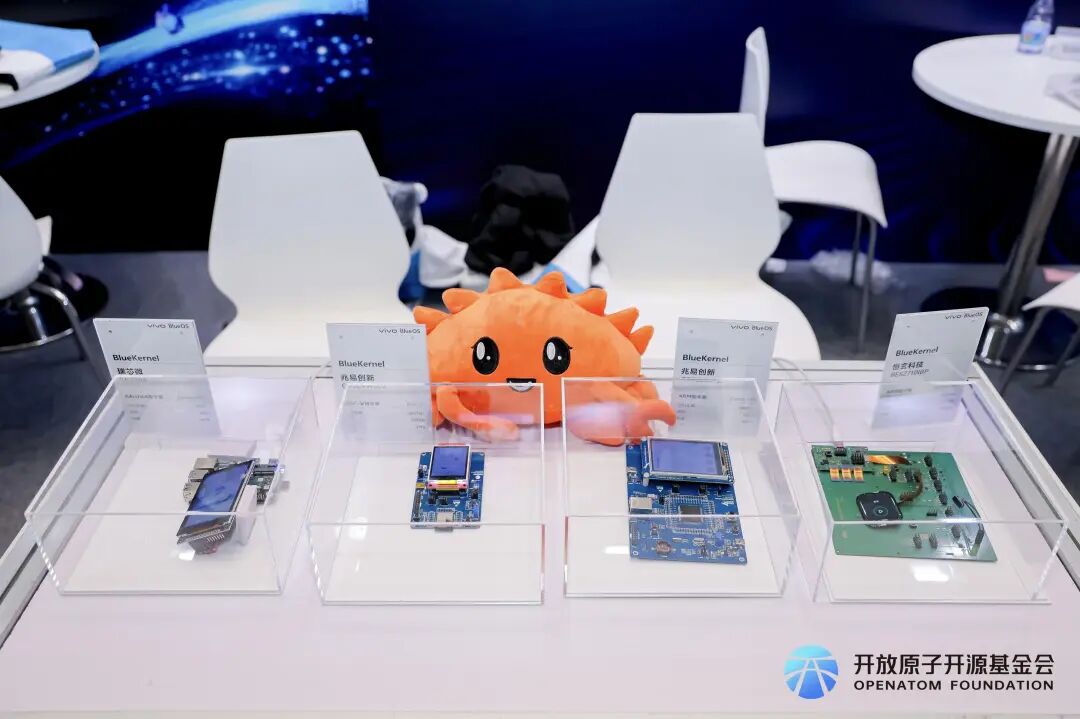
Image Source: OpenAtom Open Source Foundation
More importantly, as the industry explores next-generation operating system directions, a closed approach leads to redundant efforts, while openness fosters collective strength.
This is the underlying logic behind vivo's donation: transforming BlueKernel from 'private property' to a 'public good'. Of course, vivo is not stepping away from the scene but rather adopting an open-source stance to invite industry-wide collaboration.
This move is not entirely novel; some institutions in the industry have also embraced open-source incubation through similar approaches. However, vivo's timing is impeccable. BlueKernel already supports mainstream chip manufacturers like GigaDevice, BES Technic, and Rockchip, covering Cortex-M, Cortex-A, and RISC-V architectures.
This means vivo has overcome the toughest 'cold start' phase and is now sharing its mature fruits with the entire industry to drive exponential ecosystem expansion.
As BlueKernel becomes a shared industry infrastructure, vivo, as the earliest architectural designer and core contributor, will wield significant technical influence and scenario-defining authority.
Is the Risk of Developing an OS Kernel in Rust Justified?
vivo is among the first domestic vendors to invest in Rust kernel development and open-sourcing, a decision that requires significant courage. But first, we must address: What is a kernel, and why do only a few players engage in its development?
The operating system kernel is the foundation of the software world. It manages CPUs, memory, and peripherals, deciding which program runs when, allocating resources, and preventing unauthorized access. If an operating system is likened to a city, the kernel is its underground pipeline system – once it fails, the entire city collapses.
Given its foundational role, kernel development is notoriously challenging.
Thus, in the domain of operating systems, where C has been the dominant language for fifty years, vivo's choice of Rust is akin to 'betting on electric vehicles in the era of fuel-powered vehicles (internal combustion engine vehicles)'. Rust lacks a vast historical codebase and mature developer ecosystem, yet vivo proceeded and chose the hardest path – building the entire kernel from scratch in Rust.
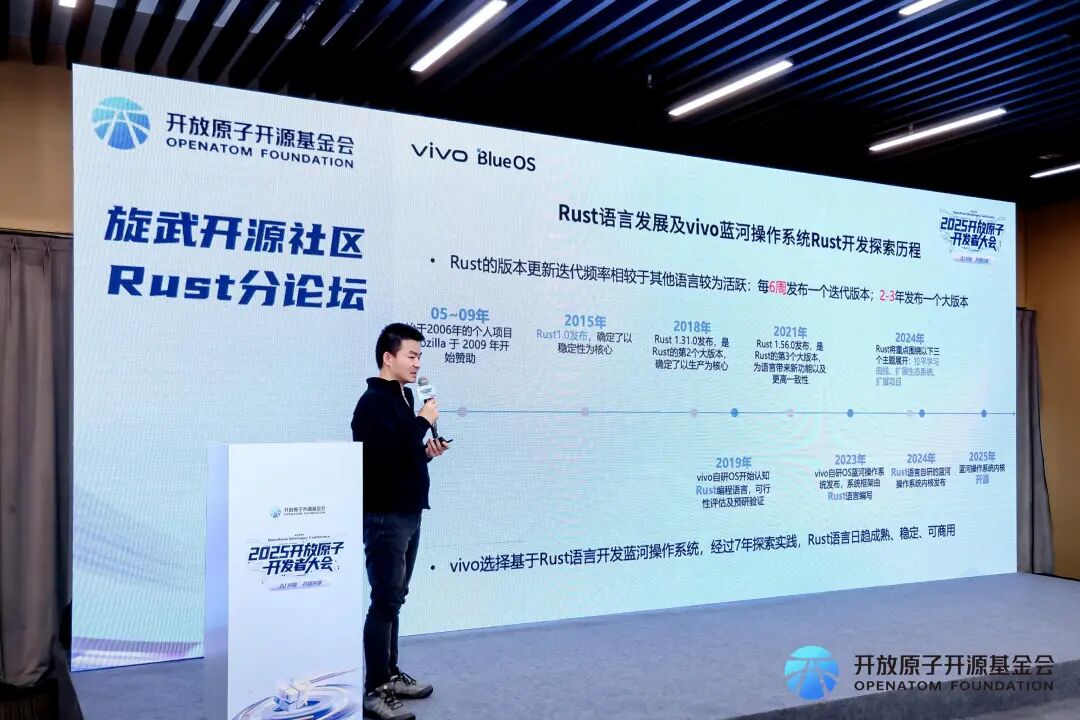
Image Source: OpenAtom Open Source Foundation
The most crucial reason behind this decision is 'security'.
Traditional operating system kernels, primarily developed in C, rely on manual memory management by developers, with vulnerabilities often patched after the fact. This model was tolerable in the PC era but has become untenable in the AGI era. A security flaw in a smart door lock could paralyze a home security system; a memory overflow in an automotive system could directly threaten lives.
Rust's revolutionary approach is to 'eliminate pollution at the source'. Its ownership system and lifecycle checks shift memory safety issues from 'runtime' to 'compile-time'. Simply put, the Rust compiler acts as a stringent inspector – any code with memory safety hazards fails to compile. This is akin to preventing defects at the factory rather than recalling products after they reach users.
However, Rust's value extends beyond technical safety; it lies in ecosystem positioning.
In 2024, the Linux kernel officially began accepting Rust code, signaling Rust's evolution toward an infrastructure language. vivo's heavy investment in Rust at this juncture is equivalent to securing an early seat in the next round of industry standard-setting.
The question remains: Why vivo?
Among global tech giants, Microsoft, Google, and Amazon are all investing in Rust, but their core businesses do not fully align with Rust's kernel-level advantages. Microsoft needs backward compatibility; Google must maintain its vast Android ecosystem; Amazon focuses more on the cloud. As a terminal vendor facing the imminent AGI era, vivo confronts the purest safety and efficiency challenges – it needs a lightweight, secure, and cross-scenario kernel. Moreover, as a ground-up self-developed project, it carries no historical baggage.
This 'lightweight and agile' advantage positions vivo as the optimal practitioner of Rust kernels.
Can BlueKernel Become the 'Water and Electricity' of the AGI Era?
No matter how elegant the technology, it requires real-world application. BlueKernel's true test lies in whether it can become the 'water and electricity' of the AGI era – invisible, essential, and ubiquitous.
To understand its potential, we must revisit vivo's three core positioning for BlueKernel: security, lightweight, and versatility.
These terms may sound like marketing slogans, but at the operating system kernel level, each represents a formidable technical barrier.
In terms of security, as mentioned earlier, BlueKernel is developed in Rust, suitable for embedded platforms and mobile devices. It ensures memory safety through compile-time static rules while relying on smart pointers for flexible runtime memory management, eliminating additional performance overhead from memory recycling. This shifts memory safety from passive defense to proactive control.
Thanks to its high-performance, low-overhead design of foundational data structures, BlueKernel significantly reduces hardware resource demands, with a minimum kernel memory footprint of just 13KB, enabling cost-effective support for various terminal products.
Currently, Rust supports multiple architectures, including ARM Cortex-M/A and RISC-V, allowing developers to write drivers once for deployment across different chips. Its compatibility with the POSIX interface standard enables low-cost migration of existing Linux ecosystem applications. This versatility drastically reduces fragmented development costs in the AGI era.
Combined, these three traits form BlueKernel's scenario-penetrating power.
For instance, in smart wearables, the 13KB minimum memory footprint allows the main chip to allocate more resources to other modules; memory safety ensures user privacy data remains protected from malicious programs; cross-architecture adaptation enables manufacturers to switch chip suppliers freely without being tied to a single platform.
In automotive ECUs, the lightweight nature allows BlueKernel to run on low-cost MCU chips costing just a few dollars, reducing overall vehicle electronic system costs. Its security features enable hard isolation between critical control units (e.g., braking, steering) and infotainment systems, ensuring driving stability in complex scenarios. Its versatility allows Tier 1 suppliers to reuse software modules across different automakers, shortening development cycles.
As AI integrates deeper with hardware devices, these three traits become even more critical.
Returning to the article's opening, vivo's donation of BlueKernel is not an isolated event when viewed on a larger scale. A growing consensus has emerged: In foundational battles like operating systems, going it alone leads nowhere. Only by enlarging the pie can sustained sharing occur.
We have long followed others' standards, but now, at least at the kernel level, some vendors are willing to share their most prized assets, bringing the entire industry to a common starting point. Can the Rust ecosystem succeed? What should operating systems look like in the AGI era? The answers will ultimately emerge through collective experimentation by countless developers, chip manufacturers, and hardware enterprises.
vivo has taken the first step; now, it's everyone else's turn.
-
![]()
Hardware is the skeleton, AI is the soul, and data integrates the two
-
![]()
China’s AI Industry: A Unified Pivot Towards Monetization?
-
![]()
New Progress! Infineon Completes Acquisition of ams OSRAM's Non-Optical Sensor Business
-
![]()
35 Million Bet on an Optical Future! Tengjing Technology Makes a Move in AR
-
![]()
Why World Models Get Stuck on Construction Roads in Autonomous Driving Applications
-
Alibaba Initiates Cultural Transformation: Is Jack Ma Making a Strategic Comeback?
-
Tianfeng Heads to Hong Kong for IPO with RMB 3.8 Billion in Funds: Xingyu's Cross-Border Foray into Embodied AI Faces Uncertain Future
-
![]()
Mengshi Auto’s High-End Aspirations Dashed: Huawei Partnership Fails to Revive Sales, New Model’s Entry Price Dips Below 300,000 Yuan