"What Is Lei Jun's Strategy for Embracing Long-Term Success?"
 12/05 2025
 722
722
Caught in the eye of a public opinion storm, Lei Jun once again finds himself standing on the precipice. Can he weather this tempest?
However, if we shift our perspective and draw inspiration from James Carse's concept of the "infinite game," we can arrive at a fresh conclusion.
James Carse, a professor of religious history at New York University, introduced a groundbreaking idea in his renowned work, Finite and Infinite Games: "There are at least two kinds of games. One could be called finite, the other infinite. A finite game is played with the goal of winning, while an infinite game is played to keep the game going."
Here, "game" is not a literal competition but rather a metaphor for business behavior or a company's operational model. Clearly, finite games represent short-term objectives and behaviors, whereas infinite games embody a commitment to long-termism.
From this vantage point, you'll see that what the outside world perceives as the "darkest moment" in Lei Jun's 33-year commercial odyssey may be nothing more than a sharp curve in the road. He does not play for the outcome of a single sprint; instead, he is engaged in an infinite game of survival, perseverance, and boundary expansion.
This is the underlying logic behind my belief that Lei Jun will undoubtedly emerge from this darkest moment stronger than ever.
—Introduction
The recent landscape of internet public opinion seems particularly unforgiving towards Lei Jun. Questions, mockery, and a flood of irrational emotions have surged toward this 56-year-old entrepreneur like a tidal wave.
To navigate through this challenging period, Lei Jun can ultimately only rely on himself. I believe he is currently contemplating this issue and will undoubtedly provide his own answer.
However, we should have confidence in Lei Jun because he is a long-termist, someone who has weathered countless "darkest moments."
A finite game resembles a 100-meter sprint, demanding an explosive performance within a very short timeframe, where success or failure determines the outcome. In contrast, an infinite game is like a marathon without a finish line, where the competition lies in enduring pain, correcting mistakes, surviving through harsh winters, and ultimately keeping the game going indefinitely.
Lei Jun is the quintessential player of the infinite game.
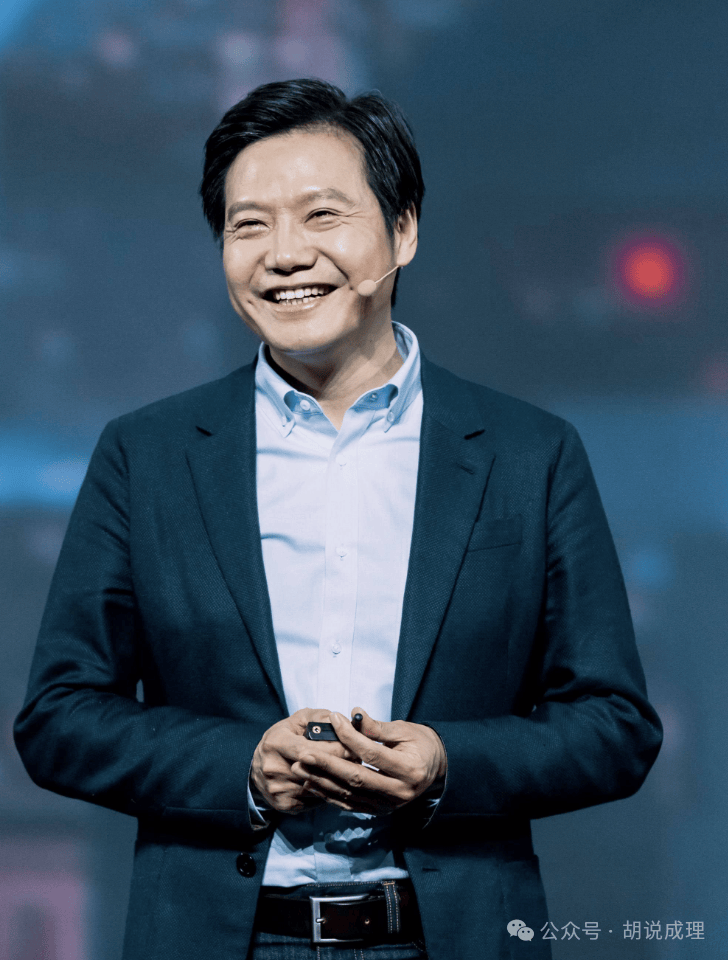
Over the past 33 years in the business world, he has engaged in countless finite games, experiencing both victories and defeats. The times when he lost were far more humiliating than his current situation, and the times when he won were exhilarating, making him an idol to many. However, these moments are not what truly define Lei Jun. What truly sets him apart are the three prolonged infinite games: Kingsoft, Xiaomi, and the ongoing Xiaomi Automobile.
Each of these three games spans decades, even pushing him to the brink each time. Externally, each seemed "on the verge of collapse," yet he emerged victorious every time.
Once you understand this, you will comprehend why the current public opinion storm cannot "defeat" Lei Jun. Someone accustomed to the infinite game has a far higher pain threshold and operates on a much longer time scale than the average person.
To truly understand Lei Jun in the present, we must return to the starting point of his business journey—Kingsoft.
Let's begin with a story that has recently captured everyone's attention:
The "three essential elements" requirement in the Ministry of Commerce's Announcement No. 61 of 2025—mandating that "documents must be filled out in Chinese, formatted uniformly in WPS, and applications are only supported on the Chinese system"—may seem like a procedural adjustment, but it is actually a crucial step for China to establish its rule-making authority in the global supply chain.
The WPS format required in this precise "rule countermeasure" and WPS's absolute dominance in China's intelligent office sector today, including its market share on both PC and mobile platforms, represents a significant achievement in Lei Jun's career. From joining Kingsoft at the invitation of Qiu Bojun in 1992 and gradually becoming its long-term helmsman to the present, it has been 33 years. This infinite game is still ongoing, but the outcome seems already determined.
He led Kingsoft to defeat Microsoft, specifically its core product, Microsoft Office.
I vividly remember that in the early 21st century, WPS was still much weaker compared to Microsoft Office. However, on December 28, 2001, when Beijing announced the results of its first large-scale procurement of genuine software, the government purchased 11,143 sets of WPS, marking it as a significant victory for Chinese software.
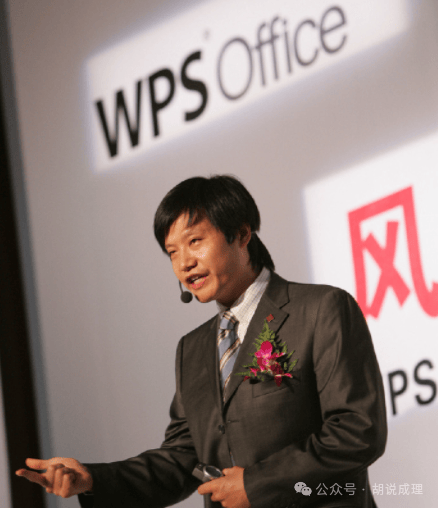
That evening, Lei Jun excitedly called me. I clearly remember him saying on the other end of the line, "Microsoft's features are indeed more comprehensive than ours, but it's like an expensive Mercedes-Benz 600, while our WPS is at most equivalent to a Santana. However, its cost-effectiveness and features are more suitable for our national and social conditions, which is why we won."
On that day, Lei Jun's genuine pride, happiness, and excitement left a lasting impression on me. For those familiar with him, Lei Jun is not someone who easily hides his emotions.
Many people take delight in talking about the sudden emergence of Xiaomi but often overlook Lei Jun's long years at Kingsoft. Even after achieving victory in 2001, the subsequent years were not filled with flowers and applause. Instead, they were a "monk-like" journey of seeking hope amidst despair. The opponent in that war was Microsoft, the most powerful software empire on Earth then and now.
This was not just a commercial competition but also a severely asymmetric war.
In the mid-to-late 1990s, PCs transitioned from DOS to Windows. Microsoft Office, deeply integrated with Windows, surged in popularity and swept across the globe. Meanwhile, Kingsoft's WPS, once synonymous with China's most powerful computer office software, was instantly overwhelmed. That period marked the first "darkest moment" in Lei Jun's career.
Particularly noteworthy was the failure of the "Pangu" component in 1995.
It was a product on which Kingsoft had invested countless resources, attempting to compete head-on with Microsoft Office on the Windows platform. To develop Pangu, Lei Jun and his team engaged in three years of closed-door development, working day and night. However, the market is ruthless. Pangu's positioning was unclear, and it was outdated upon release, resulting in dismal sales and the near-total loss of millions in research and development funds.
How desperate was Lei Jun during that time? According to colleagues at Kingsoft from that period, Lei Jun often felt a suffocating sense of depression. He once confessed to a friend that it was an extremely difficult time for him, feeling as if he were living under Microsoft's enormous shadow. To alleviate the almost overwhelming bitterness, he often went to the seaside alone, shouting loudly at the ocean. It is even said that he took a short leave of absence for several months, yearning to escape.
If Lei Jun were a player of the "finite game," the game would have ended at the moment of Pangu's failure. Admitting defeat or simply starting a new project would have been rational choices to limit losses.
But he did not. The traits of an infinite game player became evident at that moment: he did not value the gains and losses of individual battles; he valued whether the life-and-death game with Microsoft could continue.
He chose the most difficult path: starting over from scratch.
Lei Jun led his team to make an astonishing decision—to completely overhaul WPS's code and rewrite it from scratch. It was akin to self-imposing a handicap and retraining from the beginning.
During those years, I noticed that Lei Jun was as fervent and diligent as a missionary in promoting the acceptance of genuine domestic software.
Every year at the end of the year, Lei Jun would bring several bottles of good wine to the editorial department of Computer World in Chongqing and have meals with several department heads and software editors. Although these were supposed to be casual gatherings, they were more like lectures by Lei Jun. Several times, everyone was already exhausted, but Lei Jun was still enthusiastically talking, talking, and talking.
He mainly talked about two things—first, how excellent Kingsoft's research and development and software were; second, how difficult it was to introduce these software products genuinely into Chinese households at that time.
Later, I learned that Lei Jun spent the end of each year in a similar manner, visiting major domestic computer newspapers and magazines with wine, treating guests to meals, drinking, and discussing the future of WPS and Chinese software. He persuaded and moved many people to support domestic general-purpose software in China.
This endurance lasted for several more years. Even after Kingsoft's difficult listing, with its market value severely underestimated, Lei Jun persisted.
In 2007, Kingsoft finally went public successfully. A physically and mentally exhausted Lei Jun handed over the reins and began contemplating his next venture.
However, WPS could not be separated from Lei Jun, and Kingsoft's performance on the Hong Kong Stock Exchange was concerning. In 2011, when Kingsoft faced the dilemma of transitioning to mobile internet and even the risk of "annihilation," Qiu Bojun and Zhang Xuanlong, his mentors and friends, approached Lei Jun again and told him—only your return can save Kingsoft and WPS; otherwise, Kingsoft would have to be sold.
At that time, Lei Jun had already founded Xiaomi and was extremely busy. However, faced with this heavy responsibility and friendship, he did not shy away. He took on the burden of chairman and resumed control of Kingsoft.
He knew he was not returning as a mascot, so he worked hard—the old version was written in assembly code from the DOS era and was no longer suitable for Windows. Lei Jun led his team to rewrite millions of lines of code from scratch. During this period, Kingsoft's stock price remained below its issue price for a long time, and many investors criticized him, but he remained silent.
In 2011, he went against popular opinion and introduced the free + cloud document strategy. Some board members calculated: we earn several hundred million a year by selling boxed software, and you're making it free? Lei Jun said: Microsoft has already made it free; if we don't, we're doomed. So Kingsoft shifted from selling software to selling services.
From 2014 to 2020, with the rise of SaaS, he began to persist in the subscription model transformation, integrating WPS into every Xiaomi and Redmi phone, setting membership prices to the lowest possible, and ensuring that features were distinct across multiple platforms. Finally, in 2023, WPS reached a turning point: its revenue in the Chinese market surpassed Microsoft Office by a significant margin for the first time. By 2025, WPS had 600 million monthly active users, with subscription revenue ranking first among Chinese SaaS companies. It is one of the few mainstream general-purpose software products in China that is fully independently developed and has traversed the PC era, the internet era, and is now entering the AI era.
This is a 20-year revenge story and an extremely rare global example of defeating Microsoft's core product, Office, in a market with hundreds of millions of users using independently developed software. Moreover, it was not a minor victory but a decisive battle.
Without this long-term effort, the triumph of "submission format must be WPS" would not have been possible.
Can someone who has struggled for 20 years under Microsoft's shadow and pressure be easily defeated by public opinion?
If Kingsoft was Lei Jun's purgatory, then Xiaomi is his nirvana.
Before founding Xiaomi, Lei Jun had already achieved financial freedom. When I visited him, I noticed a small freezer in his office filled with Diet Coke, and he had switched from smoking 0.8 Zhongnanhai cigarettes to 0.1 Zhongnanhai. I teased him, saying, "You've become quite particular," and he blushed, saying, "Can't I slightly improve my quality of life?"
Indeed, Lei Jun is a person with very low material desires, to the point where drinking sugar-free Coke became an "improvement in quality of life."
At the beginning of Xiaomi's founding, Lei Jun still faced a seemingly impossible "deadlock."
At that time, the smartphone market was dominated by Apple and Samsung at the high end, while the mid-to-low end was filled with overpriced and poorly performing "knockoff phones" and some so-called big brands that were not only technologically backward but also excessively priced (such as certain brands from Japan, South Korea, and Taiwan at the time). Domestic phones were roughly equivalent to "low-end" and "poor quality."
Lei Jun once again embarked on an infinite game.
He led a dozen people to do something that no one dared to imagine at the time: selling high-end smartphones for 1999 yuan.
This was seen as a "spoiler" at the time and even hated by peers. However, from the perspective of the infinite game, Lei Jun's move completely changed the rules of the Chinese smartphone industry.
He was not racing against a specific competitor (such as Samsung or HTC) on a limited track; he was redefining the track. Using extreme cost-effectiveness as a weapon, he forcefully brought down those overpriced products that were exploiting consumers.
The rise of Xiaomi objectively accelerated the popularization of mobile internet in China. Thanks to Redmi and Xiaomi, hundreds of millions of ordinary Chinese people could enjoy the benefits of mobile internet at low prices.
Over the past decade, he has also faced numerous challenges: supply chain disruptions, quality issues, patent wars, the rise of Huawei, OPPO, and VIVO, Honor's counterattack, stock price plunges, and constant doom-and-gloom predictions.
Every time, the outside world declared, "Xiaomi is doomed."
Every time, Lei Jun quietly focused on his own work.
But that's not enough. Lei Jun's vision was not limited to the smartphone screen. He saw a farther future—the Internet of Things (IoT).
Thus, the Xiaomi Ecosystem came into being. Through strategic investments and empowerment initiatives, Xiaomi has propelled a vast array of Chinese manufacturing companies forward. Its influence spans from power strips and air purifiers to robot vacuum cleaners and smart lamps. Xiaomi replicated the 'Xiaomi model' across hundreds of industries, engaging in a series of 'survival-of-the-fittest' battles to elevate the overall quality standard of the entire Chinese manufacturing sector.
This is also a quintessential example of an infinite game. A finite game is centered on achieving short-term goals like 'securing the top spot in phone sales this year,' whereas an infinite game is focused on long-term sustainability, such as 'ensuring the prosperity and continuous growth of my ecosystem.'
In this enduring game, Lei Jun also encountered his darkest hours. During 2015 and 2016, Xiaomi grappled with a supply chain crisis, experiencing a decline in sales and being overtaken by Huawei, OPPO, and VIVO. At that juncture, the external world was predicting Xiaomi's downfall, convinced that Lei Jun's 'internet thinking' approach had faltered.
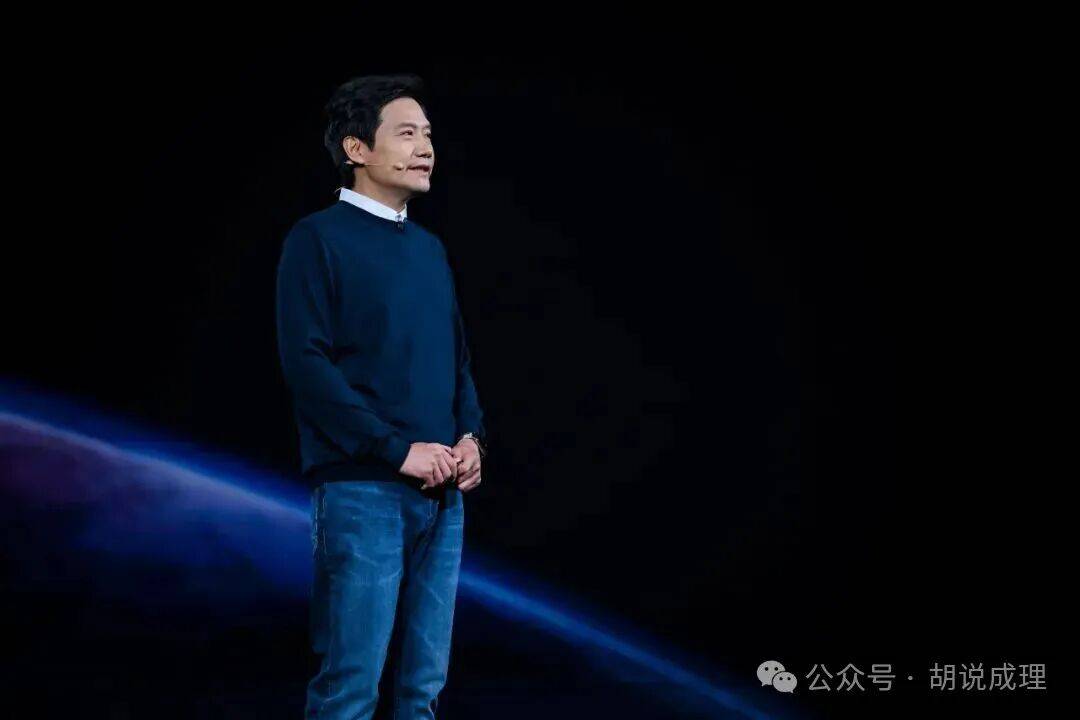
What was Lei Jun's response? He took personal charge of the supply chain, dedicating over ten hours a day to the task and visiting suppliers' factories. Once again, he showcased his ability to 'endure long-term hardships,' gradually steering Xiaomi back from the precipice.
In the annals of business history, Xiaomi stands as a nearly unique case of a phone company rebounding from a precipitous sales decline and achieving counter-trend growth.
Now, let's return to the present.
Confronted with overwhelming public opinion and controversies surrounding Xiaomi Automobile, what is Lei Jun doing?
If you peruse his Weibo and WeChat Moments, observe his public statements and behavior, you'll notice an intriguing 'low-sensitivity' state.
He rarely directly responds to negative comments and seldom exhibits emotional outbursts. The content he shares revolves around work details: the kilometers he ran today to test the car, the number of times he fine-tuned the feel of a button; or Xiaomi's charitable endeavors and societal contributions.
He doesn't respond with grand gestures but silently conveys two messages through these actions:
I'm still diligently working, and the research and development of Xiaomi Automobile are progressing smoothly. I'm continuously striving and won't let down the 500,000 Xiaomi car owners. I haven't acted out of fear.
For an infinite game player, emotions are superfluous distractions.
The outside world perceives Lei Jun as being in a precarious position now and might 'collapse.' But this assessment is based on the mental resilience of ordinary individuals. For someone who has endured 20 years of challenges at Kingsoft and continuously rebounded from various crises at Xiaomi, the current pressure is merely another routine workout.
Participants in 'finite games' often resort to short-term speculative behaviors to alleviate anxiety when faced with pressure. However, Lei Jun demonstrates strategic resolve. He continues to discuss technological investment and long-term goals.
This resolve stems from his profound understanding of the nature of the 'game': it's not a sprint. As long as I remain in the game and keep improving, the outcome remains undetermined.
Why is Lei Jun considered 'unbeatable'?
In 'Antifragile,' Nassim Nicholas Taleb states, 'The wind extinguishes a candle but powers a fire.'
From the survival struggle of WPS to the comeback of Xiaomi, almost every leap Lei Jun has made has been accomplished amidst crises.
For Lei Jun, building cars represents the last major entrepreneurial endeavor of his life. The underlying message of this statement is: I am prepared to dedicate the rest of my life to it. This is a commitment spanning a decade or two, not merely for the sake of making next year's financial report look favorable.
From the perspective of a finite game, if Xiaomi's first car model doesn't become a hit, Lei Jun loses. But from the perspective of an infinite game, the first car model is just the beginning, an entrance ticket. As long as Xiaomi's cars continue to evolve, address issues, and create value for users, the game is far from over.
This pursuit is destined to be a thorny path. But he has been walking it for 33 years, and his feet have grown thick calluses. These current thorns cannot pierce his defenses.
In this fast-paced era, the overabundance of information gives us a false impression that the world is transparent and we know everything.
Because we think 'we know everything,' we are too quick to jump to conclusions. We love to witness the birth of a myth and then eagerly anticipate its downfall—how thrilling!
However, for an entrepreneur like Lei Jun, who has proven his resilience over 33 years, perhaps we should show a bit more patience.
He is playing an infinite game. In this game, as long as he doesn't give up, no one can declare him a failure.
As James P. Carse said, 'Infinite game players do not play for the sake of attaining a position of power; they play to manifest their vitality in the process through various means.'
Over the past 33 years, none of Lei Jun's journeys have been flawless, but each one has made the next journey more stable.
It was Kingsoft before, then smartphones, and now cars. The battlefields have changed, and the opponents have changed, but Lei Jun's long-term perspective remains unwavering. This is a particularly important dimension when observing Lei Jun.
-
![]()
Hardware is the skeleton, AI is the soul, and data integrates the two
-
![]()
China’s AI Industry: A Unified Pivot Towards Monetization?
-
![]()
New Progress! Infineon Completes Acquisition of ams OSRAM's Non-Optical Sensor Business
-
![]()
35 Million Bet on an Optical Future! Tengjing Technology Makes a Move in AR
-
![]()
Why World Models Get Stuck on Construction Roads in Autonomous Driving Applications
-
Alibaba Initiates Cultural Transformation: Is Jack Ma Making a Strategic Comeback?
-
Tianfeng Heads to Hong Kong for IPO with RMB 3.8 Billion in Funds: Xingyu's Cross-Border Foray into Embodied AI Faces Uncertain Future
-
![]()
Mengshi Auto’s High-End Aspirations Dashed: Huawei Partnership Fails to Revive Sales, New Model’s Entry Price Dips Below 300,000 Yuan