Xiaomi's Second-Largest Shareholder, Lin Bin, to Gradually Divest Holdings Worth $2 Billion, Embarking on a New Chapter as a Tech Visionary
 12/29 2025
 565
565
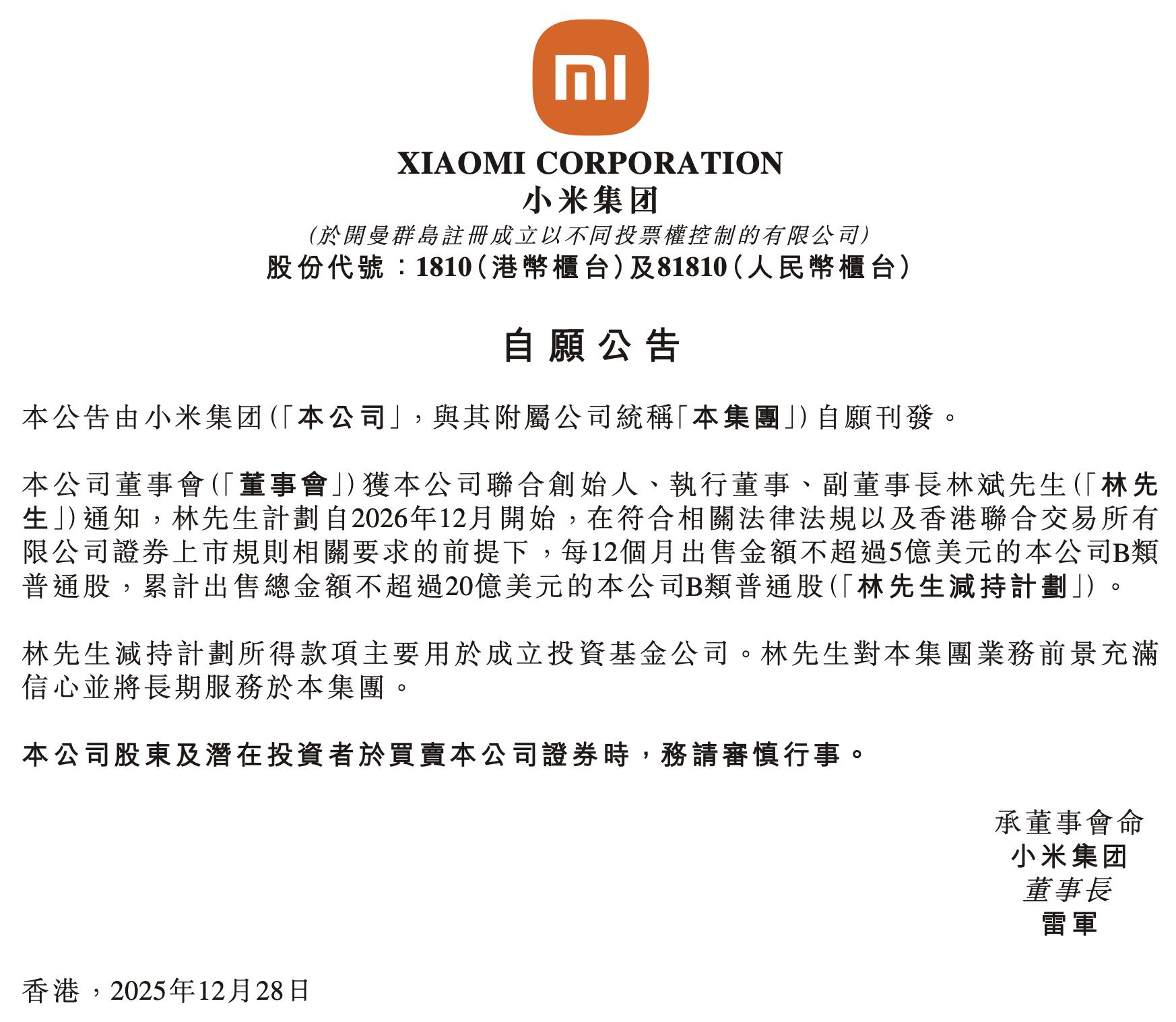
On December 28, 2025, Xiaomi Group made an announcement that caught the market's eye. Co-founder and Vice Chairman Lin Bin revealed plans to sell up to $500 million worth of Class B ordinary shares every 12 months, starting from December 2026, with a cumulative cap of $2 billion. The proceeds from these sales will primarily be channeled into setting up an investment fund company.
Lin Bin remains optimistic about Xiaomi's business outlook and his enduring commitment to the group. Born in 1968, he earned a Bachelor's degree in Radio and Electronic Engineering from Sun Yat-sen University and a Master's degree in Science from Drexel University in the United States. Before joining Xiaomi, he spent 15 years at Microsoft and Google, serving as Engineering Director.
In 2010, when Lei Jun decided to venture into founding Xiaomi, Lin Bin made a bold move. He left his well-paying position at Google to co-found Xiaomi. He initially served as President until 2019 and then transitioned to the role of Vice Chairman.
During Xiaomi's formative years, Lin Bin played a pivotal role. He spearheaded the establishment of the company's operational framework, supply chain management, sales channel development, and overseas market penetration.
As of June 30, 2025, Lin Bin held 2.155 billion ordinary shares of Xiaomi through Apex Star LLC, representing 8.31% of the total share capital. This makes him the second-largest shareholder after Lei Jun.
Based on the latest market valuation, Lin Bin's stake in Xiaomi is worth over $10 billion.
On the 2025 Hurun Global Rich List, Lin Bin secured the 219th position with a fortune of 80 billion yuan.
The share reduction plan unveiled by Lin Bin specifies that he will sell up to $500 million worth of the company's Class B ordinary shares every 12 months, starting from December 2026, with the cumulative total not exceeding $2 billion.
It's important to note that this isn't Lin Bin's first foray into share reduction at Xiaomi. Public records indicate that he has previously cashed out approximately HK$8.5 billion through three separate share reductions.
In August 2019, he offloaded 41.307 million shares, pocketing around HK$370 million. In September 2020, he sold 350 million Class B shares, raising approximately HK$7.997 billion. And in June 2024, he further reduced his holdings by 10 million shares, netting approximately HK$179 million.
From a chronological standpoint, Lin Bin's share reductions have occurred at various stages following Xiaomi's public listing. However, on each occasion, he has publicly reiterated his 'confidence in the company's prospects.'
The distinctive feature of this share reduction plan is its commencement date set for December 2026, a year from now, and its gradual approach of annual and limited-quantity sales. This 'pre-announcement and phased execution' strategy is uncommon in both the A-share and Hong Kong stock markets, underscoring his intent to minimize market disruption.
Sources reveal that Lin Bin aims to establish an investment fund to invest in emerging technologies, sports, and other sectors, marking a new chapter in his career as a tech leader.
From a personal wealth management standpoint, gradually diversifying wealth heavily concentrated in a single company's stock is a prudent financial strategy.
In reality, such a transition isn't unique to the tech industry. What distinguishes Lin Bin is that he hasn't entirely severed ties with Xiaomi. He continues to serve as Vice Chairman and Chairman of the Hong Kong Foundation, maintaining a strong bond with the company.
This 'semi-retired yet engaged' status ensures the stability of Xiaomi's management while opening up new avenues for personal value creation. From an industry perspective, China's tech sector is undergoing a paradigm shift from the 'entrepreneurial era' to the 'investment era.'
Most of the first-generation internet and hardware entrepreneurs are now in their fifties, and their companies have transitioned from a phase of rapid growth to a more stable development stage.
Founders gradually relinquishing management control to focus more on industrial ecosystem development and next-generation technological innovation is both a personal choice and a sign of industry maturation.
-
![]()
Hardware is the skeleton, AI is the soul, and data integrates the two
-
![]()
China’s AI Industry: A Unified Pivot Towards Monetization?
-
![]()
New Progress! Infineon Completes Acquisition of ams OSRAM's Non-Optical Sensor Business
-
![]()
35 Million Bet on an Optical Future! Tengjing Technology Makes a Move in AR
-
![]()
Why World Models Get Stuck on Construction Roads in Autonomous Driving Applications
-
Alibaba Initiates Cultural Transformation: Is Jack Ma Making a Strategic Comeback?
-
Tianfeng Heads to Hong Kong for IPO with RMB 3.8 Billion in Funds: Xingyu's Cross-Border Foray into Embodied AI Faces Uncertain Future
-
![]()
Mengshi Auto’s High-End Aspirations Dashed: Huawei Partnership Fails to Revive Sales, New Model’s Entry Price Dips Below 300,000 Yuan