Diverse Strategies for Home Appliances Converge at CES: Global Manufacturers Embrace Differentiated Competition
 01/05 2026
 667
667
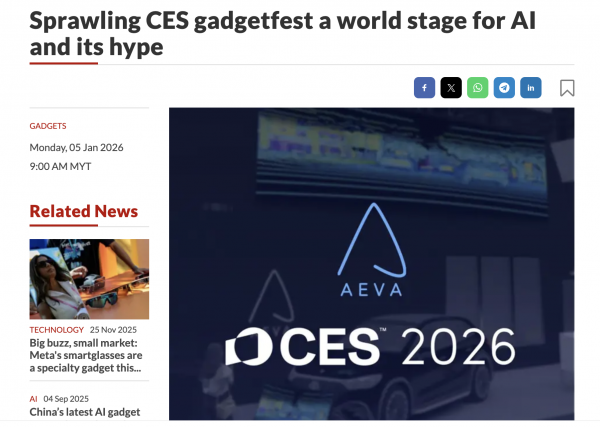
The CES, an annual event held in January in Las Vegas, USA, has long served as a pivotal indicator for the global home appliance and consumer technology sectors. However, CES 2026, scheduled from January 6th to 9th, is experiencing a paradigm shift in its significance.
Judging by the intense pre-event buzz from US media, product teasers from companies, and the exhibition layout, this year's CES transcends being merely a platform for concentrated new product launches. Instead, it has evolved into a concentrated display of technological trajectories, industry divergence, and strategic choices by manufacturers.
Particularly in the smart home and home appliance domains, the fusion of AI and devices is progressing beyond the 'concept demonstration' phase into a replicable, scalable application era. Home appliances are no longer confined to hardware upgrades but are being repositioned as the cornerstone of intelligent living ecosystems.
Based on currently available information, at least four distinct regional strategies can be discerned at CES 2026, reflecting the varied outlooks of Chinese, Korean, Japanese, and European and American firms on the future of smart homes and appliances.
I. Chinese Companies: Transitioning from Product-Centric to Systemic and AI-Driven Collaboration
From the CES official preview and brand updates, it is clear that Chinese firms are intensifying their focus on the smart home and appliance sectors. Shifting away from past emphasis on individual product prowess, Chinese brands are accelerating their transformation towards platformization, systematization, and AI-powered collaborative capabilities, a trend that will be prominently showcased at this year's CES.
It's important to note that this shift is not a fleeting adjustment. Chinese home appliance companies have been exploring smart homes, cross-device collaboration, and AI applications for years, both domestically and internationally, gradually forging verifiable business models.
In the CES exhibition context, Chinese companies are moving away from repeatedly highlighting specifications and hardware performance. Instead, they are more frequently presenting 'scenario-based collaboration,' 'home system interoperability,' and AI-driven holistic solutions. This change essentially amplifies their long-standing strengths: platform-level architectural expertise, cross-category integration experience, and scalable AI application capabilities in real-world home settings.
US media reports in the lead-up to CES also highlight that this year's exhibition will place greater emphasis on 'localized, sustainably operating home systems.' Synergy between devices and on-device AI inference capabilities will be key focal points.
This suggests that the path relying solely on individual product performance is narrowing, while firms with true system integration capabilities are gaining more prominence.
II. Korean Companies: Prioritizing Experience, Expanding into Robotic Living Scenarios
Korean companies have consistently maintained a strong presence at CES, with their strengths traditionally rooted in user experience and design.
According to US tech media outlets like The Verge, LG will unveil its next-generation CLOiD household robots at CES 2026, pushing the boundaries of household automation with more sophisticated mechanical structures and AI perception capabilities. These products aim not to maximize short-term practicality but to enhance the imaginative space of 'smart assistants integrating into daily family life' through specific forms.
Samsung, meanwhile, has confirmed the launch of its next-generation Bespoke AI kitchen appliance lineup at CES, featuring refrigerators, microwaves, and stoves that collaborate with Google Gemini and Google Cloud AI, focusing on image recognition, personalized recommendations, and human-machine interaction experiences. These products do not seek to revolutionize appliance forms but rather emphasize 'intelligence without added complexity' through continuous optimization of usage processes.
From a strategic standpoint, Korean companies are not eager to prove their leadership in underlying technologies. Instead, they focus more on a fundamental question: How will future family life be reorganized? This experience-centric approach makes them highly shareable at the CES venue.
III. Japanese Companies: Pursuing Technology and System Routes with Low Direct Exposure
Compared to Chinese and Korean companies, Japanese brands do not enjoy as prominent direct exposure in the home appliance exhibition area. However, this does not diminish their significance at CES.
Judging by the overall CES structure and US media interpretations of trends, Japanese companies are more inclined to participate through technology platforms, core components, and cross-industry collaborations rather than focusing solely on showcasing high-profile consumer products. This strategy may not offer short-term visibility advantages but remains strategically vital in high-end systems and long-term industrial chain positions.
US industry analysis suggests that CES 2026 will continue to emphasize the 'robots + physical AI' exhibition direction, aligning closely with Japanese companies' traditional strengths in precision manufacturing, system reliability, and engineering stability. The path taken by Japanese manufacturers appears to be an early layout for future scalable systems and cross-scenario applications.
IV. European and American Companies: Leading in Platforms, Standards, and AI Ecosystems
European and American exhibitors, particularly US tech firms, are not solely focused on specific home appliance products at this year's CES.
From Nvidia's keynote speech to the technological roadmaps of AMD and Intel, US media generally view CES 2026 as a crucial showcase for AI strategies. AI is transcending chips and the cloud, further infiltrating home appliances, energy management, and home systems, becoming an integral part of underlying capabilities.
European companies continue to emphasize interoperability and open standards. Protocols like Matter are frequently mentioned in CES discussions, underscoring the importance of cross-brand compatibility and ecosystem collaboration. This standards-oriented approach is not a short-term competitive tactic but lays the groundwork for future large-scale adoption.
US domestic brands, on the other hand, are more inclined to directly link AI with efficiency improvements, transforming technology into tangible value for users through products like smart kitchens and smart refrigerators.
Four Definite Signals from CES 2026
Based on media and corporate information, CES 2026 has sent at least four clear signals:
First, AI is transitioning from algorithm demonstrations to embedded, physical applications, with home appliances serving as key carriers;
Second, smart homes are shifting from a product-centric approach to a holistic living system, with isolated products gradually being phased out;
Third, standardization and interoperability capabilities will become long-term competitive thresholds;
Fourth, home service robots are beginning to transition from concepts to real-world applications.
The varied focuses of Chinese, Korean, Japanese, and European and American companies at CES 2026 are not merely about technological superiority but are natural outcomes of their respective industrial foundations, market cultures, and user expectations.
It is foreseeable that in the coming years, the competitive focus of the home appliance industry will shift from 'whose product is stronger' to who can truly integrate into and reshape family lifestyles.
And this is precisely the most compelling value of CES 2026, worthy of repeated interpretation.
-
![]()
Hardware is the skeleton, AI is the soul, and data integrates the two
-
![]()
China’s AI Industry: A Unified Pivot Towards Monetization?
-
![]()
New Progress! Infineon Completes Acquisition of ams OSRAM's Non-Optical Sensor Business
-
![]()
35 Million Bet on an Optical Future! Tengjing Technology Makes a Move in AR
-
![]()
Why World Models Get Stuck on Construction Roads in Autonomous Driving Applications
-
Alibaba Initiates Cultural Transformation: Is Jack Ma Making a Strategic Comeback?
-
Tianfeng Heads to Hong Kong for IPO with RMB 3.8 Billion in Funds: Xingyu's Cross-Border Foray into Embodied AI Faces Uncertain Future
-
![]()
Mengshi Auto’s High-End Aspirations Dashed: Huawei Partnership Fails to Revive Sales, New Model’s Entry Price Dips Below 300,000 Yuan