Chinese TV Giants Overtake Korean Rivals: Samsung Struggles to Hold Ground
 01/15 2026
 723
723
By: Hou Yu Editor: Sun Congying
During the 2026 New Year holiday,
Using executive survival practices as a lens, the series dissects the development logic of the home appliance industry under pressures like vanishing profits, technological disruption, and capital reshuffling. It uncovers the core drivers of corporate growth and personal career advancement, offering actionable insights and forward-looking guidance for industry and manufacturing leaders.
The first installment (details: 2025 Home Appliance Executives Survival Guide: Who’s Exposed? Who’s Breaking Through? Who’s Inheriting? Who’s Defending? (Part 1)) and the second installment (details: Inheritors: Midea Group’s "Blueprint" for Mass-Producing Executives Sparks Industry Attention) focused on individual leaders. The final installment examines the survival strategies of Chinese and Korean display firms during CES 2026, shifting from personal narratives to broader industry trends.
As the dust settles on CES 2025, a seismic shift has occurred in the global consumer electronics arena. The throne of display technology has changed hands.
A decade ago, Chinese giants like Hisense and TCL had scaled-up CES booths, but their TVs remained trapped within technical frameworks set by Samsung and LG. Despite bearing "Chinese Brand" labels, core components like panels and backlights were controlled by Korean titans, reducing Chinese firms to mere shadows of Korean technological leadership.
Today, the tables have turned. Hisense and TCL have unleashed their Mini LED arsenal, overtaking Korean OLED/QD-OLED technologies. This not only rewrites the high-end TV competition but also marks the official transfer of global TV industry influence to China.
China’s Twin Giants Synchronize Strategies, Mini LED Steals the Spotlight
Despite fierce rivalry for the global TV market’s second spot, Hisense and TCL aligned strategies at their North American pre-CES 2025 launches.
Both unveiled cutting-edge Mini LED products and technologies, using innovation to overshadow OLED and redefine TV evolution.
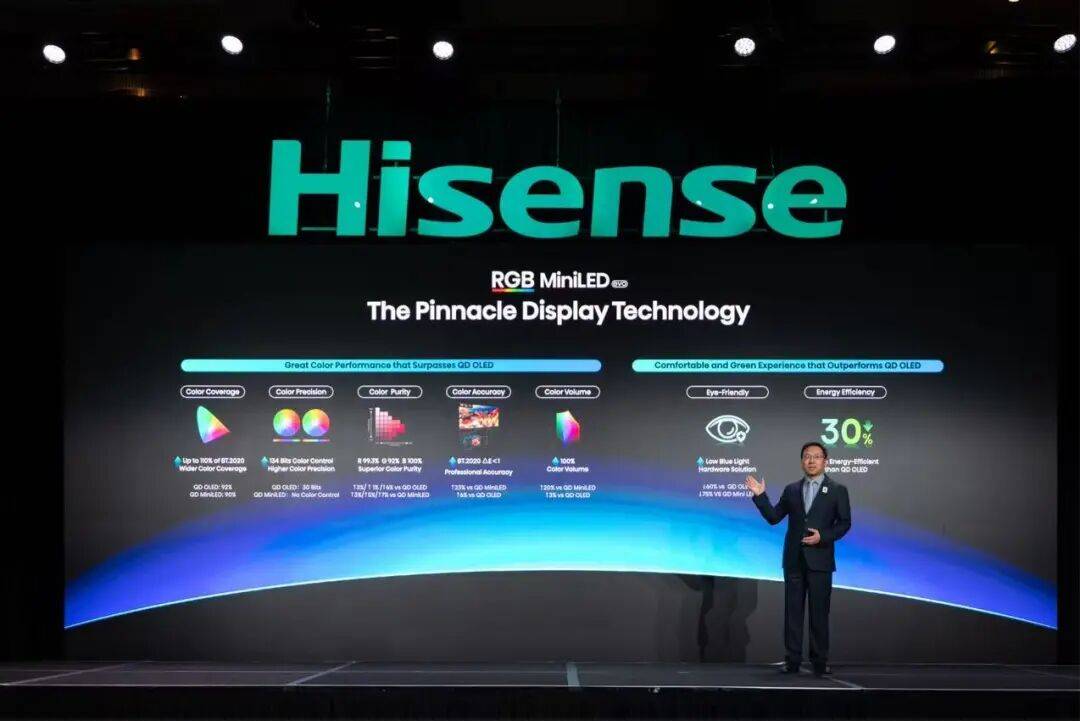
● Hisense: RGB-Mini LED Sets New Benchmarks
Hisense unveiled RGB 3D Color Control Technology and its next-gen Xinxin AI Picture Chip on January 6 (U.S. time), launching the world’s first 116-inch RGB-Mini LED TV (116 UX). By using independent red, green, and blue LEDs for direct emission—eliminating quantum dot filters—the TV achieves 97% BT.2020 color gamut coverage, surpassing QD-OLED and earning Pantone certification. (Extended reading: Hisense Vision’s H1 Report: Big Screens and RGB Synergy Drive High-Quality Growth, Second Growth Curve Emerges)
Addressing OLED’s mid-brightness color weakness and traditional QD-Mini LED’s high-brightness “bleaching,” Hisense’s self-developed Xinxin AI Picture Chip H7 achieves 3×26-bit color precision, resolving millions of trillion color variations while reducing harmful blue light by 38%—balancing picture quality and health.
By late 2025, Hisense had filed 179 RGB-Mini LED patents. Nine of every 10 RGB-Mini LED TVs sold globally were Hisense models, cementing its industry leadership.
● TCL: SQD-Mini LED Redefines “Picture Quality Ceiling”
TCL hosted a global launch, unveiling its second-gen QD-Mini LED TV X11K with 14,112 local dimming zones and 6,500-nit peak brightness—a record. It also showcased the 115-inch QM891G.
Powered by “Super Quantum Dot” (SQD) and fourth-gen “Spotlight Micro-Lens” technologies, the TV achieves purer RGB backlighting via high-concentration quantum crystals, boosting light control precision by 46.9% and dynamic contrast to 10 million:1. Color gamut coverage reaches 157% (BT.709).
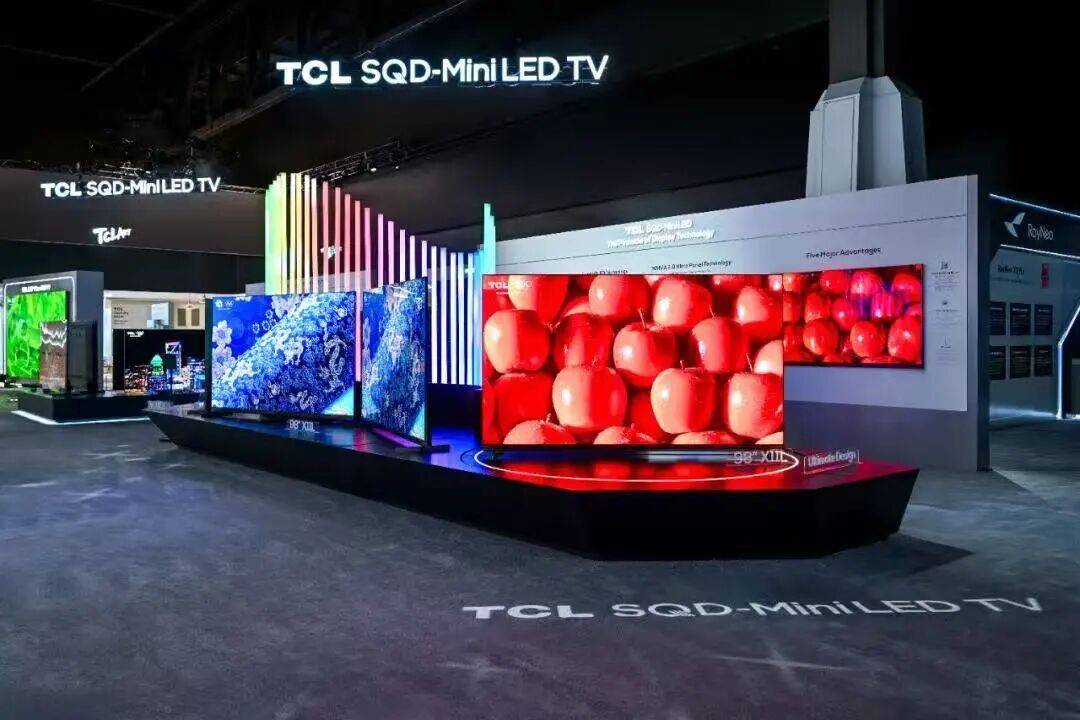
TCL compared its product directly to OLED, concluding that SQD-Mini LED matches OLED’s performance without burn-in risks. Leveraging CSOT’s panel dominance, TCL slashed ultra-HD Mini LED TV prices below $1,500 and 98-inch giant screens below $4,500, democratizing premium technology.
While their technical approaches differ, Hisense and TCL will continue competing. Yet compared to Samsung’s QD-OLED (low brightness, short lifespan) and LG’s transparent OLED (high cost, organic material decay), Chinese Mini LED products offer distinct advantages:
1. Brightness: Peak brightness hits 10,000 nits, far exceeding Korean rivals’ 3,500–4,000-nit limits, ensuring sharper high-brightness details.
2. Color: Full high-color-gamut coverage (Hisense: 97% BT.2020; TCL: 157% BT.709) resolves Korean firms’ high-brightness gamut compression issues.
3. Practicality: No OLED burn-in risks, with cost control via supply chain synergy, aligning with global consumer needs.
Market performance validates product strength. Omdia’s 2025 global data shows Chinese brands dominating the 85-inch+ segment, with Mini LED TV shipments surpassing 9 million units—exceeding OLED’s 6.68 million and confirming China’s technological victory.
Behind the Overtaking: Korean Struggles vs. Chinese Focus
China’s rise is no accident. LGD’s OLED bet revealed inherent flaws, while Samsung’s dual-track strategy faltered, creating openings for Chinese firms to disrupt the status quo.
Post-LCD era, display competition shifted to new frontiers. Korean giants once dictated technical directions.
● OLED’s Decline: LGD’s Strategic Quagmire
LGD dominated large-size OLEDs before 2020, monopolizing upstream markets. However, 2022 marked a turning point: global large-size OLED panel shipments dropped 8.4% year-on-year due to the pandemic. (Details: OLED TVs Vanish in 2022?)
In fall 2024, LGD shuttered its China marketing office, symbolizing OLED’s retreat in the market.
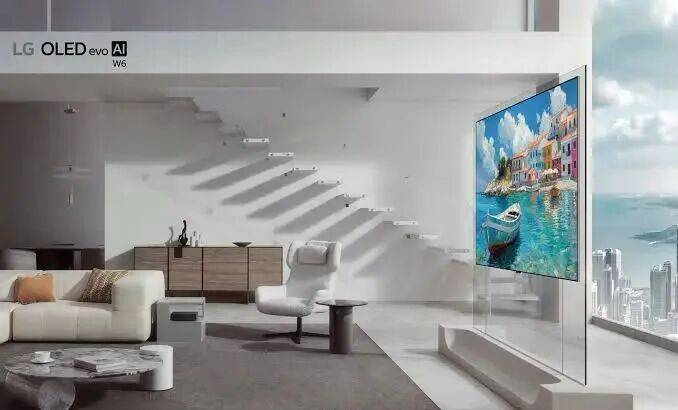
By mid-2025, LG’s OLED TV business turned unprofitable. Its transparent OLED, while visually striking, faced organic material decay risks and high production costs, limiting market acceptance.
● Samsung’s Dilemma: Dual-Track Strategy Backfires
Samsung, the 15-year LCD leader, pursued a “both QD and OLED” approach. In 2023, it entered the OLED arena, integrating quantum dot strengths into OLED products to hedge against industry shifts.
At AWE 2023, Samsung launched OLED TVs with Neural Quantum Dot Processors. (Details: Can Samsung Revive OLED TVs?)
Yet this “win-both” strategy diluted focus. In contrast, TCL and Hisense avoided Korean tech distractions, refining Mini LED and fusing quantum dots with Mini LED backlights.
Chinese firms built R&D, patent, and supply chain barriers. Their Mini LED strategy outperformed OLED and surpassed Samsung in quantum dot applications.
TCL invested over ¥60 billion in R&D (2019–2024), amassing 3,274 quantum dot patents by late 2025—ranking second globally.
Hisense established a “Chip-Backlight-Terminal” ecosystem, filing 179 RGB-Mini LED patents by late 2025, with 90% of global RGB-Mini LED TV sales.
Academician Ouyang Zhongcan of the Chinese Academy of Sciences declared at the 2025 China Display Conference that “Hisense’s ULED X surpasses OLED in picture quality,” signaling OLED’s waning technical edge.
Samsung’s Counterattack: Litigation and Smear Campaigns
Strategic Volatility and Patent Wars: Korean Giants’ Desperate Moves
Chinese firms’ integration of Mini LED and quantum dots dismantled Korean leadership. TCL’s SQD-Mini LED, for instance, elevated color, precision, and stability, addressing traditional quantum dot and RGB-Mini LED pain points.
China’s growing dominance rattled Korean rivals.
Samsung Electronics, a consumer tech titan in phones, TVs, and memory chips, has a history of precise competitive strikes.
In 2025, it targeted Hisense and TCL.
On February 25, 2025, U.S. consumer Robert Macioce sued Hisense USA in New York’s Southern District Court, alleging false advertising and fraud in QD5, QD6, QD65, and U7N QLED TVs. He claimed these models lacked advertised QLED tech or contained minimal quantum dots, demanding $5 million in damages.
By late October 2025, evidence submission began. Hisense USA’s lawyers filed a motion to seal “confidential technical information,” arguing public disclosure could unfairly advantage competitors. The judge compromised: sealed full evidence (A) with a redacted public version.
Given limited U.S. consumer tech expertise, the lawsuit’s timing and precision suggested corporate influence. The U.S. is Samsung’s largest market.
In September, South Korean media ETNews published “QD TVs Lack QD? TCL TVs Spark Controversy,” alleging HanSong Chemical’s SGS and Intertek tests found no indium (In) or cadmium (Cd)—key QLED quantum dot components—in TCL’s C775, C655, and C655 Pro TVs.
TCL responded that quantum dot film content varies by supplier but confirmed cadmium presence, citing SGS reports showing 4mg/kg cadmium—industry compliant.
In October, Samsung filed a complaint in Australia, accusing TCL’s C655 and C745 QLED TVs of “false and misleading claims” about QLED tech. After an independent industry tribunal review, Australia ruled in TCL’s favor, noting no legal standard for “quantum dot tech” and that “QLED” merely signals “better picture quality” to consumers. Samsung expressed disappointment but maintained its stance.
Next came the precision strike in marketing approaches. In late October 2025, Samsung released a video advertisement on its official YouTube channel, depicting the inner conflict of a salesperson dressed as a clown who was selling fake QLED TVs, repeatedly asking, “Where is the real QLED?”
Samsung explained that it hoped to introduce Samsung QLED TVs to consumers in a more interesting way and help them identify genuine QLED TVs. However, seasoned industry insiders were well aware that this was a veiled jab at Hisense and TCL, implying that their QLED TVs were not “real QLED.” To strengthen its position, Samsung's new QLED TVs also received the “Real Quantum Dot Display” certification from Germany's TÜV Rheinland, attempting to set an industry benchmark.
This all-out war against China's top two color TV brands was comprehensive. Samsung's series of moves were essentially an attempt to disrupt the overseas expansion pace of Chinese companies through patent disputes and public opinion campaigns. Data from 2024 showed that Samsung TV's global market share dropped from 30.1% to 28.3%, with the gap between its share and those of TCL and Hisense continuing to narrow. In the first half of 2025, Samsung's shipments remained flat year-on-year, while TCL and Hisense achieved against the trend growth (counter-trend growth) of 12.5% and 7.3%, respectively. Facing technological competition setbacks, lawsuits and public opinion battles became Samsung's desperate measures to maintain its market share.
Notably, Chinese companies have developed mature response capabilities: TCL Huaxing, together with BOE and other companies, initiated patent invalidity challenges, mitigating risks through technological cooperation and cross-licensing of patents. Hisense, on the other hand, protected its R&D achievements by sealing its core technologies, rendering Samsung's patent blockade ineffective.
Industry Transformation: The Arrival of a Chinese-Led Era, Korean Incumbents Struggle Against the Trend
The rise of Hisense and TCL marks the official entry of the global color TV industry into a new era of “Chinese leadership.” Samsung and LG's efforts to maintain their positions are unlikely to reverse the inevitable trends of technological iteration and market competition.
According to data from authoritative institutions like Omdia, Samsung Electronics has been the world's top color TV (television) shipper for 19 consecutive years from 2006 to 2024. In 2024, its global TV sales share reached 28.3%, with a shipment share of 17.6%, maintaining significant advantages in the high-end, large-screen, and ultra-high-end markets. However, in the first half of 2025, global TV shipments reached approximately 92.5 million units, up slightly by 2% year-on-year. Among the top five manufacturers, TCL, Hisense, and Xiaomi were the only brands to achieve positive growth, while Samsung remained flat and LG saw a 1.1% decline. Chinese brands are further seizing market share from Korean brands.
In the core Mini LED segment, Chinese brands dominate absolutely: In 2025, TCL led the global Mini LED TV shipments with a 28.8% market share, while Hisense grew by over 76%. The combined share of Chinese brands far exceeded that of Korean brands. In the high-end TV market (above $1,000), Mini LED accounted for 45%, far surpassing OLED's market share.
More significantly, Chinese technology began defining industry standards: Hisense's RGB-Mini LED technology has been followed by Japanese and Korean brands like Samsung and Sony, while TCL's SQD-Mini LED technology, through a “technology demotion” strategy, brought high-end configurations to the mid-range market, driving Mini LED to become the industry mainstream. By 2026, the RGB-Mini LED brand camp (brand lineup) will further expand, with LG also planning to enter the field, underscoring the industry's recognition of China's technological approach.
Facing these transformations, Samsung and LG adopted a “avoid strong points, attack weak points” defensive strategy: In 2022, Samsung announced it would abandon the LCD display business to focus on OLED and QD (quantum dot) technology, attempting to consolidate its high-end market advantages. However, this move nearly ceded the mid-to-low-end market to Chinese brands, leading to an imbalance in competitiveness.
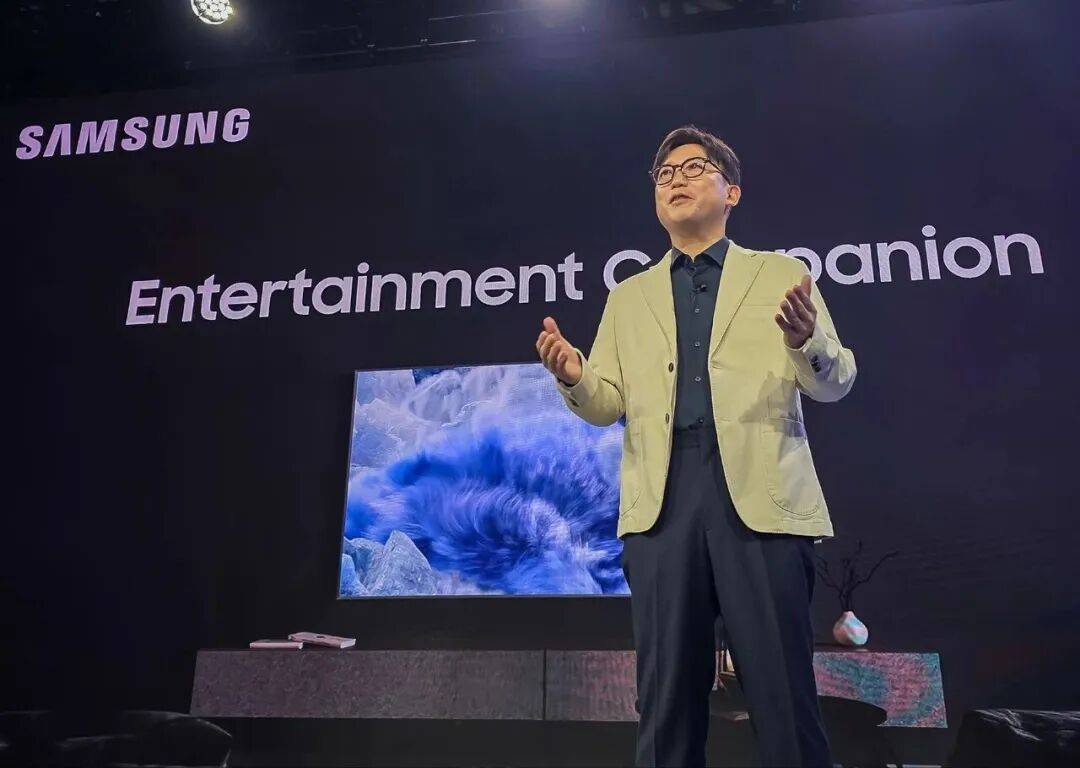
Before the 2026 CES show, Samsung showcased a 130-inch Micro RGB LED giant screen (model R95H) and the new QD-OLED S95H series, emphasizing the promotion of AI Engine Pro and the SmartThings ecosystem to enhance compatibility with home environments. LG, as mentioned earlier, launched the Micro RGB evo series TVs, its first RGB-Mini LED flagship, filling the ultra-high-end LCD market gap.
To address technological shortcomings, Samsung announced in June 2025 its collaboration with Hansol Chemical to develop new QD optical films, seeking to break long-term dependence on the Japanese supply chain and reduce costs. However, this “inward-focused” strategy stands in stark contrast to the full industrial chain layout (layout) of Chinese brands.
In reality, the century-long evolution of the display industry has already proven that there are no eternal technological kings, only innovators who adapt to trends. From Sony and Panasonic in the CRT era to Samsung and LG in the LCD era, and now to Hisense and TCL in the Mini LED era.
The transfer of technological influence has always been accompanied by a hard-power contest of “independent R&D + industrial chain synergy.” The 2025 color TV industry has demonstrated that independent core technology and industrial chain collaboration are the foundations for enterprise survival. Chinese brands are leveraging Mini LED as a pivot to propel the global color TV industry into a new era of “Chinese-defined standards and Chinese-led pattern (landscape).”
-
![]()
Hardware is the skeleton, AI is the soul, and data integrates the two
-
![]()
China’s AI Industry: A Unified Pivot Towards Monetization?
-
![]()
New Progress! Infineon Completes Acquisition of ams OSRAM's Non-Optical Sensor Business
-
![]()
35 Million Bet on an Optical Future! Tengjing Technology Makes a Move in AR
-
![]()
Why World Models Get Stuck on Construction Roads in Autonomous Driving Applications
-
Alibaba Initiates Cultural Transformation: Is Jack Ma Making a Strategic Comeback?
-
Tianfeng Heads to Hong Kong for IPO with RMB 3.8 Billion in Funds: Xingyu's Cross-Border Foray into Embodied AI Faces Uncertain Future
-
![]()
Mengshi Auto’s High-End Aspirations Dashed: Huawei Partnership Fails to Revive Sales, New Model’s Entry Price Dips Below 300,000 Yuan