Stepping Out of Future Narratives: A Pivotal Year for Apple's Immersive Video and VR Cinema | Annual Feature
 02/05 2026
 585
585
After over a decade of technological advancements and artistic exploration, the immersive video ecosystem has gradually taken shape.
Text by VR Gyroscope / Wan Dou
For years, VR technology has been hailed as the future of the film industry—a new chapter in cinematic language following 3D and IMAX, offering audiences an experience more immersive than traditional filmmaking. From an industry perspective, discussions about VR cinema inevitably resurface with each technological leap.
Traditional films and anime have also ventured into imaginative depictions of VR and brain-computer interface technologies. Works like Ready Player One, Avatar, and Sword Art Online showcase worlds centered around immersive technology.
Hollywood director James Cameron believes that (Meta Quest) headsets can deliver cinematic-quality 3D experiences: “I think this will herald a new era. Since we perceive the world in 3D, our brains are naturally attuned to this format.” He estimates that stereoscopic 3D content enhances immersion by about 20% and predicts that all content, including news broadcasts, will eventually adopt 3D formats.
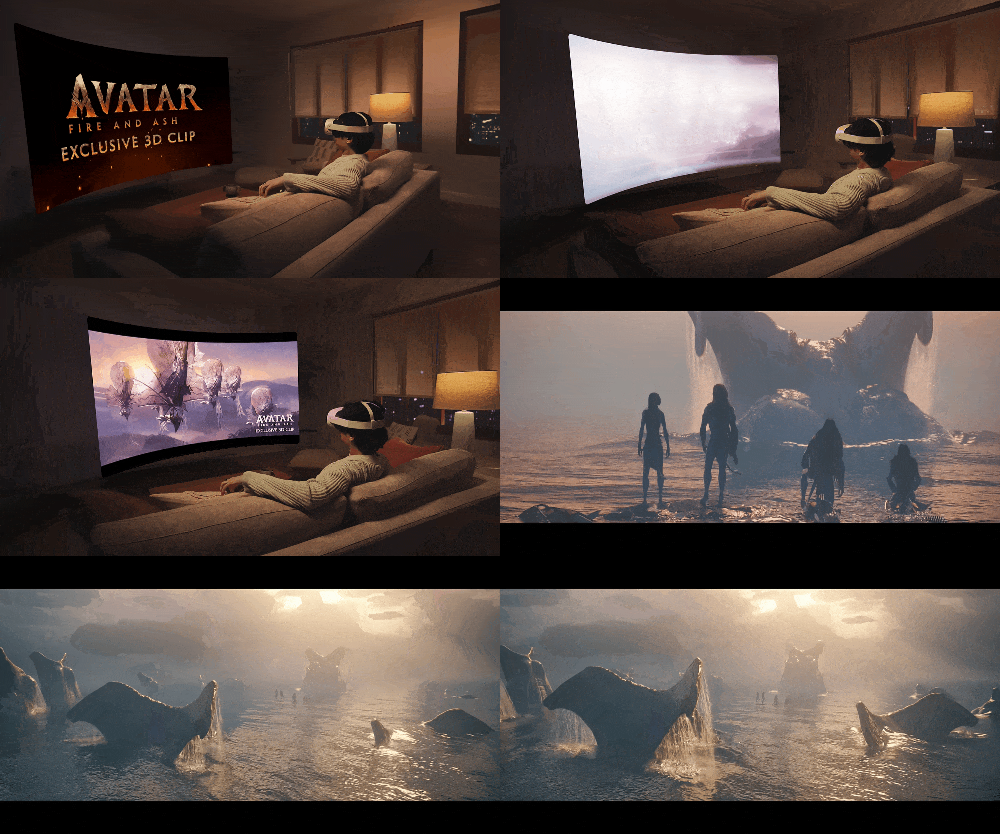
Exclusive 3D trailer for Avatar 3: Fire and Ash (Image source: Meta)
Over the past decade, VR cinema has evolved from high anticipation to gradual cooling, only to be reignited by industry giants. It is now progressing toward an industrialized film system, reaching a pivotal moment in 2025 with simultaneous transformations in content formats, production systems, and offline venues.
01 Virtual Reality Cinema and Large-Scale Spaces: The Most Viable Commercial Model for VR
The domestic film industry is entering a new era of imaging technology fused with innovation, exemplified by broad definitions of VR cinema (seated and walking experiences; 180°/360° stereoscopic imagery), VR large-scale spaces, and “virtual reality films” that have passed National Film Bureau reviews and received dragon-seal certification. These are not entirely synonymous with traditional VR imagery; a significant portion of content is created and exhibited primarily through VR large-scale spaces.
2025 marks the 120th anniversary of Chinese cinema. From film to digital, 2D to 3D IMAX, and now XR immersive filmmaking, technological advancements continue to redefine storytelling and viewing experiences. VR/MR technologies shift cinema from “watching stories” to “stepping into stories,” creating a stark contrast with traditional film experiences.
This trend has also impacted offline cinemas. In recent years, theater spaces have been repurposed, with idle areas leased to third parties offering social experiences, film merchandise retail, dining, or experiential services. Meanwhile, cinemas face significant challenges as internet-driven shifts alter audience consumption habits: the rise of convenient streaming content, competition from short videos, and diverse gaming and interactive entertainment forms are reshaping the conditions under which audiences choose to “go to the movies.”
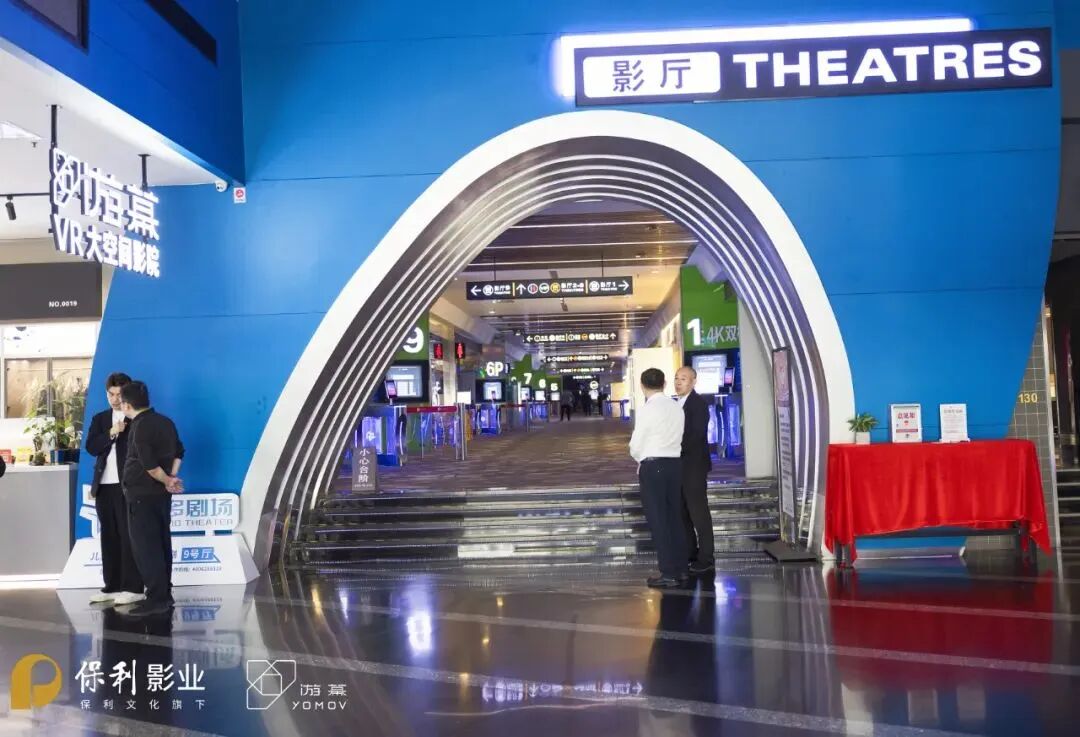
Cinemas and VR large-scale spaces are now expanding nationwide, bolstered by bold collaborative innovations among enterprises and clearer policy pathways from the National Film Bureau in 2025. To date, 126 virtual reality films have received dragon-seal certification, establishing XR content as a formal distribution channel outside traditional cinema systems—and signaling the beginning of standardized regulation, production, and exhibition. In 2025, China’s first pilot space for virtual reality film screenings debuted in Beijing’s 798 Art Zone.
Advancements in hardware iteration, engine capabilities, and interaction technologies have transitioned immersive content from experimental art forms to mass-cultural products. VR cinema has evolved from early 360° panoramic content to today’s walking experiences emphasizing spatial awareness and participation, particularly aligning with the rapid adoption of VR/MR all-in-one headsets in recent years.
Seated experiences have also evolved. Under its Xiyi Boundless brand, Xiyi Group innovatively introduced a full-stack solution for “seated” virtual reality standard cinemas—the Xiyi Boundless·SIE Virtual Reality Cinema Seat—redefining immersive viewing modes while exploring new business models.
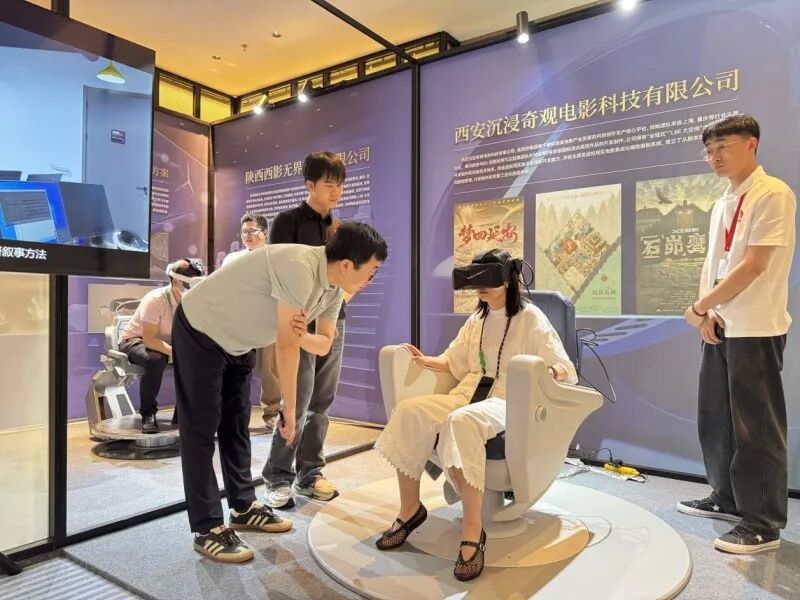
Xiyi Boundless·SIE Virtual Reality Cinema Seat
The artistic forms and expressive capabilities of XR content have also gained recognition at domestic film festivals. Events like the Beijing International Film Festival’s “Boundless ∞ Immersive Unit,” the Shanghai International Film Festival’s Future Cinema section, and the Golden Rooster and Hundred Flowers Film Festival’s Virtual Reality Cinema Season showcase new interactive content formats. Additionally, 2025 saw offline events such as the Golden Dream Morpho Honor Ceremony & Virtual Reality Cinema Technology and Industry Exchange and the 2025 Sandbox Immersive Exhibition (SIF 2025), which gathered high-quality immersive experiences from around the world to explore XR entertainment trends across film, media, and culture.

Image source: 27th Shanghai International Film Festival
Upgrades to offline immersive experience spaces have expanded domestic consumption scenarios for immersive entertainment. Small theme parks and cultural-entertainment complexes are proliferating, particularly with phenomenal successes like The Vanished Pharaoh drawing nationwide attention and proving that high-quality XR narrative content can appeal to mainstream audiences (as of now, The Vanished Pharaoh has welcomed over 500,000 visitors nationwide).
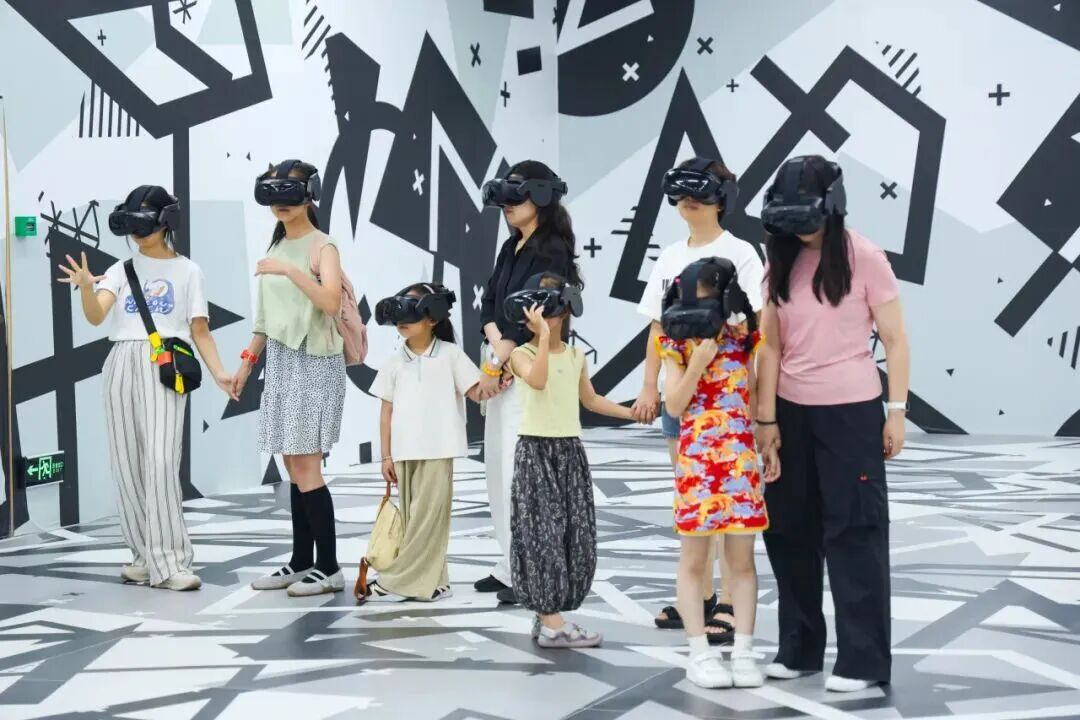
Image source: Boxin Metaverse
Location-based VR experiences are inherently sensitive to physical space. Design teams must align specific venue conditions—walls, columns, boundaries, and supervision zones—with the spatial structure of the virtual world. Even artistic design must revolve around these immovable real-world elements.
If the constructed world is compelling enough, interactivity and narrative can be gradually layered on top. Social interaction among users is also crucial; while interactions may not alter the story’s trajectory, they strengthen spatial presence. Even strangers naturally converse, laugh, and high-five during experiences—a direction yet to be fully explored.
As more content teams, cultural tourism groups, and headset manufacturers enter this field, VR large-scale spaces are transitioning from pop-up exhibitions or one-time experiences to sustainable business models. For details, read: Over 200 New Projects in 2026: Where Is XR Large-Scale Space Headed? | Annual Feature
With maturing technologies, domestic policies, and offline venues, the true challenge for immersive XR content now returns to creation itself: How should stories be told? How are scripts written? How are scene and sound transitions handled? How do directors and cameramen remain hidden? How are 180°/360° scenes edited? These questions linger from a decade ago when VR technology first entered the film industry.
02 Early VR Cinema: Exploring Narrative Art Through VR Perspectives
While refining answers to these questions, creators did not attempt to overthrow traditional filmmaking’s established language, narrative, and production systems. Instead, they began with documentaries and real-world imagery, gradually exploring VR’s unique value in “presence” and “subjective perspectives.”
International film festivals serve as crucial incubators for VR cinema. Events like the Venice International Film Festival, Tribeca Film Festival, and Cannes Film Festival often feature VR works in experimental sections or immersive screenings, providing creators with technical support, exhibition spaces, and early audiences.
In 2016, dubbed the “first year of VR,” filmmaker and artist Lynette Wallworth released Collisions, a 15-minute VR film narrating the story of Nyari Nyari Morgan, an Aboriginal man in remote Australian deserts witnessing his first encounter with Western technology—an atomic bomb test explosion. Collisions won an Emmy Award in 2017, becoming a landmark in early VR cinema.

Behind-the-scenes footage of Collisions shot with 360° cameras (Image source: YouTube)
Limited by technology and hardware at the time, Wallworth summarized three key filming rules: “First, no camera movement. Second, no longer than 10 minutes. Third, the brain cannot process transitions between scenes, so use fades.” She also noted that VR technology could one day enable cinematic narratives that show the world through others’ eyes. The creative environment then differed significantly from traditional filmmaking, forcing creators to re-explore film language.
Judging by the themes of 2025’s international film festival selections, overseas VR cinema still prioritizes immersing audiences in others’ perspectives over scalable commercial content. Like Collisions, many VR works gaining international festival attention revolve around real-world issues such as family dynamics, social realities, cultural identity, and technological ethics.
The dominance of documentaries and real-world imagery in VR cinema is no coincidence. VR’s standout strength lies in “presence”—transporting audiences into authentic spaces rather than merely observing constructed 3D worlds.
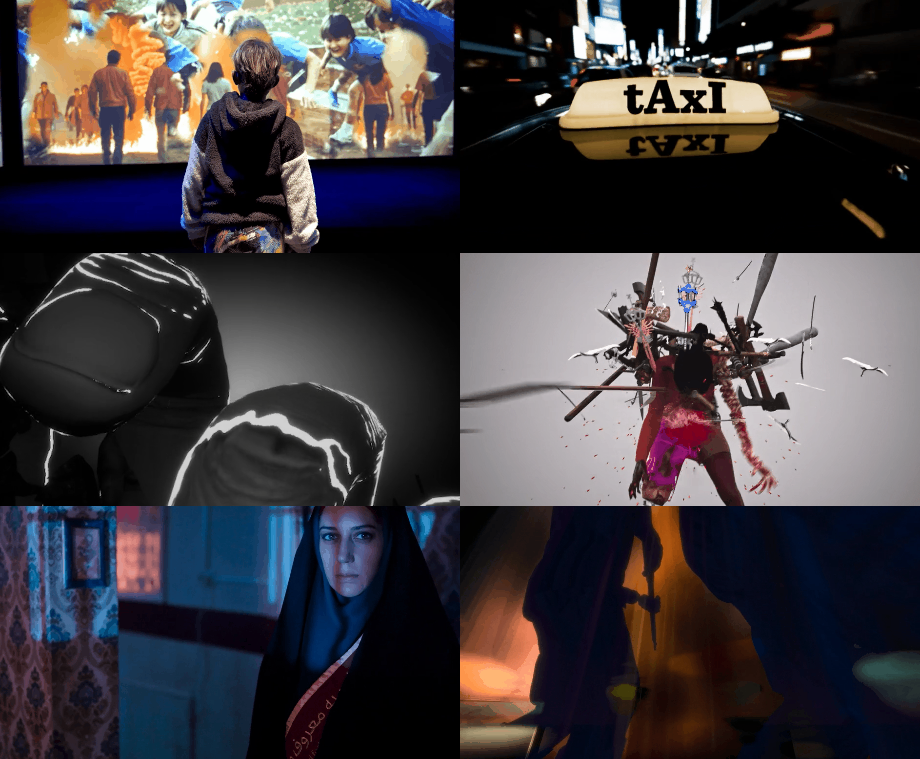
Image source: 2025 Cannes Film Festival
However, this creative direction has long confined VR cinema and immersive content to the realm of “artistic exploration that raises questions and reveals hidden truths.” The issue lies not in subject matter or creativity but in VR cinema’s persistent lack of a replicable, scalable production workflow. From shooting norms and editing language to distribution and viewing methods, nearly every aspect required redefinition. Early VR technology struggled to integrate into mature film industries.
Only in recent years have immersive imaging production systems closer to existing film industry logic begun to emerge.
03 Apple’s Immersive Video: “Lessons Learned”
Unlike VR large-scale spaces requiring walking experiences, immersive video combines VR cinema’s immersion with traditional filmmaking’s emotional resonance—akin to bringing a “new cinema” into users’ homes, with vast potential for future exploration.
While earlier VR cinema focused on creative expression and self-discovery, immersive video over the past year has addressed a more fundamental question: How should content be produced, delivered, and reused? With the Vision Pro’s release, Apple is intensifying investments to consolidate fragmented immersive imaging experiences into a new production workflow.
Two years after the Vision Pro’s launch, VR Gyroscope’s incomplete statistics as of February 3, 2026, count 40 Apple Immersive Videos on Apple TV, including announced but unreleased titles. Thirteen immersive videos debuted in 2025.
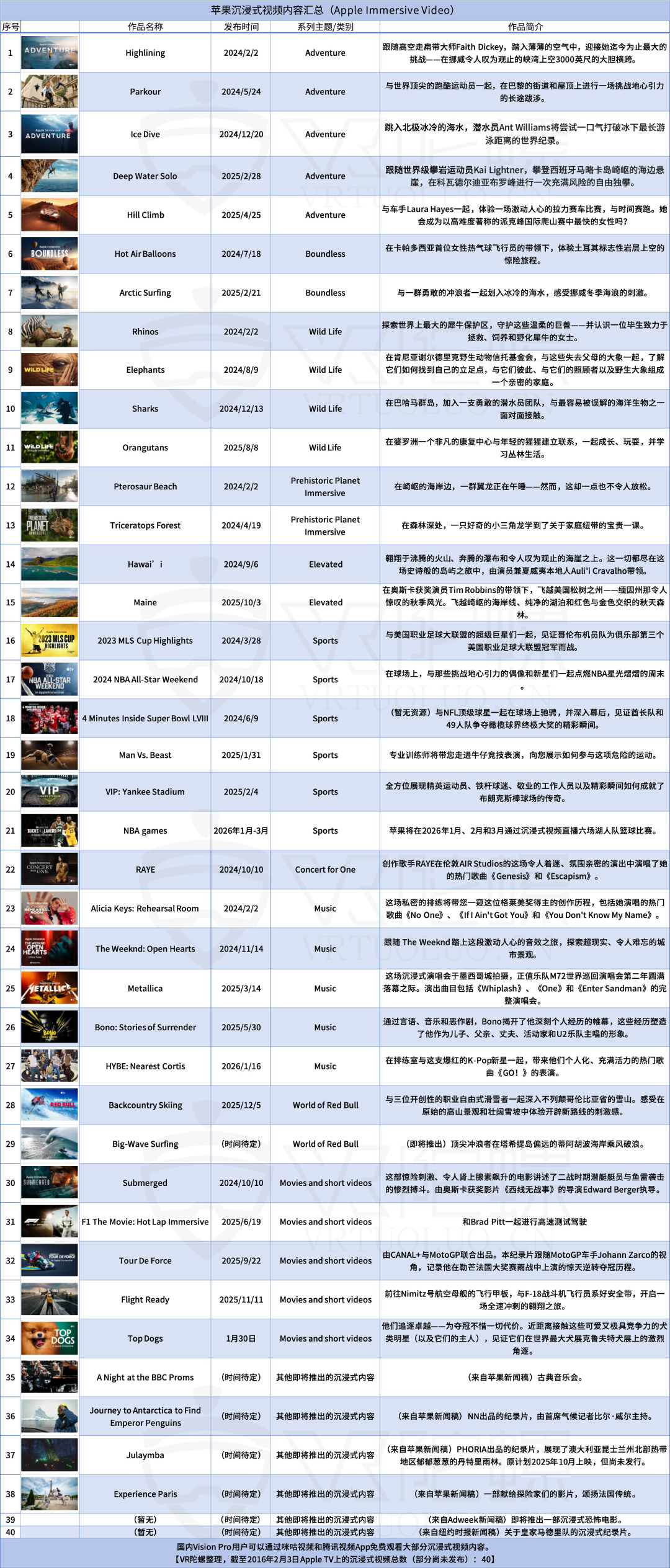
Apple Immersive Video content roundup (Image source: VR Gyroscope)
From the Vision Pro’s inception, Apple positioned immersive video as a core content format: announcing content partnerships with Disney, introducing 3D spatial film content from multiple IPs, launching new video file formats, playback standards, and distribution platforms.
Ecologically, iPhones support spatial video shooting for Vision Pro viewing. Apple collaborated with Blackmagic Design to develop immersive video production equipment and updated editing systems. A relative content production chain—from shooting, production, and post-production to distribution and viewing—has begun to emerge.

Anton Tammi, film director (Image source: Apple)
During pre-production for The Weeknd’s immersive MV Open Hearts, director Anton Tammi emphasized the importance of virtual previsualization. Unlike traditional films relying on storyboards, tools like Blender and Unreal Engine allow creators to build complete CG pre-visualization scenes in advance, providing clear references for final immersive shooting.
At the same time, because immersive cameras simulate the way human eyes see, their sensitivity to details in the image is much higher than that of traditional lenses, and any unrealistic set details will be magnified. This forces producers to invest more resources in practical set construction, prop details, and lighting design, and also reduces reliance on post-production visual effects to a certain extent, as any elements within the 180° field of view that do not belong to the set need to be fully processed or removed.

Image Source: Apple
During the planning process, Apple Creative Director France Costrel summarized a series of practical experiences: for example, it is most comfortable to keep the camera about six feet away from the subject, and if closer, it should be no less than four feet; the camera height is usually set between 50 and 60 inches, roughly corresponding to the height of an adult's collarbone. Unlike traditional films that rely on lens switching and focal length changes to guide the narrative, immersive imagery relies more on moving the camera position itself to shape the viewer's experience.
During the editing phase, immersive video essentially compels creators to revisit and redefine their understanding of the term "editing." Tim Amick, Apple's Supervisor for Immersive Video Post-Production, highlighted that, unlike traditional films where viewers can take in the entire scene at once, immersive video grants viewers significant freedom in deciding where to direct their gaze. As a result, creators must meticulously manage the density of information to prevent cognitive overload. Simultaneously, they need to factor in viewer comfort and narrative pacing when guiding attention.
He further elaborated that, in practice, "black field transitions" have emerged as a widely adopted and effective strategy. In the context of immersive video, these transitions function akin to a blink, facilitating spatial shifts and guiding viewers' eyes back to the center of the frame. To a certain extent, these experiences do not entirely overturn traditional film language; instead, they reposition familiar cinematic techniques within an immersive context, prompting a reevaluation of how viewers engage with content in real-time.
From pre-production rehearsals and spatial layout planning to establishing unified standards for filming, post-production editing, and viewing experiences, these efforts enable a wider range of creators to adopt and expand upon immersive video.
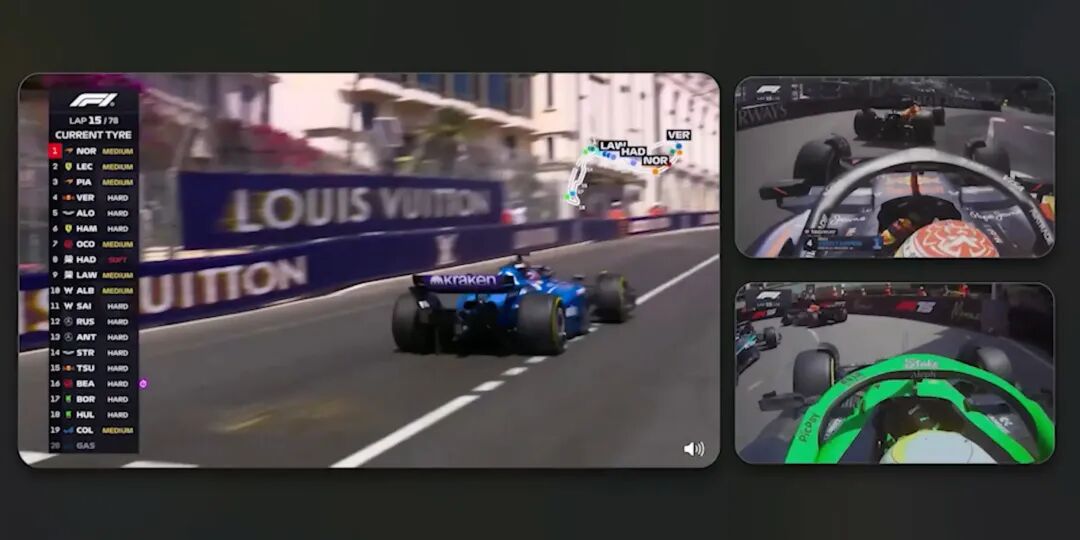
Image Source: Apple
As the immersive video production system matures, its potential for real-time content delivery is becoming increasingly evident. "Immersive live streaming" is poised to become the most compelling content format. Recent developments indicate that Apple is integrating technologies like multi-angle live streaming and spatial visual experiences into event broadcasts within its ecosystem. For instance, it has offered immersive live viewing experiences for the 2026 Formula 1 (F1) races and NBA basketball games, paving the way for new avenues in immersive content development.
For immersive content, the true challenge remains in how it is viewed, operated, and integrated into real-world settings.
Closing Thoughts
Reflecting on 2025, VR large-space projects have witnessed explosive growth across China, with nearly simultaneous launches in first- and second-tier cities as well as key cultural and tourism hubs. Immersive content has started to gain more frequent public attention, with immersive video and VR films demonstrating varying degrees of maturity and diversity across different scenarios.
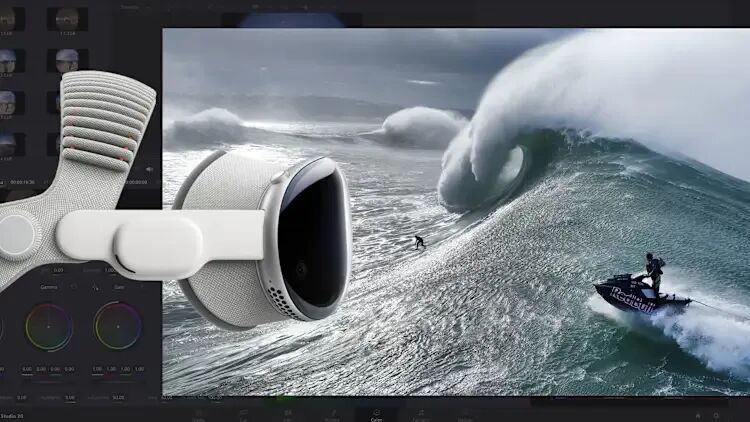
Concurrently, immersive video and immersive live streaming have entered an exploratory phase and shown steady development this year.
However, the current consumer market size for Vision Pro remains relatively small, making it challenging to achieve reasonable returns on investment for the time being. Even renowned creators face difficulties in recouping production costs. Unlike Meta's VR content ecosystem strategy, which provides funding or grants to developers, Apple opts to purchase the rights to high-quality works. Apple also encourages independent studios to maximize profits through cross-platform distribution, although the proprietary nature of Apple's immersive video restricts its compatibility with other devices.
The current business model for Apple's immersive video appears more geared towards creating assets for future high-quality service offerings, such as licensing, offline location-based entertainment (LBE) or theme park activities, and B2B enterprise applications. Apple's continuously updated immersive video content can enhance brand perception, ensure sustained product development, and anticipate a growing user base, ultimately reaching a viable consumer market size.
Overall, while VR large-space projects, VR films, and immersive video exhibit slightly different development trajectories, they collectively underscore the vibrancy of the immersive content ecosystem in 2025. The lingering issues from a decade ago, when VR technology was first introduced into video content creation, have not vanished. However, they are no longer confined to theoretical discussions—their solutions demand repeated validation across online and offline platforms, new devices, and major platforms.
-
![]()
Hardware is the skeleton, AI is the soul, and data integrates the two
-
![]()
China’s AI Industry: A Unified Pivot Towards Monetization?
-
![]()
New Progress! Infineon Completes Acquisition of ams OSRAM's Non-Optical Sensor Business
-
![]()
35 Million Bet on an Optical Future! Tengjing Technology Makes a Move in AR
-
![]()
Why World Models Get Stuck on Construction Roads in Autonomous Driving Applications
-
Alibaba Initiates Cultural Transformation: Is Jack Ma Making a Strategic Comeback?
-
Tianfeng Heads to Hong Kong for IPO with RMB 3.8 Billion in Funds: Xingyu's Cross-Border Foray into Embodied AI Faces Uncertain Future
-
![]()
Mengshi Auto’s High-End Aspirations Dashed: Huawei Partnership Fails to Revive Sales, New Model’s Entry Price Dips Below 300,000 Yuan