Will QianWen’s Potential Acquisition Revive the 'Dormant' Meizu Smartphone Brand?
 03/02 2026
 533
533
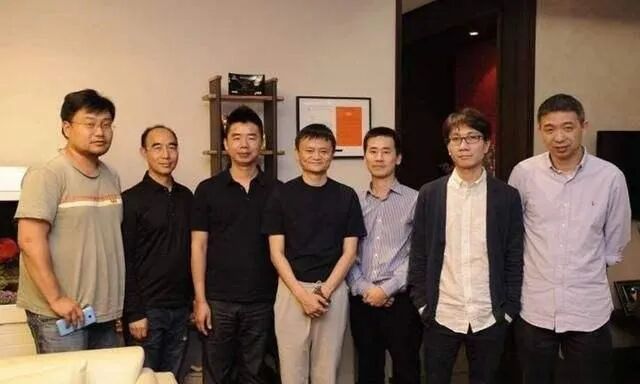
Could Alibaba Step In to Rescue Meizu Smartphones Once Again?
In recent years, Meizu has faced significant challenges, including sell-offs, restructuring, transformations, leadership changes, and attempts to innovate its product lineup. Despite these efforts, the company's market performance has remained lackluster, with stagnant sales, shrinking distribution channels and business scale, and substantial financial losses.
At Meizu's 22nd product launch event in September 2025, StarV Meizu Group CMO Wan Zhiqiang candidly remarked, "The difficulties we are encountering now surpass those of the past 22 years combined." Simultaneously, newly appointed CEO Huang Zhipan emphasized the importance of perseverance, stating, "Only by staying in the game can we discuss the future."
Meizu Temporarily Halts Smartphone Production
The reality of the market has set in. Months later, rumors began circulating about Meizu's potential delisting. Despite the lack of an official rebuttal, concerns about the 23-year-old company's future continued to mount.
On February 27, Meizu became a trending topic on Weibo's hot searches before issuing a formal and emotionally charged "Strategic Transformation Announcement." The company firmly denied rumors of "bankruptcy restructuring" and "business shutdown," passionately asserting, "As long as there are Meizu fans, Meizu will endure." This announcement set the stage for a pivotal decision: Meizu will temporarily halt the development of new domestic smartphone hardware.
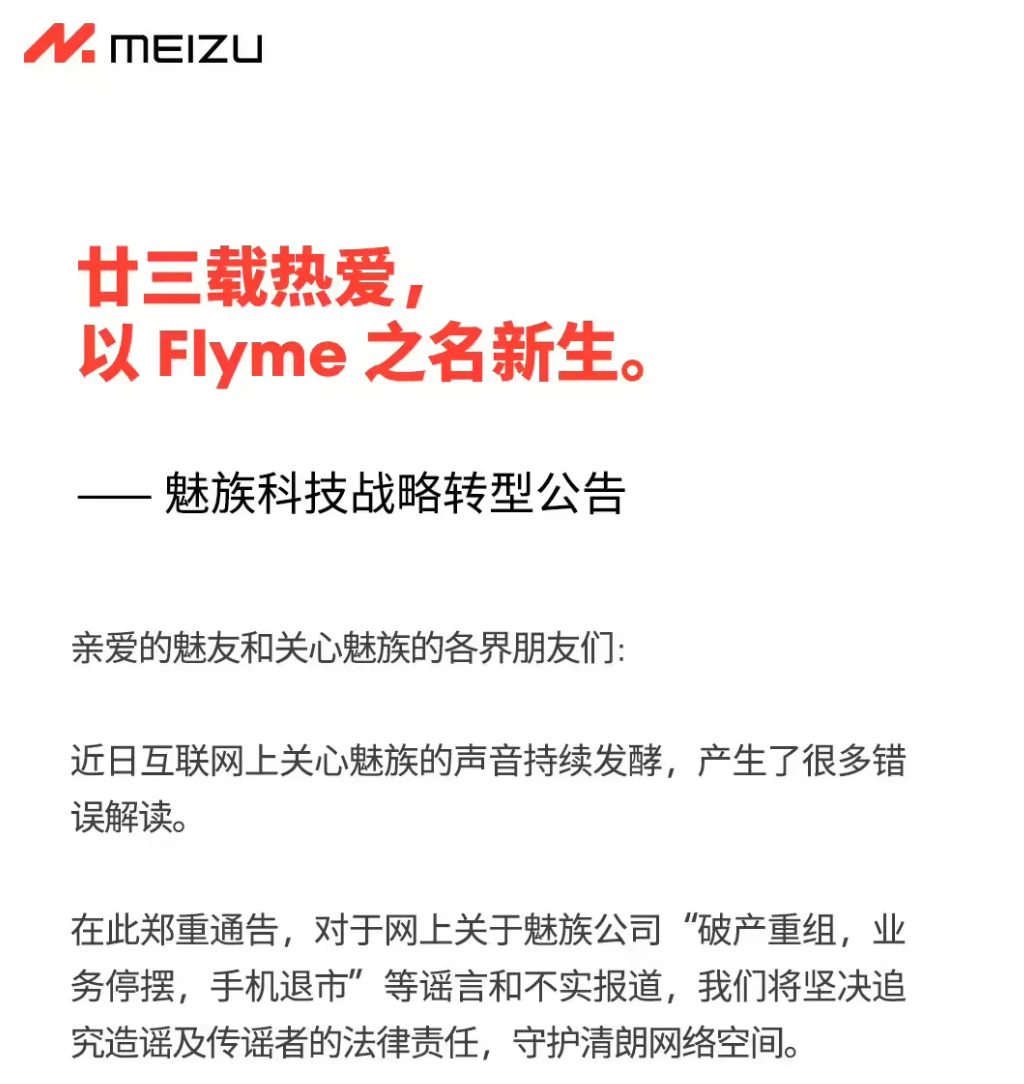 Figure | Screenshot of Meizu's announcement
In essence, the Meizu brand will persist, avoiding delisting, but Meizu smartphones will exit the market, entering a "dormant" phase with no clear timeline for their return. For now, Meizu will shift its focus from hardware to software, advancing the Flyme ecosystem while expanding its overseas operations in response to market demands.
Meizu has not entirely abandoned self-rescue efforts but has effectively entered the "intensive care unit." Returning to the competitive landscape will not be easy. The transformation announcement explicitly cited two primary reasons for its struggles: intensified market competition and soaring memory prices.
These factors accurately reflect the survival challenges faced by mid-sized smartphone brands. In a market solidified by the Matthew effect, even minor supply chain fluctuations can devastate "other" players operating on thin margins or selling at a loss.
When the return on investment in hardware R&D collapses, retreating from "asset-heavy manufacturing" to "asset-light operations"—preserving the brand and core asset Flyme—while integrating as a "Powered by" component within Geely's product ecosystem and other AI terminals may represent Meizu's most dignified strategic choice.
Over its 23-year history, Meizu has stood out as a "maverick" among Chinese smartphone brands, rivaling Huawei, OPPO, and Vivo in prestige but lacking the financial success of Xiaomi. Its journey has been a rollercoaster, repeatedly saved by "benefactors."
Alibaba's involvement has been particularly notable: In February 2015, Alibaba Group announced a $590 million investment in Meizu—its largest post-IPO investment and Meizu's first strategic investor. Prior to this, Huang Zhang's tight control had led to Meizu being labeled a "family business."
Alibaba's capital injection boosted Meizu's marketing and R&D confidence, propelling the company to its peak. In 2016, Meizu held over a dozen launch events, releasing new models monthly—a strategy mocked as "concerts every month." Backed by the Mblu sub-brand, a "machine sea" tactics approach, and channel expansion, Meizu's annual sales once reached 20 million units.
Former Meizu Senior Vice President Li Nan, the architect of Mblu, later stated that deeper integration with Alibaba was the only way to secure a "final ticket" to sustained success: "Without Alibaba, our 20 million annual sales lacked dominance."
As part of the deal, Meizu ceded control over Flyme (its Android-based OS) to deploy Alibaba's self-developed YunOS.
Officially, the collaboration meant Alibaba would support Meizu in e-commerce, internet services, mobile systems, data analysis, and payments. In return, Meizu would aid Alibaba in promoting its smartphone system, customizing hardware and user experiences, formulating market strategies, and expanding offline channels.
Alibaba's intent was clear: leverage Meizu's hardware to break Android's monopoly and build its mobile ecosystem.
Wang Jian, then Alibaba's CTO, stated, "This investment will significantly expand Alibaba's ecosystem and marks a crucial step in our mobile internet strategy."
The partnership initially benefited both parties but ultimately faltered due to blockades led by industry giants and impenetrable ecosystem barriers.
History has shown that without paradigm-shifting core technology or application-driven scenarios, relying solely on hardware sales and "binding" hardware partners—an asset-heavy model—faces insurmountable breakthrough challenges and weak risk resistance. Once hardware carriers stumble, the entire ecological vision crumbles like a castle in the air, unable to establish real competitive moats.
Will QianWen Acquire Meizu Smartphones?
A decade later, Alibaba and Meizu find themselves at a familiar crossroads: Meizu stands at another pivotal moment, while QianWen emerges from the digital realm to deploy AI devices, seizing new entry points in the AI landscape.
Over the past month, QianWen has strengthened its "AI-powered lifestyle" positioning through product iterations, Alibaba ecosystem integration, and marketing campaigns like the "Spring Festival Hospitality Plan."
Its latest strategic move targets AI hardware, with plans to release AI glasses, earphones, and rings in 2026. Alibaba aims to position QianWen as an AI assistant that seamlessly integrates software and hardware across multiple terminals.
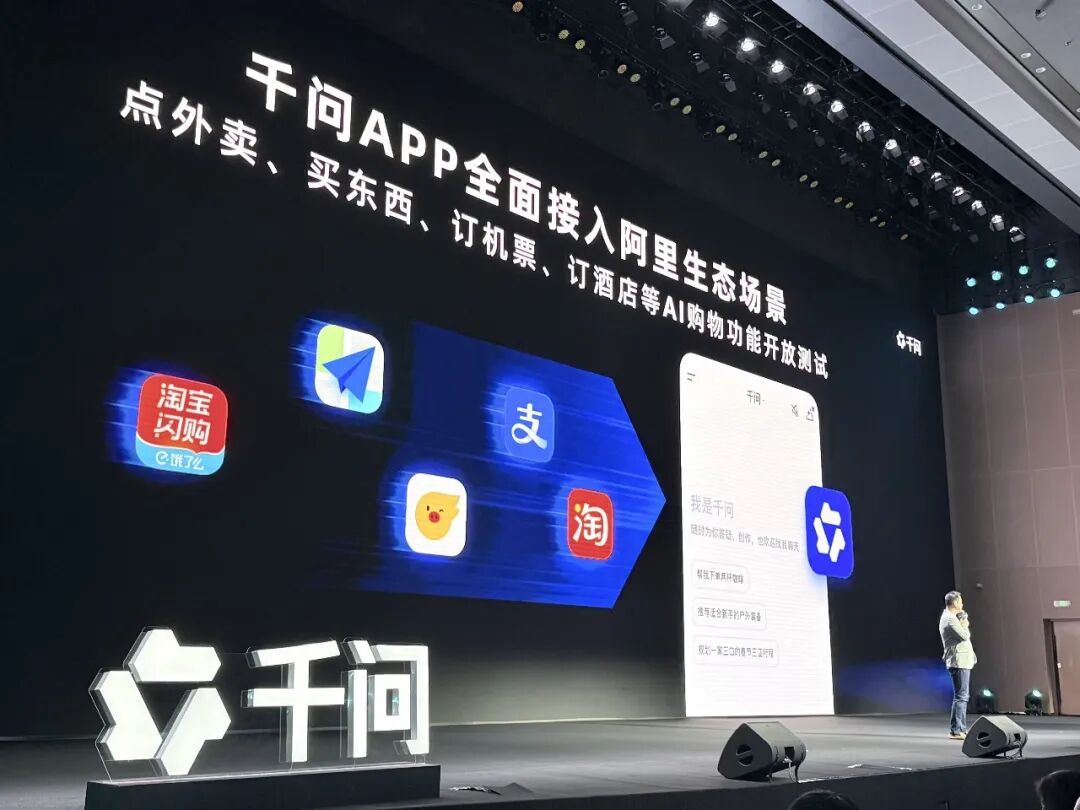 Figure | QianWen App launch event (Photo by Tang Chen)
Could Alibaba and Meizu reunite? More bluntly: Will QianWen acquire Meizu smartphones?
My answer: It's possible, but unnecessary. QianWen's current path fundamentally differs from Alibaba's YunOS era—its core logic has evolved.
AI has entered the Agent era, shifting from ChatBot competitions to Agent capabilities (i.e., task execution). The biggest bottleneck? Lacking direct hardware access, leaving AI largely as "cloud-based customer service."
Doubao AI phones went viral precisely because they achieved a "perception-decision-execution" closed loop under limited system permissions.
If QianWen can bridge this "last mile," giving AI a "physical presence," it realizes Wu Yongming's vision: AI's greatest potential lies not in screens but in governing the digital world.
This means QianWen doesn't need to "own a hardware factory" or a phone brand. It needs terminals that mobilize cameras, sensors, local computing power, and execute complex tasks—soft-hard integrated gateways for AI Agents and scenarios where AI truly reaches users and solves problems.
Unlike the YunOS era, Alibaba holds unique advantages in AI hardware. On critical infrastructure, Alibaba's "TongYunGe" positions it as a comprehensive player.
Moreover, QianWen differentiates itself from other AI giants. ByteDance excels in content and information distribution—Doubao and its apps leverage ByteDance's ecosystem for information access and content consumption. QianWen's strength lies in life services and task execution: backed by Alibaba's ecosystem, it orders food, shops, books flights—truly binding AI to daily life.
Compared to Google's AI hardware strategy, QianWen aims to "ground" AI. Google's hardware serves its ecosystem, reinforcing information distribution. QianWen seeks what ByteDance couldn't achieve: transforming AI from an "information provider" to a practical problem-solving assistant.
This reflects AI's new "soft-hard integration" paradigm. AI entry points are no longer singular smartphones (though still optimal). With AI glasses, rings, and earphones maturing, entry points fragment and contextualize.
QianWen's AI hardware strategy blends "brand convergence" and "AI capability spillover": launching QianWen-branded AI hardware while embedding QianWen's AI into diverse terminals for ubiquitous smart services.
This explains why Alibaba no longer needs to acquire Meizu.
Today, Alibaba builds competitive moats not through acquisitions but through open collaboration—seeking "last mile" AI entry points to weave a comprehensive AI ecosystem.
This asset-light, experience-heavy, service-oriented path may define future AI hardware strategies for major industry players.
Meizu's strategic pivot isn't merely a result of mismanagement but a rational damage control measure under market laws—a microcosm of smartphones entering a phase of "stock competition" and the eve of the AI revolution.
References:
21st Century Business Herald, 'Meizu Smartphones Hit the Brakes: The "Specialist" Faces Its Fourth Crossroads'
-
![]()
Hardware is the skeleton, AI is the soul, and data integrates the two
-
![]()
China’s AI Industry: A Unified Pivot Towards Monetization?
-
![]()
New Progress! Infineon Completes Acquisition of ams OSRAM's Non-Optical Sensor Business
-
![]()
35 Million Bet on an Optical Future! Tengjing Technology Makes a Move in AR
-
![]()
Why World Models Get Stuck on Construction Roads in Autonomous Driving Applications
-
Alibaba Initiates Cultural Transformation: Is Jack Ma Making a Strategic Comeback?
-
Tianfeng Heads to Hong Kong for IPO with RMB 3.8 Billion in Funds: Xingyu's Cross-Border Foray into Embodied AI Faces Uncertain Future
-
![]()
Mengshi Auto’s High-End Aspirations Dashed: Huawei Partnership Fails to Revive Sales, New Model’s Entry Price Dips Below 300,000 Yuan