MWC 2026|AMD: Full-Stack AI Solutions Target Commercial AI PCs
 03/03 2026
 604
604
Produced by Zhineng Zhixin
MWC 2026 seemed to be overshadowed by US-Iran tensions, but in reality, many companies focused on 6G and AI had to strategize amid rising memory costs to tell growth stories.
AMD continues to promote its core strategy of "full-stack AI solutions" under the theme "The IQ Era" ("Intelligence Quotient Era"), prioritizing the enterprise AI PC market.
◎ For the first time, the RDNA 3.5 GPU architecture and XDNA 2 NPU are integrated into the AM5 desktop platform, filling the gap in desktop AI computing power.
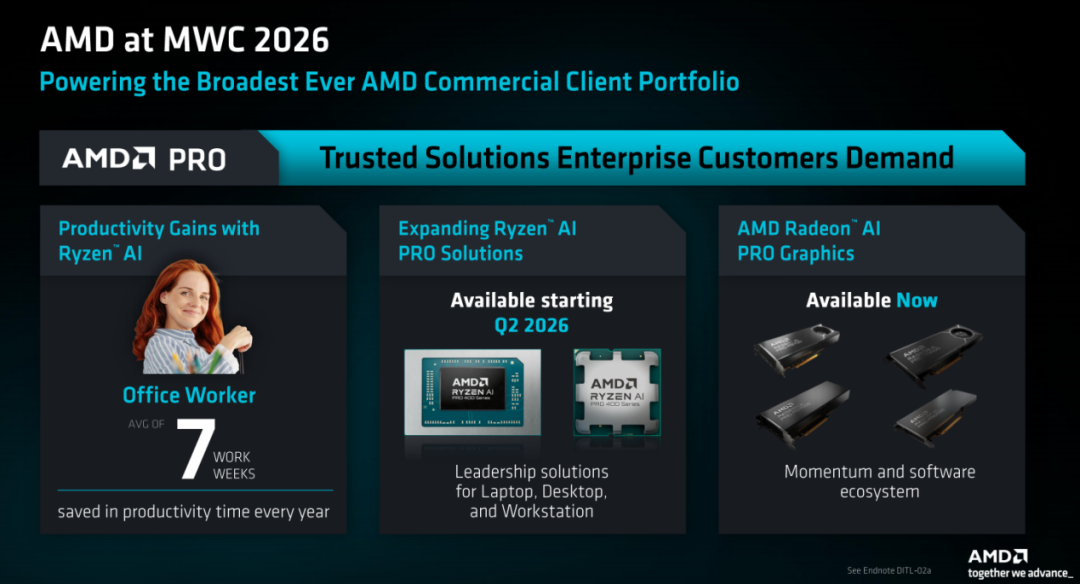
◎ The Ryzen AI PRO 400 series covers both mobile and desktop commercial scenarios, building a unified enterprise IT ecosystem.
◎ Radeon AI PRO compute cards offer a cost-effective solution for local LLM deployment.
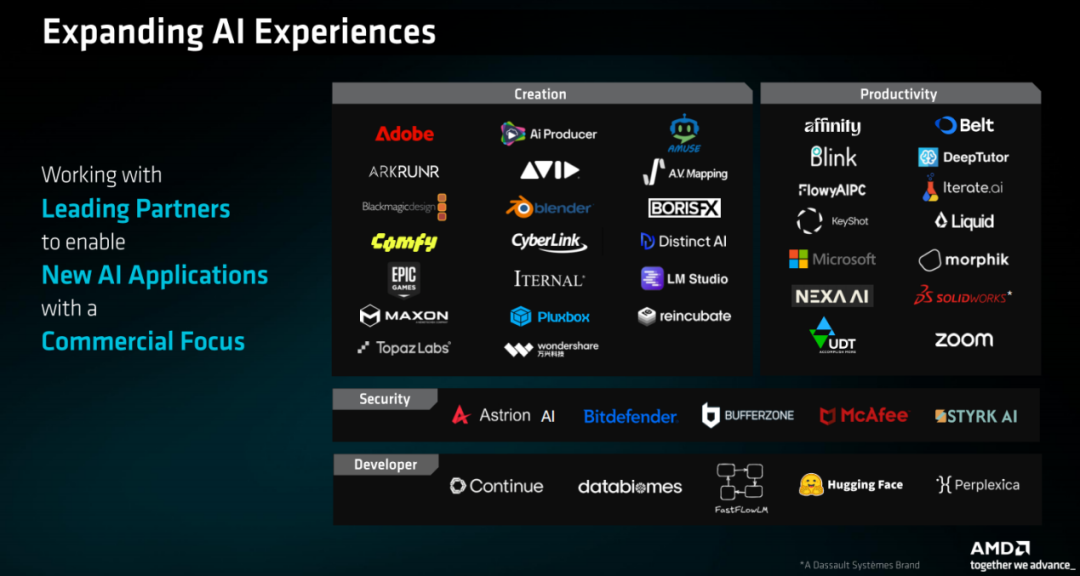
◎ Supported by a product matrix of 200+ partners (Acer, ASUS, Dell, HP, Lenovo) for large-scale commercial rollout in Q2 2026.
AMD has upgraded its strategy in the commercial AI PC market from "mobile-first" to a dual approach of "mobile + desktop." With increasing demands for Openclaw and various AI agents, embedded AI terminal requirements are rising.
AI Demand and AMD's Product Strategy
At MWC 2026, AMD centered its theme around "The IQ Era," deeply integrating AI with mobile communications. Choosing this stage to launch commercial AI solutions was strategically precise, as key target customers (enterprise IT decision-makers, operators, system integrators) were highly concentrated.
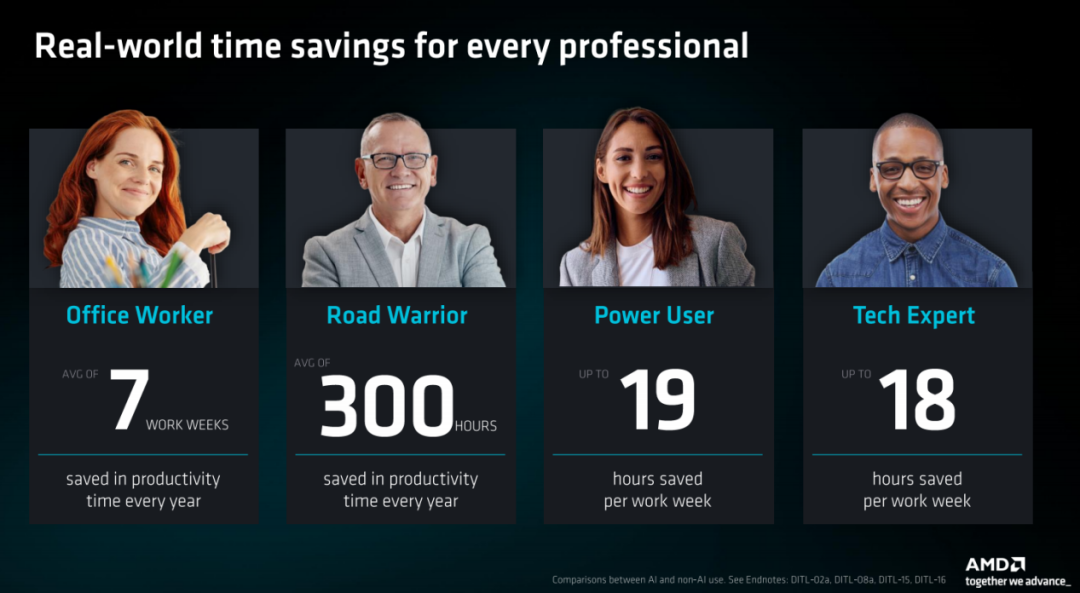
AMD's current product logic primarily targets white-collar workers, saving office workers 7 weeks of work annually, business professionals 300 hours per year, high-performance users 19 hours weekly, and technical experts 18 hours weekly.
The core advantages of local AI over cloud AI include stronger data privacy protection, stable performance without network dependency, lower long-term operational costs, and compliance with data sovereignty requirements for sensitive enterprise data. This is particularly critical for regulated industries like finance, healthcare, and government.
The commercial AI PC market is currently a three-way race: Intel leads with Core Ultra's first-mover advantage, Qualcomm advances rapidly with Snapdragon X Elite on ARM architecture, while AMD differentiates through x86 compatibility and powerful integrated graphics.
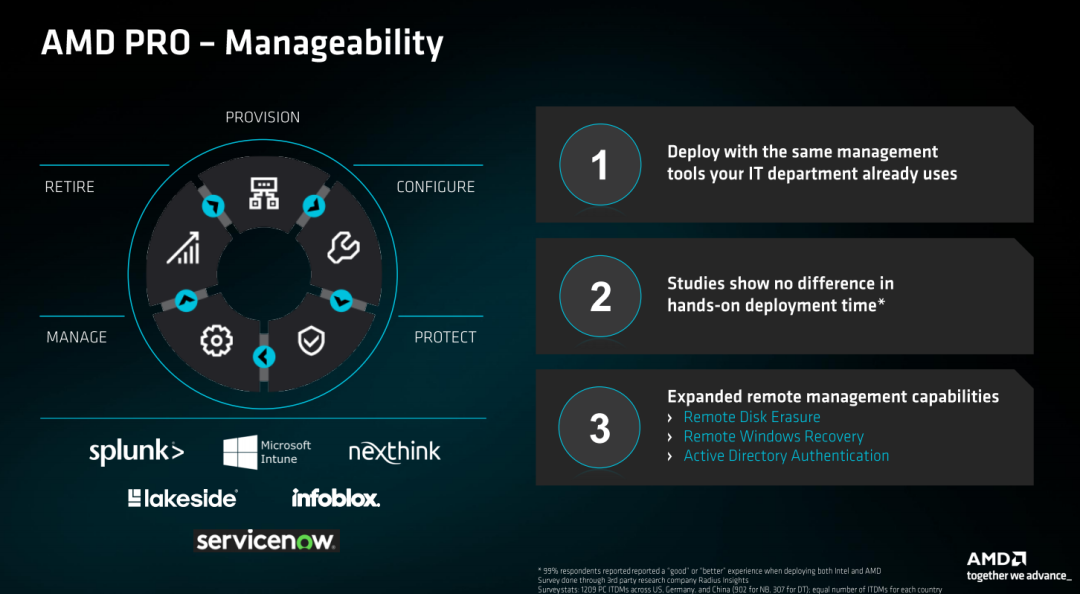
AMD's emphasis on "deployment parity" and support for existing IT management tools directly addresses enterprise IT departments' concerns about migration costs.
● Ryzen AI PRO 400 Series Mobile Processors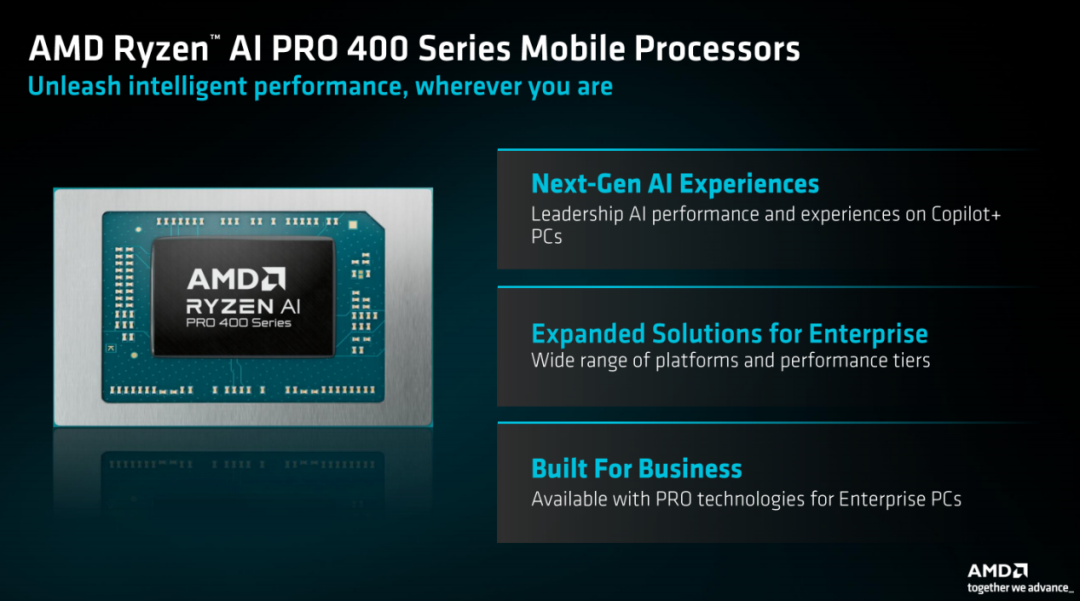
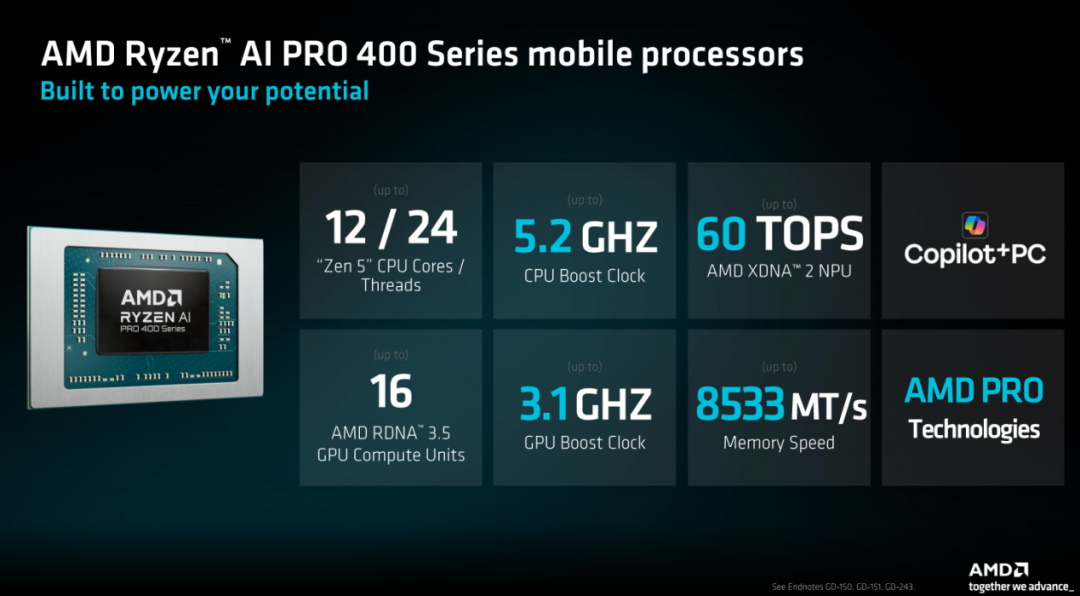
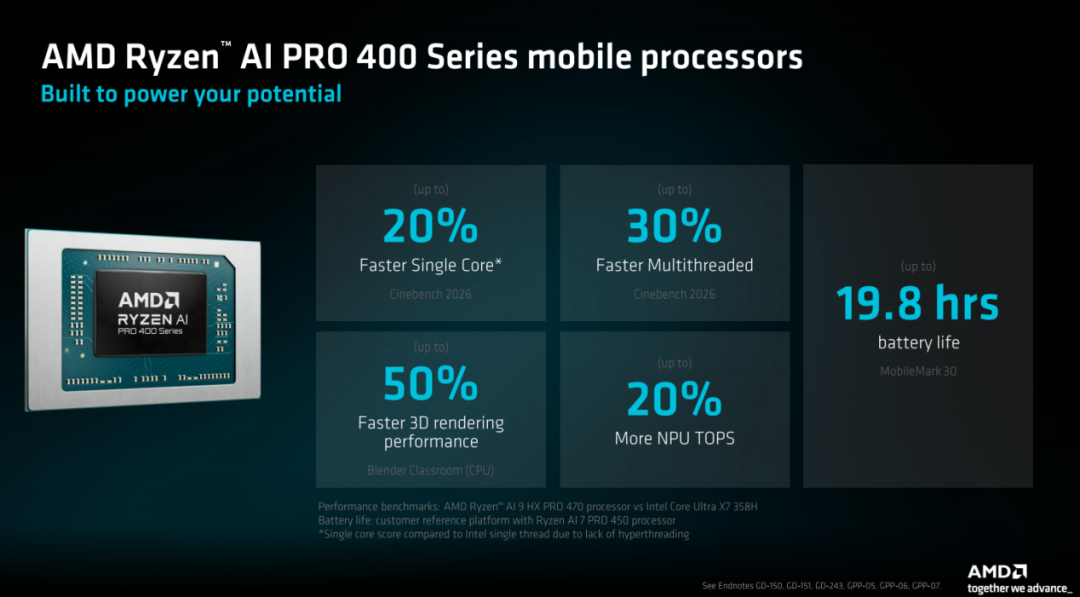
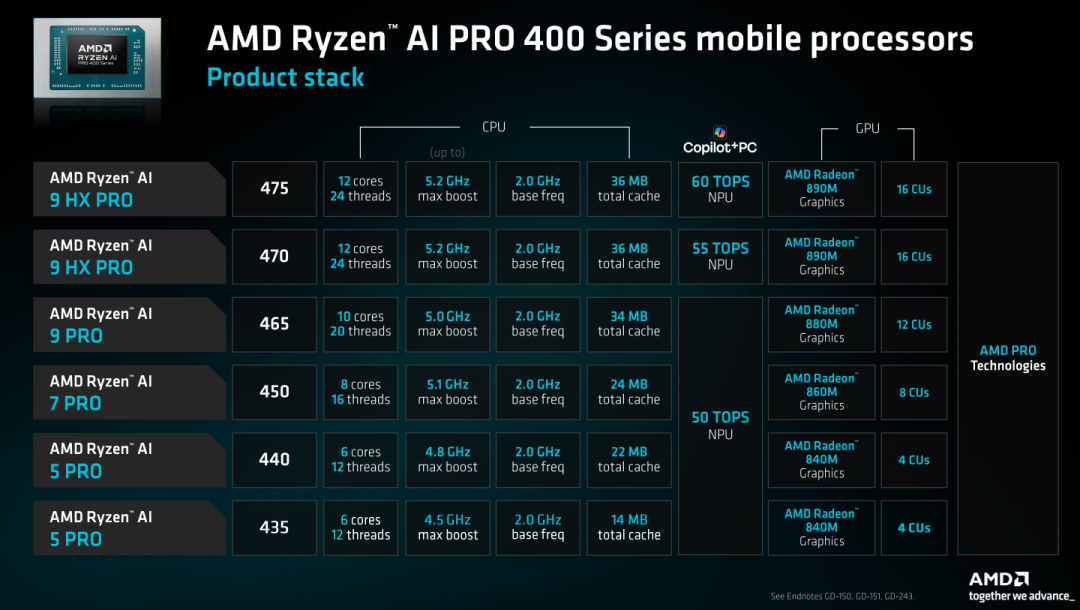
The mobile product line is the main focus of this launch, fully covering flagship to entry-level segments, all based on the Zen 5 CPU + RDNA 3.5 GPU + XDNA 2 NPU tri-core architecture.
◎ Clear NPU computing power gradients (50/55/60 TOPS), with 60 TOPS meeting Microsoft Copilot+ certification requirements.
◎ Radeon 890M (16CU) integrated graphics performance rivals entry-level discrete GPUs, reducing the need for enterprise procurement of dedicated graphics cards.
◎ The Ryzen AI 7 PRO 450 delivers up to 19.8 hours of battery life in real-world tests, offering strong appeal for business travel scenarios.
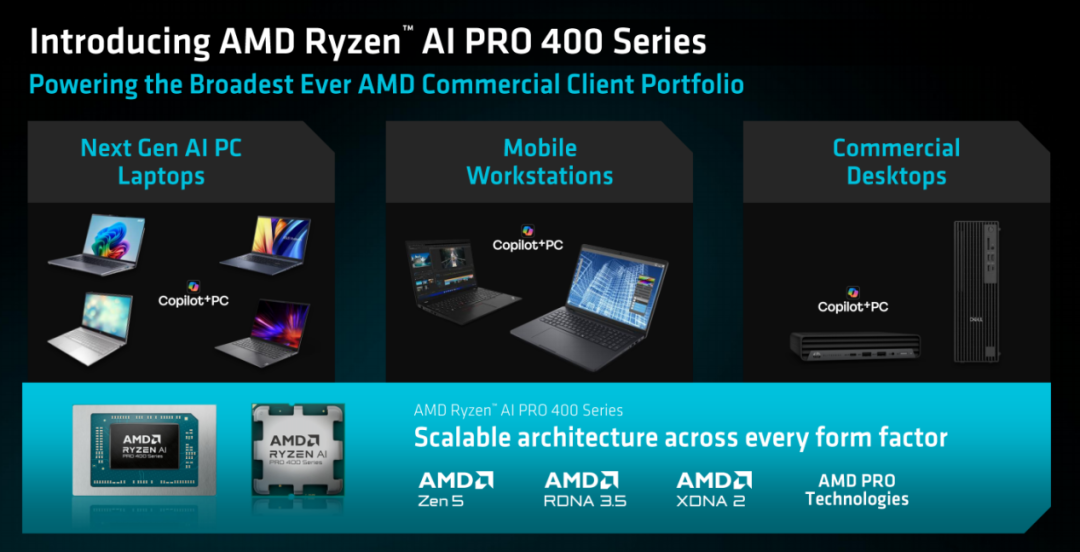
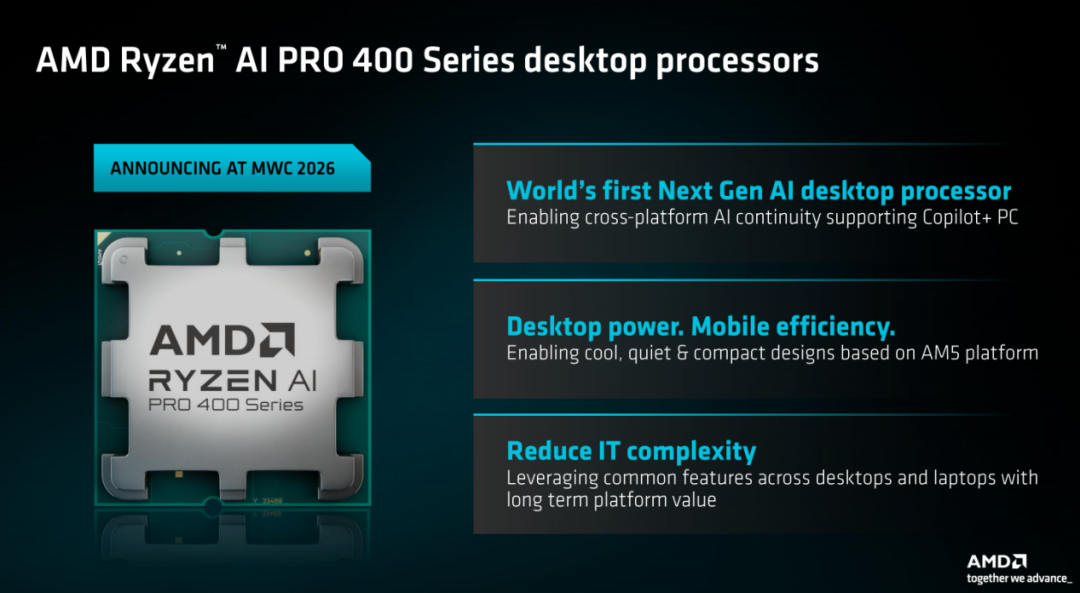
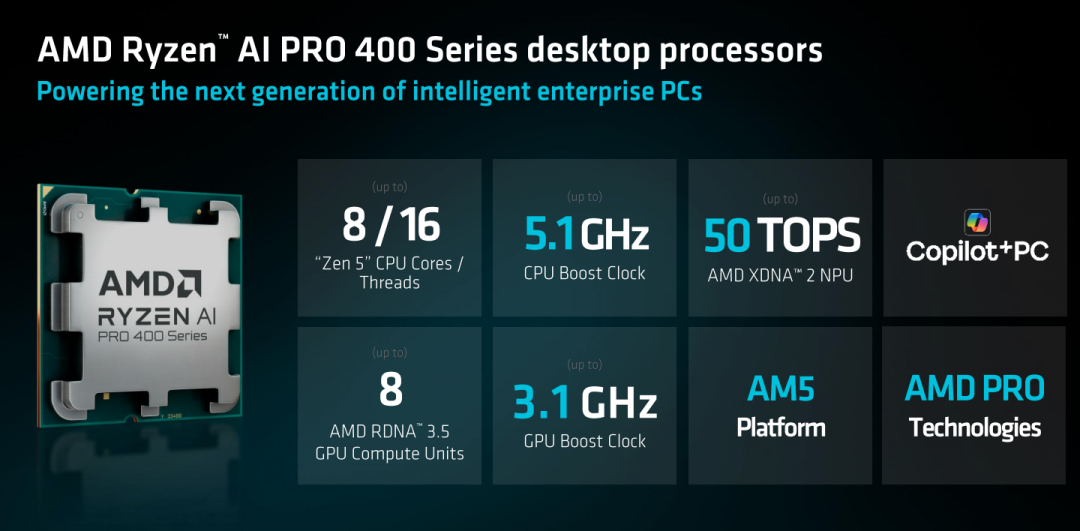
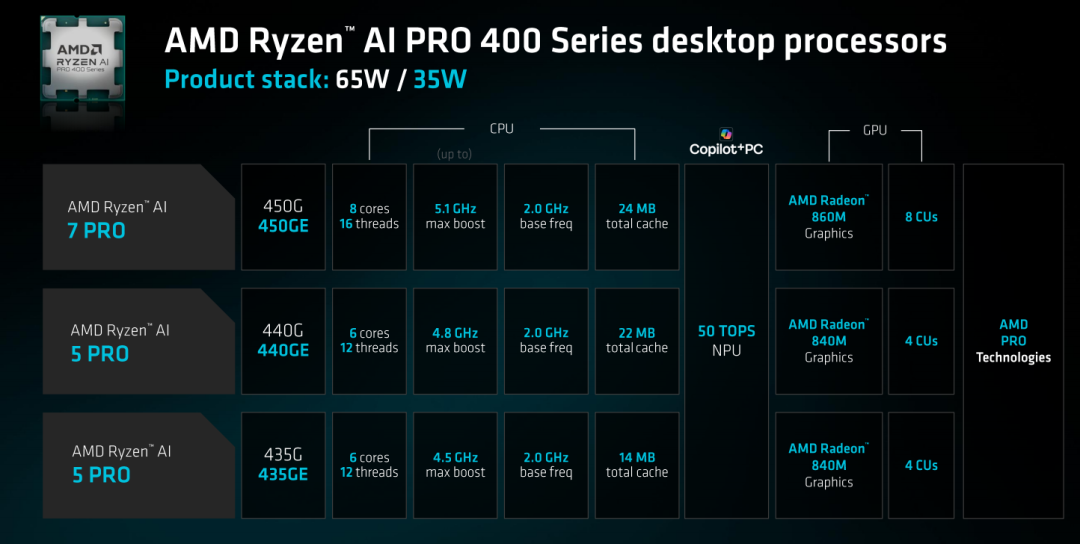
The Ryzen AI PRO 400 desktop processor's release is one of the most noteworthy moves, marking AMD's first introduction of the XDNA 2 NPU to the AM5 desktop platform.
◎ Enterprises can share AMD PRO management ecosystems across mobile and desktop, with IT departments maintaining only one toolchain.
◎ The x86 architecture ensures zero migration costs for existing enterprise software.
◎ The 35W GE series is designed for mini commercial hosts, covering space-constrained enterprise deployment scenarios.
The desktop version tops out at 8 cores and lacks a flagship HX variant, with CPU performance ceilings lower than pure Zen 5-based Ryzen 9000 series, positioning it as lightweight commercial workstations rather than high-performance computing platforms.
● Radeon AI PRO Graphics Cards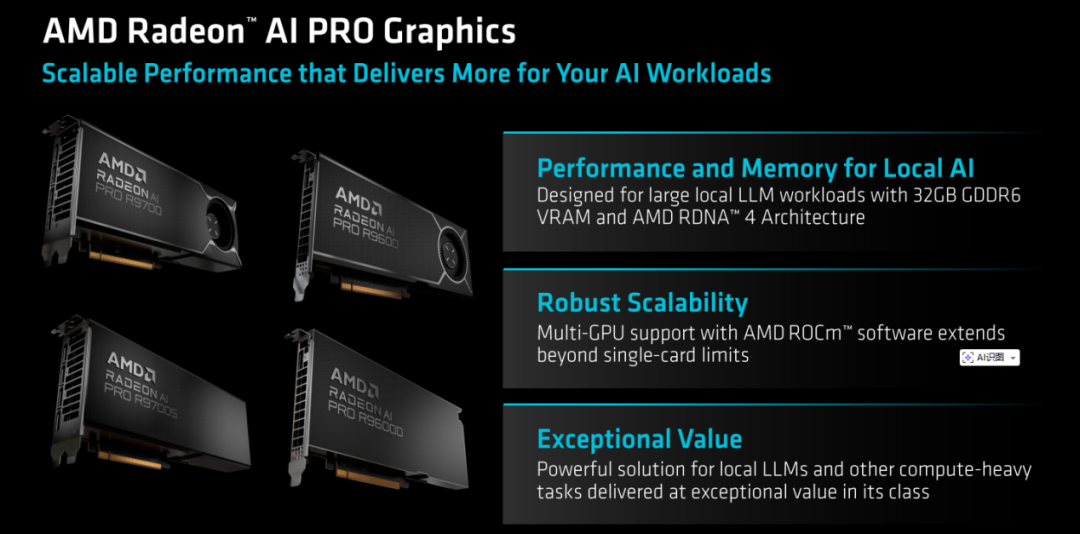
Based on the RDNA 4 architecture with up to 32GB GDDR6 memory, primarily targeting enterprise users requiring local deployment of large language models.
◎ 32GB memory can fully load mainstream 70B parameter quantized models for complete offline AI inference.
◎ Supports ROCm multi-GPU parallelism for scalable computing power, reducing cloud GPU rental costs.
◎ Offers more competitive pricing compared to NVIDIA's equivalent memory solutions.
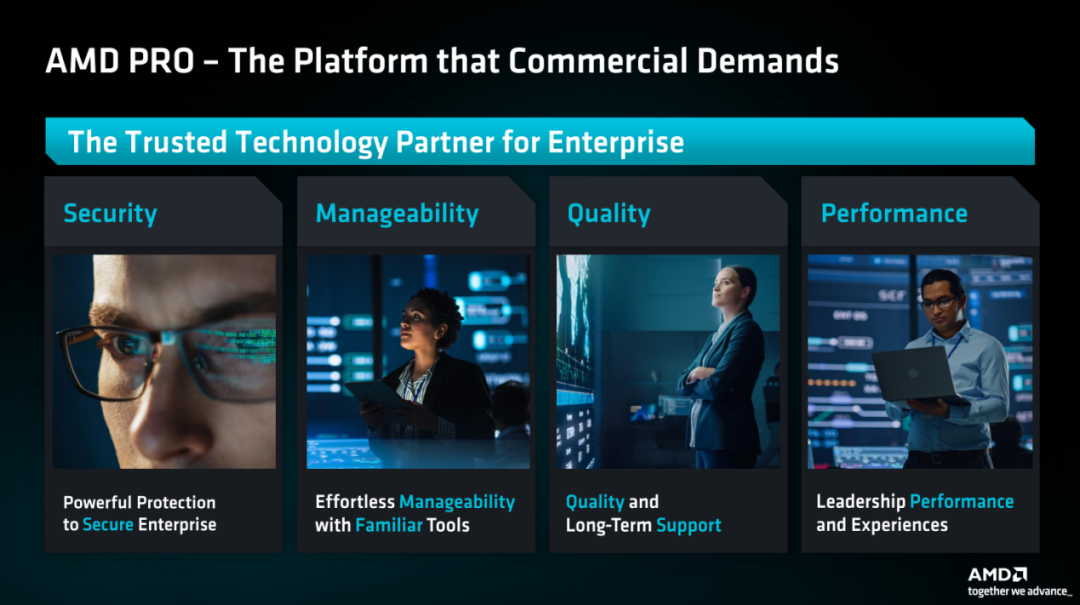
AMD PRO forms the core foundation of this commercial strategy, with four key capabilities creating enterprise-grade differentiation.
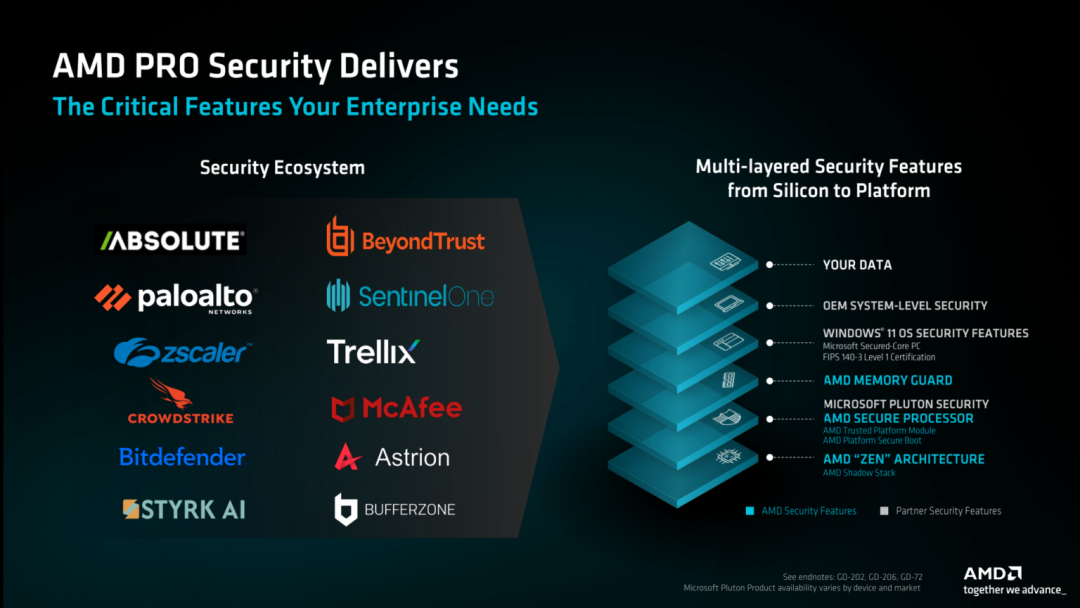
◎ Security: Multi-layer protection from silicon to platform, including AMD Memory Guard memory encryption and hardware trust roots, directly competing with Intel vPro.
◎ Manageability: Supports zero-replacement of existing enterprise IT tools with core remote management functions like remote disk wiping and Windows system recovery.
◎ Long-term support: Provides over 18 months of platform stability guarantees and over 60 months of software support post-supply, reducing enterprise supply chain risks.
◎ Ecosystem coverage: Acer, ASUS, Dell, HP, and Lenovo have joined, with 200+ products expected to launch in Q2 2026, covering ultra-thin business laptops, mini hosts, desktop workstations, and other full scenarios.
Conclusion
While AMD's approach may seem unfriendly to workers, the overall trend is continuous deployment of various AI agent applications at the endpoint to enhance efficiency. AI will keep improving individual productivity, steadily reducing work hours—though not necessarily granting more vacations, it might just let you rest properly at home.
-
![]()
Hardware is the skeleton, AI is the soul, and data integrates the two
-
![]()
China’s AI Industry: A Unified Pivot Towards Monetization?
-
![]()
New Progress! Infineon Completes Acquisition of ams OSRAM's Non-Optical Sensor Business
-
![]()
35 Million Bet on an Optical Future! Tengjing Technology Makes a Move in AR
-
![]()
Why World Models Get Stuck on Construction Roads in Autonomous Driving Applications
-
Alibaba Initiates Cultural Transformation: Is Jack Ma Making a Strategic Comeback?
-
Tianfeng Heads to Hong Kong for IPO with RMB 3.8 Billion in Funds: Xingyu's Cross-Border Foray into Embodied AI Faces Uncertain Future
-
![]()
Mengshi Auto’s High-End Aspirations Dashed: Huawei Partnership Fails to Revive Sales, New Model’s Entry Price Dips Below 300,000 Yuan