Why is Insta360 willing to 'open-source' its patents?
 03/05 2026
 616
616

Is Insta360 arming smaller players just to encircle the market leader?
Is Insta360 handing out 'free guns' to rally everyone for a 'Rush B' assault?
On March 2, a social media post by Liu Jingkang, founder of Insta360, marked the end of a nearly two-year Section 337 investigation by the U.S. International Trade Commission (ITC).
'After spending over $10 million, we’ve finally reached this point,' Liu reflected, alluding to the two-year legal battle waged by his in-house legal team and external law firms—a microcosm of Chinese companies earning respect in overseas markets through compliance and adjudication.
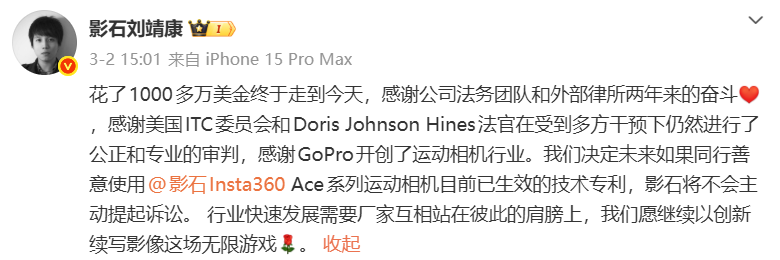
What proved even more thought-provoking than the legal victory was Liu’s subsequent decision: 'In the future, if competitors use Insta360 Ace series action camera patents in good faith, Insta360 will not proactively initiate lawsuits.'
This pledge of 'non-prosecution' was interpreted by outsiders as a form of de facto 'patent open-sourcing.' In the ruthless tech industry, particularly in the patent-intensive action camera sector, such 'cake-sharing' is rare. After all, GoPro had long dominated the market by leveraging its first-mover advantage and patent arsenal.
Why would a Chinese company—fresh from a overseas patent victory and nearing RMB 10 billion in 2025 revenue—choose to retreat on its most potent defensive weapon: patents? Is this an act of 'magnanimity' or a calculated 'stratagem'?
01
'Open-sourcing' patents is no act of charity
Spending tens of millions to win patents, only to 'give them away for free'—in the cutthroat world of business, such moves are rarely driven by altruism but by a grander strategy.
As the pioneer of action cameras, GoPro once dominated the global market. However, the rise of Chinese brands, particularly Insta360 and DJI, with their relentless technological innovation, began eroding GoPro’s market share. Faced with this challenge, patent litigation became the incumbent’s weapon of choice.
The U.S. Section 337 investigation, notorious for its broad jurisdiction and severe penalties (including import bans for losers), has long been a nightmare for Chinese companies going global. GoPro’s initiation of this investigation was transparent: to legally bar competitors from the U.S. market and fortify its moat.
After a protracted legal process, the ITC ultimately ruled that multiple GoPro patents were invalid or non-infringing. Only one design patent applied to certain Insta360 products, but revised designs had already addressed the issue. The final ruling imposed no import bans or exclusion orders, allowing Insta360 to continue selling in the U.S.
Following conventional business logic, patent litigation winners typically do two things: pursue licensing fees from competitors and raise patent barriers to solidify their market position.
In a surprising twist, Insta360 tore up the script. Liu Jingkang declared in a statement: 'In the future, if competitors use Insta360 Ace series action camera patents in good faith, Insta360 will not proactively initiate lawsuits.'
Why would a company that just spent millions to win a patent battle 'give away' its technology for free? The answer lies in its performance.
Insta360’s 2025 revenue hit RMB 9.858 billion, up 76.85% year-on-year—a record high. This means that during the two-year 337 investigation, Insta360’s business not only remained unscathed but grew rapidly.
Meanwhile, the action camera industry underwent a seismic shift. According to Jiuqian Consulting’s *Global Panoramic and Action Camera Market Research Report*, GoPro’s global market share plummeted from 77% in 2023 to 18%, while DJI captured 66% in Q3 2025, becoming the global leader by a wide margin.
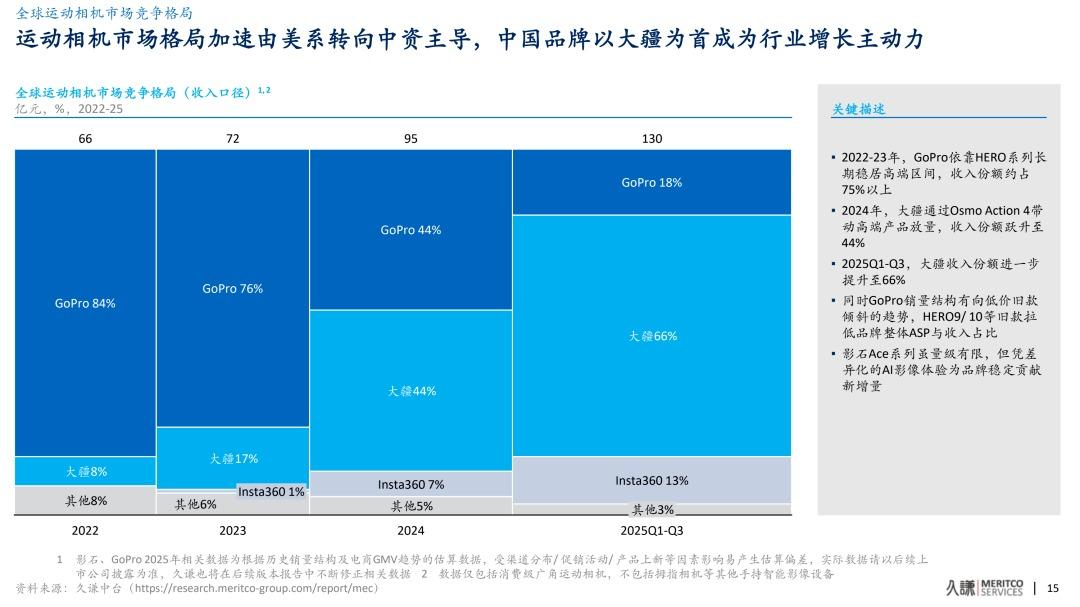
GoPro’s patent litigation now resembles a desperate struggle by a 'defender of the status quo.' For Insta360, which had already achieved scalable profitability, the $10+ million in legal fees were manageable, but patent wars remain costly and exhausting.
Insta360’s 'non-prosecution' pledge is, in fact, a shrewd move to reduce litigation costs and focus on core competitiveness.
Insta360 has long deep cultivation (deeply cultivated) panoramic technology, stabilization, and AI imaging processing. By adopting this approach, Insta360 effectively screens its rivals: it avoids wasting resources on court battles with minor players while reserving the right to sue malicious actors (e.g., GoPro). This frees up resources to invest in next-gen technologies like AI and computational photography.
02
Is Insta360’s 'infinite game' about hunting giants?
With its defenses secure, Insta360’s deeper strategy lies in reshaping the industry ecosystem. In tech, using open-source models to grow ecosystems is hardly new.
In 2014, Elon Musk open-sourced all Tesla patents, inviting others to expand the electric vehicle market while cementing Tesla’s technological leadership. Toyota open-sourced thousands of fuel cell patents; IBM, Google, and Samsung frequently share vast patent portfolios with open-source communities.
The underlying logic: when a company achieves sufficient technological leadership, open-sourcing patents ceases to be 'self-sabotage' and becomes a way to 'reap rewards'—by setting industry standards and expanding ecological influence to solidify dominance.
Research Nester projects the 2025 action camera market to exceed $7.3 billion, with a 12.2% CAGR over the next decade.
For Insta360, guarding patents to restrict smaller players is less valuable than lowering industry barriers through openness. When more manufacturers adopt Insta360’s stabilization algorithms or interface standards, Insta360 evolves from a 'product seller' to a 'rule setter.'
Industry insider Li Yuhao told *Super Focus* that Insta360’s seemingly magnanimous 'de facto open-sourcing' is, in a way, 'handing knives' to smaller players in the action camera industry.
Notably, Insta360’s true competitive moat is its globally dominant panoramic cameras, while the Ace series represents traditional single-lens action cameras—the core stronghold of legacy giants like GoPro. By flattening the technical barriers for single-lens technology, Insta360 is essentially distributing free weapons in rivals’ territories, acting as a 'knife vendor' for the action camera sector.
The action camera market extends beyond Top players (top players); it also includes numerous cost-effective brands like AKASO and SJCAM lurking in the shadows.
Historically, these long-tail manufacturers, constrained by weak R&D and vulnerable to patent litigation, survived only in niche low-end markets.
Now, Insta360’s 'non-prosecution' pledge offers these firms a free pass. By adhering to 'good faith' rules, they can drastically enhance their single-lens products at minimal compliance and R&D costs.
This 'arming the long-tail' strategy has ignited a proxy war against incumbents.
As hordes of small brands, armed with Insta360’s licensed technologies, flood mid-range and even premium markets with cost-effective products, traditional single-lens cameras’ pricing and product barriers will crumble.
Insta360 avoids getting bogged down in single-lens competition; instead, by releasing non-core patents, it turns rivals’ profit pools into a bloodbath, forcing them to fend off encirclements from smaller brands.
This exemplifies Liu Jingkang’s 'infinite game'—a sophisticated departure from traditional zero-sum patent wars. Instead of engaging in mutually destructive battles, Insta360 repurposes its old weapons to 'divide and conquer,' securing its ecological niche as the 'standard setter' while upending the old guard.
In this new order, competition hinges not on wielding patent clubs but on controlling the ecosystem’s rules.
However, its success depends on industry interaction: How many rivals will use its patents in 'good faith'? Will these technologies become de facto industry standards? Can Insta360 sustain its lead in an open ecosystem? And will this model inspire other tech firms, fostering a more virtuous competitive culture?
The answers will unfold in the coming years.
- END -
-
![]()
Hardware is the skeleton, AI is the soul, and data integrates the two
-
![]()
China’s AI Industry: A Unified Pivot Towards Monetization?
-
![]()
New Progress! Infineon Completes Acquisition of ams OSRAM's Non-Optical Sensor Business
-
![]()
35 Million Bet on an Optical Future! Tengjing Technology Makes a Move in AR
-
![]()
Why World Models Get Stuck on Construction Roads in Autonomous Driving Applications
-
Alibaba Initiates Cultural Transformation: Is Jack Ma Making a Strategic Comeback?
-
Tianfeng Heads to Hong Kong for IPO with RMB 3.8 Billion in Funds: Xingyu's Cross-Border Foray into Embodied AI Faces Uncertain Future
-
![]()
Mengshi Auto’s High-End Aspirations Dashed: Huawei Partnership Fails to Revive Sales, New Model’s Entry Price Dips Below 300,000 Yuan