Apple’s New ‘Affordable’ Products Enter the Market: Is Targeting Mid-to-Low-End Models a Transitional Strategy for Apple’s AI Transformation?
 03/12 2026
 552
552
When Mid-to-Low-End Devices Take Center Stage in Apple’s Grand Strategy
Amidst rising prices for domestic mid-to-low-end smartphones, Apple has today released its new mid-to-low-end offerings: the iPhone 17e smartphone and the MacBook Neo computer.
With the application of national subsidies, the iPhone 17e, starting at 256GB storage, is priced as low as 3,999 yuan at launch. Similarly, the MacBook Neo, also starting at 256GB, launches at just 3,909 yuan—both models dipping below the 4,000 yuan mark.
Even if this year’s national subsidy allocation has been exhausted, there’s no need to worry. With the current “10 billion subsidies” promotion, the iPhone 17e can be purchased for as low as 3,899 yuan after applying coupons, while the MacBook Neo drops even further to 3,599 yuan post-coupon.
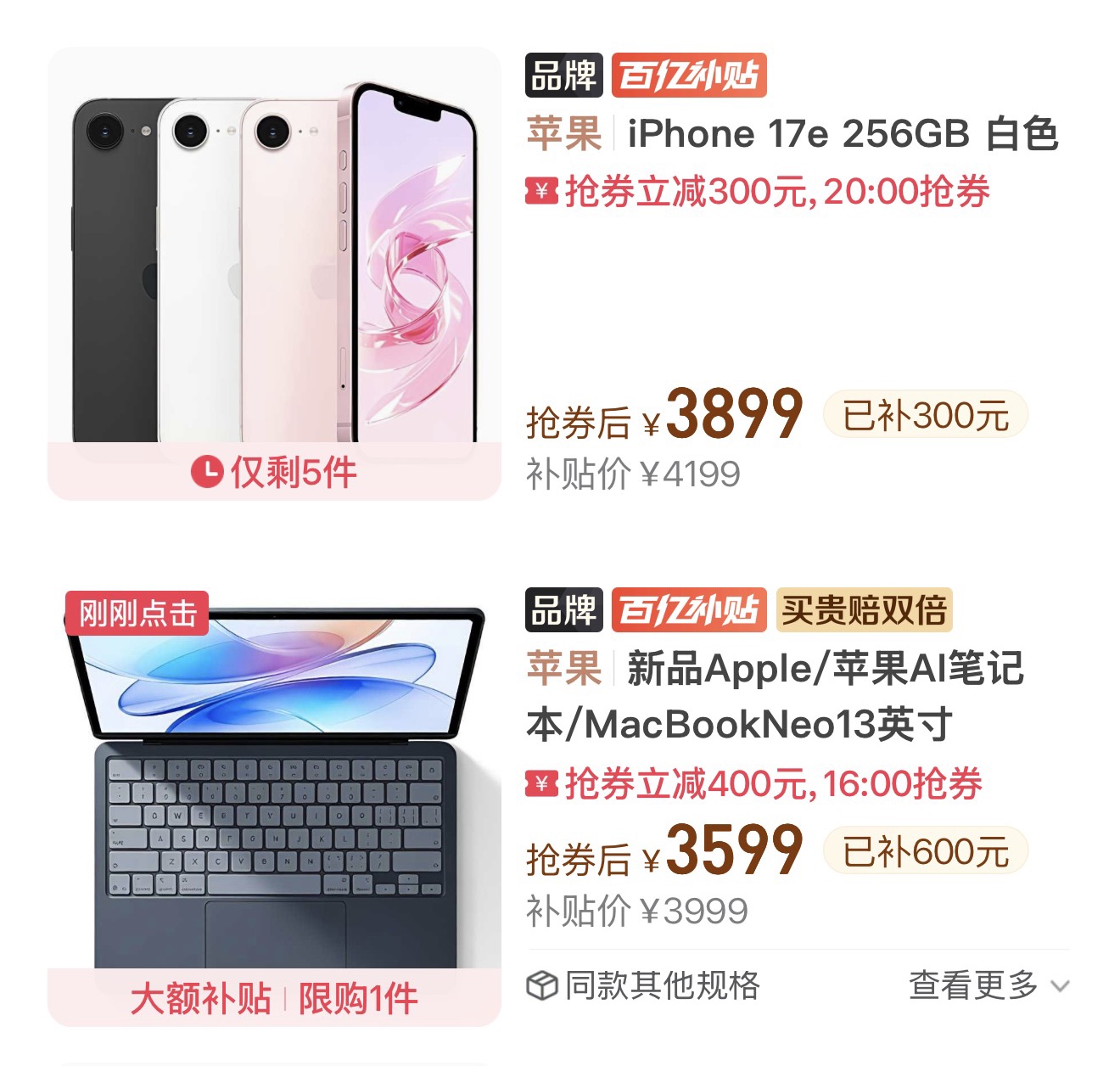
Image Source: 10 Billion Subsidies Platform
Given the strong sales momentum on the first day, prices for the MacBook Neo and iPhone 17e could approach or even fall below the 3,000 yuan threshold during this year’s 618 shopping festival.
iPhone 17e Launches Amid Tight Supply for iPhone 17 Pro
Let’s take Guangzhou as an example to examine the supply situation on the launch day of Apple’s new products.
On JD.com’s self-operated platform, the 256GB iPhone 17e in Light Pink and White is expected to be available after March 20 (orders can be placed now), while the Black version offers same-day delivery via express shipping or next-day delivery via standard shipping. In contrast, all color variants of the 256GB MacBook Neo require pre-ordering and are not yet widely available.
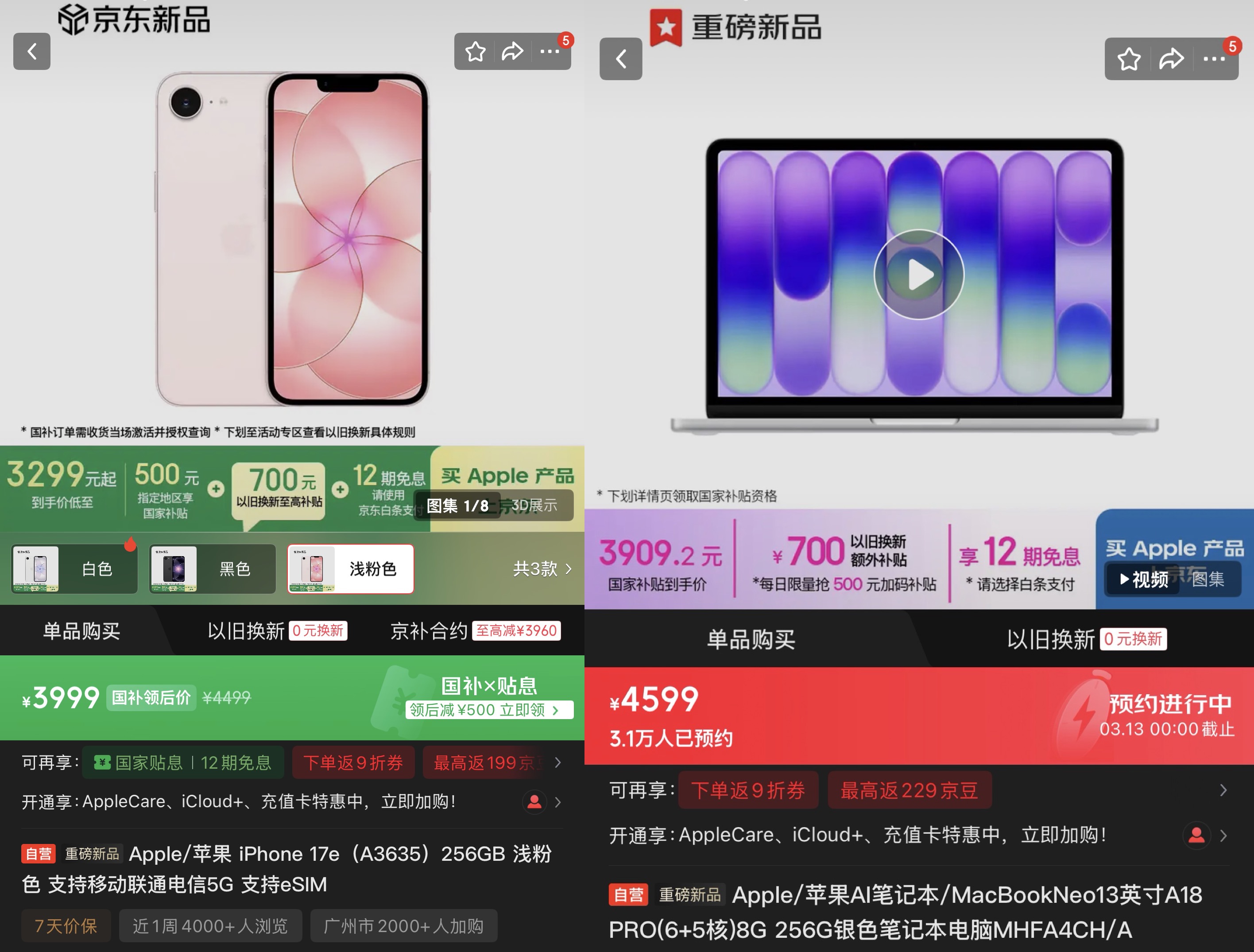
Image Source: JD.com
On Apple’s official website, where national subsidies cannot be applied, all color variants of the 256GB iPhone 17e are readily available, with same-day express delivery or next-day standard shipping. For the 256GB MacBook Neo, only the Peach Pink variant is expected to arrive by late March; other colors will be delivered the following day.
Interestingly, on both JD.com and Apple’s official site, the relatively scarce model is the iPhone 17 Pro, which has been on the market for several months, with extended delivery dates across all color variants.
Specifically, the White 256GB iPhone 17 Pro is expected to be available after March 26 on JD.com (orders can be placed now); Apple’s official site estimates delivery between March 15 and 18.
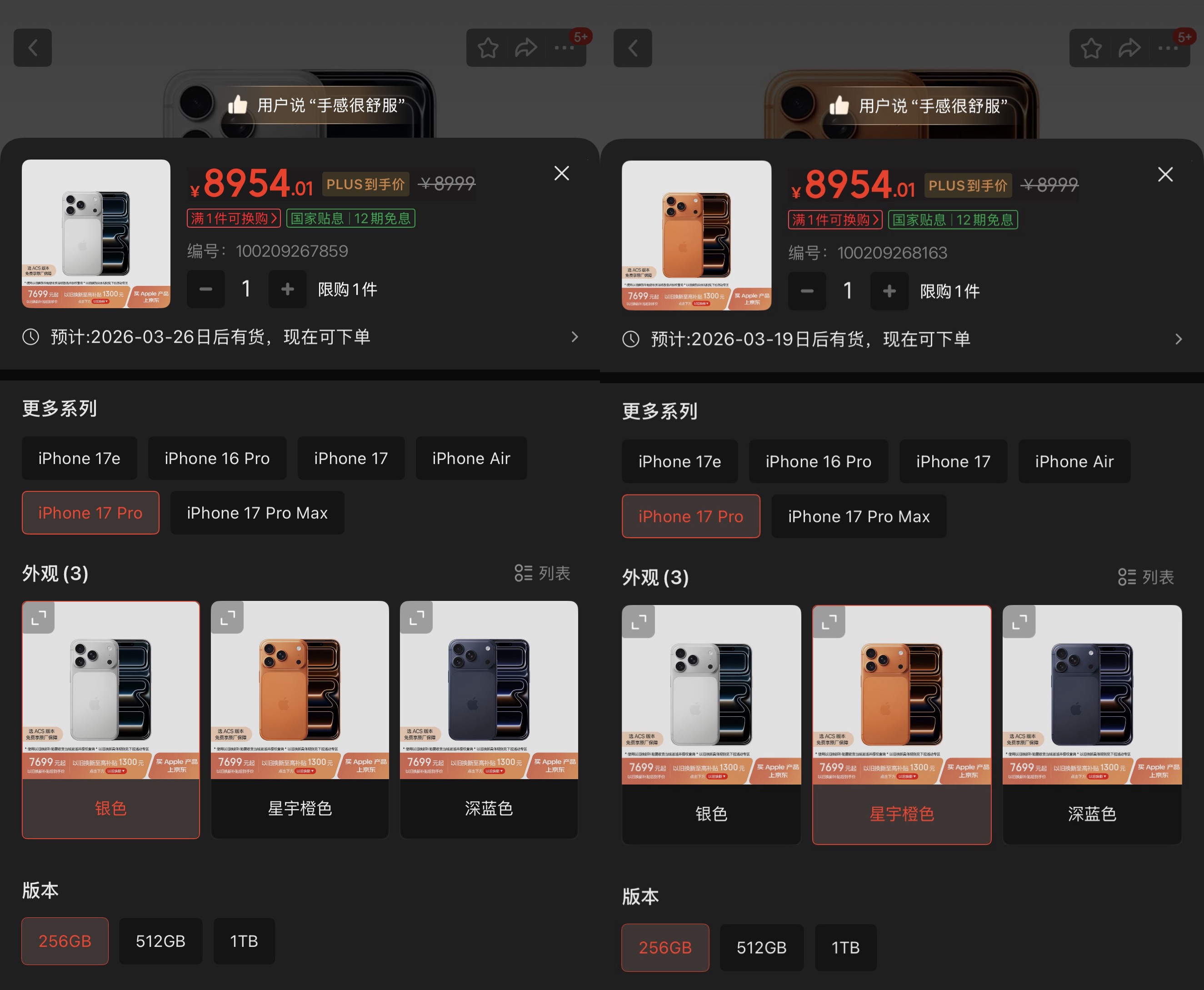
Image Source: JD.com
According to the latest quotes from recycling channels on March 11, the “brand-new, unopened” 256GB iPhone 17 Pro in all three colors is priced around 8,900 yuan, just about 100 yuan below its launch price.
The fact that the resale value of the new iPhone 17 Pro has not declined but instead risen seems to confirm the current supply shortage.
Indeed, since its launch in September last year, among the iPhone 17 family, the iPhone 17 faced supply constraints first, followed by the iPhone 17 Pro, while the top-end iPhone 17 Pro Max has consistently topped the bestseller charts.
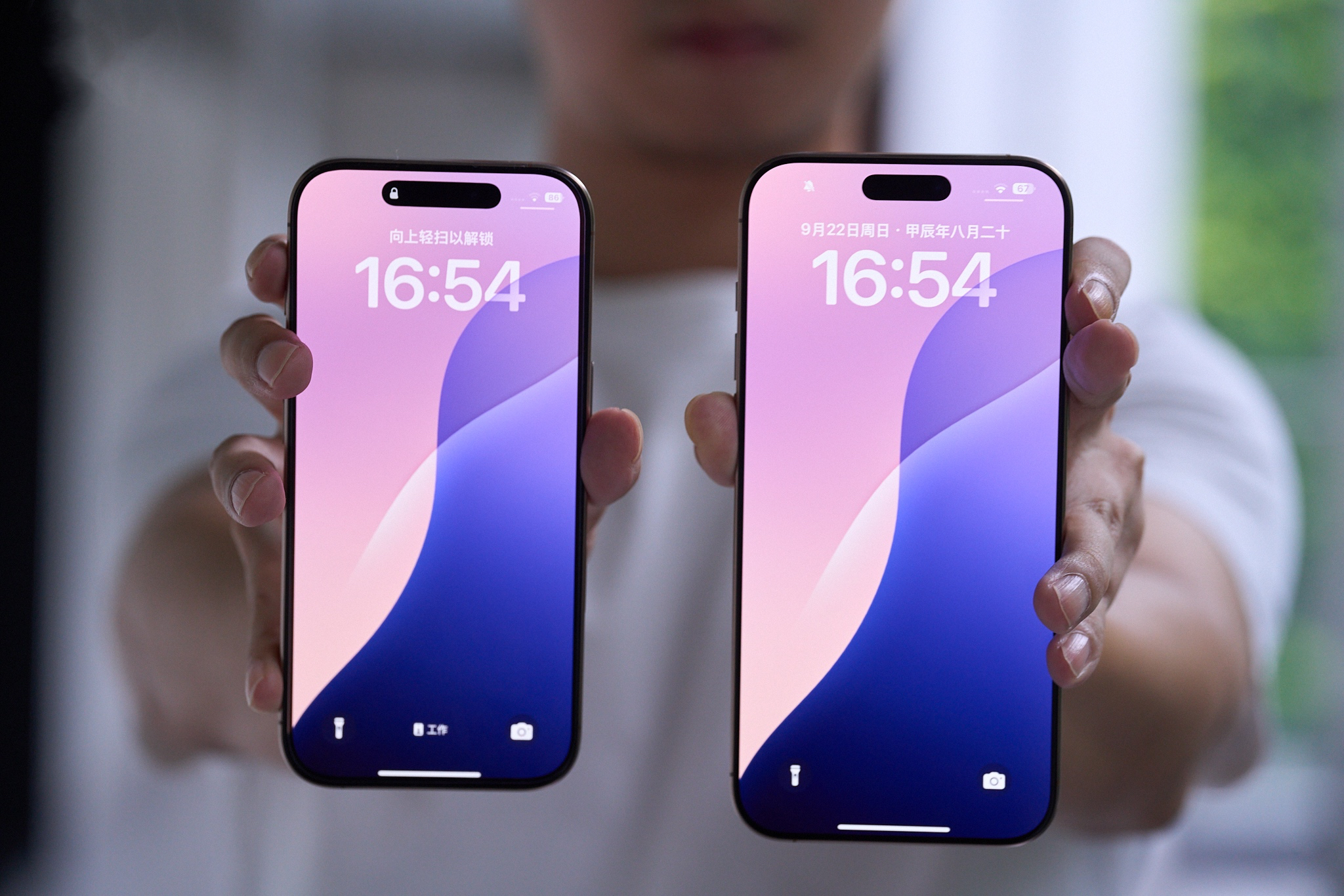
Image Source: Leitech
After overcoming the initial supply shortage last November, the iPhone 17 has consistently outperformed the iPhone 17 Pro in sales. In other words, among the iPhone 17 family, the current bestsellers in China are the top-end flagship iPhone 17 Pro Max and the mid-range flagship iPhone 17.
From top-end flagships to mid-range flagships, the iPhone 17 family dominates the new device landscape—but Apple is not content to stop here.
Can Apple’s ‘Budget Model’ Break the Curse of Poor Sales in China? The iPhone 17e Holds the Most Promise
When viewed through the lens of Chinese and global market pricing, Apple’s so-called “budget models” are actually mid-range devices.
From the iPhone 5c to the iPhone SE series, Apple has consistently attempted to penetrate the global mid-range market. However, this segment has remained largely untapped until last year, when Apple introduced the first “e” suffix model to the new iPhone lineup.
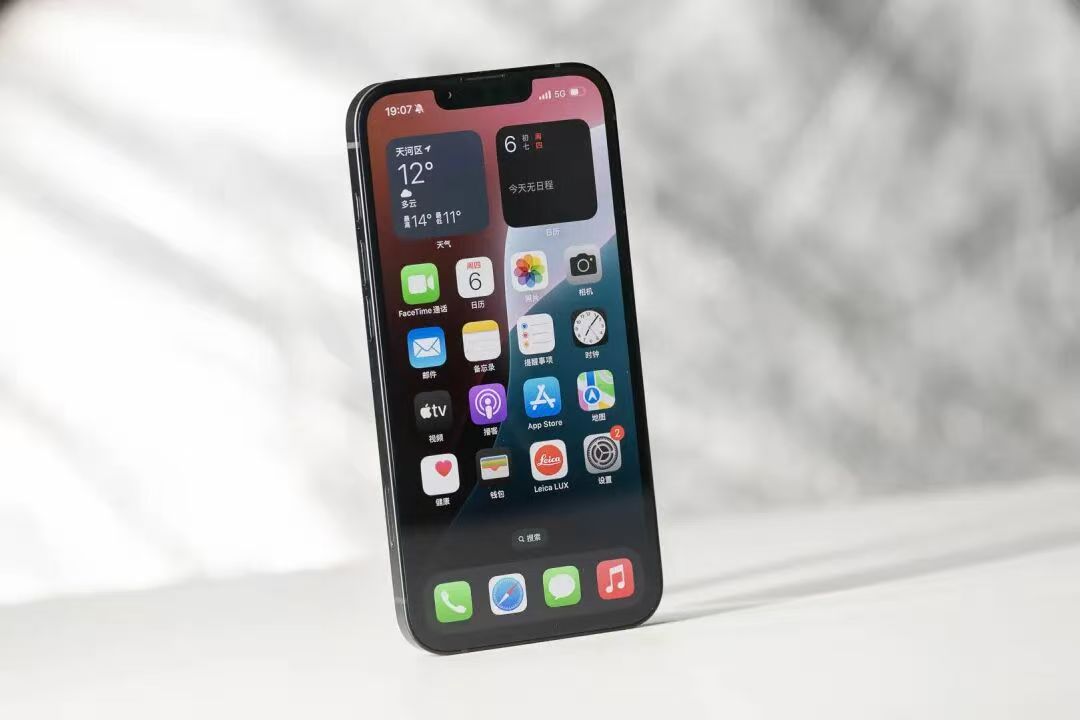
Image Source: Leitech
In February last year, Apple launched the iPhone 16e, which performed differently in the Chinese and overseas (global) markets.
Counterpoint data shows that the iPhone 16e ranked among the top ten best-selling smartphone models globally in 2025.
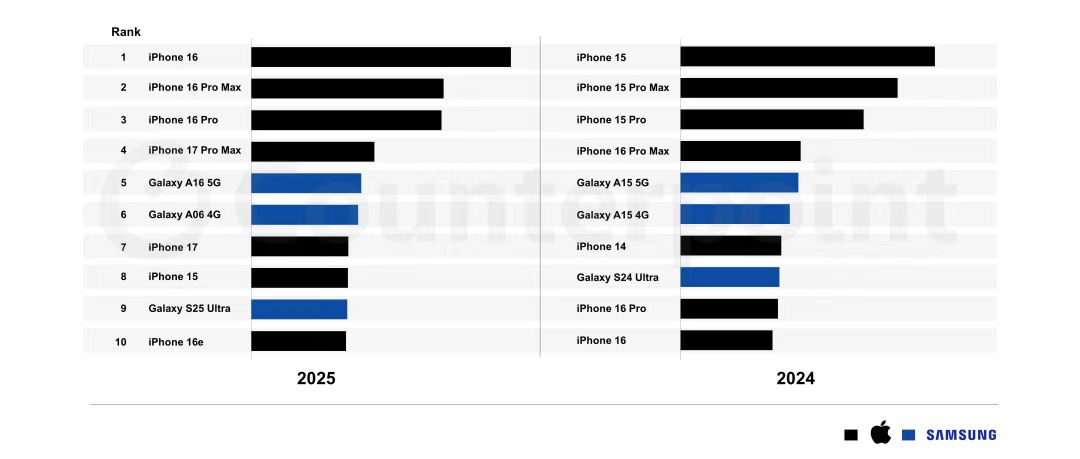
Image Source: Counterpoint
However, in the Chinese market, the iPhone 16e has not seen such “strong sales,” and to date, no specific sales figures have been released.
From my observations, Apple likely did not “expect” strong sales for the iPhone 16e in China. After its launch, Apple did not engage in aggressive or frequent price reductions for the China-specific model, and its presence has remained relatively low.
Today’s launch of the iPhone 17e presents a completely different scenario.
At the product level, the iPhone 17e offers “more for the same price,” with domestic mid-range smartphones poised to raise prices, while Apple prices its new 256GB model at the same level as the previous 128GB version. This has garnered “quite positive” feedback in terms of both user reputation and market perception.
At the production level, among the iPhone 17 family, the market prices of the iPhone 17 Pro Max, iPhone 17 Pro, and iPhone 17 remain robust, forming a stark contrast with the iPhone 16 family. Which model in the new iPhone lineup is better suited for price reductions and promotions? For the iPhone 16 series, it was the iPhone 16 Pro and Pro Max; for the iPhone 17 series, it seems to be the 17e.
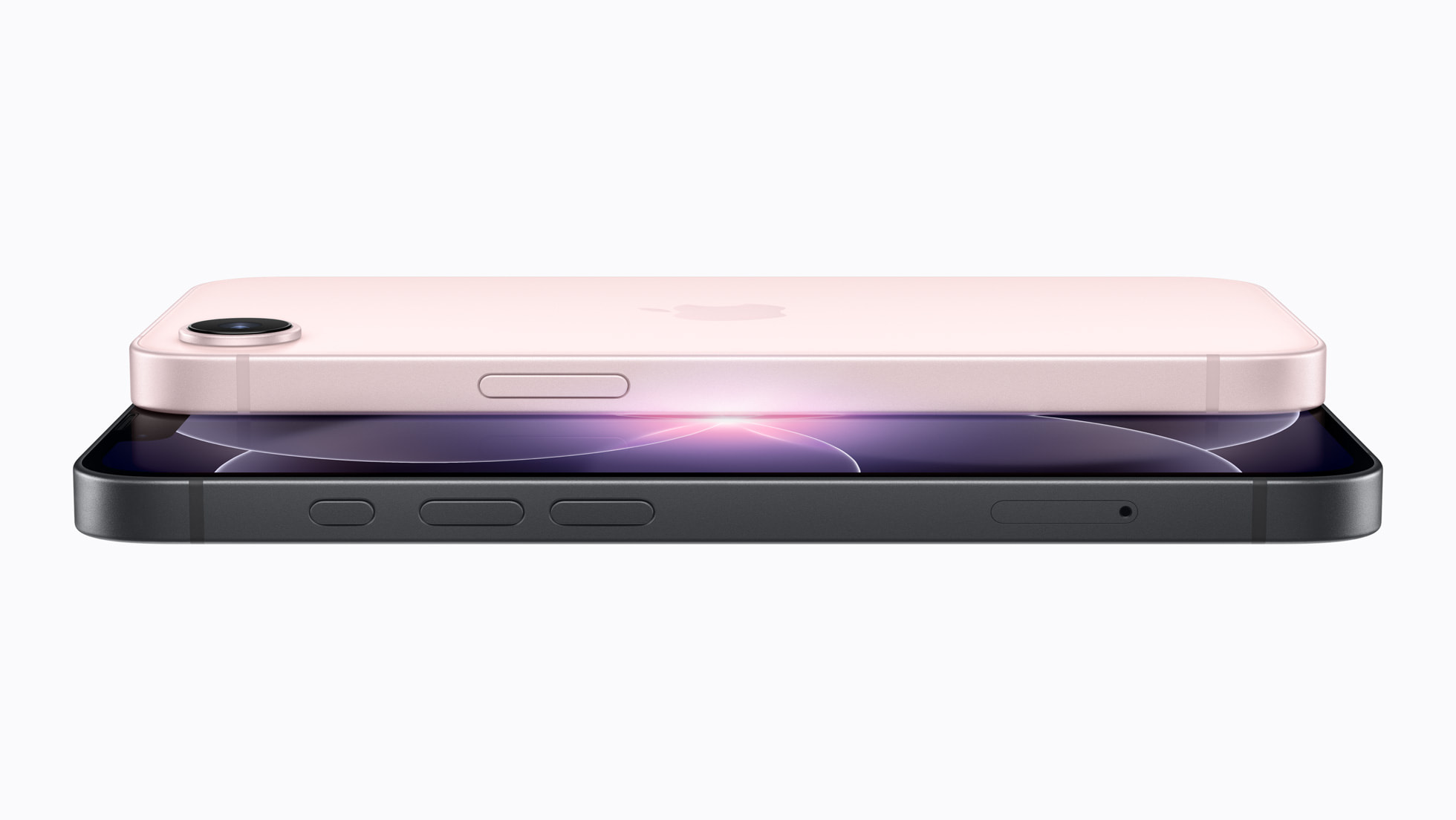
Image Source: Apple
At the pricing level, in recent years, a popular sentiment in China regarding Apple products has been, “There are no unsuitable products, only unsuitable prices.” Last year, when the 128GB iPhone 16e occasionally dropped below 3,000 yuan, many people praised it as a “great deal.” If the 256GB iPhone 17e falls below 3,000 yuan later this year, it won’t just be a “great deal” for some—it will spur impulse buys and actual purchases.
Meanwhile, Apple could fully integrate the iPhone 17e into China’s carrier contract phone programs. If consumers can get this new iPhone for free with a monthly phone plan costing over 100 yuan (e.g., a three-year plan), many would be willing to sign up.
In promoting the new model to consumers, Apple could target middle-aged and elderly users, as well as those with relatively low-frequency photography and videography needs. For trade-ins of older iPhone models, platforms like JD.com could also offer larger subsidies.
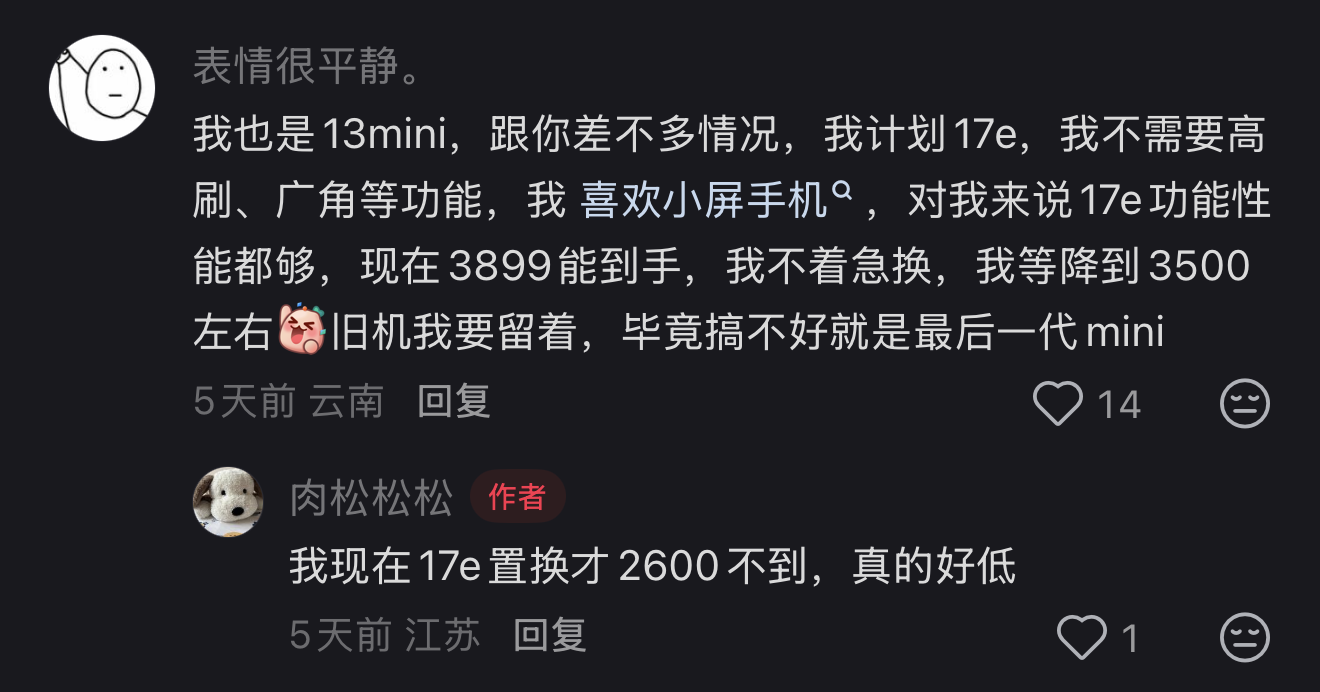
Image Source: Xiaohongshu
Overall, today’s launch of the iPhone 17e is likely to capitalize on the “wave of price hikes” for domestic smartphones, breaking Apple’s curse of poor sales for “budget models” in the Chinese market.
MacBook Neo: More Than Just a ‘Premium’ Chromebook
In the Chinese market, Apple likely places significant importance on the performance of the iPhone 17e. Globally, however, Apple is more focused on the debut of the MacBook Neo.
In global markets, especially developed ones, the MacBook Neo is clearly positioned as a “premium” alternative to Chromebooks. In terms of build quality and operating system, the MacBook Neo is well-suited for this role.

Image Source: Apple
Targeting university and high school students in developed markets, Apple needs to offer a “Chromebook-like” product alongside its mid-range flagship MacBook Air—a format already well-validated in the market.
In fact, the “iPad” model in Apple’s iPad lineup has already proven that Apple can create products that align with students’ budgets and usage preferences.
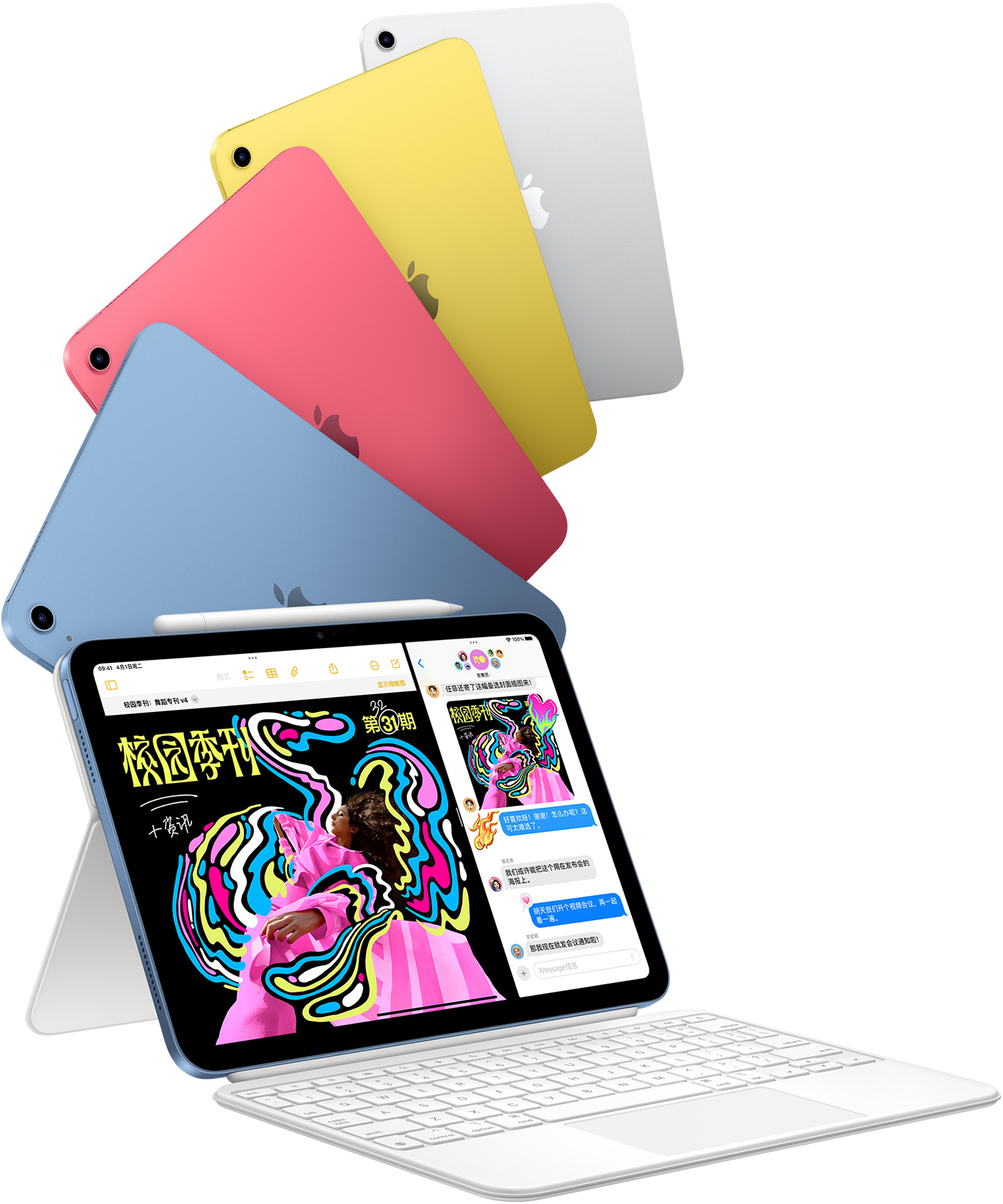
Image Source: Apple
For Chinese users, the “iPad” model is not only used by university and high school students but also by a significant proportion of users across all age groups. Their preferences are simple: watching videos, playing games, chatting, online shopping, and so on.
These widespread online and general entertainment needs among Chinese users can seamlessly transfer to the MacBook Neo, with the added benefit of “light office” functionality.
Apple’s A18 Pro chip is more than sufficient for net surfing and light office tasks. The MacBook Neo’s main drawback is likely its 8GB of RAM.
But if you have needs beyond surfing, general entertainment, and light office work, why buy an Apple laptop priced below 4,000 yuan at launch (even lower with subsidies) that might later approach or even dip below 3,000 yuan?
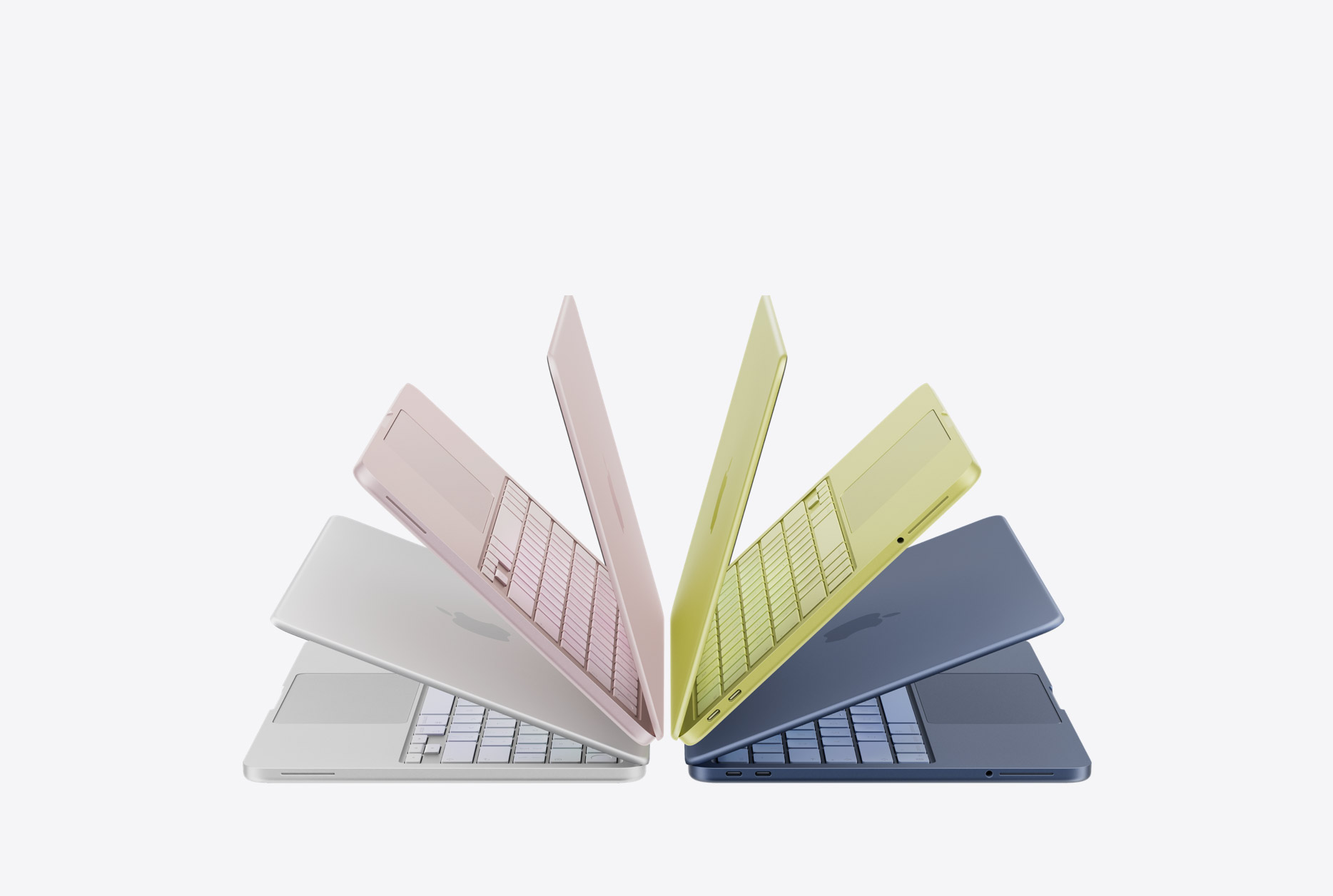
Image Source: Apple
Of course, future iterations of the MacBook Neo may upgrade to 12GB or even 16GB of RAM.
There’s also good news for today’s MacBook Neo: thanks to Apple’s deep integration of chips, systems, and memory architecture in Mac devices, the MacBook Neo will become the lowest-cost hardware for local OpenClaw deployment among Apple computers.
Although the MacBook Neo’s starting price is 100 yuan higher than the Mac mini’s, the Mac mini requires additional purchases of a display, keyboard/mouse, and other peripherals. Meanwhile, the “lobster farming” trend among Chinese users has driven up prices for both new and used Mac minis, significantly reducing their perceived “cost-effectiveness” compared to last year.
It’s worth noting that current local deployments of OpenClaw typically access large models via APIs or platform subscriptions (e.g., Coding Plan membership). Many users want to deploy large models locally, but this requires extremely high computer specs—beyond what most casual users can afford—and does not offer a better overall experience than paid API calls or subscriptions.
Thus, the 8GB RAM MacBook Neo and the 16GB RAM Mac mini may not differ significantly in terms of OpenClaw local deployment experience. Of course, the MacBook Neo uses the A18 Pro chip, while the current Mac mini uses the M4 chip.
Targeting Mid-to-Low-End Markets: Apple’s ‘Transitional’ Strategy for AI Transformation
From last year’s iPhone 16e to this year’s iPhone 17e and MacBook Neo, it’s clear that Apple’s market strategy has undergone a major shift: from previously attempting to cover the mid-to-low-end market to now strategically focusing on it.
From iPads to iPhones to MacBooks, Apple—a 50-year-old tech empire—is now charging full speed into the mid-to-low-end market.
For today’s two new products, the iPhone 17e will expand Apple’s footprint in China’s mid-range market, especially amid the current wave of price hikes for mid-to-low-end smartphones. The MacBook Neo will spark a new wave of Apple’s mid-to-low-end laptops globally, including in China.
However, Apple’s strategic focus on the mid-to-low-end market may merely serve as a “transitional” solution in its efforts to transform into an AI platform.
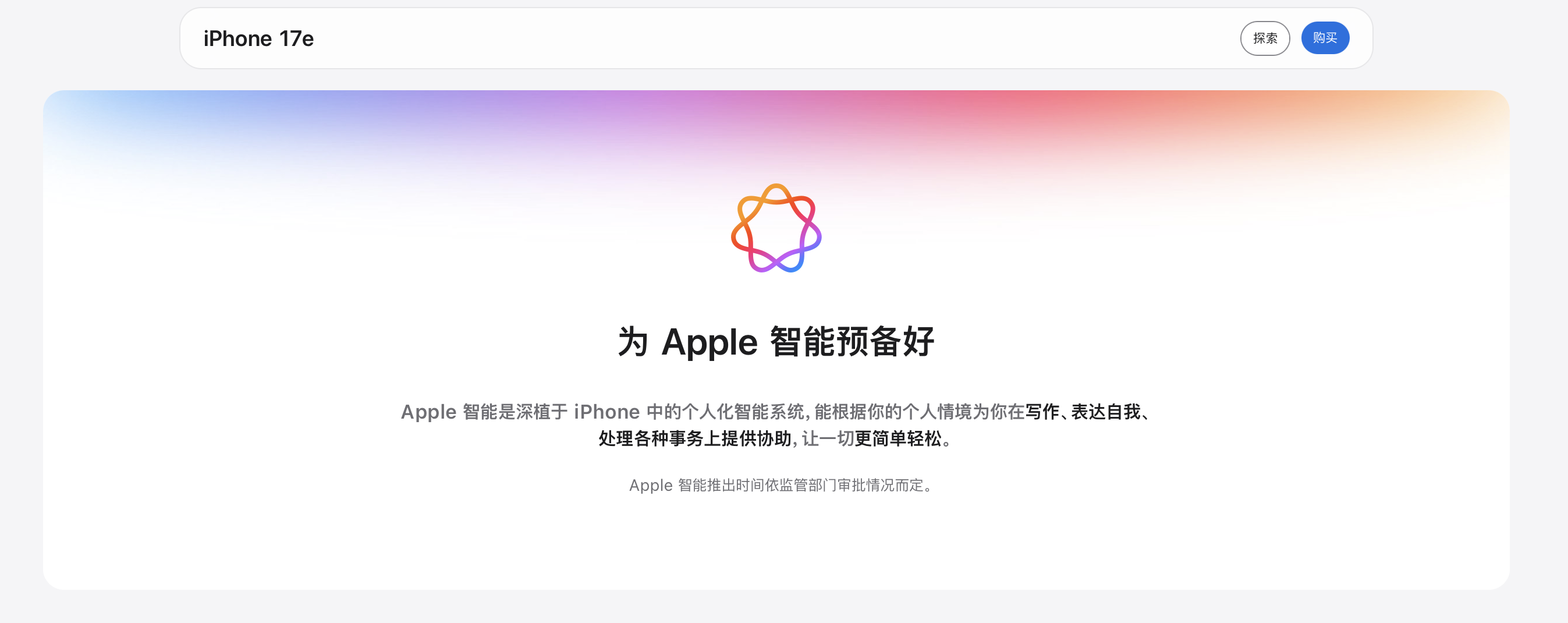
Image source: Apple
Apple’s “weakness” in system-level AI capabilities and its “lag” in the application of its proprietary AI system resemble a “Sword of Damocles.”
It’s not easy for Apple in the Cook era to have come this far. Cook’s unfinished business and greatest regrets may only be left for his successor to handle.
Apple iPhoneMaciPhone17eMacBookNeo
Source: Leikeji
The images in this article are from: 123RF Royalty-Free Image Library
-
![]()
Hardware is the skeleton, AI is the soul, and data integrates the two
-
![]()
China’s AI Industry: A Unified Pivot Towards Monetization?
-
![]()
New Progress! Infineon Completes Acquisition of ams OSRAM's Non-Optical Sensor Business
-
![]()
35 Million Bet on an Optical Future! Tengjing Technology Makes a Move in AR
-
![]()
Why World Models Get Stuck on Construction Roads in Autonomous Driving Applications
-
Alibaba Initiates Cultural Transformation: Is Jack Ma Making a Strategic Comeback?
-
Tianfeng Heads to Hong Kong for IPO with RMB 3.8 Billion in Funds: Xingyu's Cross-Border Foray into Embodied AI Faces Uncertain Future
-
![]()
Mengshi Auto’s High-End Aspirations Dashed: Huawei Partnership Fails to Revive Sales, New Model’s Entry Price Dips Below 300,000 Yuan