Analysis of Volkswagen Group's Business Performance in 2025 and Strategic Outlook for 2026
 03/12 2026
 597
597
With profits halved, tariff blows, and another 50,000 layoffs... Volkswagen in 2025 is still undergoing its most severe transformation pains. From the 2025 data and 2026 plans, it's clear the company will have to continue tightening its belt.
I. Business Performance and Financial Results in 2025
1. Global Market Performance
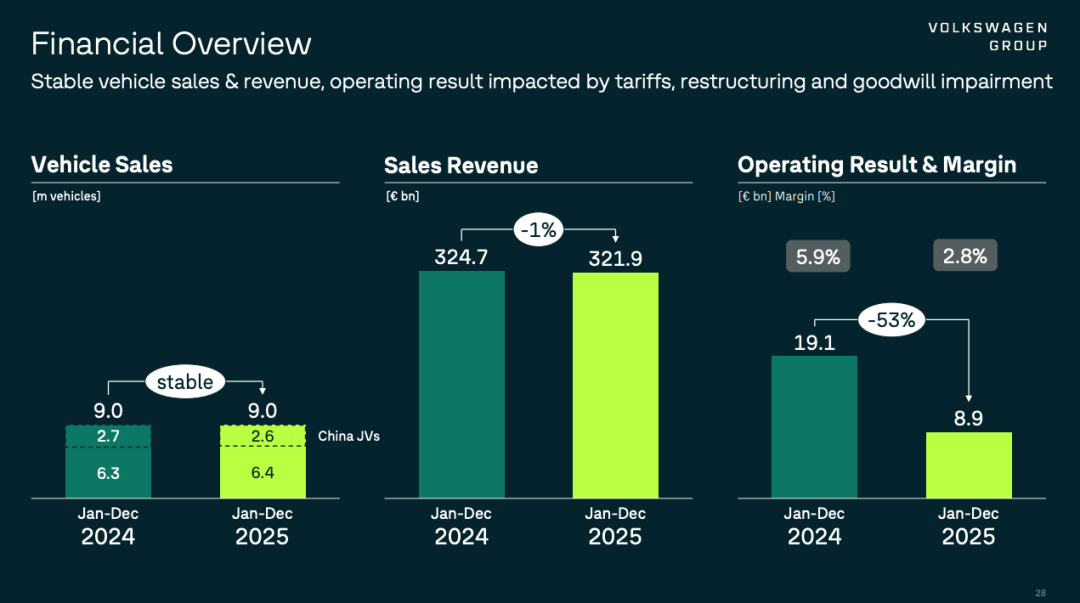
Delivery Stabilization: Annual deliveries reached approximately 9 million vehicles, with a precise figure of 9.022 million, essentially flat compared to last year in a highly dynamic market environment. As shown in our previous article "Top 10 Global Automakers by Sales in 2025," Volkswagen Group remains the second-largest automaker by global sales, with the top three global automakers' rankings unchanged.
Regional Divergence Intensifies:
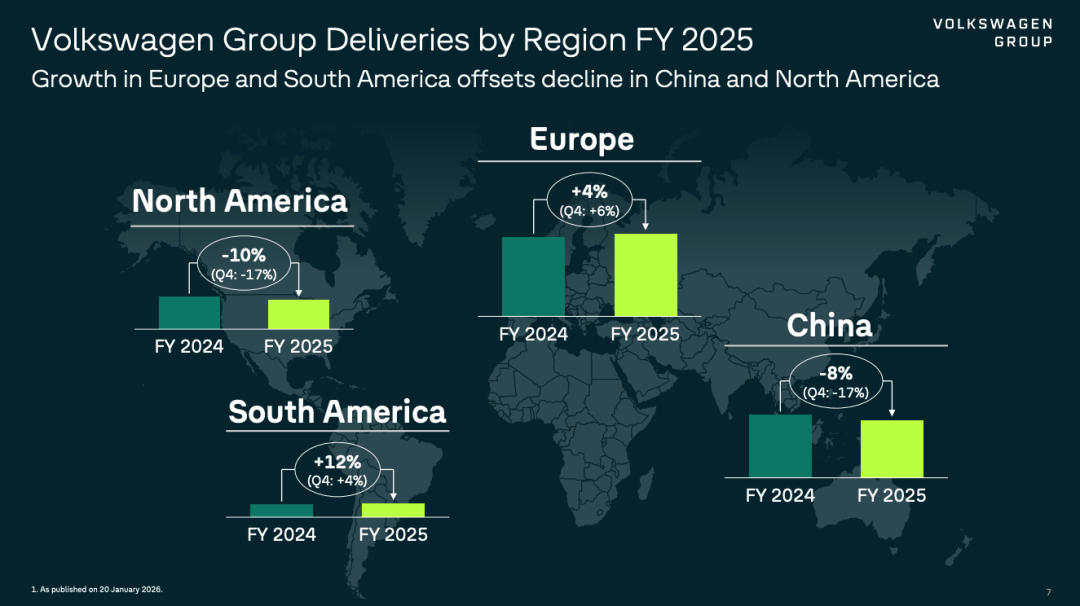
European Stronghold: Performance remains robust, up 4%, with a significant increase in the share of battery electric vehicles (BEVs) to 19.1%.
China: Continues to decline, down 8%, following a 10% drop last year. According to our previous article "The Resilience and Cost of Volkswagen Group's Global and Chinese Performance in 2025," Volkswagen Group sold 2.69 million vehicles in China in 2025.
North America: Affected by this year's tariff issues, sales fell 10%. Fortunately, neighboring South America performed strongly, increasing by 12%, becoming Volkswagen's new star market.
Electrification Progress: The global delivery share of BEVs increased from 8% in 2024 to 11%. The European market was particularly outstanding, with Volkswagen capturing a 27% market share, maintaining its first-place position.
2. Financial Data
Revenue Decline: Volkswagen Group's revenue was €321.9 billion, down slightly by 1% year-on-year. Despite lower sales in North America and China, the group managed to maintain its revenue, suggesting that car prices in Europe and South America remained firm.
Profit "Halved": Operating profit plummeted by 53% to €8.9 billion, with an unadjusted operating profit margin of just 2.8%. This was primarily due to €5.9 billion in "special items" expenditures: including €2.7 billion in goodwill impairment for Porsche, €2 billion in Porsche product strategy adjustment costs, and €1.3 billion in restructuring costs. Additionally, U.S. tariffs incurred an extra cost of €2.9 billion. Excluding these special items and tariffs, the operating profit margin would barely maintain at 5.5%.
Cash Flow Defense: Net cash flow rebounded against the trend to €6.4 billion, with net liquidity remaining healthy at €34.5 billion. This was attributed to extremely stringent inventory liquidation in the fourth quarter (releasing €4.8 billion in funds) and capital expenditure control.
3. Cost and Efficiency Adjustments
Radical Cuts: Management confirmed that 50,000 jobs will continue to be cut in the future. Manufacturing costs at German factories have successfully been reduced by 20%.
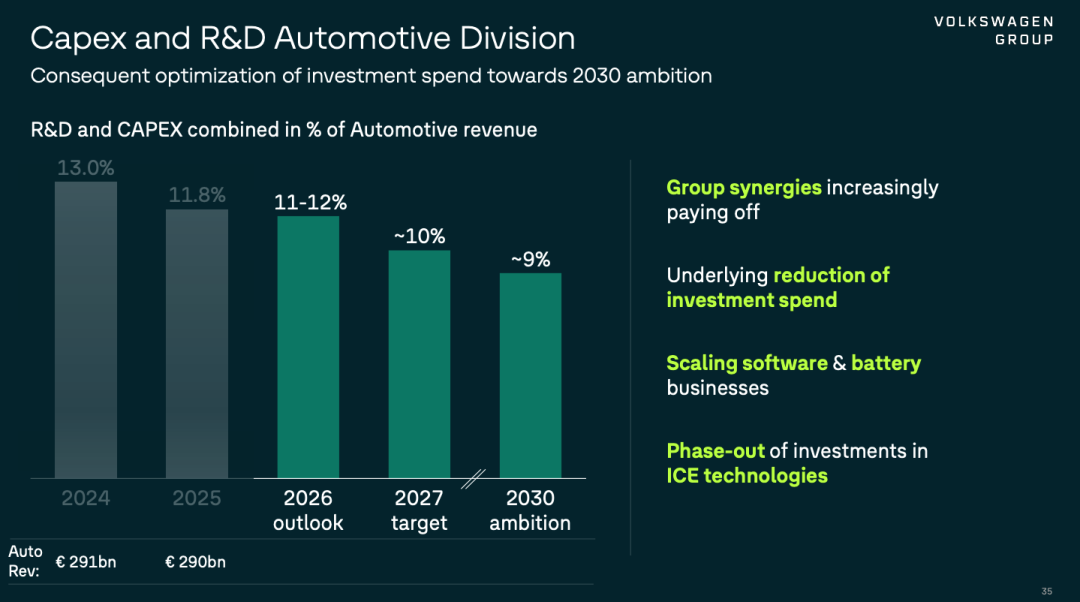
Investment Contraction: The automotive division's research and development and capital expenditure (R&D & CAPEX) ratio has dropped to 11.8%, with plans to further compress it to around 9% by 2030.
II. Product and Technology Directions in 2026
1. Product Offensive
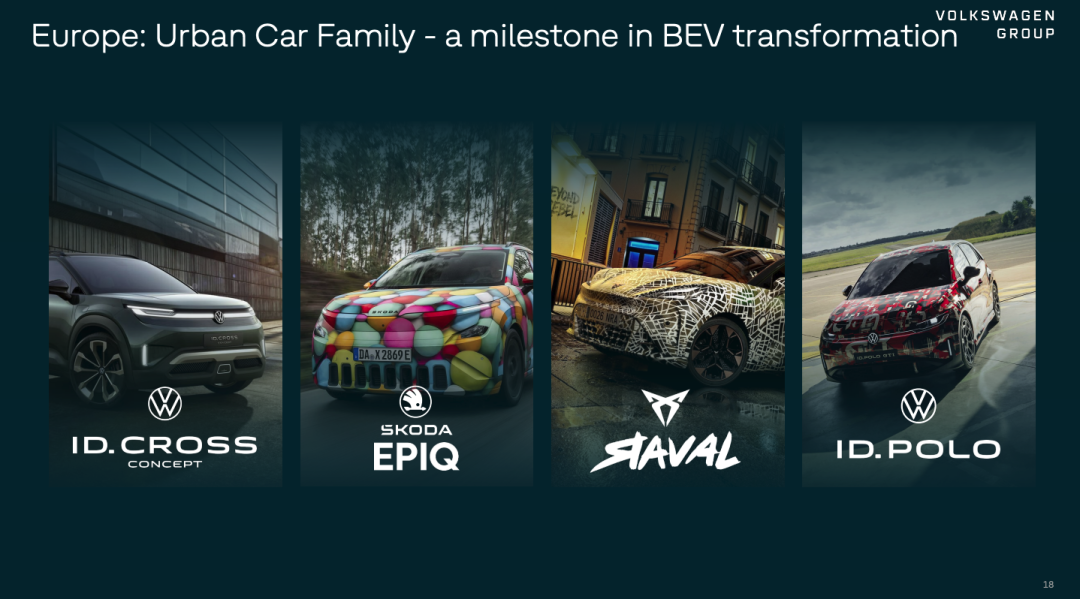
Entry-Level EVs: Launching the "Urban Car Family" in Europe, including the Volkswagen ID. POLO, ID.CROSS, Skoda EPIQ, and Cupra Raval. Using entry-level pricing and platform-sharing strategies to capture the mass market. The emergence of these price-cut products suggests that Europe's electrification is entering a high-growth era.
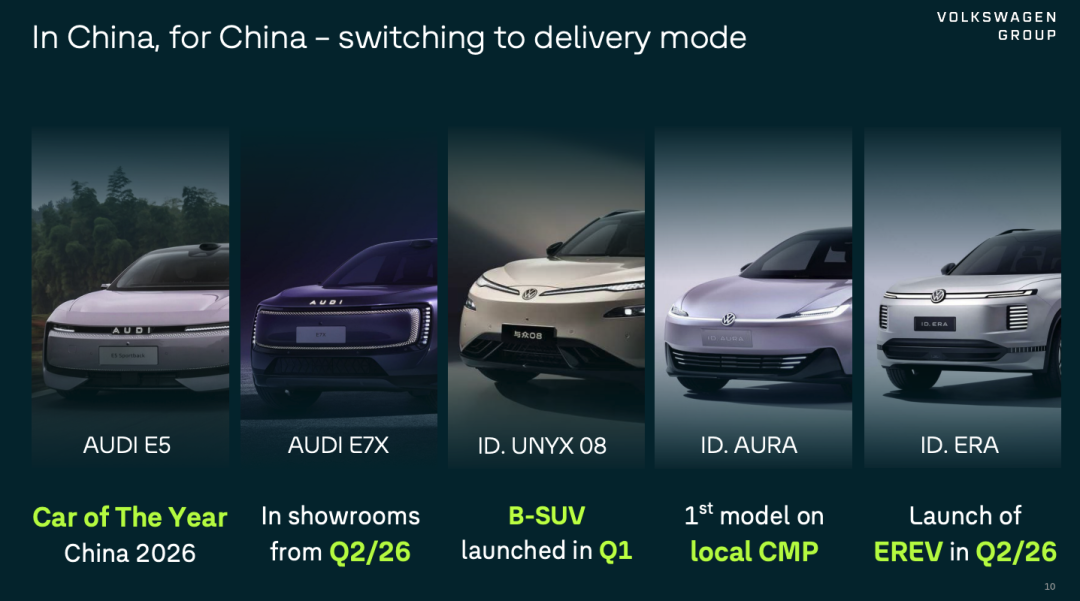
China-Exclusive Models: Over 30 new models will be launched in China by 2027, including extended-range electric vehicles (EREVs) in the second quarter to meet local demand. This year marks a significant year for Volkswagen's new generation of intelligent electric vehicles in China, with changes expected to be visible in Q3 and Q4.
2. Technology Layout
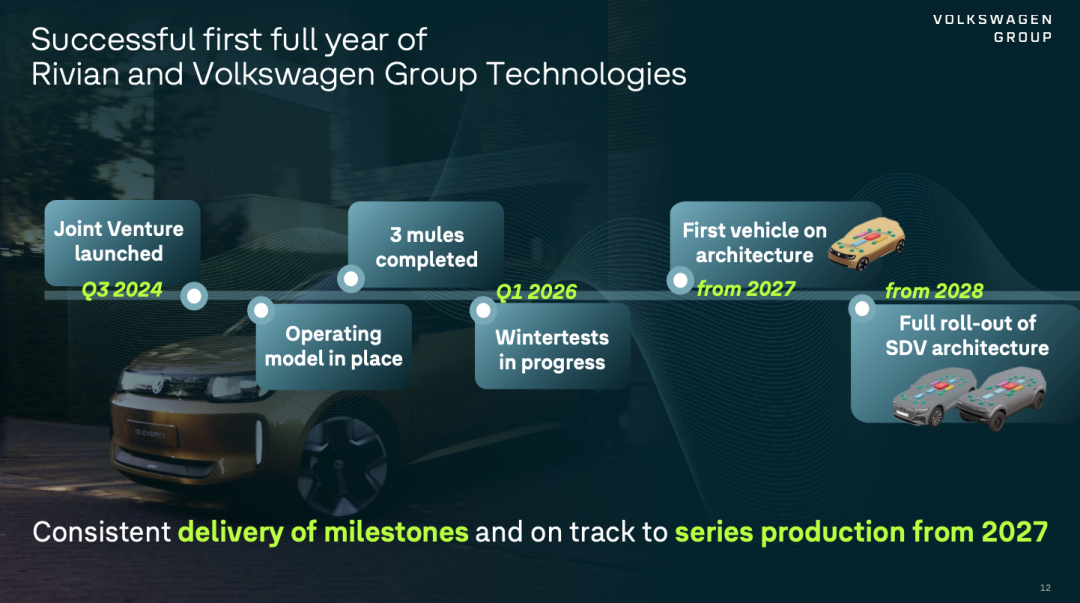
Software and Autonomous Driving: Volkswagen's software and autonomous driving layout (layout) are implemented according to different regional market strategies. In North America, the joint venture with Rivian progressed smoothly in its first year, completing three test vehicles, with the first model based on the new architecture to be launched in 2027.
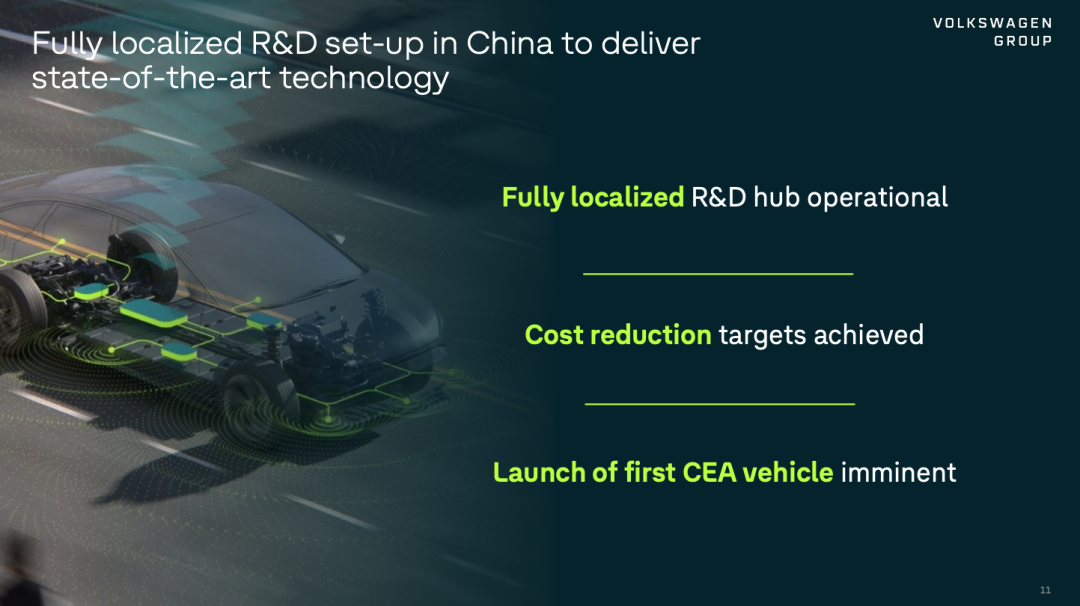
In China, cooperation with Horizon is advancing autonomous driving, with the first model featuring the CEA architecture set to be released.
In Europe, close collaboration with Mobileye and Bosch aims to demonstrate L2+ advanced driver-assistance capabilities comparable to competitors in markets like the U.S. by 2027.
L4 Autonomous Driving and Robo-taxis: Announced plans with Mobileye to expand testing operations significantly in 2026, adding urban road tests in Oslo, Norway, and Berlin, Germany, following initial tests in Hamburg, Germany. Meanwhile, Volkswagen will partner with Uber to officially launch commercial operations in Los Angeles, U.S., this year.
Battery Strategy: PowerCo's battery factory in Salzgitter officially commenced production, marking a crucial step for Volkswagen to reduce reliance on Asian battery suppliers and achieve cost reduction and efficiency gains.
III. Regional Strategic Adjustments
1. Chinese Market
Quoting Volkswagen Group's CFO at the earnings release: "We face immense competition from over 150 competitors, so nothing is guaranteed. We've entered a situation where 'we must stay at the table.'" In China, Volkswagen has fully shifted to a defensive stance to remain in the game.
"In China, For China": Fully localized R&D centers are now operational.
Profit Expectations Continue to Decline: In 2025, the pro-rata operating profit from Chinese joint ventures was just €958 million. More pragmatically (or harshly), facing intense competition from over 150 automakers, Volkswagen expects joint venture profits to further shrink to between €200 million and €600 million in 2026. Volkswagen's heyday in China may indeed be hard to reclaim. The group expects profit recovery in China to be visible only by 2027.
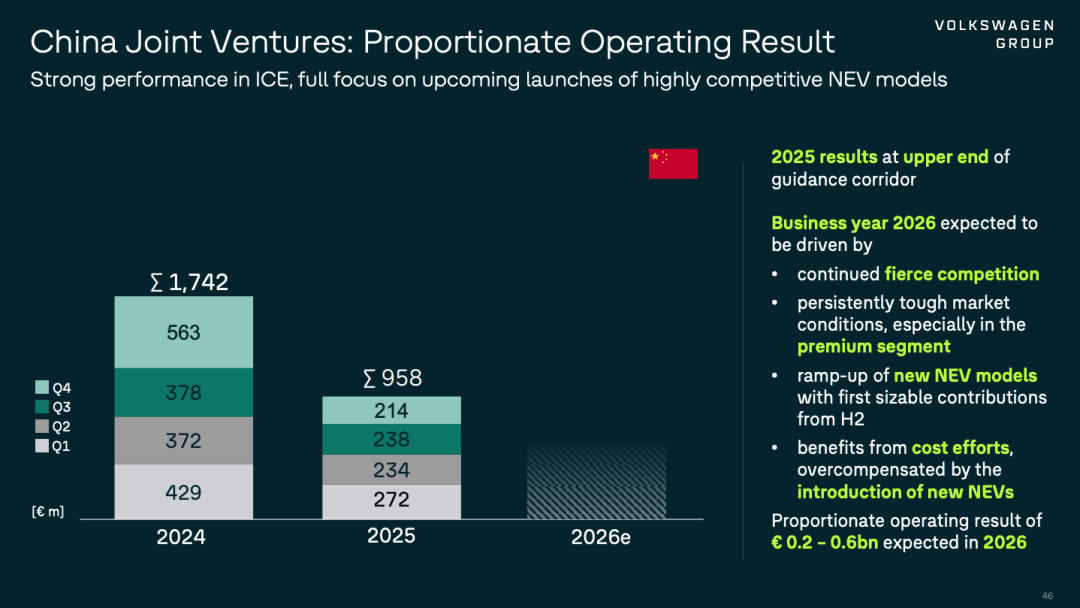
For insights into Volkswagen's 2025 performance in China, refer to our previous article "The Resilience and Cost of Volkswagen Group's Global and Chinese Performance in 2025."
2. North American Market
Local Adaptation: Focus shifts to SUVs, pickups, and hybrid electric vehicles (HEVs).
Scout Brand Adjustments: Due to slowed U.S. demand for BEVs and policy changes, Scout will add extended-range versions, with targets pushed back to 2028. Affected by Mexico's 27.5% export tariffs, Volkswagen's slogan of "achieving 10% market share in North America" has shifted to a long-term vision.
3. European Market
Defensive Counterattack: Consolidate the 19.1% market share advantage in the BEV market. Management clearly states that the European market will face direct impacts from Chinese automakers, necessitating extreme cost reductions (especially at German factories) to counter price wars from Chinese car exports to Europe.
IV. Challenges and Risks
1. External Environment
Geopolitics and Tariffs: This was Volkswagen's most painful lesson in 2025. Porsche, relying 100% on exports, suffered heavily in the Chinese and U.S. markets.
Pressure from Chinese Local Brands: Price wars in the Chinese market have nearly drained the profit pools of joint ventures.
2. Internal Pressures
High Transformation Costs: Despite significant cost reductions, the fixed costs of electrification transformation and the sunk costs of phasing out internal combustion engines make profit margin recovery difficult.
V. 2026 Outlook
Financial Targets: Sales revenue is expected to grow by 0% to 3%. The operating profit margin target is to recover to 4.0% to 5.5%. Automotive investment is to be controlled between 11% and 12%.
Strategic Focus: Firmly execute the "Volkswagen Group Vision 2030" by simplifying the group's management model, reducing complexity, and accelerating cost-reduction measures.
VI. Summary - Keywords for Volkswagen's 2025 and 2026
2025 Keyword: "Breaking the Cauldron and Sinking the Boats." Facing halved profits and tariff blows, Volkswagen did not sugarcoat the situation but chose to clean up "messes" like Porsche goodwill impairment and restructuring severance pay in one year. This was an extremely painful but necessary process of squeezing out excess, demonstrating the credibility and values of this established enterprise, worthy of respect.
2026 Keyword: "Gambling Against the Wind." External uncertainties persist, with cutthroat competition in the Chinese market and trade barriers in Europe and the U.S. becoming the norm. In 2026, the focus for Volkswagen is no longer about reclaiming its peak but whether this "cost-reduction + cash flow preservation" combination can steadily navigate the giant ship through the storm.
References and Images
2026-03-10_Volkswagen_Group_FY25_AMC pdf Volkswagen Group Annual Report Presentation *Unauthorized reproduction and excerpting strictly prohibited-
-
![]()
The Unstoppable Rise of 'Optical Progress and Copper Decline': Sunny Optical’s Strategic Vision for the Next Decade
-
![]()
AI + Going Global in the Second Half: No Intermission for Robot Vacuum Cleaners
-
![]()
The Suffering Endured in E-commerce, Walmart Doesn't Want to Repeat in AI
-
![]()
What Does the Doubling of New Energy Vehicle Exports Mean?
-
![]()
Ghosn: 'Only I Can Save Nissan'
-
![]()
Volkswagen Lays Off 100,000 Employees, The Elephant Sits Down
-
![]()
Expanding Production Capacity! Yutong Optics Acquires Approximately 1.5 Hectares of Industrial Land in Chang'an, Dongguan
-
![]()
Why Is Nokia Making a Comeback in the AI Era?