Mobile Phones Falter, and Now Computers Face Struggles Too, with Prices Projected to Soar by 40%! Netizens: Consumers Are Shouldering the Burden Once Again
 03/12 2026
 554
554
Recently, the mobile phone industry has been thrown into disarray due to escalating prices of upstream memory chips. Manufacturers are not only incessantly bombarding consumers with the notion of significant price hikes for new models, but older mobile phone models have also discreetly seen their prices climb!
It has come to light that in the first half of March, several manufacturers have already implemented price increases for older mobile phone models, with hikes ranging from 100 yuan to 800 yuan. But the story doesn't end there—industry insiders forecast that, owing to frequent fluctuations in memory prices, a pattern of multiple price hikes within a single year could emerge by 2026.
Some dealers have even lamented that prices are fluctuating on a daily basis, making business operations exceedingly challenging! 
One dealer mentioned that after March 15th, both low-end and high-end domestic brand new models will witness price increases of at least 300 yuan. 'The entire market is on the rise, and profit margins are dwindling.'
Another dealer remarked: 'The mobile phone industry is fiercely competitive, relying on cost-effectiveness and subsidies to lure customers. Now, with prices surging and changing daily, fewer people are showing interest in phones. For instance, a phone that originally cost 4,200 yuan now retails for 5,000 yuan—how are we supposed to sell it?'
Naturally, on the consumer front, with the price escalations, an increasing number of users are adopting a wait-and-see approach, leaving only essential purchases in the market. The wave of price hikes has further constrained potential consumer spending, prompting mobile phone manufacturers to reduce shipment volumes. Simultaneously, some manufacturers have reportedly halted the development of flagship products and streamlined their product lines. 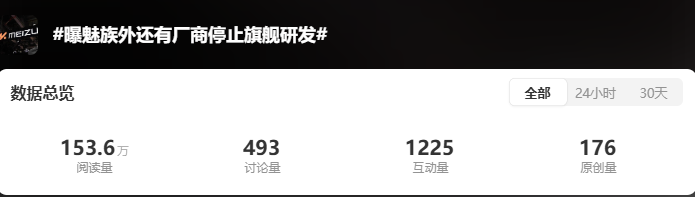
Beyond the realm of mobile phones, computer price hikes are also gaining momentum, with increases even more substantial than those for mobile phones.
Today, related topics have also surged on the hot search list—computer prices may surge by over 40%. 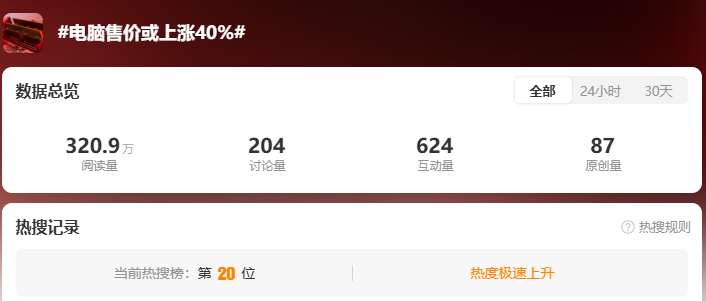
According to the latest report from TrendForce's notebook industry research, the global notebook market in 2026 is grappling with dual pressures of sluggish demand and escalating costs. In addition to rapidly rising memory prices, CPU prices have also commenced their ascent.
The agency posits that if brand manufacturers and distributors aim to maintain their previous profit structures, mainstream models with a suggested retail price of 900 USD would necessitate an increase of around 40%.
In essence, either manufacturers must sacrifice their profit margins, or they must transfer the increased costs onto consumers.
Upon encountering this news, numerous netizens, without prior consultation and quite coincidentally, expressed identical viewpoints: 'Are we shifting our speculative focus from real estate to electronics now?' 'I'm perplexed—are we no longer speculating on real estate?' 'This rhetoric bears a striking resemblance to real estate speculation.' 
'Suddenly, it seems as though we've ceased speculating on real estate and have commenced hyping up electronics instead.' 
Some netizens also pointed out that these terminal manufacturers already enjoy substantial profit margins on their products. Now, with upstream costs on the rise, it appears that manufacturers are reluctant to sacrifice their profits and are instead passing on all the increased costs to consumers without incurring any losses themselves.
Other netizens questioned whether, once upstream prices decline, these manufacturers would lower their prices accordingly. It increasingly gives the impression that this wave of price hikes is a coordinated scheme between terminal and upstream manufacturers.
More netizens simply stated that if prices continue to rise, they will refrain from purchasing—after all, unless one is a gamer, there isn't much need for a high-performance computer.
In reality, manufacturers are also grappling with this wave of price hikes. After all, both mobile phones and computers are becoming increasingly difficult to sell amid the price escalations, especially in the computer market, where sales pressure is already immense. Another round of price hikes would only exacerbate the situation.
Omdia predicts that global PC shipments will decline by 12% year-on-year in 2026, plummeting to 245 million units. If memory supply risks deteriorate further, the decline could surpass 15%.
Chaigoufski©
Edited by | Tan Song
END
-
![]()
Hardware is the skeleton, AI is the soul, and data integrates the two
-
![]()
China’s AI Industry: A Unified Pivot Towards Monetization?
-
![]()
New Progress! Infineon Completes Acquisition of ams OSRAM's Non-Optical Sensor Business
-
![]()
35 Million Bet on an Optical Future! Tengjing Technology Makes a Move in AR
-
![]()
Why World Models Get Stuck on Construction Roads in Autonomous Driving Applications
-
Alibaba Initiates Cultural Transformation: Is Jack Ma Making a Strategic Comeback?
-
Tianfeng Heads to Hong Kong for IPO with RMB 3.8 Billion in Funds: Xingyu's Cross-Border Foray into Embodied AI Faces Uncertain Future
-
![]()
Mengshi Auto’s High-End Aspirations Dashed: Huawei Partnership Fails to Revive Sales, New Model’s Entry Price Dips Below 300,000 Yuan