NIO Has Earned the Right to Survive
 03/12 2026
 468
468
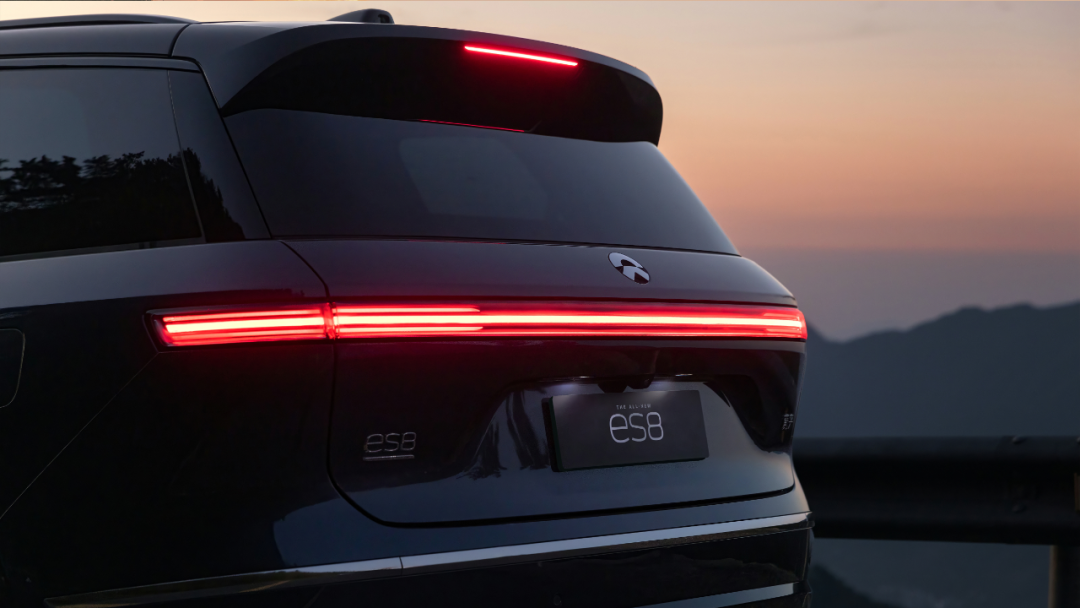
"We need to do this to prove ourselves," said Li Bin.
Author I Zhang Wen
Editor I Jiang Jiao
Cover I NIO
NIO finally achieved quarterly profitability at the end of 2025. After eight years of listing and cumulative losses exceeding RMB 100 billion, the Chinese new energy vehicle company recorded positive net profit for the first time in a single quarter.
On March 10, NIO released its financial report for the fourth quarter and full year of 2025. The report showed that NIO's net profit for the quarter was RMB 282.7 million, with an operating profit of RMB 807.3 million. Under non-GAAP accounting standards, NIO's adjusted net profit for the quarter was RMB 726.8 million, and the adjusted operating profit was RMB 1.2513 billion.
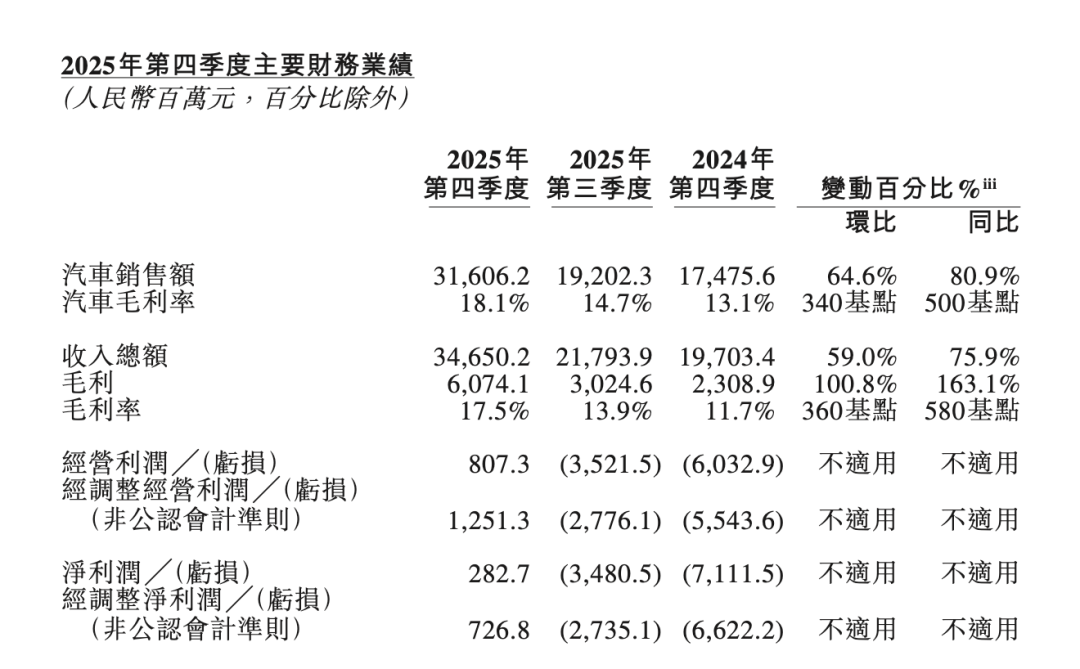
NIO's Financial Report for the Fourth Quarter and Full Year of 2025
Although NIO ultimately failed to achieve its goal of delivering over 50,000 units in a single month last year, other positive news may have been enough to overshadow this flaw.
In the fourth quarter of 2025, NIO's quarterly revenue, deliveries, and total gross profit all reached record highs. The gross profit margins for both complete vehicles and overall operations hit three-year highs. The company achieved positive free cash flow for two consecutive quarters and positive operating cash flow for the full year of 2025.
Following the release of the financial report, NIO's U.S.-listed shares surged 5% in pre-market trading yesterday (March 10) and closed up 15.38%. Today (March 11), NIO's Hong Kong-listed shares also soared by over 14%.
Li Bin could hardly conceal his delight during the financial report conference call. Over the past year, he had repeatedly set the goal of quarterly profitability on various occasions, and now he had finally fulfilled his promise. He declared that the company had officially entered the third stage of development and would embark on a new cycle of rapid growth. NIO's new operational goal is to achieve full-year Non-GAAP profitability in 2026.
The fact that an automaker took more than a decade to finally achieve single-quarter profitability may not prove much, except for how poorly the company had been managed in the past.
Many people have used Tesla as an example to defend NIO—Tesla also took 10 years to achieve its first quarterly profit. However, Tesla was in a completely different stage of development. When Tesla was founded in 2003, new energy vehicles seemed like a far-fetched idea. By the time NIO was founded in 2014, Tesla had already released the Model S and Model X and had officially started deliveries in China.
Compared to its domestic peers in the new energy vehicle sector, NIO's best-ever financial report is not even particularly impressive. NIO's gross profit margin for complete vehicles reached 18.1% in the quarter, a level that Li Auto had already achieved three or four years ago. Xiaomi Motors, which began manufacturing cars just three years ago, exceeded a 20% gross profit margin for complete vehicles in the fourth quarter of 2024.
But for NIO, which had been mired in losses for so long, achieving quarterly profitability for the first time at least proved that it had earned the right to survive. It's not that losses are terrifying—especially considering that Li Bin is probably the most adept CEO in China at raising funds—but prolonged losses can undermine market, user, and even industry confidence in NIO.
In an interview with the media last year, Li Bin said that the losses shown in the financial reports affected them in every aspect, impacting user conversion rates, recruitment, and the supply chain, among others. Therefore, proving that they could be profitable at this appropriate time was crucial.
"Profitability isn't just for show. We know that at this point, we need to do this to prove ourselves," Li Bin said.
How Did NIO Achieve Quarterly Profitability?
NIO is one of the most loss-making Chinese new energy vehicle companies. Over the past eight years since its listing, NIO has accumulated operating losses of RMB 104 billion, averaging RMB 13 billion per year, or roughly RMB 35.61 million in losses per day. In the worst years, 2023 and 2024, NIO incurred annual losses of RMB 22 billion.
LatePost once measured NIO's rate of money loss using the price of gold, stating that the company was losing money faster than the same period price of gold, "Every second is worth its weight in gold."
Even though NIO's annual losses in 2025 hit a four-year low, they still reached RMB 14.041 billion. This was despite achieving profitability in the fourth quarter. If we only look at the first three quarters, NIO's cumulative operating losses amounted to RMB 14.849 billion, averaging RMB 5 billion in losses per quarter. In comparison, during 2020-2021, NIO's annual losses were only around RMB 4 billion.
No wonder Li Bin said internally in the middle of last year that when he first proposed the goal of quarterly profitability in the fourth quarter, the proportion of people who believed in this target was probably less than 1%—Li Bin shouted the slogan of quarterly profitability in the first quarter of last year, when NIO's quarterly losses hit a record high, with a loss of RMB 6.4 billion in a single quarter and sales of only 42,000 units, practically at a critical juncture.
But why, three quarters later, did NIO miraculously turn around? Over the past year, NIO's quarterly operating losses gradually narrowed, falling from RMB 6.4 billion and RMB 4.9 billion to RMB 3.5 billion, and finally achieving an operating profit of RMB 800 million in the fourth quarter, silencing external skepticism.
One aspect is the improvement in the sales structure. In the past few years, the majority of NIO's sales came from the 5566 models, including the NIO ET5/5T and NIO ES6/EC6, which accounted for about 90% of NIO's annual sales in 2023. Meanwhile, sales of NIO's high-priced models like the ES8 failed to make significant breakthroughs. The second brand, LeDao L60, which NIO had high hopes for, also underperformed, leading to the dismissal of Ai Tiecheng.
The change came after the launch of the LeDao L90 and the all-new NIO ES8. Both models abandoned NIO's previous high-end strategy and began emphasizing cost-effectiveness, boosting NIO's sales in the second half of the year.
The LeDao L90 was priced as low as RMB 265,800, and when purchased through a battery leasing plan, the price was less than RMB 200,000, turning around the sluggish sales of the LeDao brand. The all-new NIO ES8, launched in September, continued the strategy of "more for less," with a starting price about RMB 100,000 lower than the previous model, and the battery leasing purchase price dropped to RMB 300,000.
Last year, NIO delivered a total of 326,028 vehicles, a year-on-year increase of 46.9%, a record high. Among them, fourth-quarter vehicle deliveries reached 124,807 units, a year-on-year increase of 71.7%.
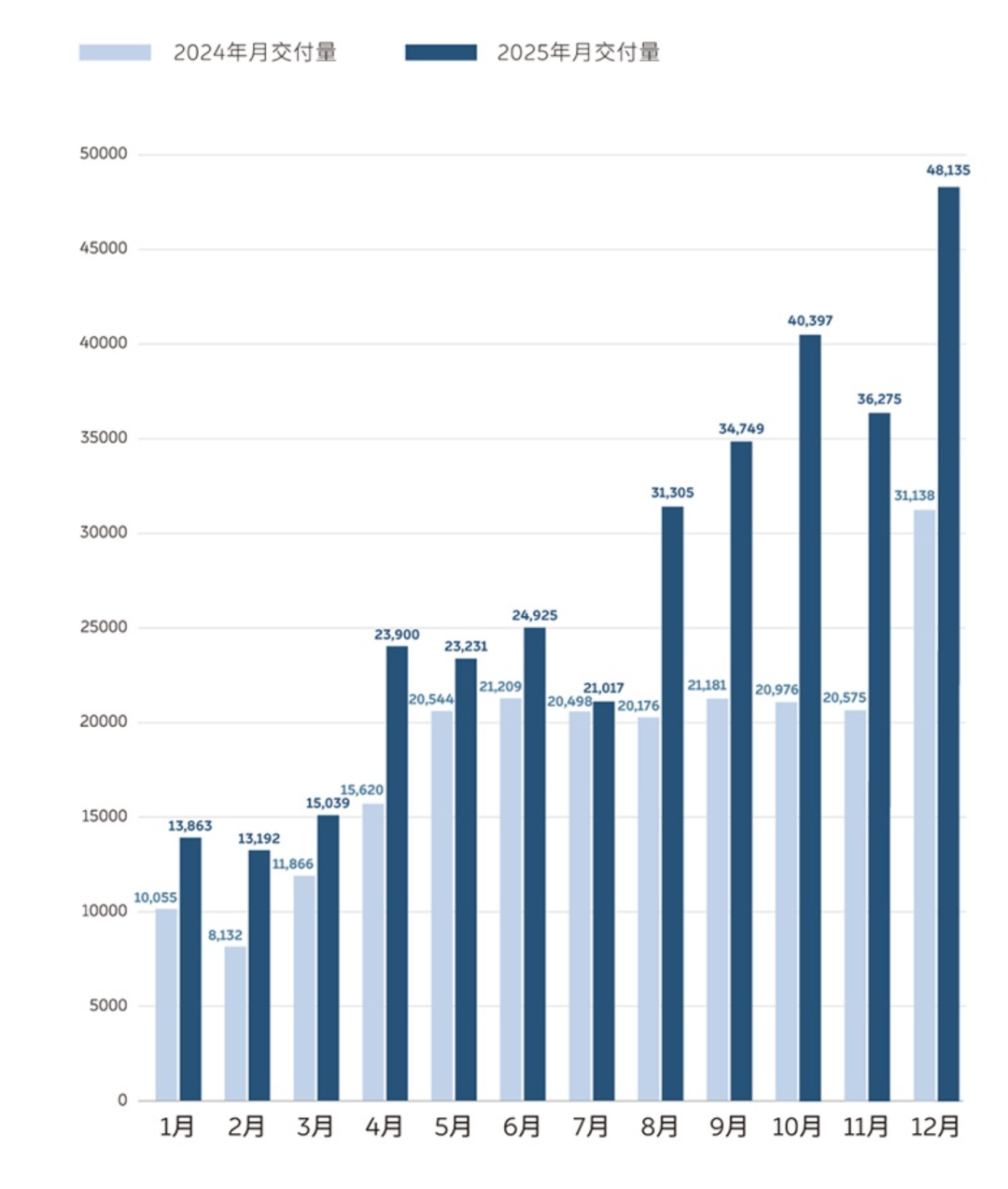
NIO's Monthly Delivery Statistics
The NIO ES8 contributed significantly, achieving 70,000 deliveries in just 160 days after its launch. According to data from the China Passenger Car Association, the NIO ES8 won the sales championship for large SUVs and vehicles priced over RMB 400,000 for three consecutive months (from December last year to February this year). The LeDao L90 also performed well, with NIO claiming it as the sales champion for pure electric large SUVs in 2025.
Driven by high-priced models, NIO's automotive sales revenue reached RMB 31.606 billion in the fourth quarter of last year, a year-on-year increase of 80.9%. Gross profit for the quarter increased by 163.1% year-on-year to RMB 6.074 billion, and the gross profit margin for vehicles also hit a three-year high of 18.1%, compared to just 13.1% in the same period last year.
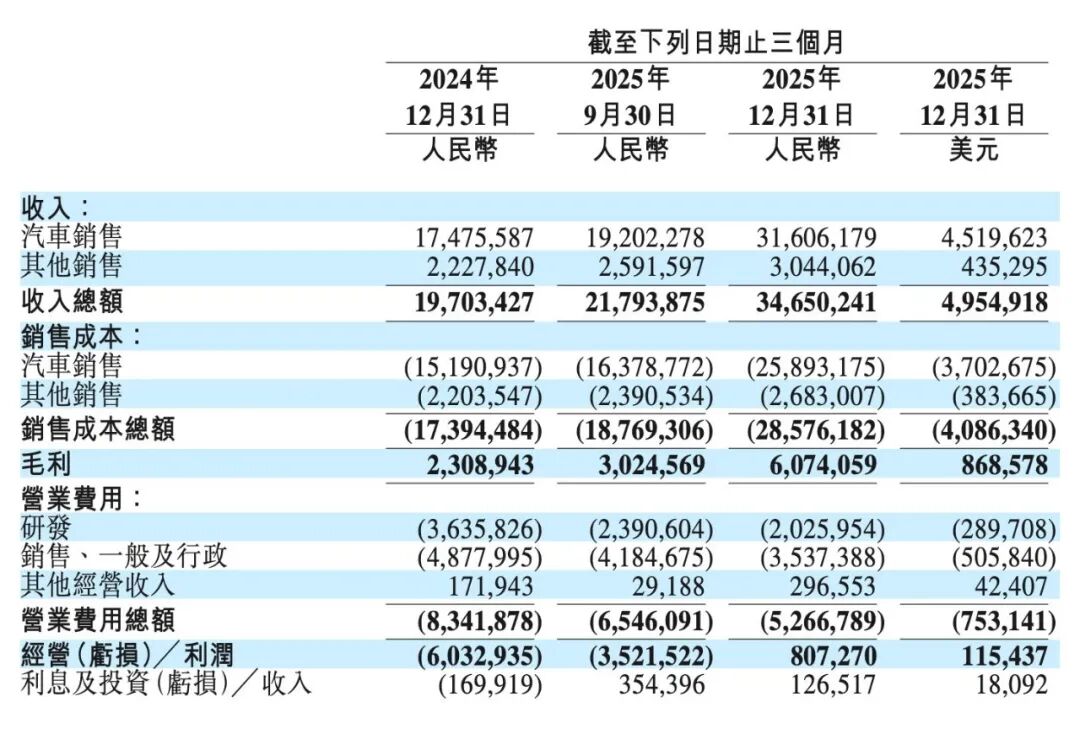
NIO's Financial Report for the Fourth Quarter and Full Year of 2025
While revenue increased, NIO also significantly tightened its costs and expenses. Early last year, Li Bin proposed an organizational reform called the CBU mechanism (Basic Business Unit) internally, emphasizing cost reduction and efficiency improvement. At the time, 36Kr cited sources close to NIO's management as saying, "The new mechanism requires that every penny invested must yield results."
Reflected in the financial report, NIO's R&D investment continuously decreased in the first three quarters of last year. Quarterly R&D investment remained at RMB 3 billion in the first half of the year but was cut to RMB 2.39 billion in the third quarter and further reduced to RMB 2.026 billion in the fourth quarter. Selling, general, and administrative expenses also declined, falling from RMB 4.4 billion at the beginning of the year to RMB 3.537 billion by the end of the year.
With these dual efforts, NIO finally achieved an operating profit of RMB 800 million in the fourth quarter of last year, marking its first quarterly profit since listing.
Temporarily Seeing the Light
Achieving quarterly profitability for the first time does not mean that NIO's profitability has stabilized. Even Tesla, after achieving its first quarterly profit in 2013, returned to losses multiple times.
In the fiercely competitive new energy vehicle market, the success or failure of a single model can make or break a company's performance.
Before 2024, Li Auto was once the top-selling new force in China's new energy vehicle market. However, with the failure of the Li Auto MEGA and subsequent pure electric models, Li Auto's growth stalled, with full-year sales in 2025 reaching only 406,000 units, a year-on-year decline of about 19%.
During the financial report conference call, analysts were particularly concerned about NIO's sales growth and gross profit margins in the coming quarters, questioning whether NIO could continue the growth trajectory of the fourth quarter last year and expressing doubts about NIO's cost control—the profitability in the fourth quarter of last year was unusually strong for NIO.
Li Bin said he is very confident in achieving 40%-50% sales growth in 2026. His confidence comes from the launch of large SUV models. This year, they will have five large SUVs on sale, including the administrative flagship NIO ES9, a large five-seat SUV based on the ES8 platform launching in the third quarter, and the LeDao L80 launching in the second quarter, covering the entire high-end large SUV market. Large SUVs can contribute more sales and profits and are more resilient to risks.
However, these models will not be launched until the second quarter or later. In the first quarter of this year, NIO's sales fell back to around 20,000 units per month. NIO's sales guidance for the first quarter is between 80,000 and 83,000 units. Considering that NIO delivered a cumulative total of 47,979 units in the first two months, NIO's deliveries in March are estimated to be around 32,000 to 35,000 units, slightly below market expectations.
However, NIO's revenue guidance is slightly higher than expected, which the market attributes more to the influence of the high-priced ES8 model. NIO CFO Qu Yu explained during the financial report conference call that due to the relatively high proportion of ES8 deliveries in the first quarter, they expect the gross profit margin and vehicle gross profit margin to remain at the level of the fourth quarter last year.
At the same time, they will continue to maintain the cost control measures implemented since the second half of last year. R&D investment for a single quarter in 2026 is expected to be around RMB 2 billion to RMB 2.5 billion, with the full-year level remaining similar to that of 2025. Selling, general, and administrative expenses will be controlled within 10% of total sales revenue.
If NIO's sales can continue the growth momentum since the second half of last year, Li Bin's full-year Non-GAAP profitability target for this year may also be achievable.
In any case, for NIO, they have finally proven themselves in stages. NIO has always adhered to the values of "long-termism," choosing to develop its own chips, build its own battery swap stations, and even develop its own smartphone products. These investments have long been criticized for being too costly and difficult to yield returns in the short term, instead dragging down NIO's performance.
Fortunately, these investments are now showing signs of hope with quarterly profitability. Excluding the suspended smartphone business, NIO's self-developed chip, Shenji, has officially entered mass production and was installed in vehicles, securing RMB 2.257 billion in independent financing in February this year. Although NIO's battery swap strategy is still questioned, the strong sales of models like the LeDao L90 and NIO ES8 since the second half of last year may to some extent prove that the battery leasing purchase method is gradually being accepted by the market.
At the same time as the financial report was released, NIO's board of directors approved the 2026 share incentive plan, granting Li Bin approximately 248 million restricted shares. These restricted shares are divided into 10 equal batches but can only be vested if the company's market value and net profit reach certain targets. The first-stage target is for the company's market value to exceed USD 30 billion, with the final target being a net profit exceeding USD 6 billion. The maximum duration of the share incentive plan is 12 years.
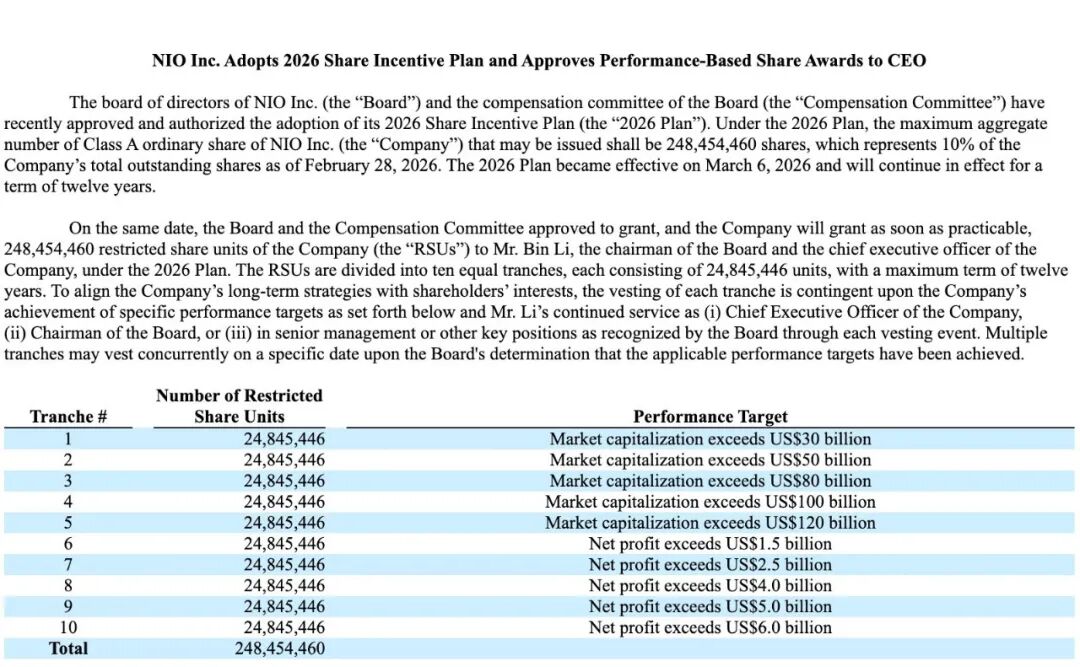
As of yesterday's close of U.S.-listed shares, NIO's market value was approximately USD 13.943 billion. As of December 31, 2025, NIO's current liabilities still exceeded its current assets.
© All rights reserved by Shanshang. No reproduction without authorization.
-
![]()
The Unstoppable Rise of 'Optical Progress and Copper Decline': Sunny Optical’s Strategic Vision for the Next Decade
-
![]()
AI + Going Global in the Second Half: No Intermission for Robot Vacuum Cleaners
-
![]()
The Suffering Endured in E-commerce, Walmart Doesn't Want to Repeat in AI
-
![]()
What Does the Doubling of New Energy Vehicle Exports Mean?
-
![]()
Ghosn: 'Only I Can Save Nissan'
-
![]()
Volkswagen Lays Off 100,000 Employees, The Elephant Sits Down
-
![]()
Expanding Production Capacity! Yutong Optics Acquires Approximately 1.5 Hectares of Industrial Land in Chang'an, Dongguan
-
![]()
Why Is Nokia Making a Comeback in the AI Era?