Insta360 Joins Forces with ByteDance to Unveil Wireless Microphone! Designed for Vibe Coding Scenarios, Will Developers Start Coding with Their Voices?
 04/29 2026
 530
530
“Shh! Keep it down; don’t disrupt my Vibe Coding session.”
Insta360 has just announced its financial results for the first quarter of 2026, reporting an operating income of 2.481 billion yuan, marking an impressive year-on-year increase of 83.11%. However, the net profit attributable to shareholders of the listed company was 84.6202 million yuan, experiencing a notable year-on-year decrease of 52.02%. The surge in revenue coupled with a sharp drop in profit can be attributed, in part, to Insta360's aggressive expansion strategy. After ramping up its drone efforts to challenge DJI's dominance, Insta360 is now accelerating the release of new products in its wireless microphone lineup.
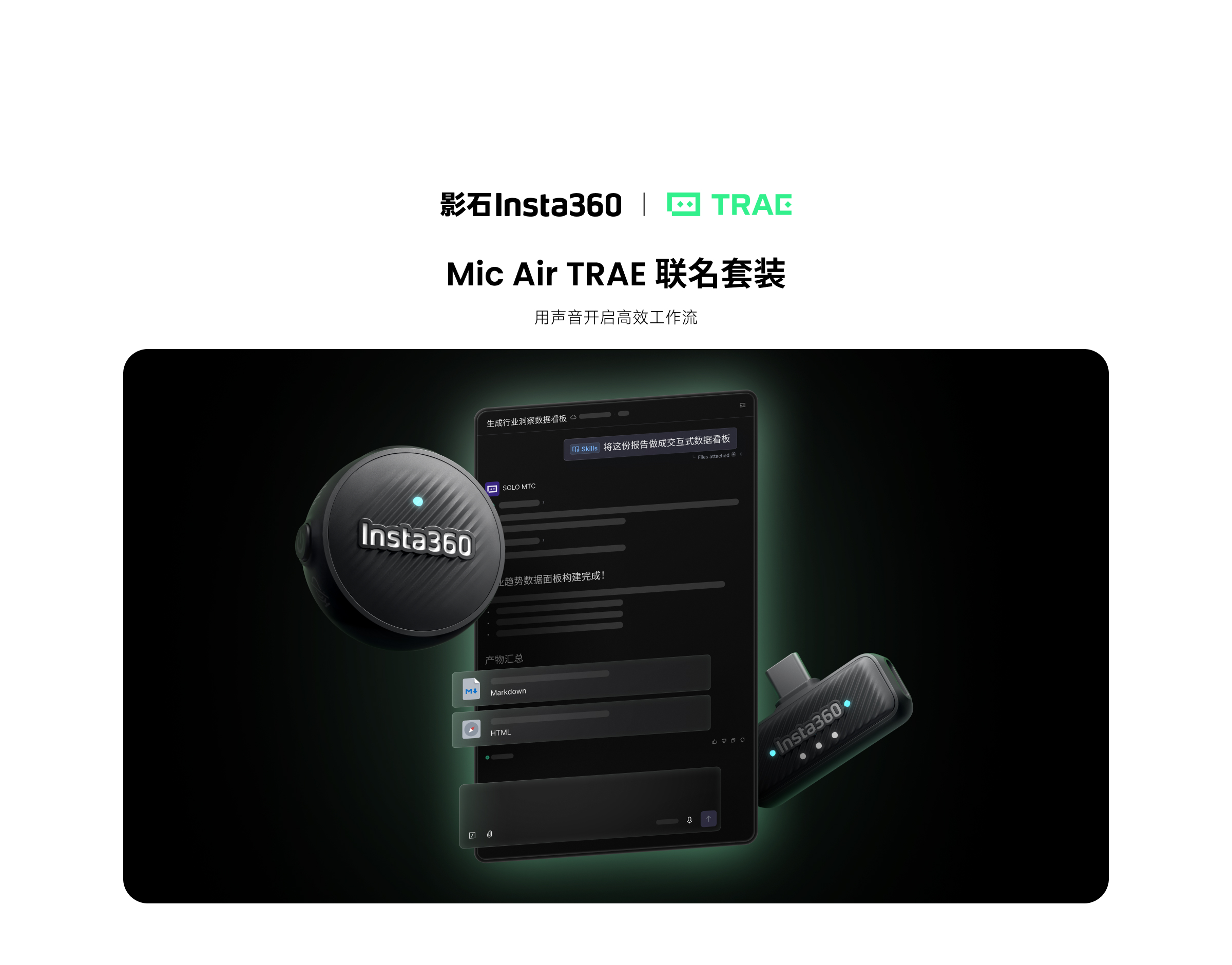
On April 27th, Insta360 collaborated with TRAE, an AI programming product developed by ByteDance, to launch the "Mic Air Microphone Suite for Vibe Coding."
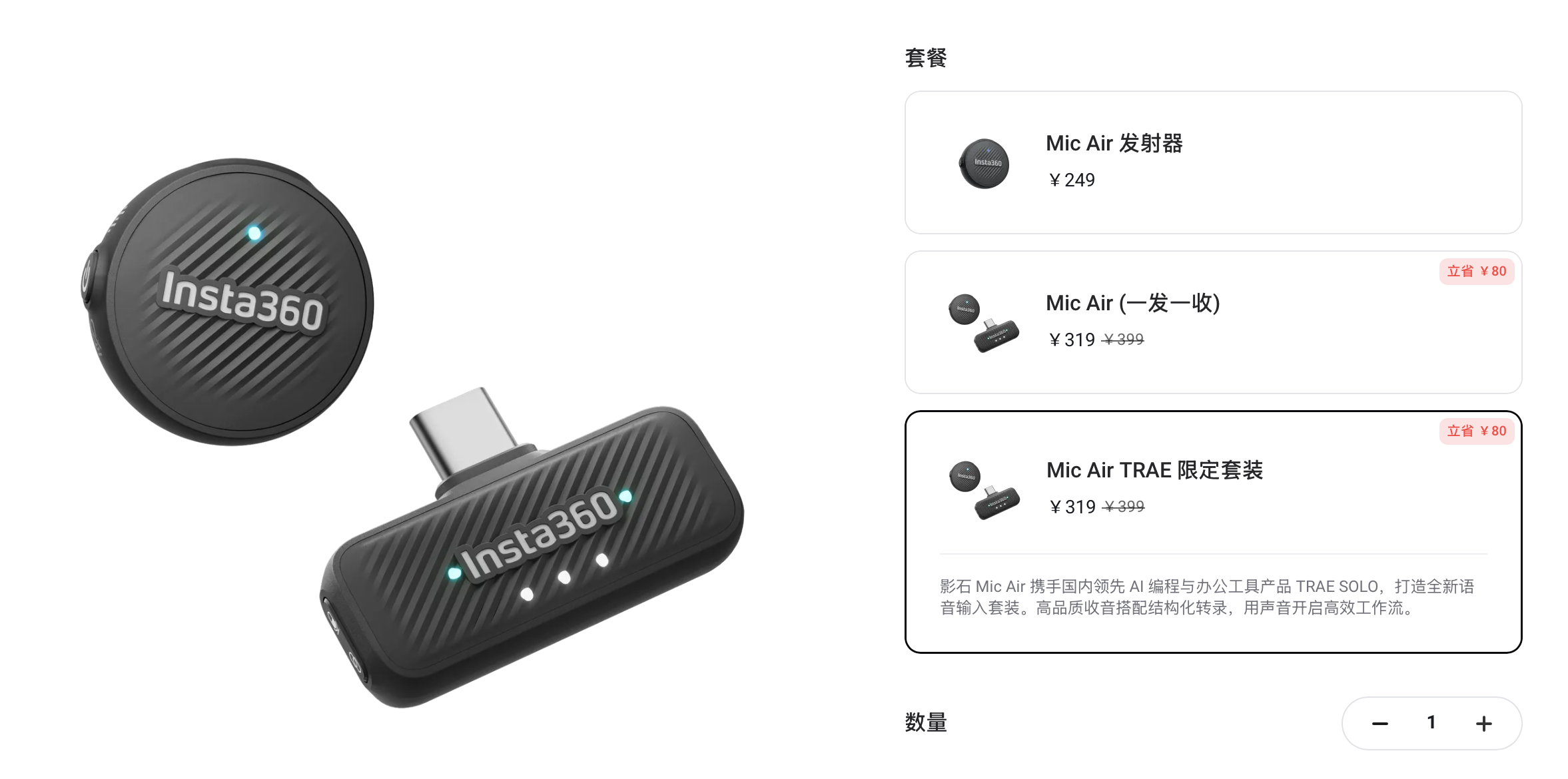
Image Source: Insta360
To be honest, when we at Leitech first laid eyes on the product details, even as a platform well-versed in AI hardware products, we were somewhat taken aback. Let's set the stage: Vibe Coding refers to a programming approach where you articulate your requirements to AI, then sit back with a cup of coffee while the AI generates the code for you.
So, how does Vibe Coding tie in with microphones? According to the introduction, this specialized Mic Air boasts "three major advantages": its high sampling rate and AI noise reduction ensure that the computer accurately captures user commands, its compact and lightweight design allows users to position Mic Air near their mouth for discreet speech, and its 10-hour battery life supports extended work sessions.
Does this bring to mind the night in May 2018 when Luo Yonghao showcased TNT's "voice summation" at the Bird's Nest?
“Shh! Keep it down; don’t disrupt my TNT.” If Luo Yonghao had had access to Mic Air eight years ago, could the subsequent "Understanding Forever" incident have been averted?
Voice Control for Work Computers: A Dubious Proposition
Although Mic Air is marketed under the "Vibe Coding" banner, Leitech views this product as more of a "conceptual peripheral" that's been forced into the AI market to capitalize on the AI trend.
Firstly, as a "Vibe Coding microphone," Mic Air lacks any irreplaceable technological advantages: its 48kHz sampling rate, AI noise reduction, and long battery life are essentially standard features of professional lavalier microphones, with no direct connection to AI or Vibe Coding.
For developers, existing built-in laptop microphone arrays or professional noise-cancelling headphones already adequately support speech-to-text needs in quiet indoor environments. Even if a laptop's built-in microphone quality is subpar, a headset with an independent microphone or a pair of mainstream TWS or open-ear headphones can better address the issue. After all, a company that permits "voice-based Vibe Coding" in an open office would certainly allow the use of noise-cancelling headphones during work.
Considering these factors, Leitech believes that developers purchasing a dedicated microphone to hang near their mouth for "Vibe Coding" is akin to university students buying an iPad specifically for note-taking during exams: the "goal" and "means" are largely disconnected.
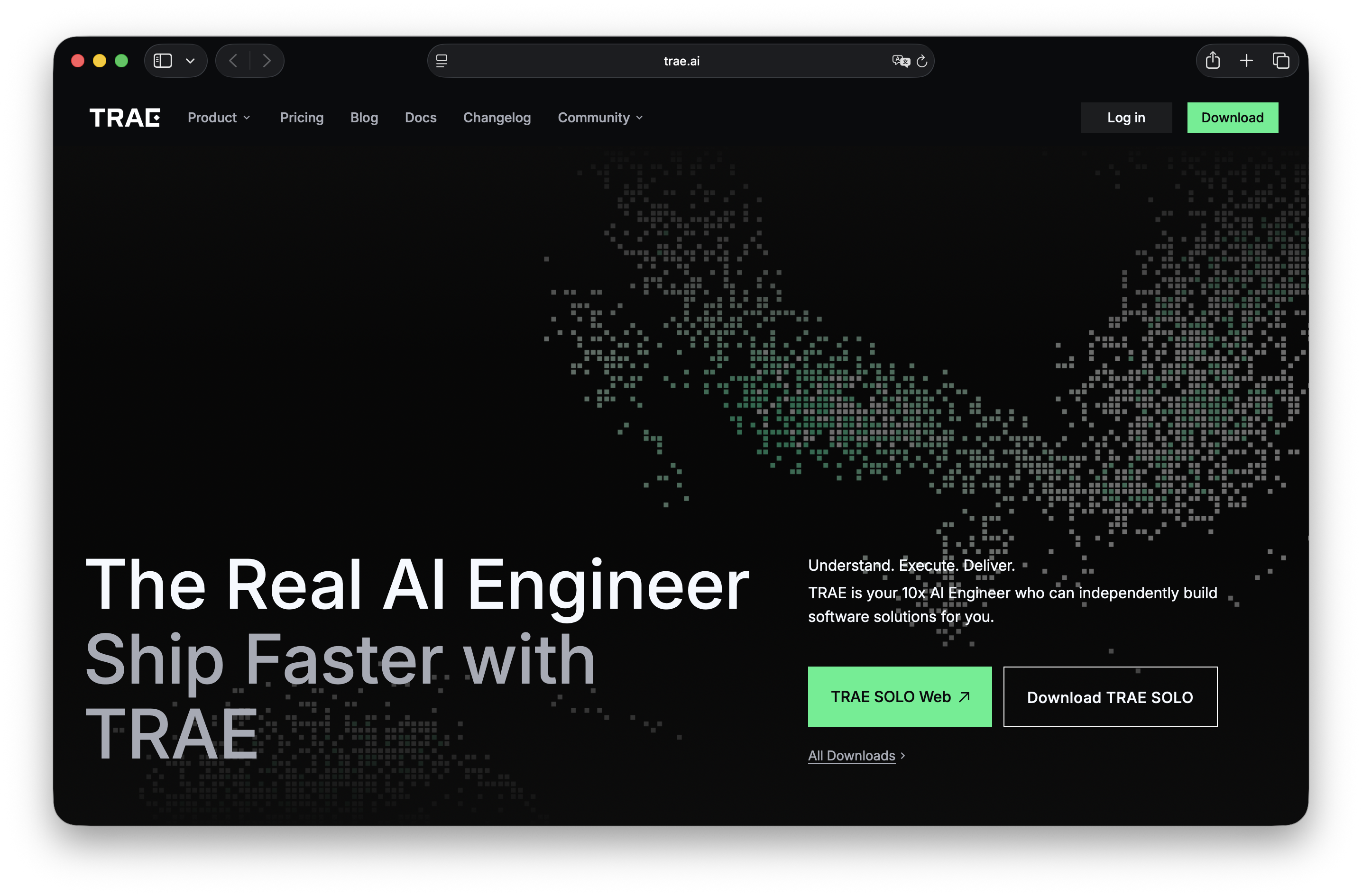
Image Source: TRAE
On a positive note, the Insta360 Mic Air TRAE suite includes access to the TRAE AI programming platform, and its pricing remains consistent with standard Mic Air transceiver suites, avoiding the AI concept premium seen with last year's AI peripherals. At least on this point, Insta360 fundamentally differs from last year's "AI mice."
Of course, considering Insta360's product strategy, Leitech doesn't believe Insta360 is a peripheral brand that needs to hype AI capabilities through Vibe Coding. This Mic Air collaboration with TRAE is likely just a "co-branded" event; once the TRAE platform officially launches and becomes widely available, this co-branded suite will likely be discontinued.
However, from another perspective, the release of the Mic Air AI Programming Suite compels us to consider a question crucial to the future direction of internet products: In the AI era, what kind of interaction methods do we truly need?
Multimodal Interaction + Agent: The True Solution for AI Interaction
In Leitech's view, voice interaction is highly convenient in daily scenarios (e.g., driving, walking, lying down to use a phone) but highly inefficient in work settings.
Firstly, from an information density perspective, speech contains numerous fillers, repetitions, pauses, and other "non-informative elements," resulting in lower information density than text (here we discuss only information density, not input speed). For inherently unstable AI services, lower information density amplifies distortion during information processing.
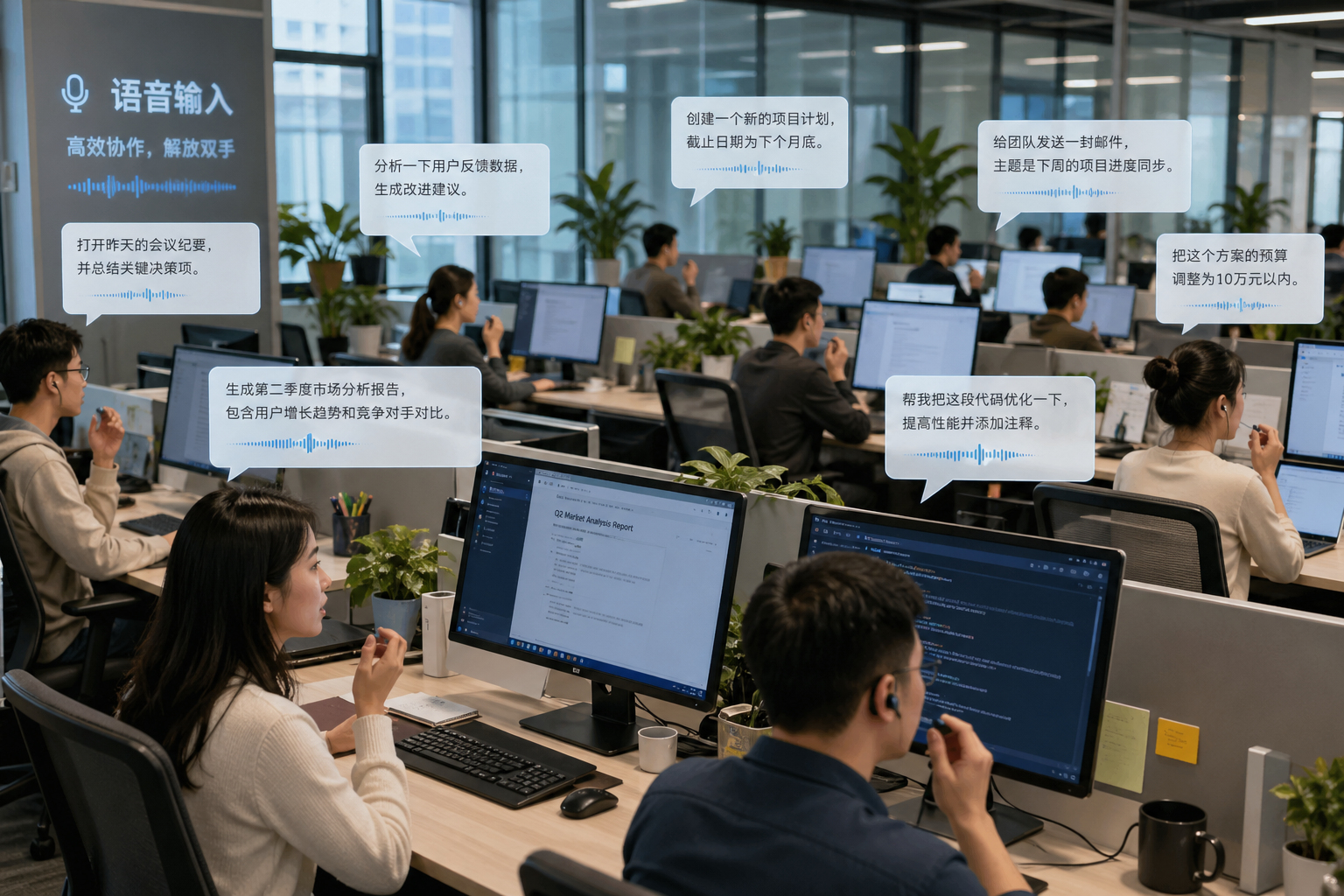
Image Source: Generated by Leitech using ChatGPT
Moreover, voice input is highly "exclusive"—a group of developers speaking simultaneously in a confined space will create overlapping sound energy, even if each tries to speak softly. Additionally, people unconsciously raise their voices amid background noise, inevitably turning the office into a lively environment.
Considering language logic differences and security risks in voice input, Leitech believes that at least in work settings, AI interaction based solely on voice remains a dubious proposition.
If voice interaction is flawed in office scenarios, what kind of AI interaction do we truly need?
In Leitech's view, current PC-side AI has evolved to a stage of "multimodal input + Agent automatic execution." The truly efficient interaction method should involve "point-and-click" visual/pointer input (precise targeting) combined with AI-predicted proactive options.
The multimodal + AI Agent model means AI has transcended "text box" limitations, enabling proactive "perception" and execution. Thus, we shouldn't view AI interaction through the outdated lens of "text window + voice input."
In Vibe Coding scenarios, the most efficient action isn't dictating prompts into a microphone but selecting code with a cursor (or capturing visual focus with an eye-tracking camera). Upon receiving input, the AI Agent proactively infers the user's "intent" and provides corresponding quick options, allowing users to click or voice-select the next step. The Xiaoyi Contextual AI in Leitech's recent Pura X Max experience adopts this "AI-predicted next action" model, delivering an outstanding user experience.
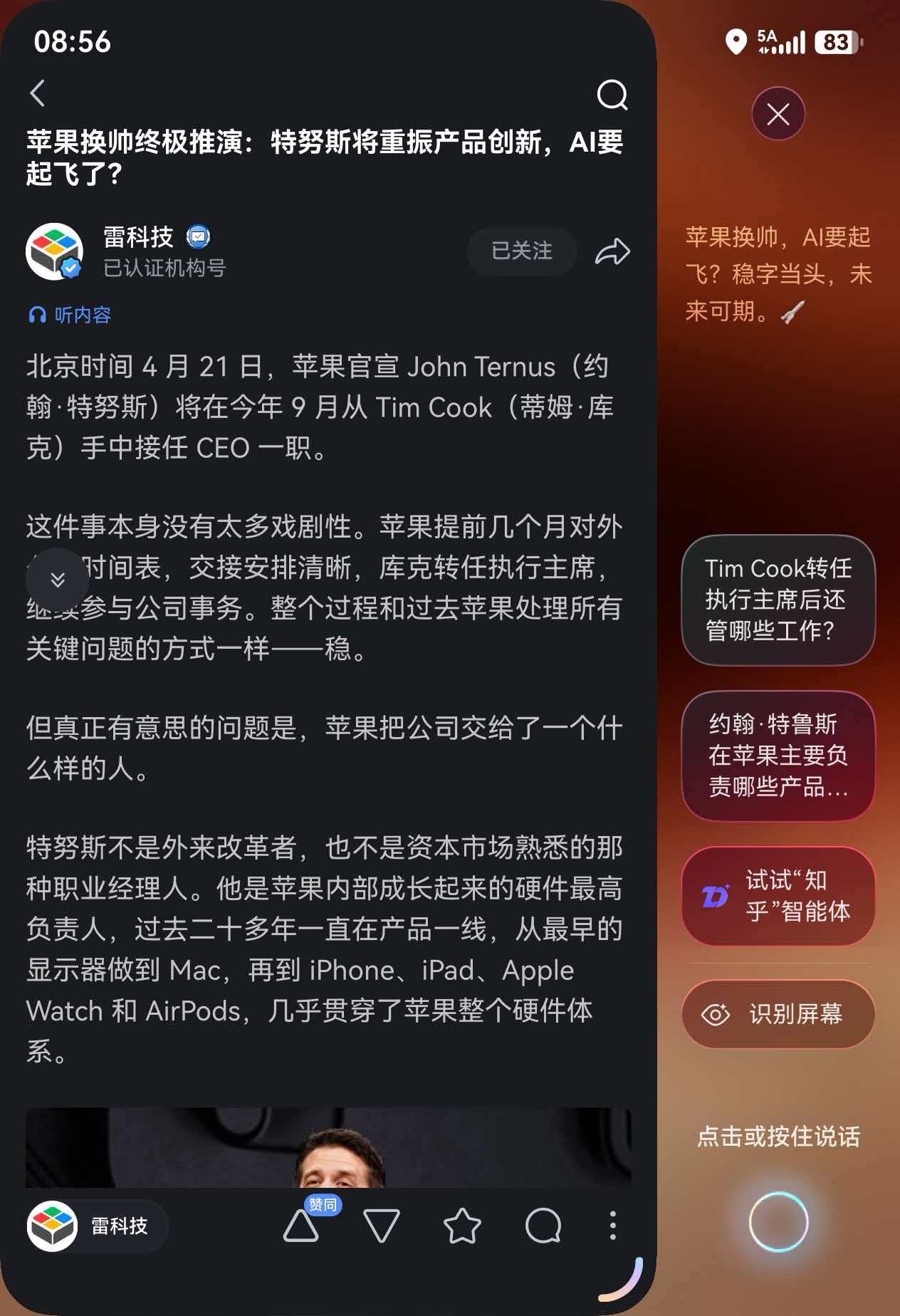
Image Source: Leitech
The TNT's universal ridicule back then wasn't due to issues with touch selection + voice commands but because natural language understanding models at the time couldn't execute "accurate operations" through "fuzzy voice commands." However, today's rapidly evolving AI Agents can complete tasks without requiring users to speak at all.
As long as future AI Agents can proactively respond and reduce reliance on user input "precision," voice input, cursor clicks, or shortcut selections can all provide complete services—just in different contexts.
One could say the 2018 TNT truly appeared in the "wrong era."
DJI, Hollyland, and Insta360 Compete in the Wireless Microphone Arena
However, in Leitech's view, Insta360's release of the "TRAE Programming Suite" can also be seen as a charge by a "new peripheral brand" into productivity scenarios in the AI era.
Over the past few years, the wireless lavalier microphone market has experienced explosive growth driven by the short video and live-streaming boom. "Rising stars" like DJI and Hollyland have seized significant market share from professional audio brands like Rode, Sony, and Sennheiser by offering superior sound pickup and noise reduction, longer battery life, more stable wireless transmission, smaller form factors, and lower prices.
Recently, after Zhang Xue's motorcycle racing championship victory, media interviews showed him wearing multiple microphones (primarily DJI Mic), vividly illustrating wireless mics' status in the influencer era.

The DJI Mic series on Zhang Xue's neck has nearly set the standard for "user-friendly wireless microphones." Buying a Pocket camera with a DJI Mic set has become default equipment for domestic video creators. Last week, DJI released the new DJI Mic mini series, enhancing "aesthetic" design alongside hardcore performance upgrades, striving to change the public perception of lavalier mics as mere "black boxes" and pursuing "artistic value"—more importantly, colorful designs allow the product to blend with the speaker (interviewee), avoiding visual intrusion and distraction.
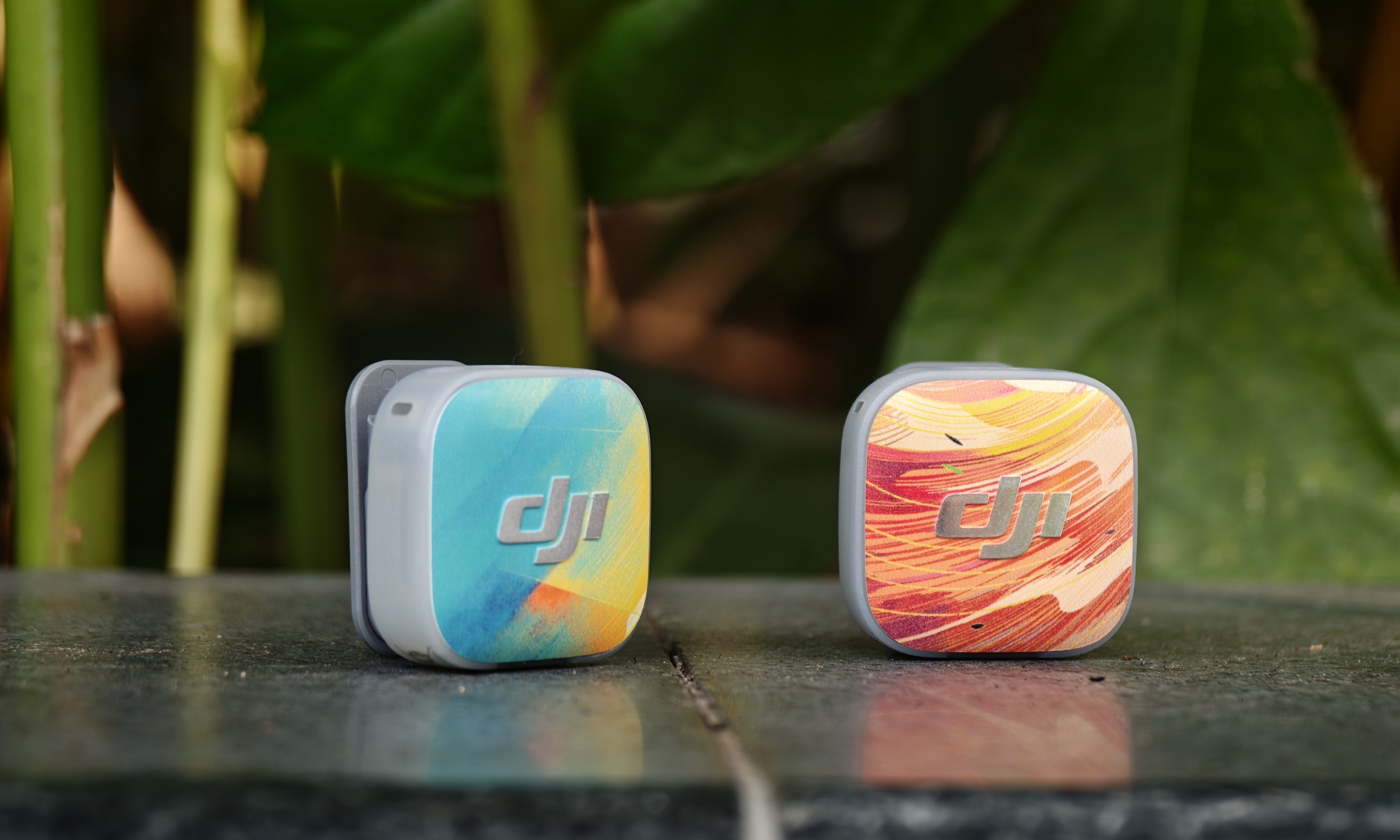
Image Source: Leitech
Hollyland's product strategy differs slightly from DJI's, adopting an "industry-grade technology democratization" approach. Leveraging its rich technical accumulation in film and broadcasting, Hollyland has become a formidable player in lavalier microphones. DJI's Wang Tao even directly listed Hollyland as a key competitor in a LatePost interview.
However, the video shooting peripheral market is already saturated—every blogger with shooting needs might own two or three microphone sets. Even Xiaolei, who only films racing videos, owns three cameras and two microphones. In the era of AI-generated videos, growth in truly naive video users with shooting needs is slowing.
In other words, in the lavalier microphone market, hardware competition has reached its limits—everyone offers noise reduction, touch controls, and ultra-long battery life, leaving only aesthetics, pricing, and stability as differentiators.
Insta360's "crossover" into AI programming suites essentially seeks new markets in "non-videography scenarios," avoiding direct competition with DJI and Hollyland. Although still applicable to "creation," the "Vibe Coding microphone" identity expands Insta360 Mic Air's market reach to more non-core users (video creators).
The collaboration with TRAE also artificially creates new differentiators beyond traditional hardware performance. True, after TRAE's official launch, microphones from other brands will enter the market. However, while competitors struggle to build differentiated experiences and user loyalty among developers, Insta360 has already established a user base.
Undeniably, office voice interaction remains a dubious proposition, but this approach of exploring new scenarios and markets is a necessary step for microphone manufacturers amid intense competition.
Ultimately, the emergence of "AI hardware" like the Insta360 Mic Air TRAE Limited Edition represents a "breakthrough" behavior by video-era brands in the AI era. With sharper market sensitivity and more focused product lines, crossover players like Insta360—and even other emerging peripheral brands—will inevitably leave arrogant "peripheral giants" like Logitech far behind.
The era of AI Agent-driven PC interaction deserves to be defined by Chinese brands.
Insta360, DJI, ByteDance, Wireless Microphones, Hollyland
Source: Leitech
Images in this article come from: 123RF Royalty-Free Image Library
-
Why Doesn’t Map-Free Intelligent Driving Rely on SLAM for Local Semantic Mapping?
-
![]()
Ali’s HappyHorse Makes Its Debut, Overseas Users Advocate for Open Source
-
![]()
How Will the European Automotive Industry Improve Cost Models to Address New Market Volatility?
-
Final Verdict: Geely’s Interim Triumph in Overseas Patent Dispute Offers Strategic Insights for Chinese Automakers
-
![]()
2026 Beijing International Automotive Exhibition | Foreign Capital Retreats, Chinese Capital Advances: China's Auto Industry Steps into the 'Home Field Era'
-
![]()
The Mega-Trial: Musk Versus Altman in the AI Arena! The Courtroom Becomes a Business Battlefield, with xAI Emerging as the Unexpected Victor
-
![]()
Insta360 Joins Forces with ByteDance to Unveil Wireless Microphone! Designed for Vibe Coding Scenarios, Will Developers Start Coding with Their Voices?
-
![]()
Behind Anyu Aixin’s Funding Success: The Dawn of the ‘Photoacoustic Fusion’ Era!