How Will the European Automotive Industry Improve Cost Models to Address New Market Volatility?
 04/29 2026
 516
516
Key Takeaways:
Volatility has become a structural issue: European original equipment manufacturers (OEMs) face ongoing uncertainty in raw materials, energy, batteries, and trade policies, rendering traditional annual budgeting ineffective.
Cost modeling is becoming dynamic: Leading OEMs and Tier 1 suppliers are moving towards scenario-based forecasting, extended indexation, and real-time bill of materials (BOM) cost tracking to protect profit margins.
Data and collaboration drive resilience: Integrated market data and cross-functional cost management are reshaping procurement, supplier negotiations, and risk management for long-term competitiveness.
Global Automotive News: According to foreign media reports, the markets for raw materials, batteries, and logistics—the pillars of the electric vehicle revolution—are becoming increasingly unstable due to price fluctuations, unpredictable trade policies, and changing market demand.
This is forcing leading automotive companies to abandon traditional static annual budgets in favor of adaptive, data-driven, multi-scenario cost modeling.
This evolution enables them to adapt quickly, protect profit margins, and remain competitive in an environment where the only constant is unpredictability.
The European Automotive Industry Enters a New Era of Turbulence
The European automotive market is facing the impact of multiple disruptive factors. Severe fluctuations in raw material prices, particularly for lithium, nickel, steel, aluminum, and plastics, are tightening profit margins and destabilizing cost structures.
At the same time, demand uncertainty has intensified due to the slower adoption of electric vehicles in some regions, leading to fluctuations in production plans. Additionally, the evolving carbon cost risks associated with policies like the Carbon Border Adjustment Mechanism (CBAM) further challenge cost stability.
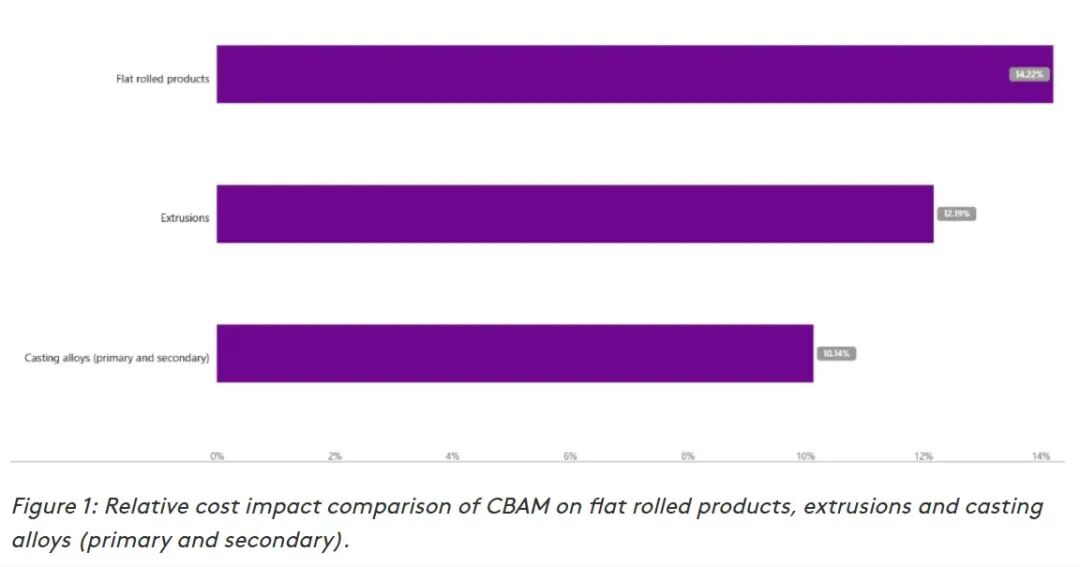
Figure 1: Comparative analysis of CBAM's relative cost impact on flat-rolled products, extrusions, and casting alloys (primary and secondary).
Figure 1 displays the weighted average CBAM cost as a relative proportion of total import value, enabling users to compare the relative impact across different products.
Why Traditional Cost Models No Longer Work?
In the current turbulent market environment, traditional cost modeling methods are beginning to reveal their limitations and introduce a new type of risk. Fixed-price annual contracts, once the cornerstone of budget stability, are now ineffective in mitigating rapid fluctuations in raw material prices.
This lack of flexibility is even more pronounced when forecasting battery cell costs, which depend on cobalt and lithium—both highly volatile materials:
Cobalt
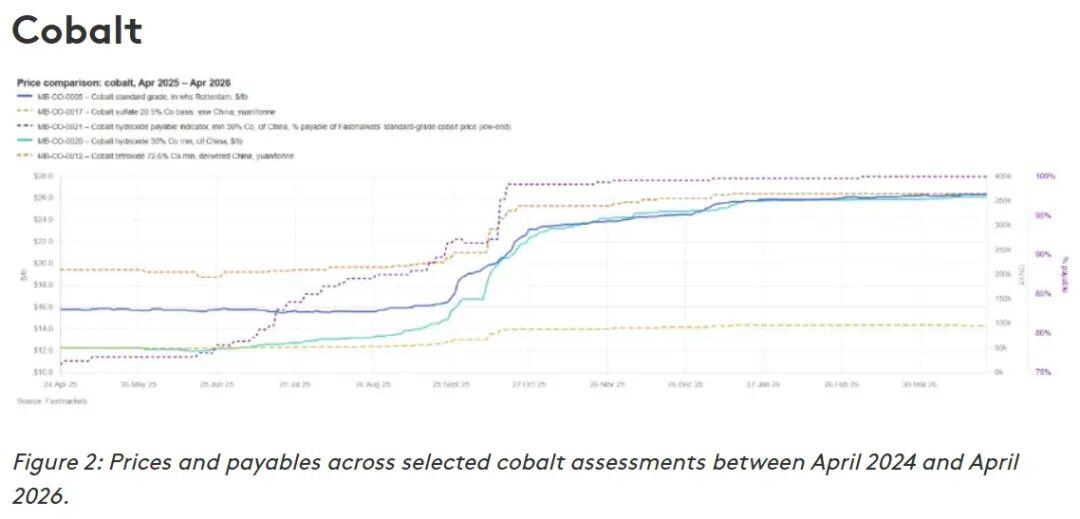
Figure 2: Price and payable amounts for selected cobalt assessments from April 2024 to April 2026.
Over the past year, cobalt prices have shown a strong upward trend with significant volatility, rising from approximately 210,000 to about 365,000, a roughly 74% increase, with a trading range between 195,000 and 365,000.
Market volatility was relatively low in early 2025, then steadily climbed, with a sharp increase from late 2025 to early 2026, followed by stabilization at higher levels. Overall, market volatility remains moderately high (annualized volatility around 23%), primarily driven by sustained price increases rather than short-term violent fluctuations.
Figure 2 clearly illustrates how geopolitics can directly reshape raw material markets. After the Democratic Republic of the Congo restricted cobalt exports, supply tightened, volatility increased, and prices surged.
Lithium
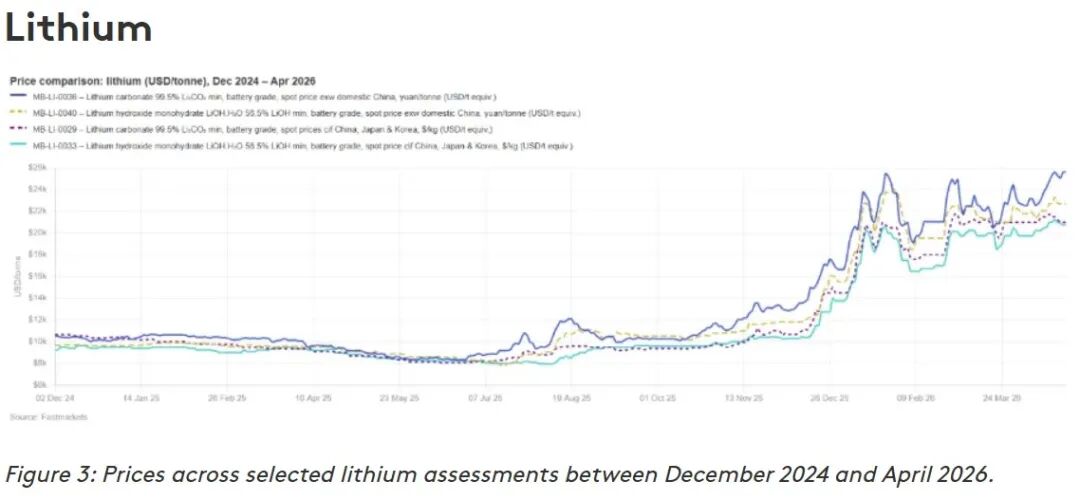
Figure 3: Prices for selected lithium assessments from December 2024 to April 2026.
Lithium prices have fluctuated sharply, showing a strong upward trend, rising from approximately $9,350 to about $19,750, a roughly 111% increase, with a trading range expanding from $7,950 to $20,500. Prices were weak and relatively stable early in the year, followed by a sharp increase, indicating a rapid tightening of market supply.
Lithium's annualized volatility is around 33%, significantly higher than cobalt's, primarily due to more violent price fluctuations and stronger upward momentum.
Limited understanding of upstream mining and refining operations only exacerbates challenges, leading many OEMs to rely on outdated manual tools incapable of handling real-time changes.
The need for transformation is evident.
How Leading European OEMs Are Improving Cost Models
Scenario Modeling Becomes Standard
Leading automotive companies are adopting multi-path forecasting methods as standard practice. These enable them to assess cost impacts under various price increase and decrease scenarios. By incorporating factors like demand elasticity and productivity fluctuations, companies can dynamically adjust production plans and procurement decisions, thereby reducing risks.
EU Raw Material Indexation Expands
Price indexation, once limited to materials like steel and aluminum, is now widely applied to battery materials such as lithium, cobalt, and nickel. OEMs and Tier 1 suppliers are increasingly structuring contracts based on benchmark prices.
The EU's upcoming draft Industrial Accelerator Act marks a significant step in accelerating the development of a domestic battery manufacturing ecosystem. Initial indications suggest the framework will link state support to strict localization rate requirements, notably mandating that automakers source at least 70% of EV components from within the EU.
Draft provisions also outline specific material requirements, including mandatory production of 25% of aluminum and 30% of plastics used in car doors within the EU.
While these measures represent a step toward developing a more autonomous industrial sector, member states remain divided on how to bridge competitiveness gaps. Should they leverage Chinese battery manufacturers for rapid scaling, or pursue a more proactive "Europe-first" industrial strategy?
Dynamic Cost Monitoring Using Market Data
OEMs are leveraging continuously updated market data to adjust material costs dynamically. This approach to dynamic cost monitoring enables them to optimize procurement strategies and production speed plans monthly or even weekly, based on reference prices and other inputs.
In a rapidly changing market, the ability to track bill of materials (BOM) costs in real-time is becoming essential for leaders to maintain competitiveness.
Collaborative Cost Ownership
To enhance responsiveness and collaboration, engineering, procurement, and finance teams are adopting unified cost models. By combining technical cost breakdowns (TCBs) with raw material risk exposure, OEMs can comprehensively address volatility impacts, ensuring cross-departmental collaboration accelerates decision-making and fosters more cohesive strategies.
Impact on Supplier Negotiations and Procurement
These evolving models are reshaping supplier relationships. OEMs using real-time indexation to validate supplier quotes enhance price transparency and foster competition. Hedging strategies are now more prevalent, providing additional risk protection for volatile materials.
Contracts now include renegotiation triggers and flexible clauses to address significant market fluctuations. The trend toward multi-sourcing is growing, particularly for critical battery materials, further enhancing market resilience.
What Are Leading Teams' Priorities for 2026?
By 2026, successful OEMs will prioritize maintaining agile planning cycles, enabling more frequent and shorter adjustments to production speed based on demand and cost changes.
Real-time BOM cost tracking will be fully integrated into production processes, with proactive risk management taking precedence over passive cost-cutting. This proactive approach will help safeguard profitability, even in highly unpredictable conditions.
A New Automotive Operating Model for the Next Decade
The European automotive industry is shifting from traditional cost review processes to a forward-looking approach centered on proactive volatility management. By integrating market data, expanding indexation structures, and adopting scenario modeling, leading automakers and Tier 1 suppliers are enhancing resilience and gaining a competitive edge.
This new operating model not only enables them to weather the storms of market unpredictability but also to thrive amidst them, laying the foundation for sustained success in the next decade.
Are You Ready to Make More Informed Decisions and Build More Resilient Cost Models for Your Automotive Business? (This article is a compilation, with the original English text and images sourced from fastmarkets.com)
Disclaimer:
The articles published on this official account are translations of content from foreign websites, with sources for the original text and images indicated as much as possible (see the end of the main text above). The translated content (i.e., the translations, hereinafter) is provided for reference only, aiming to facilitate information exchange and knowledge dissemination, and does not constitute any professional advice or commitment.
1. Copyright Notice:
The copyright of the original English text belongs to the original foreign author or copyright holder. The translation behavior of this official account strictly adheres to the principle of fair use as stipulated in the Copyright Law of the People's Republic of China, primarily for non-commercial information dissemination, learning, and exchange purposes. If copyright issues are involved, the original author or copyright holder is requested to contact this official account promptly. We will verify and take corresponding measures immediately. If the article or images constitute infringement, the published files will be deleted.
2. Content Accuracy
Due to potential understanding biases or language conversion differences during the translation process, this official account does not assume responsibility for the absolute accuracy or completeness of the translated content. Readers should exercise their judgment regarding its applicability when using the translated content published on this official account and verify it with other reliable information sources.
3. Liability Exemption
The copyright of this article belongs to the original author. Commercial use is strictly prohibited. This official account assumes no responsibility for any direct or indirect losses, disputes, or legal liabilities arising from the use of this translated content by readers/others. By using the translated content, readers are deemed to have fully understood and accepted the aforementioned risks.
4. Contact Information
If you believe that the translated content published on this official account infringes upon your legitimate rights and interests or if you find errors or inaccuracies in the content, please contact us. We will promptly address your feedback.
This notice applies to all translated content published on this official account. The final interpretation rights belong to this official account. Thank you!
-
AI: No Sign of a Bubble!
-
![]()
NVIDIA-Backed AI Unicorn Secures $1.5 Billion Funding: Revenue Soars 2000%
-
![]()
Doubao Pro is Here: How Can Seed 2.1 Be Integrated into Real Processes?
-
"PCB Juice" Sees Four Consecutive Declines: Even Computing Power Material Suppliers Can't Lift This "Old Stock"
-
![]()
Potential 'Seismic Shift' in the U.S. TV Industry: Competition Shifts from Hardware Sales to Traffic Entry Points
-
![]()
Audi A6L's Defense in the Luxury C-Class Market: Following Huawei's Smart Driving Integration, Is Large-Battery HEV the Next Move?
-
![]()
Zhipu VS Minimax: A Chinese Reflection of Anthropic PK OpenAI
-
![]()
Dialogue with Trooly.AI: AI is Just the Pathway to Connect Authentic User Voices Directly to Brands