OpenAI Forays into Smartphone Manufacturing, Apple Suffers $50 Billion Loss in a Single Night
 05/09 2026
 428
428
On April 27th, TF International analyst Ming-Chi Kuo posted on X. Renowned for his accurate predictions regarding Apple's supply chain, this time, his focus shifted from Apple to OpenAI.
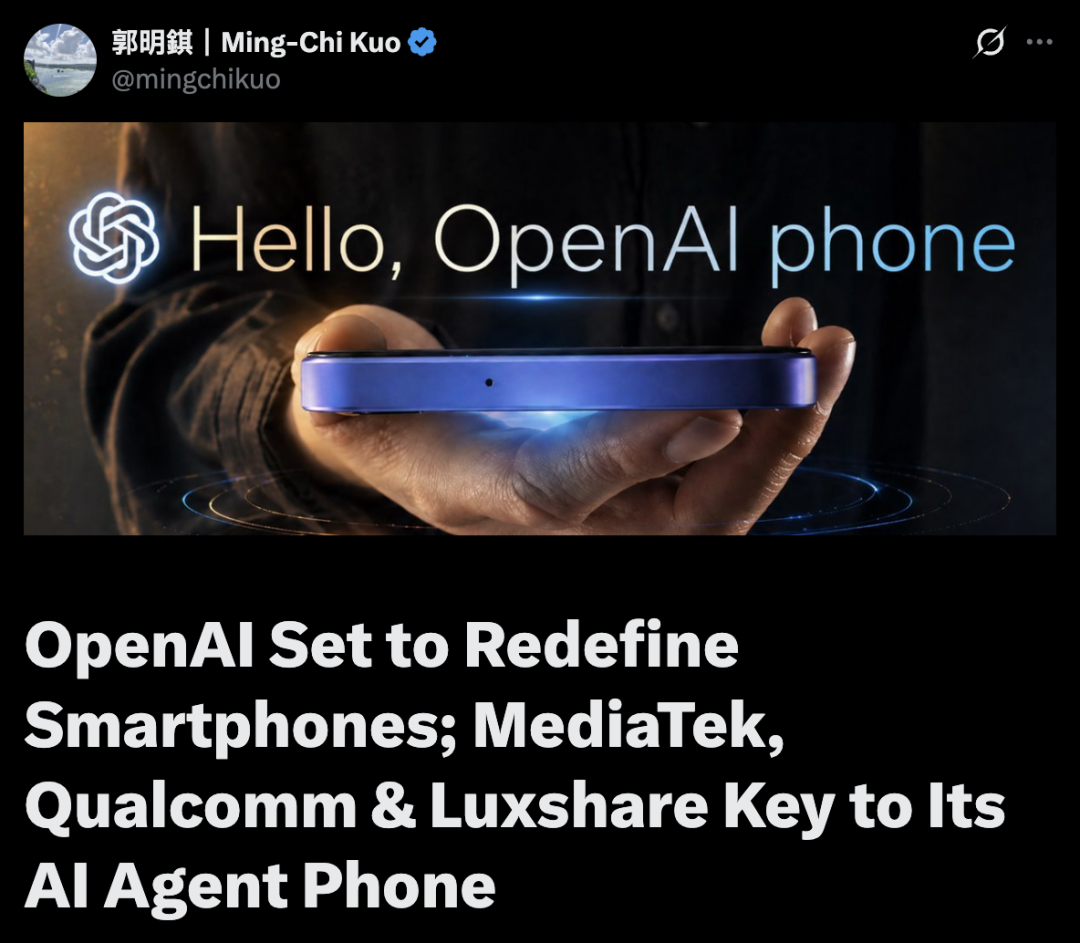
OpenAI is venturing into smartphone manufacturing.
This time, it's not just idle talk. OpenAI is actively negotiating with two chipmakers, MediaTek and Qualcomm, while Luxshare Precision is set to handle the assembly, aiming for mass production and shipment by 2028.
This news sent Luxshare Precision's stock surging to its daily limit, boosting its market capitalization beyond $520 billion, with Qualcomm's stock jumping over 12% in pre-market trading. In contrast, Apple's stock dipped by 1.27%, resulting in a loss exceeding $50 billion overnight.
The capital market's response was swift and tangible.
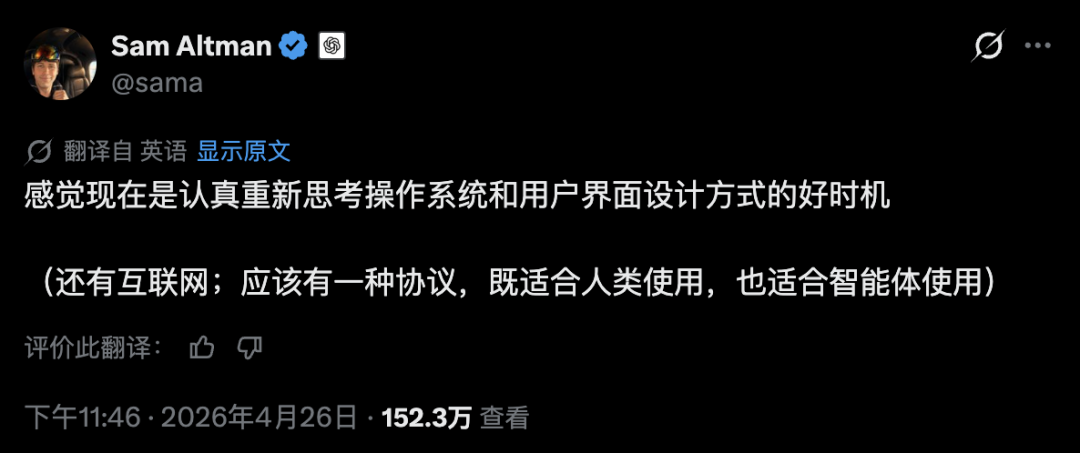
The day before Kuo's post, Sam Altman wrote on X: It's time to rethink the design of operating systems and interfaces. The internet also requires a protocol that can be utilized by both humans and AI agents.
Let's first tackle the central question: Why is OpenAI developing its own smartphone?
Kuo summarizes OpenAI's motivations into three key points.
Firstly, permission bottlenecks. For AI to genuinely serve people, it needs access to the system's core functionalities, which it currently lacks.
Secondly, smartphone data is immensely valuable. Your location, schedule, chat history, spending habits, and health data collectively provide a comprehensive profile of you. AI relies on this real-time information for accurate judgment. Without this "sensory input," even an intelligent AI is rendered ineffective.
Thirdly, smartphones dominate in terms of scale. While glasses, earphones, and watches serve as complementary devices, smartphones reign supreme with over a billion units sold annually worldwide, a lead that no other device is poised to overtake anytime soon.
Together, the conclusion is evident: For OpenAI's AI Agent to transcend chatboxes and become a true assistant, it must have control over the entire technological stack—from chips to systems to hardware. Operating on platforms owned by others sets an excessively low ceiling.
Now, what will this phone look like?
Kuo sketched a conceptual image, juxtaposed with an iPhone home screen—the contrast is striking.
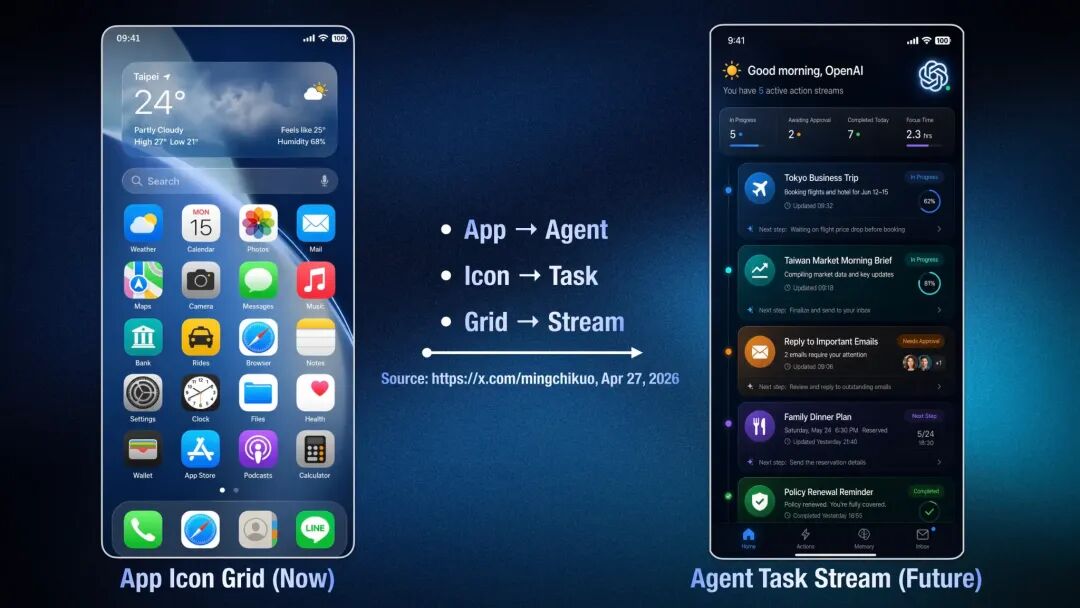
On the left, familiar rows of app icons await interaction. Essentially, it's a digital shelf—items are present, and you pick what you need.
On the right, no app icons are visible. Instead, a list of tasks is presented: Book a Friday flight to Shanghai, with the progress bar nearly full; today's market briefing, already generated; three important emails to review. The interface is divided into four sections: Home, Actions, Memory, and Inbox.
Left: a toolbox. Right: a personal butler.
Kuo argues that people don't use phones to open apps—they use them to accomplish tasks.
From 2007, when Jobs unveiled the first iPhone, to the present, nearly two decades later, we've lived in an app-centric world. To perform a task, one must find the appropriate app, open it, learn its interface, and then proceed. The App Store forms the bedrock of Apple's empire; Google Play is the lifeblood of Android. Everyone assumes this is the way it must be.
However, if AI can directly handle tasks—ordering on Meituan without opening the app, booking tickets on Ctrip without launching it, even replying to WeChat messages via AI—apps become nearly invisible. The entire mobile internet's "traffic distribution + ad monetization" model crumbles at its roots.
Of course, this scenario may still be far off, but I personally believe it will eventually materialize.
On the supply chain front, OpenAI approached both MediaTek and Qualcomm. This year's high-end Android phones predominantly use Qualcomm's Snapdragon 8 Elite Gen 5 or MediaTek's Dimensity 9500—selecting these two is hardly surprising.
Assembly duties are entrusted to Luxshare Precision exclusively. Luxshare also assembles iPhones for Apple, showcasing proven capabilities from components to finished products. For Luxshare, surpassing Foxconn's assembly share in Apple's supply chain is challenging, but securing OpenAI as a new client means gaining a foothold in the next era. The news propelled Luxshare's stock to an all-time high.
Specifications and supplier lists are expected to be finalized by late this year to early next year, with mass production commencing in 2028.
Those following OpenAI's moves are aware that smartphones are not its first foray into hardware. The company is simultaneously advancing multiple product lines—a bold strategy.
The first to launch will be a smart speaker, priced between $200 and $300, with shipments starting next February.
Next in line are AI earphones, codenamed Sweetpea, featuring a metal pebble design with capsule-shaped buds placed behind the ears, powered by a 2nm chip, designed by Jony Ive, manufactured by Foxconn, and set to debut this September with a first-year shipment target of 40–50 million units.
Then come smart glasses, slated for mass production in 2028, directly competing with Meta Ray-Ban and Apple N50. There's also an AI pen called Gumdrop, iPod Shuffle-sized, wearable around the neck or in pockets, designed for pure voice and environmental interaction.
Even a smart lamp is in the works, with a prototype ready, though its release date remains undecided.
Speakers, earphones, glasses, pens, lamps, phones—six product lines advancing simultaneously.
OpenAI spent $6.5 billion, entirely in stock, to acquire Jony Ive's io studio, integrating all 55 engineers and designers. OpenAI's hardware team now boasts 200 people, with core leaders almost entirely hailing from Apple.

Ive's vision for this project is also noteworthy. He's not taking the traditional wearable route—instead, alongside Altman, he defines it as the "third core device," placed beside the MacBook and iPhone, the third essential item on your desk. Not a replacement, but a new category.
Technically, OpenAI's approach involves edge-cloud synergy.
A small model runs locally on the phone, continuously understanding the user's context—where are they? What are they doing? What might they do next? These computations cannot all be offloaded to the cloud due to latency and privacy concerns—especially with tightening European and U.S. regulations on data collection. Sensitive computations must remain on the device.
Complex tasks, like writing a market analysis report or coordinating five people's schedules, are handled by cloud-based large models.
This places new demands on chips. They require not just raw computational power but optimized power efficiency, memory management, and local small-model efficiency—a different direction from today's phone chips, which focus on benchmark scores and GPU rendering.
Kuo calculated that, using MediaTek's TPU Zebrafish collaboration with Google as a reference, revenue from one AI server chip roughly equals that of 30–40 smartphone AI processors. However, smartphones sell in vast quantities. The global high-end phone market is 300–400 million units annually. If AI Agent phones trigger a replacement wave, MediaTek and Qualcomm have significant growth potential.
Speaking of Qualcomm, its current position is delicate.
Its smartphone chip revenue growth slowed in Q4 last year, with Q1 expected revenue at $6 billion, down 13% year-over-year. Global smartphone SoC shipments fell 8% overall, with double-digit declines for both Qualcomm and MediaTek. Worse, Qualcomm's contract to supply baseband chips to Apple expires in 2027, and Apple's self-developed baseband progress is accelerating—a business contributing $5.7–5.9 billion annually is shrinking.
Qualcomm CEO Cristiano Amon responded by stating that the company no longer views Apple's orders as critical to its future. Qualcomm is also reportedly developing a data center CPU based on Arm architecture, targeting AI Agent needs.
OpenAI's move comes at an opportune time for Qualcomm.
But don't get too excited just yet. Software companies venturing into smartphones have a dismal track record.
In 2014, Amazon launched the Fire Phone, with Bezos personally endorsing it. It sold 35,000 units in 25 days, then dropped to $0.99 six weeks later to clear inventory, ultimately writing off $170 million.
In 2013, Facebook partnered with HTC to launch the HTC First, with Zuckerberg aiming to make Facebook the phone's soul. Only 15,000 units sold in the U.S., with the price slashed from $99 to $0.99.
Microsoft fared even worse. From 2011–2016, after acquiring Nokia's phone business to push the Lumia series, it wrote down $7.6 billion in goodwill.
Andy Rubin, the "Father of Android," personally led Essential PH-1, raising $300 million. Despite a well-made phone, the company collapsed.
Every name is iconic, every team well-funded and talented—yet all failed.
For OpenAI, the biggest hurdle may be the operating system.
OpenAI lacks its own mobile OS—a hurdle it cannot bypass.
Modifying the Android Open Source Project (AOSP) is technically feasible, but using the Google Play Store and services requires signing a licensing agreement with Google. This conflicts with OpenAI's goal of defining a new Agent interface logic—to disrupt apps, yet rely on Google to distribute them.
Building a new OS from scratch is tantamount to recreating Android—an engineering feat that makes the 2028 mass-production timeline unrealistic.
Distribution is another challenge. iPhone and Android phones reach every corner of the world not just through products but also carrier subsidies, contract bundles, and retail store presence—a system OpenAI lacks entirely.
The developer ecosystem is even more daunting. If OpenAI truly pursues "no apps, only Agents," it sidelines tens of millions of app developers worldwide. Enterprise software like Slack or Notion could adapt as Agent interfaces relatively easily. But consumer-facing apps like Uber, TikTok, or Instagram—where the app experience is part of the product—cannot simply extract functions for AI to handle.
Every issue is substantial, enough to topple a company.
But OpenAI isn't without cards to play.
In March, it closed a $122 billion funding round, valuing it at $852 billion post-money—the highest among global unlisted companies. Amazon, NVIDIA, and SoftBank led, with Microsoft and a16z participating. Last October, it signed a strategic partnership with Broadcom to deploy a 10-gigawatt AI chip cluster, starting operations in the second half of this year and fully operational by 2029. Its self-developed ARM-based AI chip is also advancing, with partners including Arm and Oracle. Data center and chip-related deals now exceed $1 trillion.
Spending is equally staggering. It expects to burn $17 billion in cash this year, with a $14 billion annual loss, optimistically projecting break-even by 2030. Reportedly, OpenAI plans to launch an IPO in Q4 this year, racing Anthropic to market.
Speaking of Anthropic, it offers an interesting contrast. By April this year, Anthropic's annualized revenue reached $30 billion, surpassing OpenAI's $24 billion, but 80% comes from enterprise API clients—it hasn't ventured into consumer hardware.
Two companies, two strategies. Anthropic bets the enterprise market is large enough to win without hardware. OpenAI bets otherwise: Models alone aren't enough—they must embed into something people carry daily to truly change the world.
OpenAI now holds Jony Ive's designs in one hand, Qualcomm and MediaTek contracts in the other, and hundreds of billions in funding in its pocket, ready to challenge Apple and Google. It feels like a moment straight out of a Hollywood blockbuster.
The challenges are immense, but the opportunities are even greater. Let's await OpenAI's next move.
If you have thoughts, share them in the comments—let's discuss.
-
![]()
From Now On, We Should Study Kimi with the Same Dedication as DeepSeek
-
![]()
Samsung Quietly 'Exiting' China? Don't Be Fooled—It's Making a Fortune Behind Closed Doors
-
![]()
From 1% to 60%—China’s NEV Penetration Rate Hits 10-Year Milestone: What Does Plug-in Hybrid Surpassing Pure Electric Signify?
-
![]()
There's No Such Thing as a Free Doubao
-
![]()
When the Input Method Starts Hijacking AI
-
![]()
Fierce Undercover Competition in China's Air Conditioning Circle | Business Wave
-
![]()
BBA's Final Stand
-
![]()
From Buying GPUs to Competing for Electricity: China's AI Industry Makes a Critical Pivot