Net Profit Drops 23%: BMW’s Q1 Performance – Unflashy, Yet Steadfast
 05/09 2026
 426
426
Sustaining Profitability
Author|Wang Lei
Editor|Qin Zhangyong
BMW has released a financial report that may not dazzle at first glance but proves to be notably pragmatic.
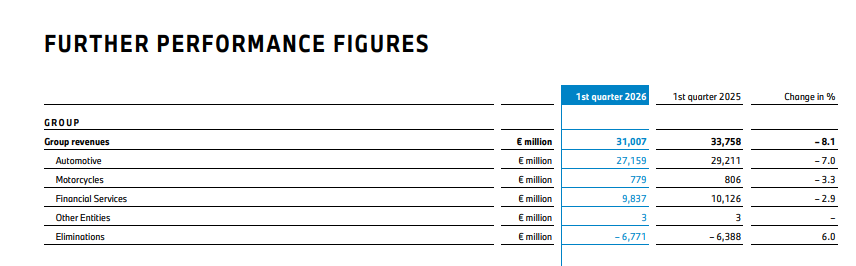
In the first quarter of 2026, BMW reported total revenues of €31 billion, an 8.1% decrease year-on-year, with net profits at €1.67 billion, marking a 23% drop compared to the same period last year.
Amid this financial report, where profit pressures are evident, a noteworthy statement emerges: BMW reaffirmed its unchanged annual performance forecast but indicated an expected "moderate decline" in annual profits.
In essence, BMW believes that even with a decrease in total annual profits, the decline will remain manageable.
Indeed, despite a significant profit drop, amidst the transformation pressures faced by the German automotive industry and intensified competition in China, BMW appears to be the most stable among the three German automotive giants.
During the same period, the other two German automotive giants, Mercedes-Benz and Volkswagen Group, reported net profits of €1.43 billion and €1.56 billion, respectively. Possibly buoyed by better-than-expected profitability, their stock prices rose instead of falling, with intraday gains nearing 5% at one point.
01
Sustaining Profitability
Let's first examine the core performance metrics.
BMW Group's revenue in the first quarter was €31 billion, down 8.1% from €33.76 billion the previous year, or a 4.3% decline excluding exchange rate impacts. Group earnings before tax (EBT) were €2.35 billion, a 24.6% decrease from the previous year; net profit attributable to shareholders was €1.672 billion, down 23.1% year-on-year.
In terms of sales, BMW, MINI, and Rolls-Royce delivered approximately 566,000 vehicles globally, a 3.5% year-on-year decrease.
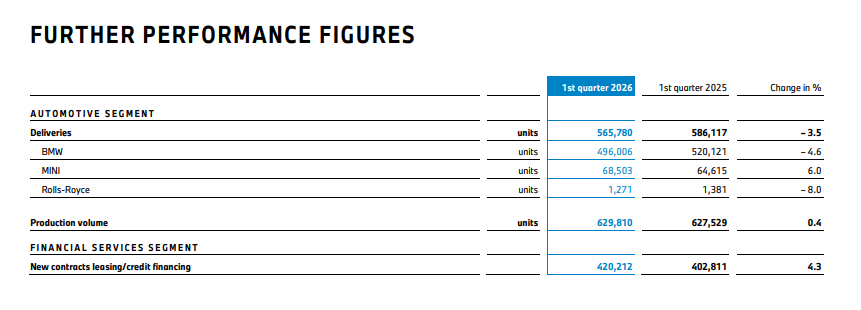
Among them, the core BMW brand delivered 496,000 vehicles, a 4.6% year-on-year decrease; the ultra-luxury brand Rolls-Royce delivered 1,271 vehicles, a 4.2% decrease, while the MINI brand was a bright spot, delivering 68,500 vehicles, a 5.9% year-on-year increase, achieving growth for five consecutive quarters.
Notably, in the first quarter of this year, BMW Group delivered just under 90,000 pure electric vehicles, a 20.1% year-on-year decrease, further reducing their share in the already small total sales, from 18.7% to 15.5%.
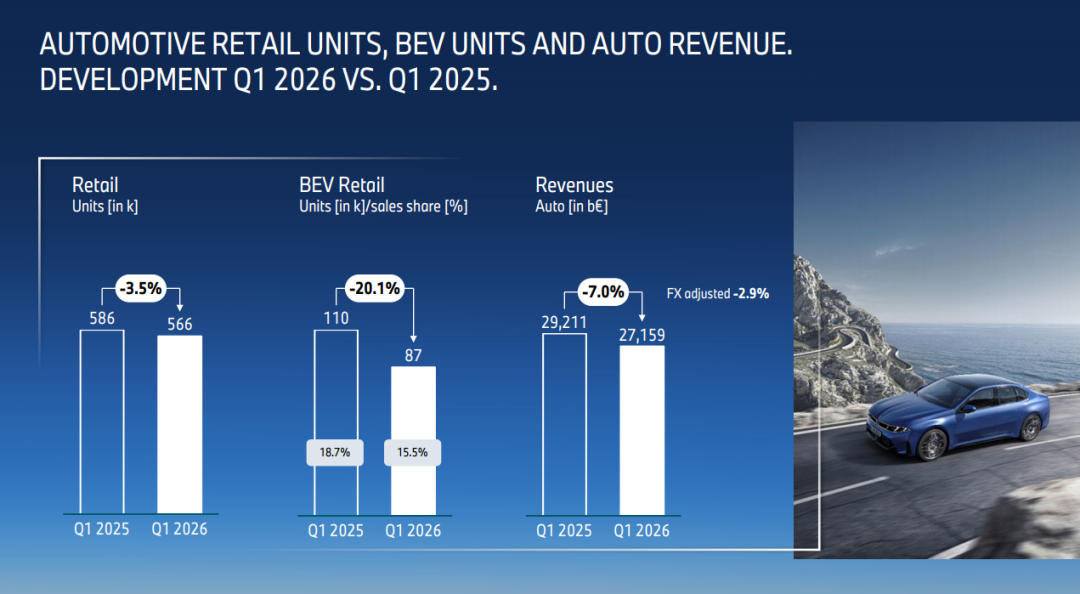
The reason is that China, BMW's largest single market, remains cautious about its electric vehicles. BMW Group's sales in the Chinese market in the first quarter were 143,958 vehicles, accounting for 25% of global sales, a 10% year-on-year decrease, still the largest declining single market.
Moreover, the core sales support still comes from traditional fuel vehicles, with the BMW 3 Series, 5 Series, X3, and X5 being the main contributors, with these four models contributing nearly 110,000 units in the first quarter.
In comparison, BMW Group's sales in the European market increased by 3% year-on-year in the first quarter of 2026, reaching 237,000 vehicles, with sales in the German domestic market at 68,000 vehicles, a 10.7% year-on-year increase. The American market saw a decline, with quarterly sales down 4.0% year-on-year to 110,000 vehicles, and sales in the U.S. market down 4.3% to 90,492 vehicles.
Fluctuations in sales directly relate to revenue performance in the automotive business segment, with first-quarter revenue at €27.159 billion, a 7.0% decline, and earnings before interest and tax (EBIT) in the automotive business at €1.345 billion, a significant 33.5% year-on-year decrease.
Although the figures are not impressive, what deserves more attention in the financial report is its profit margin. In the first quarter of 2026, BMW Group's pre-tax profit margin reached 7.6%, almost on par with last year's full-year figure of 7.7%.
Although the pre-tax profit margin in the automotive business segment, most affected by car sales, slipped from 6.9% to 5.0%, it still fell within the full-year guidance range of 4%–6%. Moreover, BMW stated that tariff factors alone dragged down the profit margin by 1.25 percentage points. In other words, excluding the impact of tariffs, BMW's automotive business EBIT margin should be around 6.25%, at the top end of the full-year guidance.
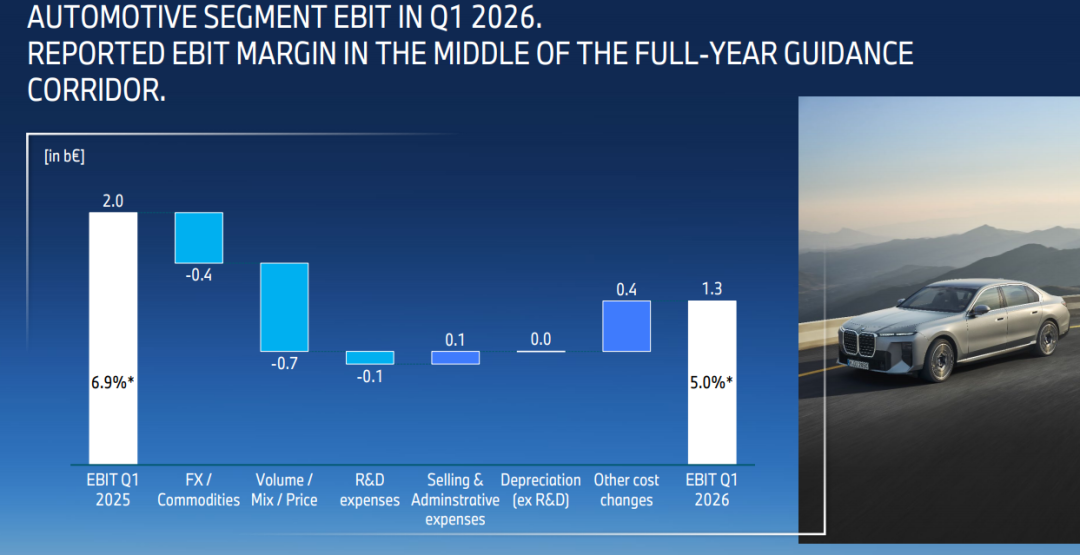
This means BMW's profitability has not been compromised by the sales decline.
As BMW Group CEO Oliver Zipse said, "We have long anticipated facing multiple headwinds this year. For us, the key is to minimize adverse impacts while continuously seizing emerging opportunities."
This is mainly attributed to two factors. There is an indicator overlooked by the market in this financial report: financial services penetration. In the first quarter, BMW's financial services penetration reached 51.6%, an 8.6 percentage point increase year-on-year, marking the first time this indicator has exceeded 50% in history.
Simply put, for every two BMWs sold, more than one is completed through BMW Financial Services leasing or loans. This means that even if whole vehicle sales are under pressure, BMW can still generate stable income and customer loyalty through its financial business.
Additionally, there is the reduction in investment spending. Cost control measures of €2.5 billion initiated last year are still taking effect, reducing production, sales, and administrative costs, as well as cutting investment and R&D expenditures. Investment in the first quarter decreased by nearly 39%, and R&D spending reduced by 11.5%.
Thanks to reduced investments, the free cash flow performance in the automotive business segment became a bright spot, surging 88.1% year-on-year, far exceeding the €413 million in the same period last year. The group expects full-year free cash flow in the automotive business to exceed €4.5 billion.
02
BMW Aims to Shift Gears and Overtake
Although various control measures can be used to stabilize profit margins, the simplest and most direct way is to sell more cars.
Despite consecutive declines in the domestic market, from a total volume perspective, China is crucial for BMW. In 2025, BMW delivered 625,500 vehicles in China, accounting for 25.4% of the group's global sales, remaining BMW's largest single market.
Therefore, the pressure in the Chinese market is the biggest variable in BMW's overall performance, which is why the Chinese market became the focus emphasized by Oliver Zipse in the first-quarter financial report communication meeting.
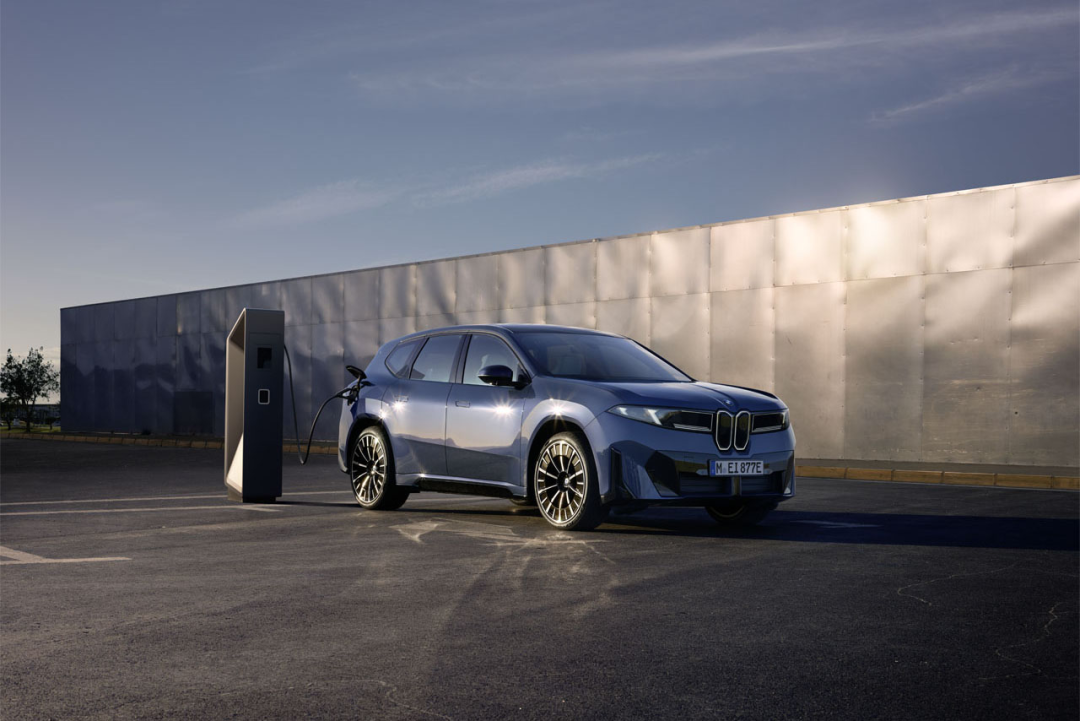
At the recently concluded Beijing Auto Show, Zipse personally took the stage to announce the official launch of BMW's largest-ever strategic project, "Neue Klasse." At the auto show, the all-new BMW 7 Series, Neue Klasse BMW iX3 long-wheelbase version, and i3 long-wheelbase version made their debut.
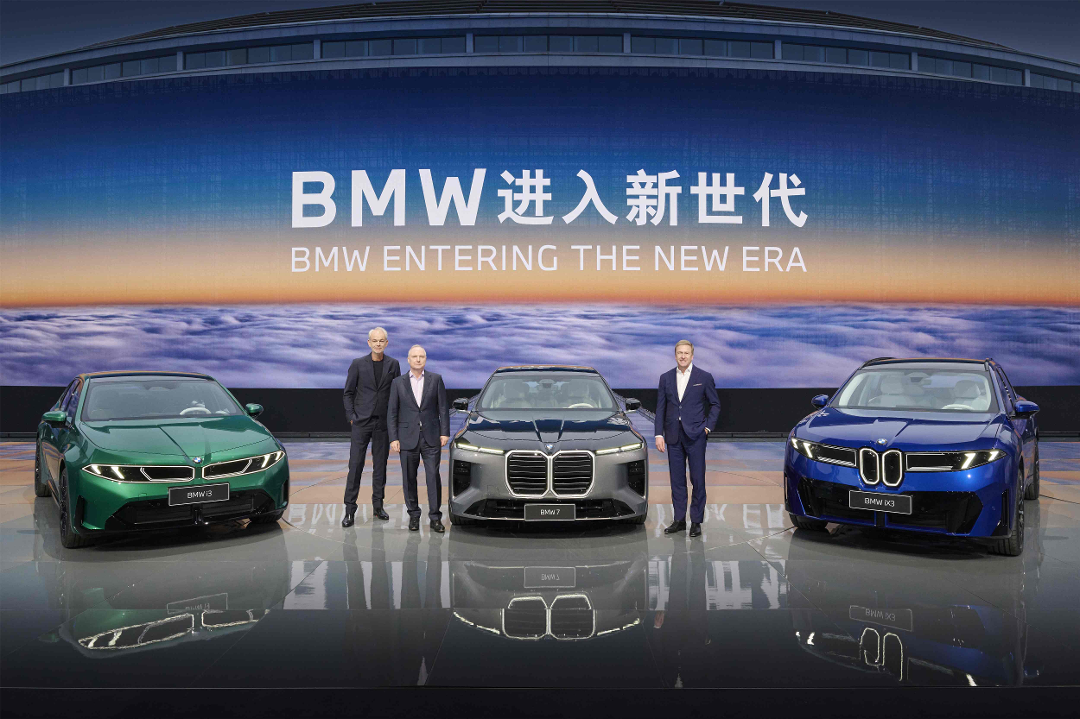
Prior to this, Zipse stated that BMW would launch its most intense product offensive in brand history, introducing over 40 new models by the end of 2027, including major facelifts and all-new models. The core strategy is to fully extend the design philosophy and core technologies of the Neue Klasse platform to the existing product line, covering both electric and fuel vehicles, achieving the largest mid-cycle refresh action in brand history.
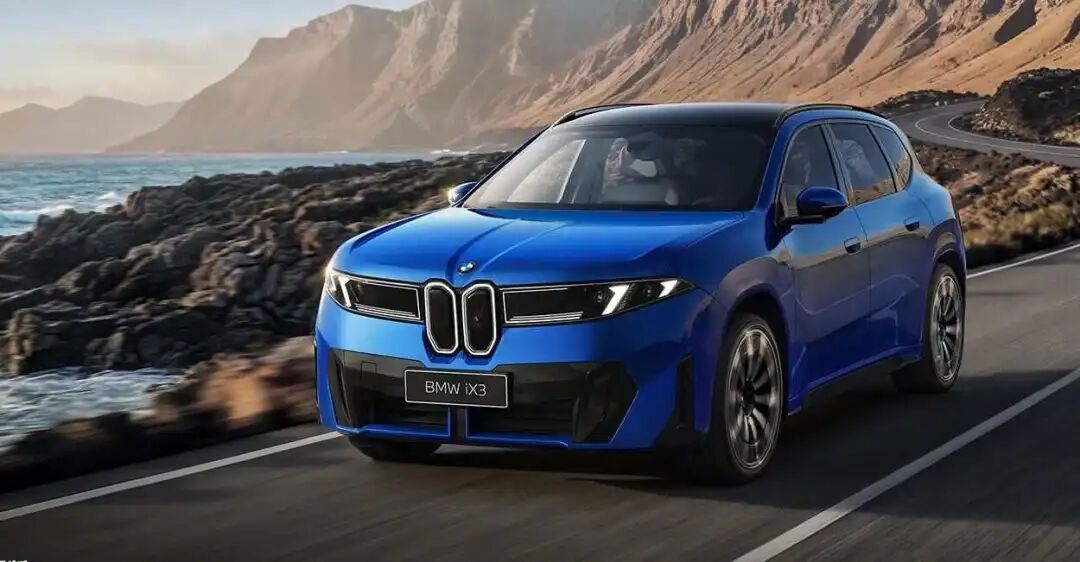
Among them, the first model on BMW's Neue Klasse platform, the all-new iX3, has already launched in Europe. The long-wheelbase version of the iX3, specifically developed for the Chinese market and jointly developed by BMW and a domestic R&D team, will also be launched in the Chinese market in the fourth quarter.
It is worth mentioning that BMW's ability to achieve the highest single-quarter order volume in history in Europe, with a 62% year-on-year surge in pure electric vehicle orders, is attributed to the first model on the "Neue Klasse" platform, the BMW iX3. As of the end of March, orders in the European market exceeded 50,000 units.
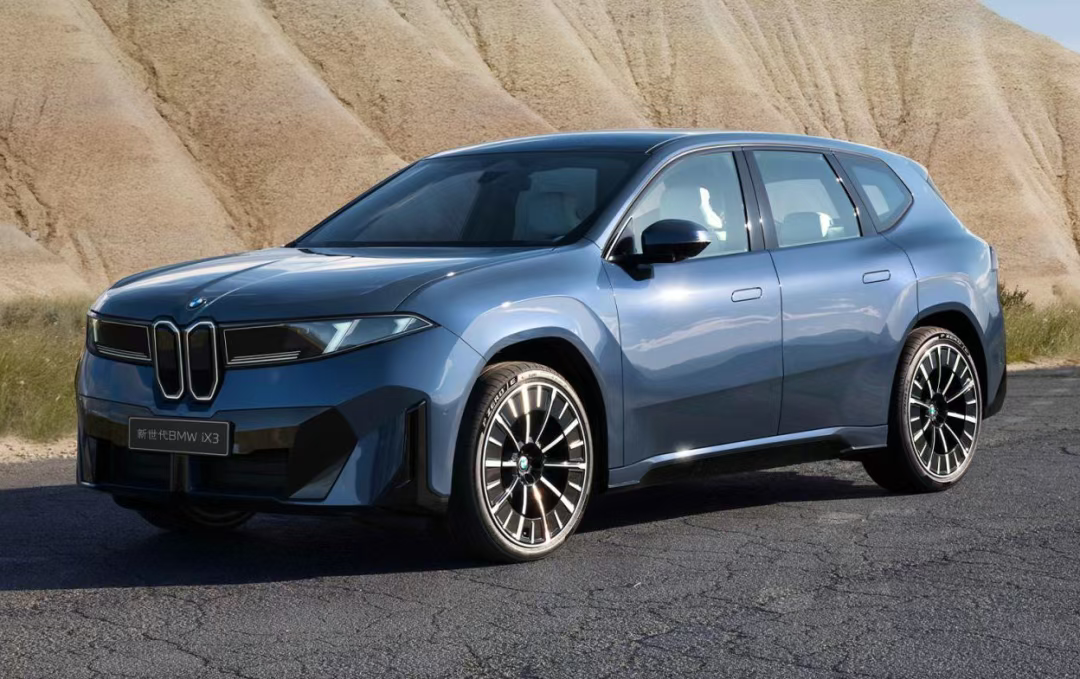
The iX3 long-wheelbase version to be launched in the fourth quarter will no longer use overseas native infotainment systems but will feature deeply localized custom voice, scenario services, and ecological connectivity. This is also BMW's most localized cockpit to date, introducing BMW's custom large language model (LLM) technology jointly developed with Alibaba. The full-scenario navigation assisted driving system is also jointly developed with Momenta.
Customizing capabilities based on current Chinese consumer preferences is undoubtedly a gesture of goodwill. However, the upcoming Neue Klasse iX3 represents only a limited window of opportunity. The second Neue Klasse model, the i3 long-wheelbase version, will not be locally produced until 2027, meaning that throughout 2026, the Neue Klasse iX3 will solely shoulder the entire burden of BMW's pure electric counterattack in China.
Looking back at BMW's "Neue Klasse" technological layout, compared to traditional luxury giants like Mercedes-Benz and Audi, it inevitably gives a sense of being "late to the party."
Audi and Mercedes-Benz have already changed their strategies, introducing new technology platforms to the Chinese and global markets last year and launching corresponding products.
For example, before BMW's first Neue Klasse pure electric product officially lands in the domestic market, Mercedes-Benz has already launched its all-new generation pure electric model, the CLA, in 2025, with a comprehensive range exceeding 860km and equipped with an assisted driving system jointly developed with Momenta.
Mercedes-Benz's second and third products are ready to go, and the company plans to launch over 15 new models in China this year, covering all market segments from the pure electric GLC SUV to the next-generation S-Class.
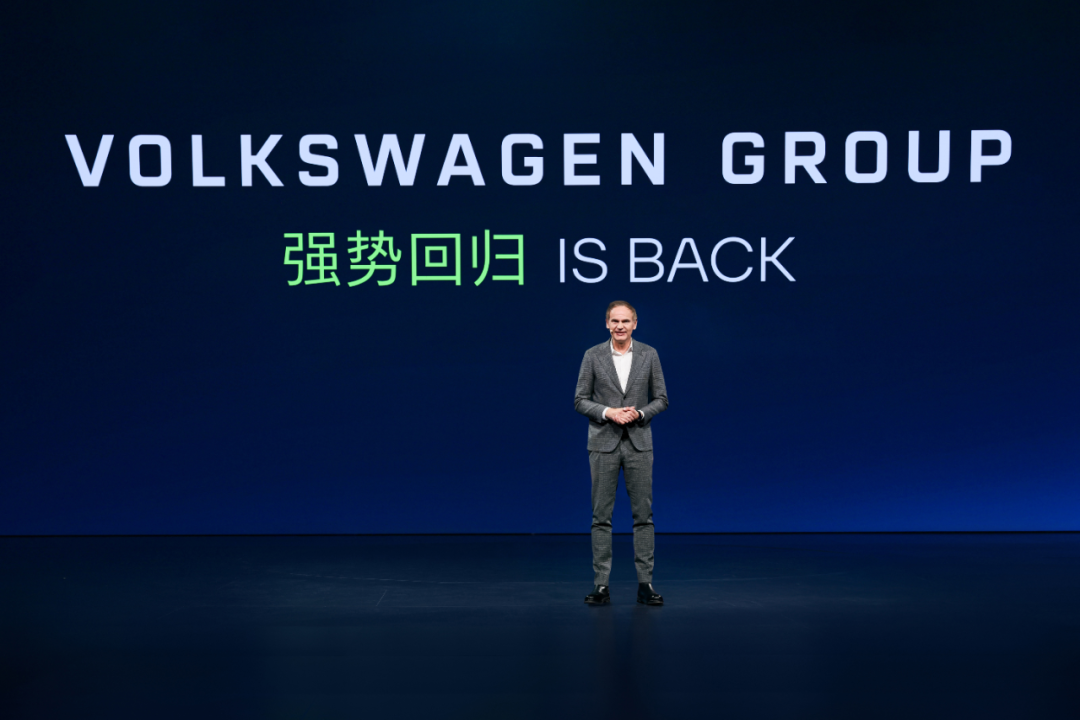
Volkswagen, Audi's parent company, is also attempting to turn the tide through an intense product offensive. On the eve of the Beijing Auto Show, Volkswagen announced its largest-ever product offensive in the Chinese market, planning to launch around 30 new energy models by 2027 and deliver approximately 50 new energy models by 2030, including around 30 pure electric models.
Among them, Audi has chosen another path of deep binding with Chinese tech giants, integrating Huawei's ADS intelligent driving system. New models like the all-new Audi Q5L and Audi A6L e-tron are equipped with Huawei's ADS intelligent driving system.
Under such fierce product offensives from competitors, can BMW's late-arriving Neue Klasse products pull the Chinese market from a "drag" position back to a "support" position?
-
![]()
Total Investment Hits Nearly 3.28 Billion! Goertek Launches Mass Production of 12-Inch Transparent Substrate Wafer for AR Glasses’ Micro-Nano Optical Components
-
![]()
Why Is This Precision Optical Film Leader Worth Reevaluating with a Tens of Millions Procurement?
-
![]()
AI Costs Plummet by 90% Over Nine Years: Key Insights from Davos You Shouldn’t Miss
-
Doubao, Your Late-Night AI Companion, Now Eyes Profitability
-
![]()
SRC Empowers SEER Intelligence to Reach a Market Cap of Tens of Billions, Yet Fails to Sustain Profitability
-
![]()
China’s Embodied AI Industry Faces Fierce Domestic Competition, Making Overseas Expansion Essential for Survival
-
![]()
32.8 Billion Yuan Investment! Goertek’s 12-Inch AR Glasses Optical Wafer Base in Lingang Begins Operations
-
![]()
How Far is the All-New Li Auto L8 from Being the Best Five-Seat SUV with In-House Full-Stack Development?