Launching 7 New Products in May, Laifen Still Needs to Master the Art of "Simplification"
 05/18 2026
 468
468
SHEN MOU
Original: Shenmou Finance and Economics (chutou0325)
Born in 1986 into a humble family in Lishui, Zhejiang Province, Ye Hongxin exhibited remarkable practical skills from a young age. As a child, he would scavenge for discarded items with his father, repurposing used batteries from fish tank flashlights into lamp beads. By middle school, his talent for modifying radio-controlled cars far surpassed that of his peers.
As an adult, Ye made his first fortune during the e-commerce boom on Taobao, only to lose it all due to an obsession with manned aircraft. One day, while standing beneath a flying device and feeling the intense gust of wind, an idea struck him: "Could this motor be installed in a hair dryer?"
This fleeting thought changed the course of his life.
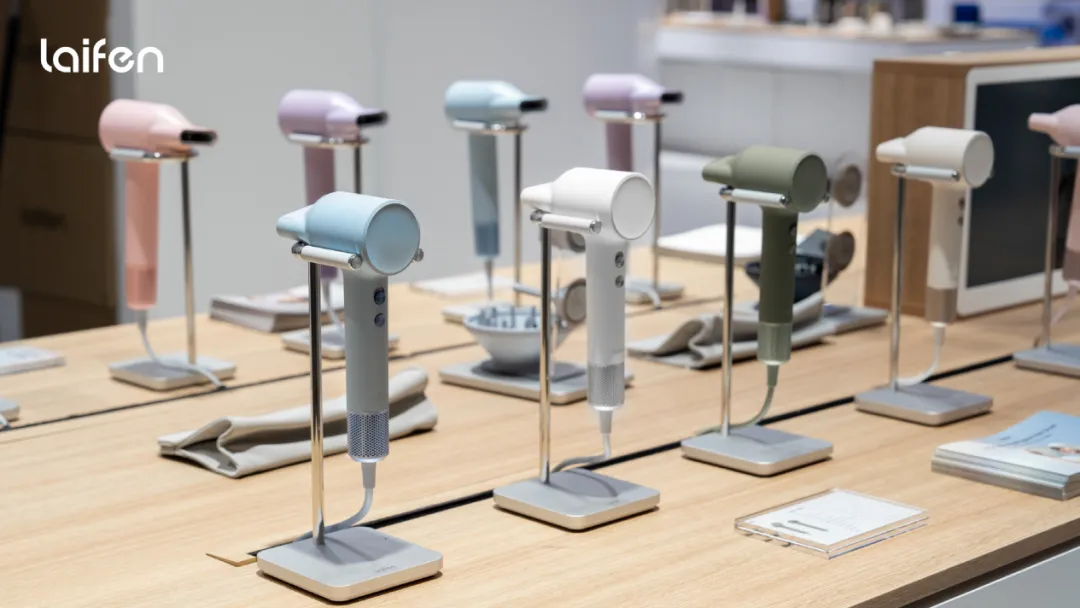
Founded in 2019, Laifen launched its first high-speed hair dryer in 2021, boasting a rotational speed of 115,000 RPM, comparable to Dyson. Over the next three years, its annual sales soared, creating a rare growth phenomenon among new consumer brands.
Suddenly, labels such as "Affordable Alternative to Dyson" and "Pride of Domestic Brands" flooded in, with many predicting it would become the "Chinese Dyson."
Yet today, this company, once considered the most likely to become the "Chinese Dyson," stands at a troubling crossroads.
01
The "Chinese Dyson" or the "Next Dali?"
Laifen's rise was the result of a combination of "favorable timing, geographical advantage, and human effort."
From 2021 to 2024, Laifen's annual sales skyrocketed from RMB 150 million to RMB 4.1 billion. Behind this numerical transformation lay a fundamental pillar: self-developed technology.
Before Laifen, high-speed hair dryers were nearly synonymous with Dyson, with the core barrier being the high-speed brushless motor, spinning at 110,000 RPM. This allowed for rapid drying through powerful airflow rather than excessive heat, significantly reducing damage to hair cuticles.
Leveraging the noticeable experience gap brought by technology, Dyson priced its hair dryers at RMB 3,000. However, this high pricing also created a gap—it blocked competitors but also alienated most ordinary consumers.
Laifen spotted this gap.
Instead of taking the shortcut of OEM manufacturing, Laifen persisted in self-development. After arduous efforts by the team, Laifen successfully developed its own three-phase DC high-speed brushless motor, exceeding 110,000 RPM and improving over traditional hair dryers by more than fivefold. Combined with aerospace-grade aluminum alloy fan blades and laser engraving weight reduction technology, it achieved hurricane-force wind speeds of 21-22 m/s, boosting drying efficiency by over 300%. Its performance parameters directly rivaled Dyson's, yet its price was just one-fifth.
As Ye Hongxin put it in his short video "Why the Hair Dryer That Outperforms Dyson Can't Grow Bigger": "It surpasses Dyson in every aspect—greater wind force, lower noise, and a cheaper price."
With product confidence, Laifen also precisely tapped into consumer psychology in an era of consumption stratification.
After Dyson firmly occupied the RMB 3,000 premium market, a large group of consumers yearning for quality yet unwilling to pay brand premiums desperately sought alternatives.
The emergence of Laifen's hair dryer satisfied consumers' aspirations for "premium features" while avoiding the psychological burden of "overpaying." This generation's consumption logic of "wanting dignity but refusing to be ripped off" was perfectly captured by Laifen.
Technological breakthroughs provided product confidence, while consumer psychology created market space. Laifen achieved in a few years what traditional home appliance brands took decades to accomplish, but concerns began to emerge.
The turning point came in 2025.
Data from All View Cloud showed that after years of sustained growth, online hair dryer retail sales reached RMB 9.1 billion in 2025, down 9.2% year-on-year.
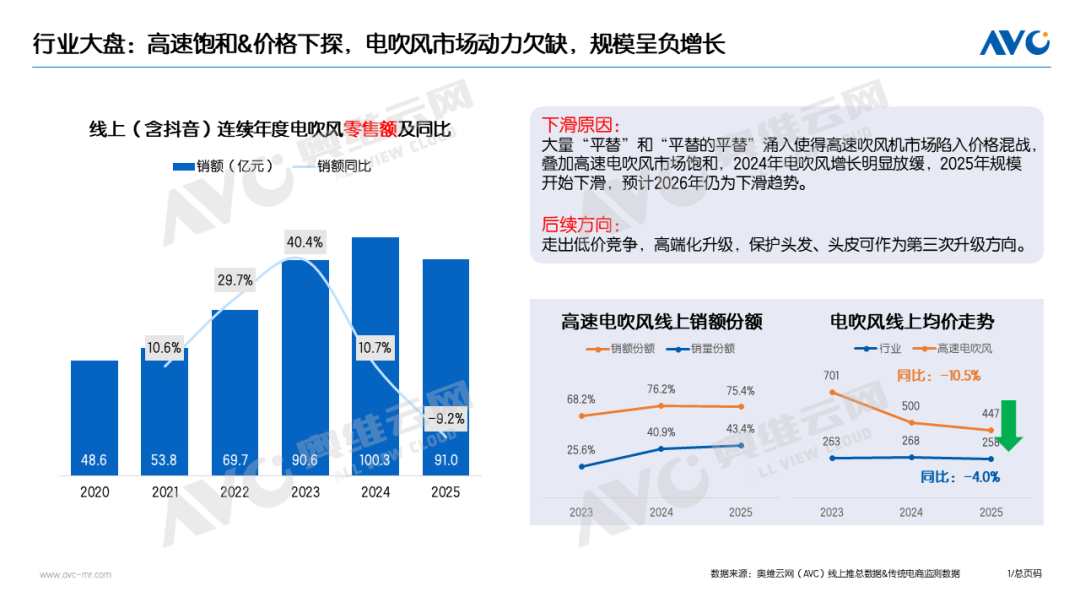
(Source: All View Cloud)
During the 618 shopping festival that year, according to Lei Feng Network, Laifen aimed for RMB 6 billion in GMV but achieved just over RMB 300 million, nearly 40% less than the RMB 500 million in 2024.
The rapidly growing Laifen began to show signs of "fatigue." To some extent, Laifen's situation resembles that of another company that rose through a "follower" strategy: Dali Foods.
Dali is China's most successful "follower" in the fast-moving consumer goods industry. In 2002, it launched Dali Yuan·Egg Yolk Pies, imitating Korea's Orion; in 2003, it introduced Kebike to rival Pringles and Lay's potato chips; in 2004, HaoChidian; in 2007, Heqizheng; in 2012, Lehu; in 2017, Doubendou...
Each followed the same "script": identifying mature categories already educated by leading brands and entering the market with "similar products at lower prices."
The "Dali Model" proved highly effective but also sowed the seeds of hidden troubles for growth. In a highly competitive market, imitators like "Dahechuan" and "Chihaodian" began appearing in rural convenience stores and on e-commerce platforms like Taobao and Pinduoduo, vying for the same consumer base with even cheaper prices.
Dali found itself transformed from an imitator to the imitated—just like Laifen.
Leveraging its precise positioning as the "Affordable Alternative to Dyson," Laifen tore open a massive gap behind the industry giant. However, as domestic supply chains matured, high-speed hair dryers evolved from cutting-edge technology to standard offerings from Pearl River Delta contract manufacturers, with costs plummeting from hundreds to tens of yuan.
Brands like Dreame and Xiaomi have driven prices for similar parameter products below RMB 200, while unbranded products from Huaqiangbei lurk, often priced at just a fraction of Laifen's. The emergence of "Affordable Alternatives to Laifen" undoubtedly signals the collapse of its strategic positioning as the "Affordable Alternative to Dyson."
If you can be an affordable alternative to others, others can do the same to you, ultimately leading to a meaningless price war.
02
The "Illusion" of Technology Reuse
Facing growth ceilings, Laifen's strategy—like other brands reliant on a single hit product—was to expand its product line.
Leveraging the brand momentum and motor technology accumulated from hair dryers to tap into the electric toothbrush and shaver markets in search of a second growth curve, this "technology reuse" methodology, however, proved somewhat "ineffective" for Laifen.
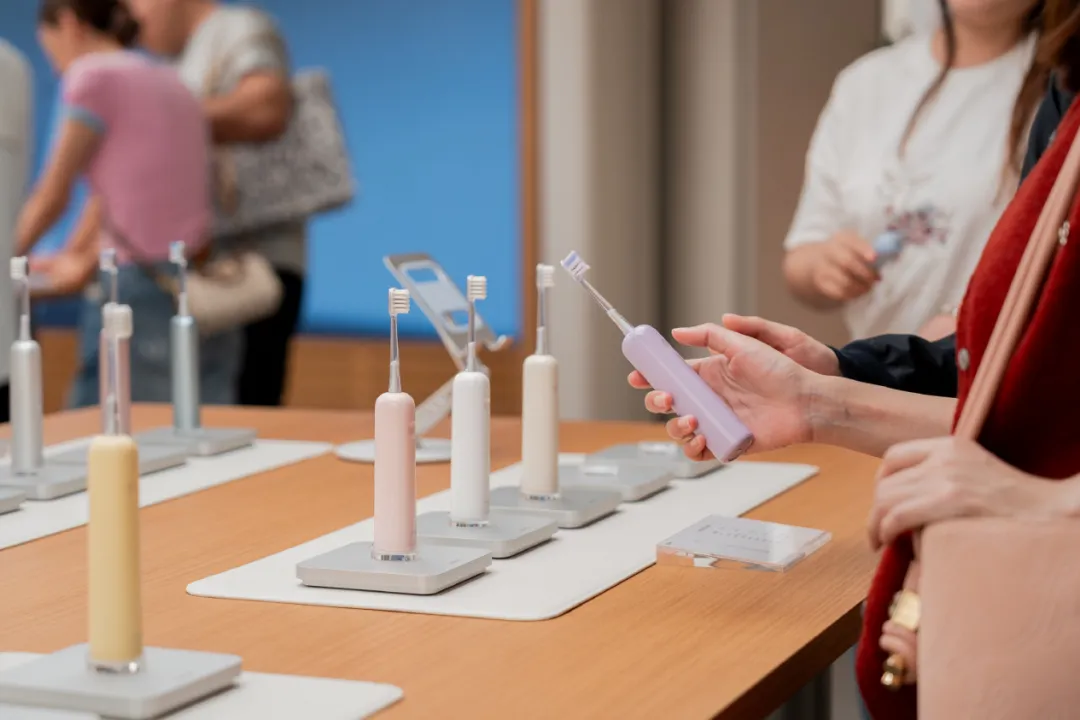
According to Jiemian News, Laifen's toothbrush product line incurred a net loss of RMB 80 million throughout 2024. During the 2025 618 festival, Laifen's electric toothbrush sales on Tmall plummeted to fifth place, surpassed by brands like Usmile and Philips.
After Laifen's shaver products officially launched in May 2025, Ye Hongxin publicly stated, "The gross profit margin of electric shavers is extremely low, and we'll likely incur 100% losses in 2025."
Evidently, Laifen's search for a second growth curve has not been smooth, possibly due to a misjudgment of the true distance between "cross-industry expansion" and "capability transfer."
On the surface, hair dryers, electric toothbrushes, and shavers all share the "motor" as a core component, making technology extension seem straightforward. However, a deeper look reveals vastly different "rules of the game" across these three sectors.
Hair dryers are essentially "functional tools," with consumers judging them based on simple, direct criteria: whether the wind is strong enough and drying is fast.
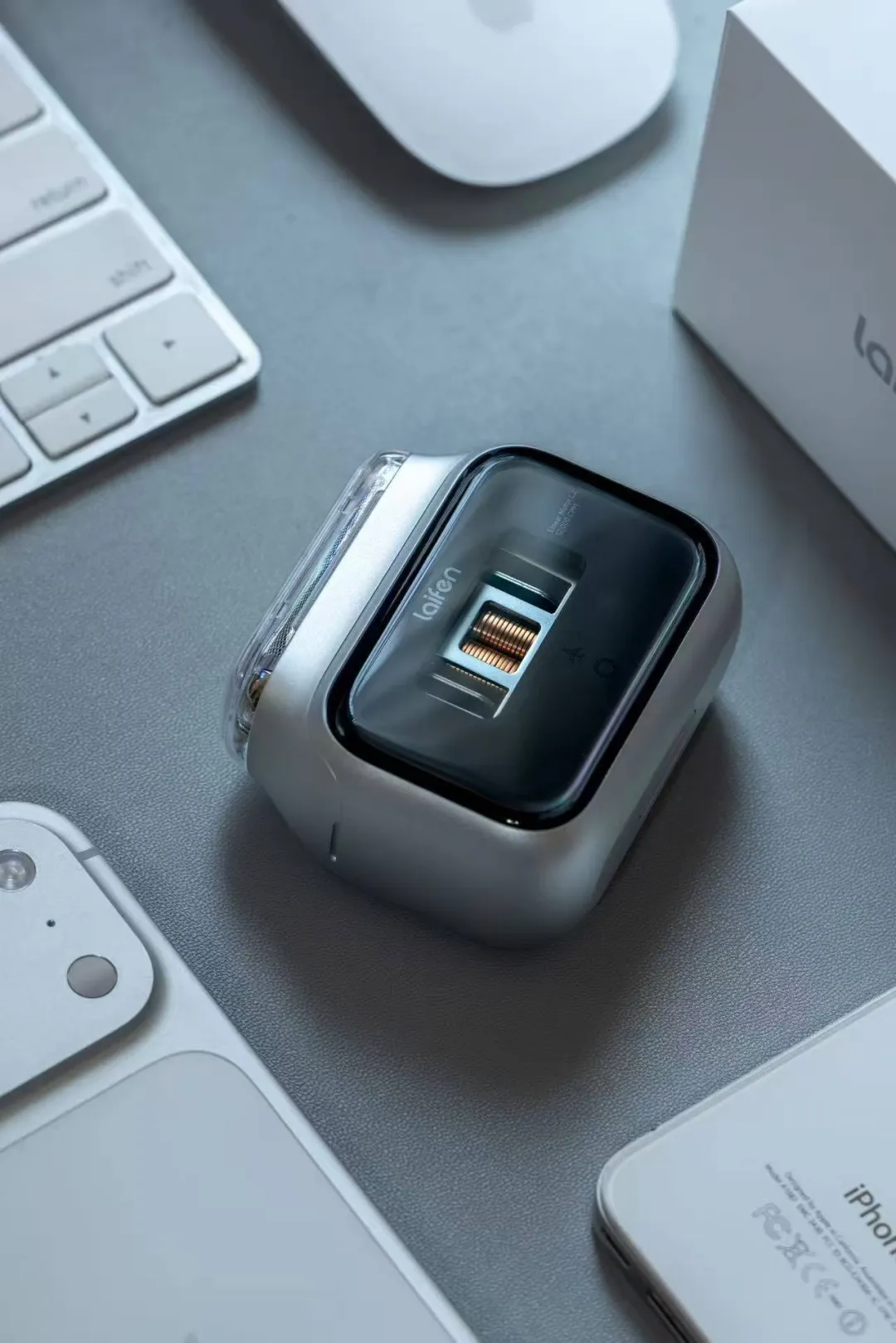
In contrast, electric toothbrushes and shavers are quintessential "experience-driven products," directly contacting human oral cavities and facial skin, involving subjective factors like comfort, fit, and vibration feedback—areas Laifen had never ventured into before. Its once-effective strategies suddenly proved ineffective.
Deeper issues lie hidden within market dynamics. Laifen's success with hair dryers owed much to the significant price gap left by Dyson. However, the electric toothbrush and shaver markets presented a different landscape.
Data from All View Cloud showed declining online retail sales and volumes for electric toothbrushes in 2024 and 2025, indicating market saturation; while the electric shaver industry demonstrated resilience with stable volumes and rising values in 2025, its growth was primarily driven by premium upgrades in portable shavers, not opportunities for new brand entry.
In these highly competitive categories, brands like Philips, Panasonic, Braun, Flyco, and Usmile have deep-rooted presence, with stable market hierarchies. Laifen's attempt to replicate its past strategy of low-price, high-perceived-value upgrades—using surprise tactics in a sector demanding head-on competition—was destined to be arduous.
03
Reinventing "Laifen"
Laifen's dilemma reflects challenges faced by all "hit-product-driven" companies.
Despite repeated setbacks in expanding its product categories, Laifen, desperate to escape its predicament and return to growth, did not halt its efforts. Instead, it proactively pivoted amid growth pressures.
From late 2025 onward, Laifen made frequent moves. In November 2025, its first offline flagship store opened in Shenzhen, announcing plans to cover 20 cities and open 300 stores by 2026; R&D investment was raised from 5% to 10%; executives from Apple, Midea, and Gree joined to address management and organizational gaps...
Laifen is attempting to reinvent itself, transitioning from a "traffic-driven online celebrity brand" to a "manufacturing and R&D-driven physical brand." To achieve this transformation, Laifen must overcome at least three major hurdles.
The first hurdle is reshaping brand perception. The label of "Affordable Alternative to Dyson" served as the best accelerator but is also a garment destined to be shed.
Essentially, this is a parasitic positioning. The brand's value is not self-defined but anchored by Dyson. The more successful it becomes, the more entrenched the label; the more entrenched the label, the harder the path to independence.
Today, when a consumer stands before a shelf, what reason other than "cheaper than Dyson" would they choose Laifen? Is it more reliable quality? A more thoughtful experience? The answer remains shrouded in fog.
The second hurdle is repairing user trust. More urgent than expanding product categories is rebuilding the fragile relationship with existing users.
After all, the value of a consumer brand is measured not by new user growth curves but by the trust bottom line of existing users. Transparent and efficient after-sales systems, fulfilled brand promises—these seemingly basic efforts are precisely what Laifen needs most now. Without trust as a foundation, all "premiumization" efforts remain castles in the air.
The third hurdle is testing strategic resolve.
According to "Southern Metropolis Daily," 2026 will be a year of explosive new product launches, "the most in the brand's history," revealed a Laifen executive.
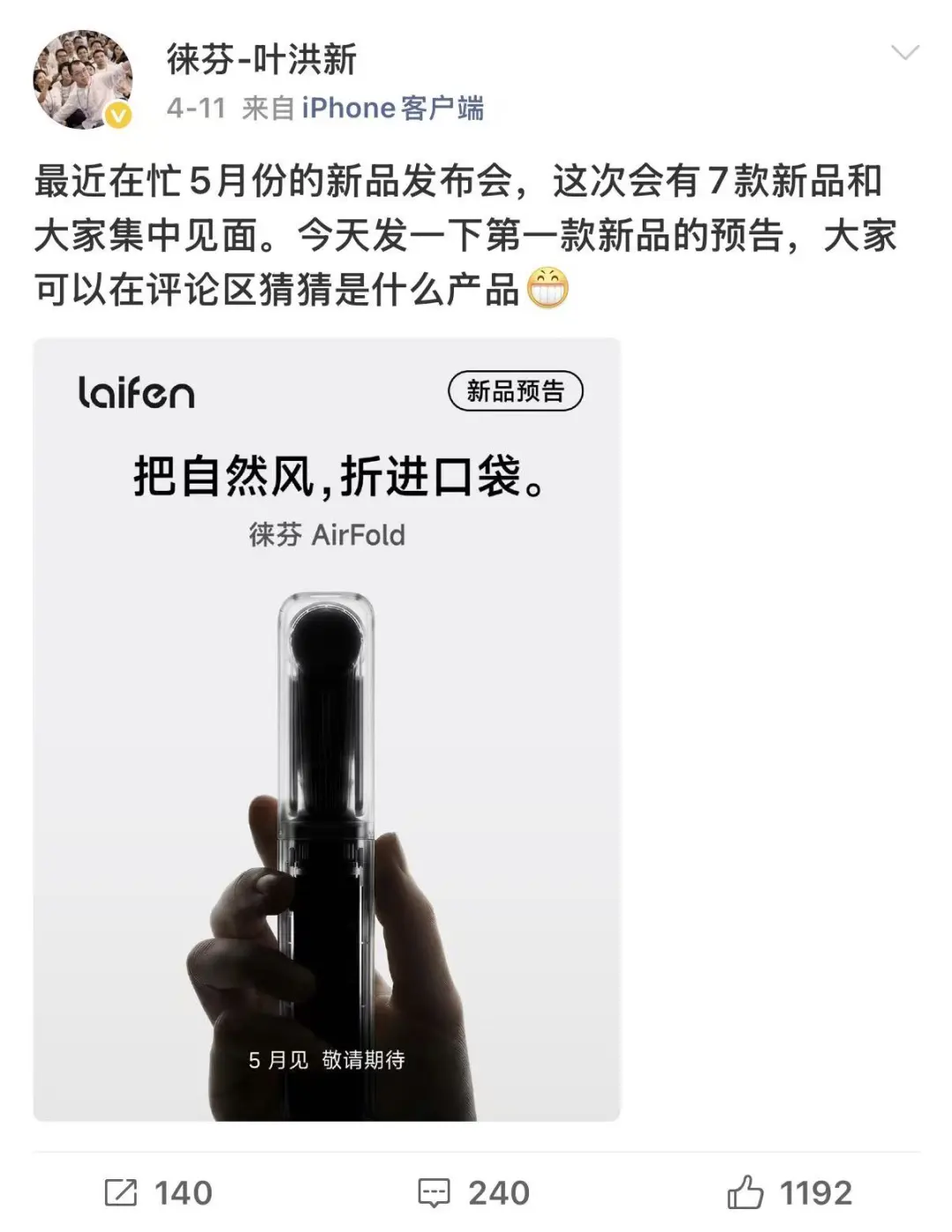
36 Krypton previously reported that Laifen has confirmed its entry into the floor-washing machine industry, with a leader from DJI, and this business has been ongoing for at least half a year.
Data shows that in 2024, China's floor-washing machine penetration was about 3.1%, leaving significant growth potential. However, while the sector is vast, it is already a red ocean dominated by fierce competitors like Ecovacs, Roborock, and Dreame, with supply chain complexity far exceeding that of personal care appliances.
Even DJI, with its deep technological accumulation in drones, has yet to shake up the industry. With only partial reuse of motor technology, what are Laifen's chances?
Sometimes, doing less yields more. What Laifen truly needs may not be expansionist ambition but the patience to cultivate deeply.
In summary, the direction to "reinvent Laifen" is clear: expanding offline presence, building factories, boosting R&D, and attracting talent. However, the real challenge lies not in deciding what to do but what not to do.
From a trash-scavenging youth to founder of a company with RMB 4 billion in annual revenue, Ye Hongxin achieved this in under a decade. But the journey from "Affordable Alternative to Dyson" to "Chinese Laifen" may prove even longer.
* Images sourced from the internet. Please contact for removal if infringement occurs.
-
Ofilm Teams Up with ADSensE to Propel Large-Scale Deployment of All-Solid-State LiDAR Powered by ADS6311 Chip!
-
![]()
Loss of 2.5 Billion Yet Facing Strong Demand for Shares? Another Battle for Control of Lianchuang Electronics
-
![]()
Huawei’s Enjoy Series Flies Off the Shelves, Prompting Xiaomi to Double Down on Budget Smartphones
-
![]()
Beijing Hyundai's Top Executive Criticizes Industry Disorder: Certain Brands Treat Customers as Beta Testers
-
![]()
The domestic mobile phone market has declined for five consecutive quarters! Huawei defies the trend with significant growth: maintains its top market share
-
Annual Revenue Surpasses 3 Billion: An Automotive Trim 'Little Giant' Makes Its Debut on the Beijing Stock Exchange
-
![]()
The Space Force Wants to Spend $30 Billion on Rocket Launches: Is Trump Doubling Down, and Is SpaceX the Big Winner?
-
![]()
Going Crazy! One out of Every Three Plug-in Hybrids Sold in Europe is a Chinese Vehicle