HONOR Creates the 'Body', nubia Infuses the 'Soul': Which Will Be Your First AI Phone?
 07/19 2026
 449
449
HONOR AI Phone's 'Hardware' Clashes with Doubao Phone's 'Software': Where Do Consumers Stand?
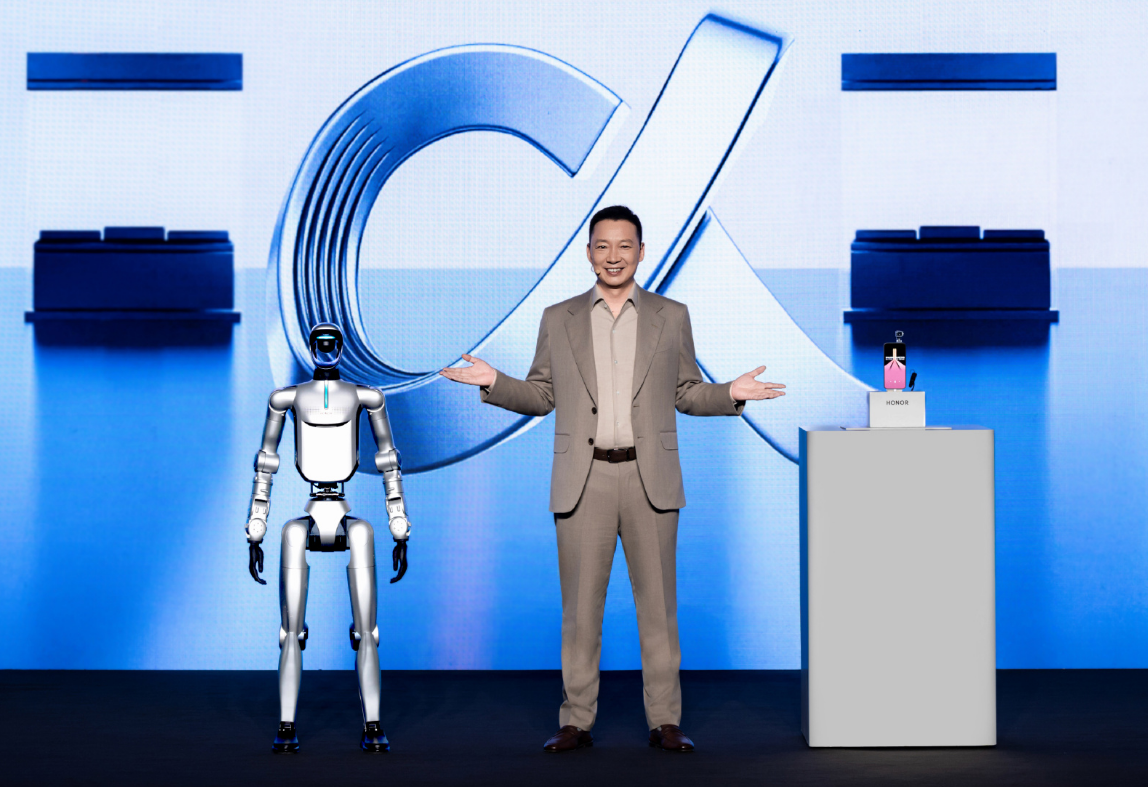
Can the newly unveiled HONOR RobotPhone outperform the 'system-controlled' second-gen Doubao AI Phone?
On July 16, HONOR Terminal CEO Li Jian announced on Weibo that the HONOR RobotPhone is ready. The posters showcase both black and white color options. It is reported that offline stores opened pre-order channels the previous day, with exclusive benefits for early reservations.
Regarding the availability of the HONOR RobotPhone, HONOR's official customer service informed New Insight Research Institute on July 17 that the phone will officially launch in the third quarter of 2026.
Around the same time, nubia announced the NaviXUltra (second-gen Doubao AI Phone), featuring a Doubao mobile assistant. Available in black, pink, white, and blue, with an orange AI physical button, the official teaser images exude a strong tech vibe.
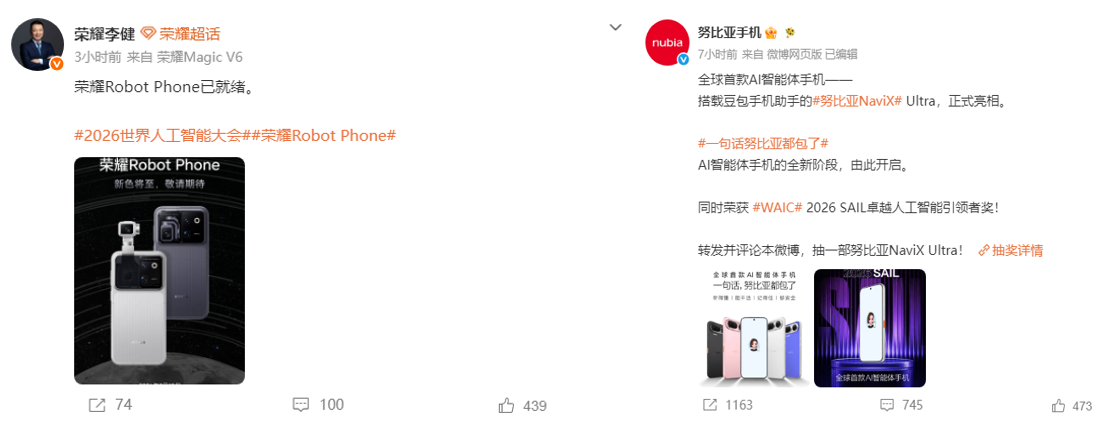
(Image Source: Weibo)
When asked about the launch date and pricing of the nubia NaviXUltra, ZTE's customer service responded to New Insight Research Institute on July 17 that the release schedule is still being planned, and no pricing information has been released yet.
A few days earlier, the Cyberspace Administration of China released a list of seven companies approved to provide on-device generative AI services, including Apple Intelligence, Huawei Xiaoyi, vivo BlueLM, Xiaomi HyperMind, and nubia's Doubao large model.
With regulatory barriers lifted, major players are expected to flood the market, and AI phones will soon transition from 'concept' to real product competition.
HONOR's newly appointed CEO, Li Jian, has his work cut out for him.
After all, he has three strategic priorities: 'RobotPhone,' 'IPO,' and 're-entering the top three.'
I
HONOR RobotPhone vs. Doubao Phone: Which Would You Choose?
The HONOR RobotPhone and nubia NaviXUltra faced off at WAIC 2026, marking the first real-world showdown of AI phones moving from 'concept' to 'reality.'
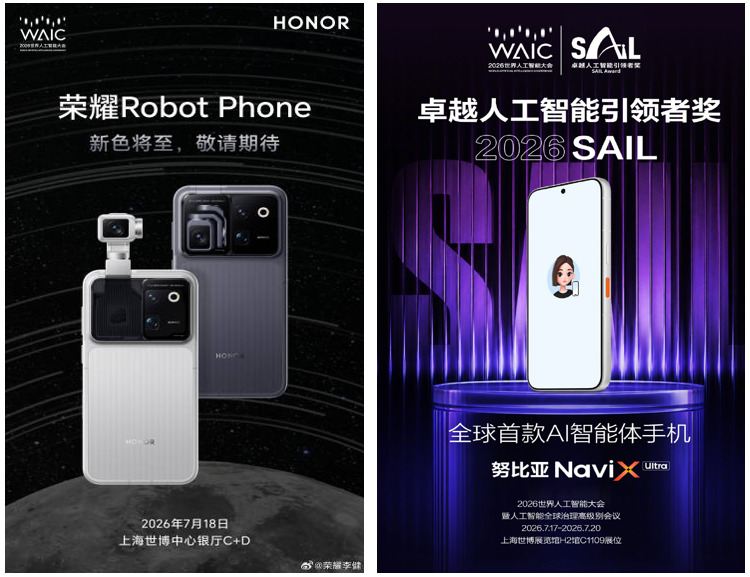
(Image Source: Weibo)
The HONOR RobotPhone concept was first introduced in October 2025 at the HONOR Magic8 series and MagicOS 10 launch event, later unveiled at MWC Barcelona in March 2026. Li Jian stated during the event that smartphones should not be just 'boring black boxes with touchscreens'—they deserve a 'brain' and even 'limbs.'
The product was directly defined as the first 'new species' under HONOR's 'Alpha Strategy.'
HONOR follows a 'hardware-defined AI' approach, with the RobotPhone's core selling point being a built-in mechanical structure. The top of the phone houses an industry-leading, miniaturized four-degree-of-freedom titanium alloy mechanical gimbal system. It integrates two major AI functions: embodied intelligent interaction and flagship imaging capabilities, allowing it to flip forward and backward, rotate 360 degrees, 'dance' to music, and even 'nod' during video calls.
According to HONOR, developing this micro-motor required collaboration with top-tier micro-motor manufacturers, who initially dismissed the idea as impossible. Undeterred, HONOR chose to design it from scratch, embodying a tenacity reminiscent of Huawei's early days.
In contrast, nubia's second-gen Doubao AI Phone takes an 'interaction-defined AI' approach.
Powered by the Doubao large model, it focuses on system-level intelligent agent capabilities. For example, users can say, 'Book me a flight to [destination],' and the AI will open apps, compare prices, and fill out forms, significantly reducing manual input. GUI (Graphical User Interface) proxy technology enables it to 'understand' the screen and simulate human-like clicks, rather than relying solely on APIs (Application Programming Interfaces).
The first-gen Doubao Phone sold 30,000 units in a single day but faced backlash from some apps over permission issues, sparking intense debates about privacy and data security.
The second-gen Doubao Phone has improved task completion efficiency.
According to nubia President Ni Fei, the new AI agent phone will feature four core capabilities: 1) Semantic understanding—able to comprehend natural language without requiring specific phrasing; 2) Task execution—capable of completing tasks independently; 3) Habit learning—able to remember preferences and reduce repetitive interactions; 4) Privacy protection—built on a secure foundation.
In essence, HONOR is giving phones 'limbs,' while nubia is giving them 'brains.'
From a technical maturity standpoint, nubia's approach seems 'lighter.' Once intelligent agents are reliable and compatible, they can quickly integrate into daily scenarios—booking tickets, shopping, planning itineraries, and even cross-app automation.
However, its intangibility lacks the visual impact of HONOR's hardware innovations, potentially resulting in weaker user perception.
Nubia has already completed regulatory filing for its intelligent agent large model, clearing the compliance hurdle. The remaining challenge is whether user experience can win people over.
There are still concerns about the second-gen Doubao Phone, as its predecessor faced issues where mainstream apps blocked AI automation permissions, limiting cross-app functions like WeChat and Alipay. No matter how smart the agent is, if apps restrict its actions, its capabilities remain constrained.
In contrast, HONOR's approach is 'heavier,' involving expensive hardware like mechanical gimbals, micro-motors, and titanium alloy structures, with uncertain yield rates and significant production challenges. However, if scaled successfully, it could create a high differentiation barrier that competitors would struggle to replicate without solving engineering problems first.
Moreover, the HONOR RobotPhone's mechanical novelty is better at generating buzz and driving offline traffic. Many people find the sight of a robotic arm 'nodding' charmingly futuristic—something software alone cannot replicate.
So, which approach will consumers prefer?
II
Li Jian's AI Terminal Dream Needs 'Shareholder' Support
Since taking office, Li Jian has repeatedly emphasized building HONOR's AI terminal ecosystem. His 'Alpha Strategy' unfolds in three phases: creating smartphones, building a smart ecosystem, and co-creating a smart world—a grand vision gradually taking shape.
The RobotPhone represents the first tangible outcome of this strategy.
However, dreams require funding. Li Jian has pledged to invest $10 billion over five years to transform HONOR into an AI terminal ecosystem company—no small sum. With smartphone profit margins shrinking, such innovation demands capital market support.
HONOR's IPO journey is paving the way for this.
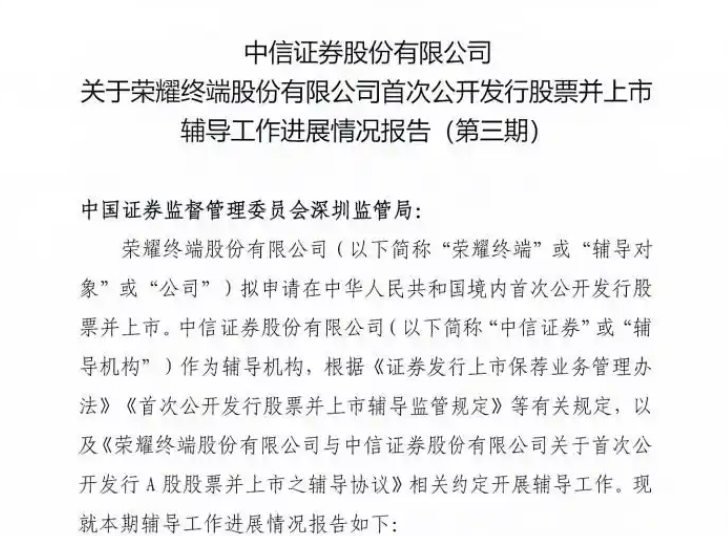
In June 2025, HONOR completed Listing guidance filing (IPO counseling filing) with the Shenzhen Securities Regulatory Bureau, with CITIC Securities as the advisor. The plan was to finish counseling by January–March 2026, but progress has stalled.
According to Jiemian News, HONOR held an internal employee shareholding meeting after failing to IPO within a year of share reform, offering employees a chance to sell shares. While executives insist 'HONOR's IPO has not terminated,' no specific timeline has been provided.
On July 15, the 'Third Progress Report on HONOR's IPO Counseling' was released, disclosing the latest developments and reigniting public interest in HONOR's IPO.
(Image Source: Shanghai Securities News)
HONOR's share reform introduced state-owned capital, operators, supply chain partners, and other shareholders. By 2025, IPO counseling was underway, aiming to become China's fourth publicly traded smartphone company. In contrast, OPPO and vivo remain hesitant.
Why the rush to go public?
The smartphone market is highly concentrated, making growth through shipment volume increasingly difficult. HONOR needs capital to fund AI R&D, ecosystem expansion, and global growth. An IPO would provide not just financial 'ammunition' but also equity incentives to retain talent and boost brand valuation.
Transitioning from a hardware manufacturer to an AI ecosystem company offers far more narrative potential.
Li Jian understands that in the mature smartphone market, traditional business growth of 10–20% is hard to achieve. Thus, transforming into an AI terminal ecosystem and attracting partners through openness—as seen with RobotPhone, YOYO intelligent agent, and cross-system interconnection—lays the groundwork for this ecosystem.
An IPO would turn 'shareholders' into supporters, providing long-term funding and confidence.
So, Li Jian's AI vision needs shareholder backing—but more importantly, time to deliver on promises.
The pain of transformation is inevitable. The key is convincing investors that AI is not just a concept but a path to tangible differentiation and revenue.
III
Risk-Taker Li Jian Leads HONOR's Aggressive AI Transformation
In May 2025, according to First Financial News, HONOR aimed to re-enter China's top three smartphone brands by year-end.
Reality dealt a harsh blow.
Omdia data showed China's smartphone market declined 1% to 282.3 million units in 2025. Huawei reclaimed first place with 46.8 million units (17% market share), followed by vivo and Apple, while Xiaomi and OPPO took fourth and fifth. HONOR failed to crack the top five.
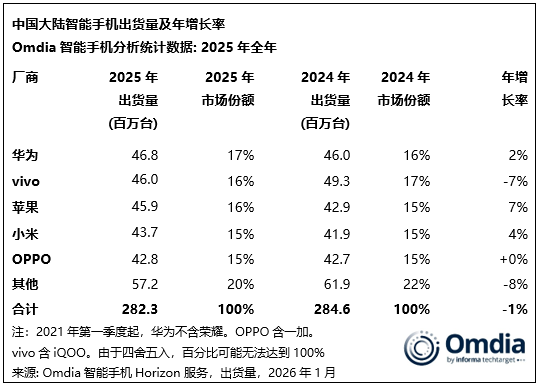
Quarterly data for 2025 showed HONOR never entered the top five, let alone the top three.
In 2026, the situation hasn't improved. Q1 and Q2 saw continued market decline, with Huawei and Apple leading. HONOR remains under pressure domestically, still outside the top five. During 618, Counterpoint data revealed HONOR's sales plummeted 33% year-on-year, far exceeding the industry average.
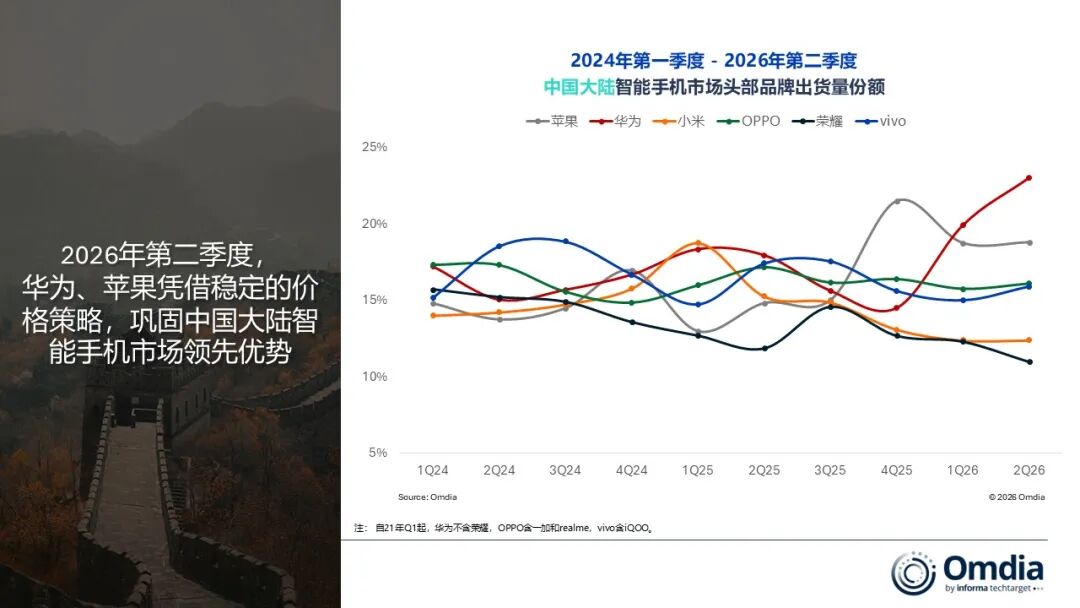
Rising component costs (e.g., memory) have driven industry-wide price hikes, hitting HONOR's mid-to-low-end models hard. Coupled with Huawei's strong recovery, cautious consumer spending, and intense competition, HONOR's domestic position remains precarious. While its overseas performance shines (e.g., in the Middle East), the domestic market is crucial.
Can Li Jian's AI transformation save HONOR?
There's potential, but sustainability is the question.
Li Jian embodies spirit of adventure (risk-taking spirit).
AI is an industry consensus, and HONOR acts fast in hardware innovation (RobotPhone, Magic series). Overseas growth provides a buffer. An open ecosystem strategy attracts partners, reducing solo risks. If the IPO succeeds, funding and brand effects could accelerate progress, creating a virtuous cycle.
However, AI transformation is costly. In the short term, hardware innovations like RobotPhone face cost and supply chain challenges, while intelligent agent ecosystems need time to cultivate user habits. With extreme market concentration, breaking into the top three from 'Others' is no small feat.
Competitors are also chasing AI aggressively: Huawei has its HarmonyOS ecosystem, Apple has Apple Intelligence (partnered with Alibaba), and nubia is collaborating with Doubao for vertical breakthroughs.
HONOR also made waves in robotics.
In April, CNR reported that at the Beijing Economic-Technological Development Area Humanoid Robot Half-Marathon, over 100 teams and ~300 humanoid robots competed. HONOR's 'Great Sage' team robot 'Lightning' won with a net time of 50:26, breaking the human half-marathon world record of 57:20.
Besides the champion team, runners-up Thunder Lightning and Spark Ignition were also from HONOR, whose robots swept the top six places.
HONOR's AI transformation extends beyond phones to other categories, showcasing its AI R&D investment and capabilities.
Now, HONOR's AI shift aims to replace scale dependency with value dependency—moving from relying on cost-effectiveness and channel volume to earning profits through unique experiences.
This aligns with the smartphone industry's logical shift in a saturated market.
But success hinges not on slogans but execution: RobotPhone's mechanical reliability, pricing acceptance, and ecosystem openness must attract partners.
If AI products generate word-of-mouth premium, HONOR can stabilize in high-end and niche markets, gradually boosting overall share. Conversely, if it remains mere concept hype, burning cash while losing market share, both investors and consumers will turn against it.
Whether HONOR can stage an AI-powered comeback depends on making consumers truly feel 'this phone is different'—not just another 'AI trend follower.'
-
![]()
Artificial Intelligence: Its Next Phase of Growth Shines in Guangdong
-
The First Country to Be Shorted by AI Emerges
-
Monthly Sales of 2,000 Units, Declining for Three Consecutive Years: smart's Luxury Script is No Longer Playing Out
-
![]()
HONOR Creates the 'Body', nubia Infuses the 'Soul': Which Will Be Your First AI Phone?
-
Insights from the 2026 World Artificial Intelligence Conference: Computing Power and Manufacturing Fuel AI's Leap from Virtual to Physical Realms
-
The Moment to Evaluate Montage Technology Has Arrived
-
![]()
StepOn Has Solved the Monetization Challenge of Large Models with Just a Smartphone
-
![]()
Is a Camera the New AI Safety Guardian? Hikvision Introduces Active Vision Operation Monitoring Gun-Ball Camera at WAIC 2026