Is a Camera the New AI Safety Guardian? Hikvision Introduces Active Vision Operation Monitoring Gun-Ball Camera at WAIC 2026
 07/17 2026
 441
441
Every day, factories face high-risk scenarios, such as working at heights and hot work operations. To maintain safety, managers typically need to carry out frequent inspections, a task that is both labor-intensive and challenging to perform on a 24/7 basis. Is there a solution—an always-online safety officer capable of continuously monitoring operations, proactively identifying risks, and issuing timely warnings?
At the 2026 World Artificial Intelligence Conference (WAIC), Hikvision unveiled its latest innovation—the Active Vision Operation Monitoring Gun-Ball Camera. This device transcends the capabilities of a mere video camera; it functions as a '24-hour AI safety officer,' integrating visual perception, scene understanding, and risk analysis to facilitate a shift in workplace safety from 'reactive response' to 'proactive prevention.'
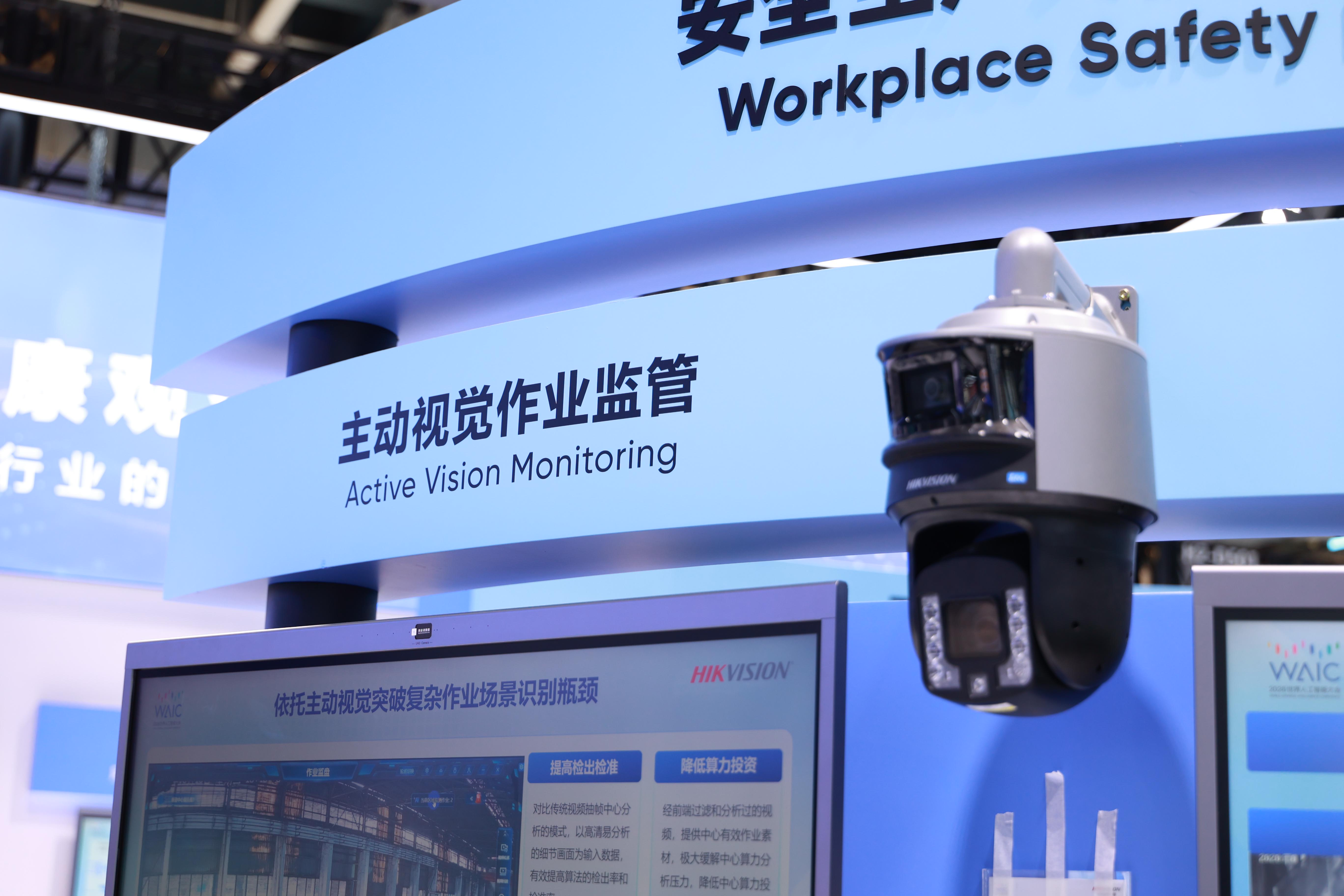
Photo: The debut of Hikvision's Active Vision Operation Monitoring Gun-Ball Camera at WAIC 2026
From 'seeing' to 'understanding': The camera with 'thinking eyes'
Traditional video surveillance systems can capture footage but lack the ability to comprehend on-site events. The most notable advancement of the Active Vision Operation Monitoring Gun-Ball Camera is its 'thinking eyes'—it doesn't just passively 'see' but actively 'understands' the scene. With its panoramic plus detail dual-lens design, the camera's panoramic view can analyze the overall situation within a 60-meter radius, perceive the distribution of personnel and potential risks, and simultaneously trigger the detail PTZ camera to automatically zoom in and focus, analyzing and identifying operation types such as hot work and working at heights, and continuously tracking and observing them.
Leveraging large model capabilities, the Active Vision Operation Monitoring Gun-Ball Camera can analyze a variety of non-compliant behaviors and safety risks. It currently supports the identification of violations related to the wearing of safety helmets, safety ropes, reflective vests, work uniforms, protective face shields, exposed skin, making phone calls, and using mobile phones. Upon detecting abnormal risks, the system promptly reports them to the platform for handling, enabling relevant supervisors to intervene at the operation site in a timely manner, thereby maximizing personnel safety and minimizing losses.
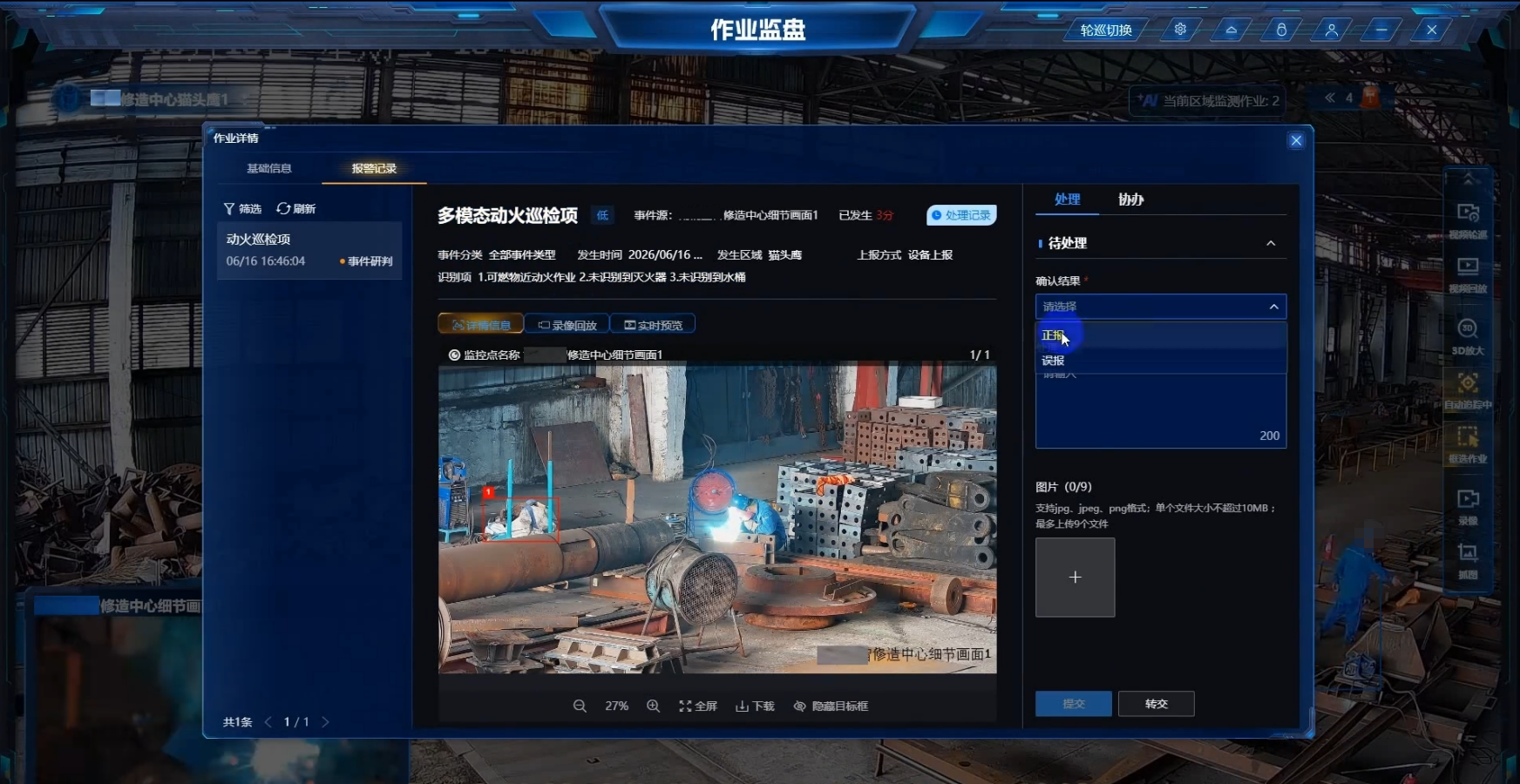
From personnel entering the site, through operation execution, to the recording of violations, a complete regulatory closed loop is established. Managers no longer need to monitor screens for extended periods; instead, AI assists in analyzing massive video data, allowing them to focus on truly critical risk events.
From 'humans seeking problems' to 'problems finding humans': Production supervision enters a new era
This transformation has already yielded significant value in real-world projects. In the steelmaking operation area of a steel plant, the original system generated a cumulative total of 418 alarm events. After deploying the Active Vision Operation Monitoring Gun-Ball Camera and leveraging large model technology, the overall false alarm rate decreased by 99.45%, aiding managers in identifying more genuine safety hazards and making on-site management more precise and efficient.
The deployment of the Active Vision Operation Monitoring Gun-Ball Camera in the steam drum layer, turbine platform, and material stacking areas of a power plant enabled the analysis of non-compliant behaviors and fire hazards, providing reliable evidence for subsequent safety inspections.
In a large-scale construction site supervision project, facing the complex environment of simultaneous operations in multiple construction areas, the Active Vision Operation Monitoring Gun-Ball Camera, combined with an inspection platform, achieved full-process operation supervision. The accuracy rate of identifying behaviors such as smoking and the wearing of safety helmets exceeded 90%, effectively alleviating the pressure of manual inspections.
With the shift from 'humans seeking problems' to 'problems finding humans,' workplace safety management is no longer constrained by human energy limitations and experience blind spots. Instead, it employs intelligent analysis to objectively identify risks and make informed judgments, rendering hazards visible and production safer.
AI infiltrates the production site, and cameras evolve into 'digital safety officers'
As artificial intelligence accelerates its integration into the industrial sector, the role of video devices is also evolving. In the past, cameras were primarily responsible for data collection; today, they are beginning to comprehend scenes; in the future, they may even participate in decision-making processes.
The introduction of the Active Vision Operation Monitoring Gun-Ball Camera represents Hikvision's significant endeavor in deeply applying visual large model capabilities to industrial safety scenarios. It not only sees the scene but also understands it; it not only identifies risks but also proactively warns of them.
When cameras are equipped with 'active vision' and 'scene understanding' capabilities, a 24/7 online digital safety officer is emerging. This may well be one of the most valuable directions for AI to empower workplace safety.
-
The Moment to Evaluate Montage Technology Has Arrived
-
![]()
StepOn Has Solved the Monetization Challenge of Large Models with Just a Smartphone
-
![]()
Is a Camera the New AI Safety Guardian? Hikvision Introduces Active Vision Operation Monitoring Gun-Ball Camera at WAIC 2026
-
The Second Half of AI: Cost-Effectiveness Takes Center Stage
-
![]()
Location, Concentration, and Trajectory Tracking: Hikvision’s TDLAS Gas Cloud Imaging Telemetry System Debuts at WAIC 2026
-
The 'AI Study Tour' Under the Original Equipment Manufacturer Model is Set to Create a New Wave of Internet-Famous Science and Innovation Cities
-
![]()
Now, There's a 'Basis' to Curb 'Price Wars': Future Reports of Automakers Setting Low Prices Will Be Probed Under New Rules
-
![]()
WAIC 2026: Farewell to Parameter Races, Full-Chain AI Commercialization