Apple Launches Used Phone Leasing, but Zhuanzhuan and Others May Have Different Views
 07/28 2026
 557
557
Source: SourceSight
As the prices of phones, tablets, and computers continue to climb, Apple is intensifying its push for leasing as a viable alternative to outright purchases.
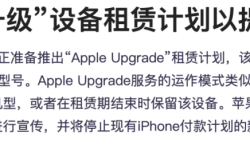
Recently, a report by Cailian Press, citing foreign media sources, revealed that Apple is poised to roll out a new "Apple Upgrade" program by the end of this month. This program will offer subscription-based leasing services for a variety of products, including phones, tablets, computers, and watches, to eligible users.
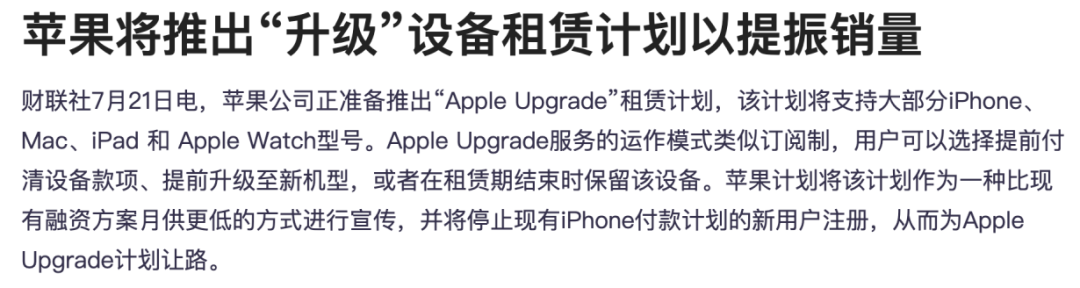
Source: Cailian Press
Under this program, the leasing period will be 24 months for iPhones and Apple Watches, and 36 months for Macs and iPads. Throughout the lease, users can enjoy the full functionality of the product by paying a modest monthly fee. Upon lease expiration, users have the option to return the device, upgrade to the latest model, or pay the remaining balance to keep their current device.
However, it's crucial to note that if a user defaults on payments during the lease, Apple has the capability to remotely lock the device into a restricted mode via the cloud.
Based on the information available, this service represents a significant enhancement to Apple's previous "Annual Upgrade" program. By subscribing to a fixed monthly fee, Apple users will gain prolonged access to multiple new Apple products. Reports indicate that Apple believes this approach will be more cost-effective for consumers than interest-free installment plans for device purchases.
Against the backdrop of escalating digital hardware costs, declining sales volumes, and prolonged user upgrade cycles, Apple's timely introduction of a "leasing instead of selling" strategy reflects its considerations for market growth in terms of product sales and revenue. It also taps into the vast potential of the second-hand device recycling and circulation market.
01 A Sophisticated Iteration of the "Annual Upgrade" Program
From the iPhone's "Annual Upgrade" program to the comprehensive "family bundle" leasing and upgrade service, Apple aims to deepen user engagement within its ecosystem through more cost-effective hardware subscription offerings.
As early as 2015, Apple pioneered the "Annual Upgrade" program for iPhones in the United States, which was subsequently introduced to the Chinese mainland market in 2016. Specifically, users who purchase a new iPhone and opt for the AC+ warranty service can trade in their old phone to Apple for recycling and receive up to a 50% discount on the next-generation iPhone within the 3rd to 15th month after purchase, while continuing to benefit from interest-free installment plans.
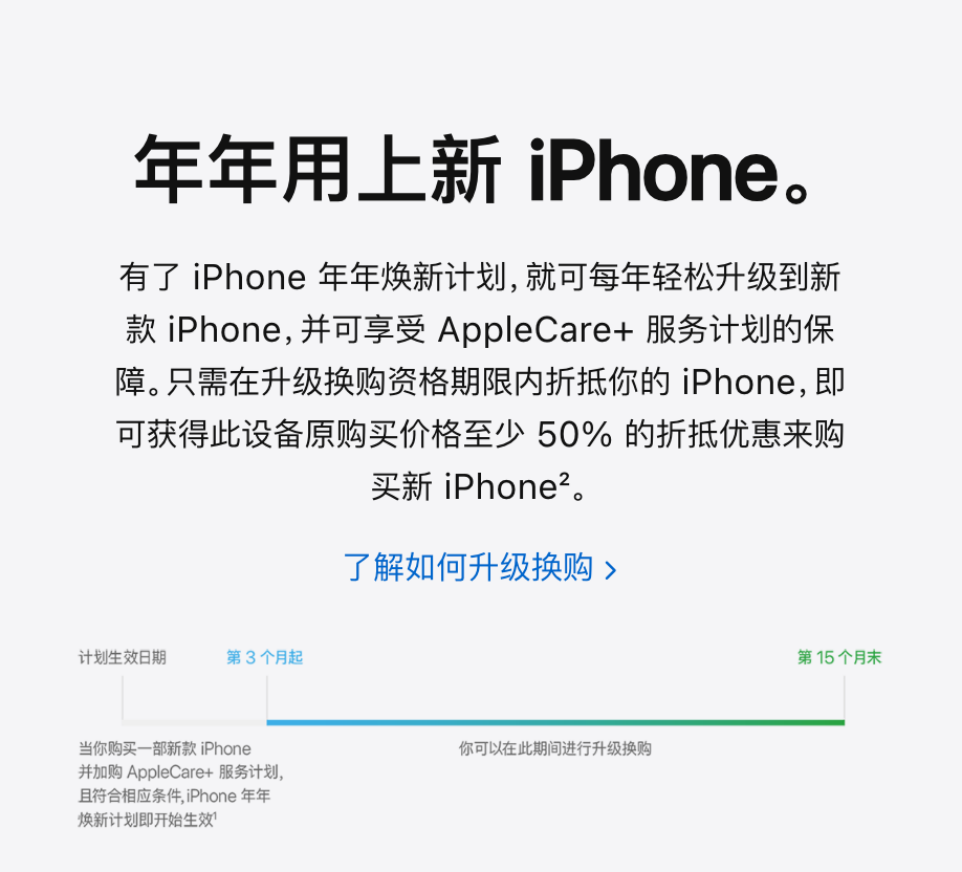
Apple's previous "Annual Upgrade" program | Source: Apple
While Apple's official trade-in service, the "Annual Upgrade" program, offers convenience, it may not always be the most cost-effective option. Users are required to purchase the AC+ warranty service, which ranges from 1,199 to 1,599 yuan, and the maximum trade-in value for old devices is capped at half the price of a new device. In essence, under the "Annual Upgrade" program, the iPhone's residual value is less than 50%.
In contrast, data from the foreign second-hand trading platform SellCell reveals that one year after the release of the iPhone 16 series, the platform's residual value rate remained as high as 51.5%, significantly outpacing Samsung's 39.5% and Google's 40.8%. These figures align closely with data from domestic B2C second-hand trading platforms like Aihuishou and Zhuanzhuan. Meanwhile, on C2C trading platforms like Xianyu, well-maintained second-hand iPhone models can retain over 65% of their value one year after release.
For the majority of domestic consumers, purchasing a new device at full price and selling the old phone on a second-hand platform often proves to be a more cost-effective upgrade strategy compared to Apple's official trade-in service.
To expedite user upgrades and further promote its "family bundle" products, Apple's new leasing service encompasses four major product lines: iPhone, iPad, Mac, and Apple Watch. It also offers more diverse upgrade options than the previous trade-in program, which provided a maximum of 50% discount on old devices. After the lease term concludes, users have the flexibility to renew and upgrade to the latest model, pay the remaining balance to purchase the current device outright, or terminate the subscription and return the device.
02 Apple Embraces Change
Currently, the digital hardware industry is grappling with the challenges posed by a prolonged super cycle of storage demand.
Affected by the soaring costs of upstream components such as storage, Apple announced a new round of global price hikes in June this year, with price increases ranging from hundreds of dollars for Macs, iPads, and various home devices. Concurrently, the global smartphone user upgrade cycle is extending from approximately two years to over three years.
IDC forecasts that global shipments of phones, tablets, and personal computers will decline by 13.9%, 7.6%, and 11.3%, respectively, in 2026. It also anticipates that the impact of this storage shortage cycle on downstream terminal manufacturers will persist until 2028.
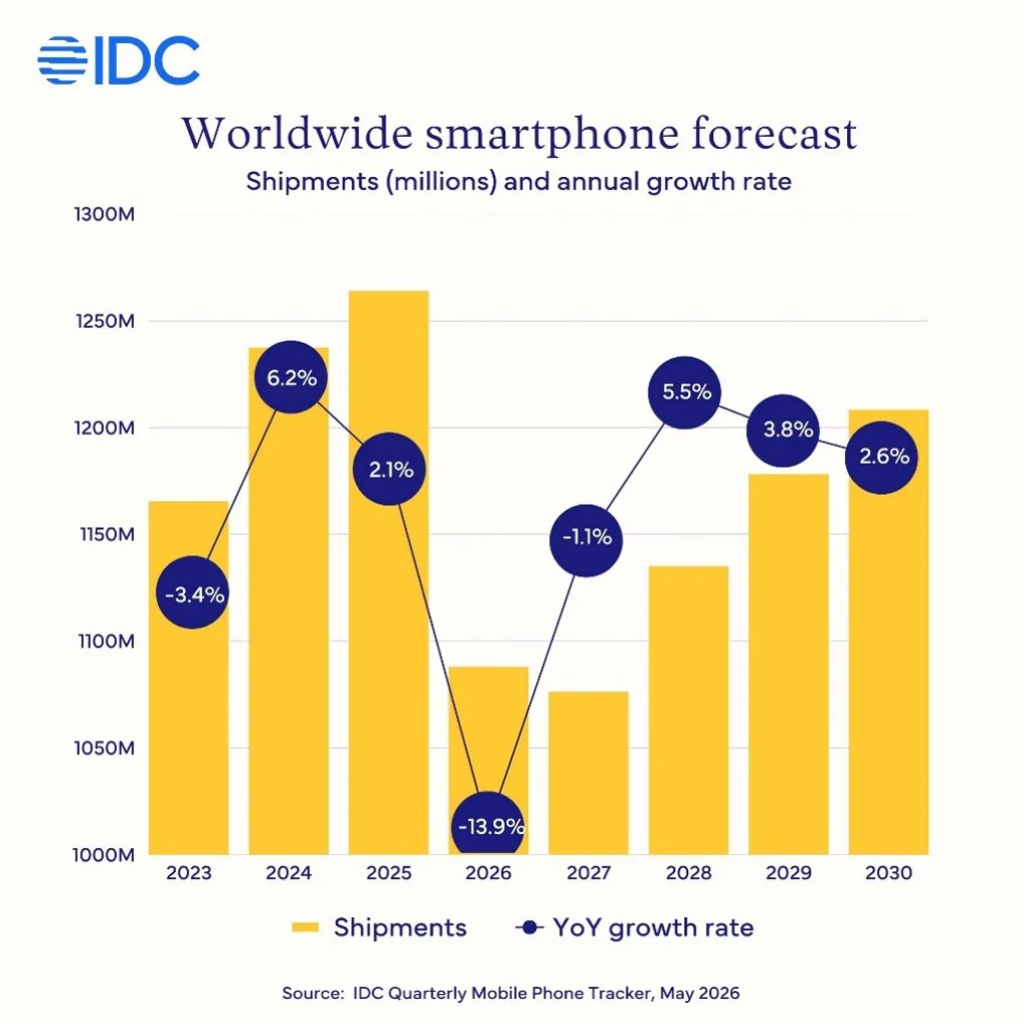
Source: IDC
Against this industry backdrop, Apple's strategic deployment of hardware subscription services aims to transform one-time hardware sales into long-term, stable subscription revenue. This not only mitigates sales growth pressure stemming from rising costs but also locks in more target users within Apple's product ecosystem through leasing services.
From a cost perspective, Apple's new leasing program establishes differentiated lease terms for various product categories, with iPhones and Apple Watches having a 24-month lease term and Macs and iPads having a 36-month term. Although Apple has yet to announce specific subscription fees, industry observers generally anticipate that the single-period subscription amount will be more affordable than interest-free installment plans for purchasing products at full price. The combination of a vast product software and hardware ecosystem with a lower entry cost threshold is expected to entice more users to participate in this hardware subscription program.
It's worth noting that, in addition to the "Annual Upgrade" program, Apple also offers official refurbished discounted products (excluding iPhones). The introduction of this new leasing system underscores Apple's long-standing commitment to establishing official refurbishment and recycling channels.
03 Disposition of Old Phones
The launch of Apple's new official upgrade system also reflects its considerations for the next phase of transformation in digital hardware consumption patterns.
According to CIC data, the market size for trading and servicing second-hand consumer electronics in China is projected to reach 987.5 billion yuan by 2026 and maintain an average annual growth rate of 26.1% over the next five years.
The latest data from second-hand trading platforms indicates that purchasing second-hand digital products has emerged as a new growth driver in the current digital consumption market.
During Aihuishou's 618 promotion period (May 13 to June 18), the platform's recovery volume across all categories and channels surged by 42% year-on-year, with the overall recovery volume for 3C products rising by 57%. Recovery volumes for phones, computers, and tablets—the three core categories—increased by 66%, 65%, and 40%, respectively, year-on-year.
Financial reports reveal that Aihuishou's total annual revenue reached 21.05 billion yuan, up 28.9% year-on-year. Its offline stores have expanded to 2,195 locations, covering 298 cities across China. Combined with a daily average of 2,154 home visit teams, it has constructed a dense fulfillment network.
According to Zhuanzhuan's "2026-618 Second-Hand Circulation Trading Trends Insight," during this year's 618 promotion period, Apple phones continued to dominate the circulation market. The iPhone 13, with its balanced performance and affordable second-hand price, topped the list, while high-end models like the iPhone 16 Pro Max and iPhone 15 Pro also ranked prominently, indicating robust demand for upgrading to older second-hand iPhones. Additionally, almost all these models were 256GB large-capacity versions, reflecting users' persistent demand for storage space.
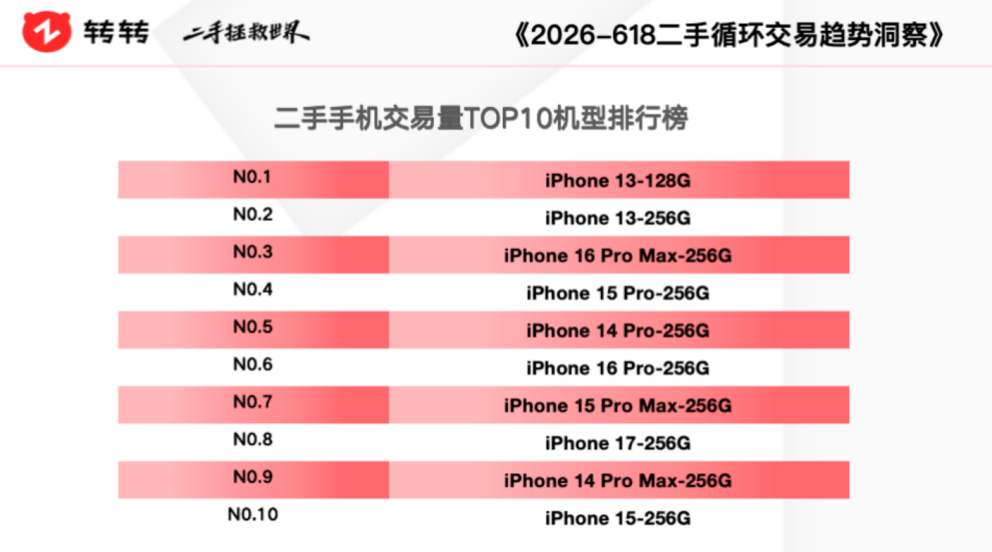
Source: Zhuanzhuan
The active trading growth data on second-hand trading platforms starkly contrasts with research institutions' significant downward revisions of shipment expectations, highlighting the current surge in trading frequency and demand for second-hand products. It also reflects a pragmatic shift in downstream consumer market demand for digital products amid price hikes, providing a market reference point for Apple's subsequent promotion of its "family bundle" leasing program.
Through this official hardware subscription service, Apple can not only drive user upgrade cycles but also gain further control over its system for recycling old devices and circulating second-hand products. For instance, under this business model, device ownership remains with Apple long-term, while users only possess the right to use the device. At the end of the lease term, devices are uniformly recovered, impacting the supply, pricing system, third-party recyclers, and individual second-hand trading of second-hand Apple devices.
However, it's important to note that this hardware subscription service is currently more likely to be launched in overseas markets, and there are still significant practical obstacles to its implementation in the domestic market in the short term.
Some images sourced from the internet. Please notify us for removal if there is any infringement.
-
![]()
Once a Sales Leader Among New Car Manufacturers, Now Selling Equipment at Bargain Prices
-
![]()
There are risks in going global, but we must rise to the challenge when facing 'competitors'!
-
![]()
Is Selling Cars in China Primarily a One-Time Transaction?
-
![]()
Who Should Be Responsible for the Long-Term Reliability of AION S Battery Failures: Automakers or Battery Manufacturers?
-
![]()
Millennium Civilization: Ultra-Fast Charging Spanning Thousands of Miles | BYD's Marco Polo New Silk Road Expedition Successfully Concludes in Shenzhen, Ushering in a New Era of Chinese-Western Civili
-
![]()
Apple Launches Used Phone Leasing, but Zhuanzhuan and Others May Have Different Views
-
![]()
Semiconductor Struggles: Why is the Market Turning to Apple?
-
![]()
E-commerce Division and Centralized Staffing: What’s Next for Kuaishou?