Xiaomi's Midlife Challenge: Balancing Soaring Smartphone Storage Costs Against Losses in Its Automotive Ventures
 08/19 2026
 472
472
On August 18, 2026, following the close of the Hong Kong market, Xiaomi Group unveiled its financial results for the second quarter.
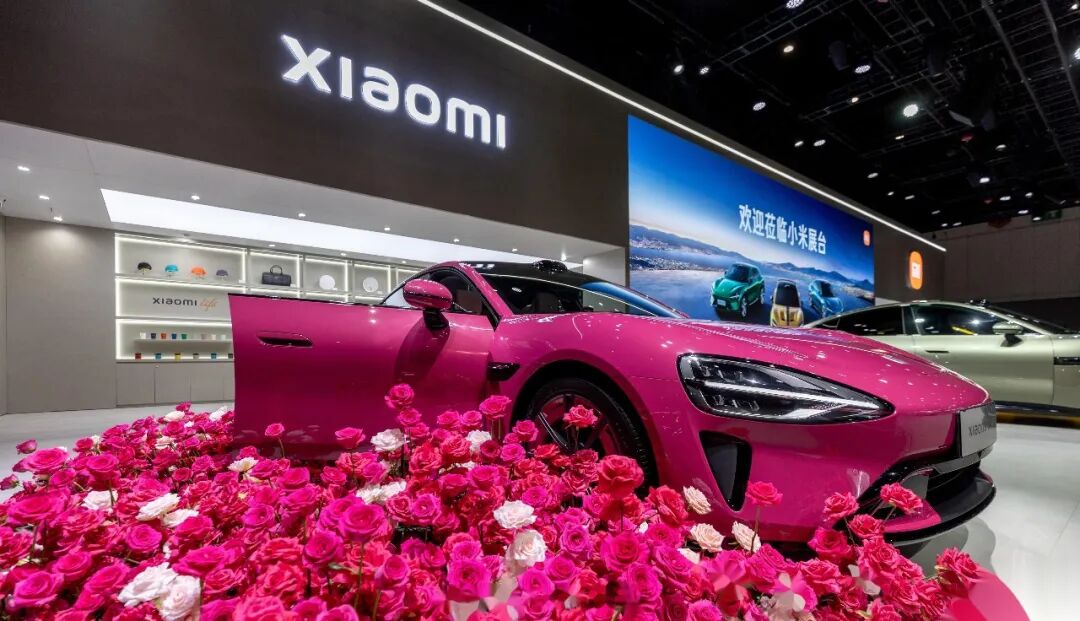
Revenue hit RMB 108.922 billion, marking a 6.1% decrease year-on-year but a 9.9% increase quarter-on-quarter. Adjusted net profit, however, took a significant hit, plunging 42.6% year-on-year to RMB 6.219 billion.
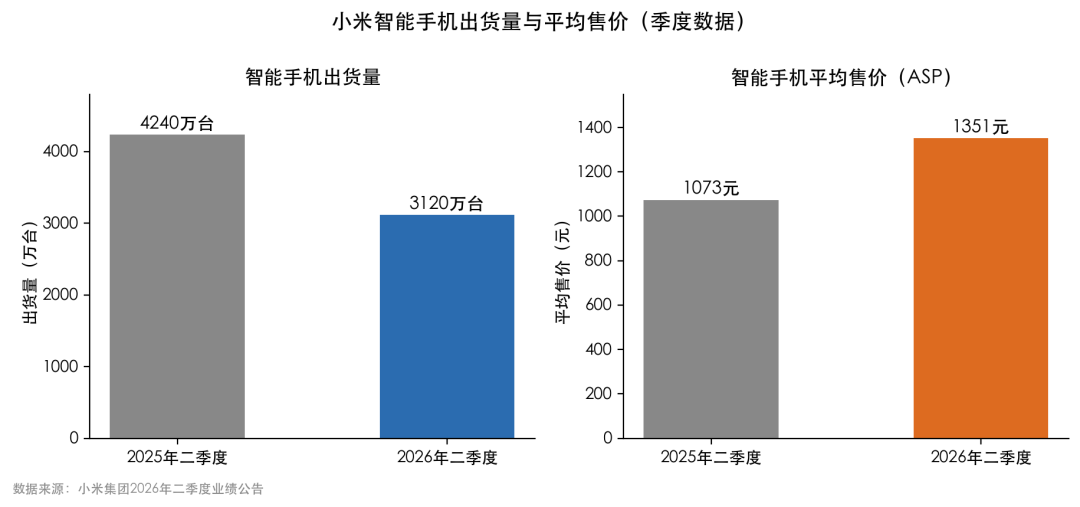
Smartphone shipments reached 31.2 million units, experiencing a steep 26.5% decline year-on-year—one of the sharpest drops among global mainstream manufacturers.
Conversely, the automotive business delivered 104,199 new vehicles, surging 28.2% year-on-year and setting a new single-quarter delivery record.
The figures paint a contradictory picture: revenue exceeded RMB 100 billion, yet profits were halved; smartphone shipments fell while automotive deliveries soared; reported net profit stood at RMB 9.463 billion, but adjusted net profit was only RMB 6.219 billion.
What exactly is happening here?
A closer look at the financial report reveals two major challenges confronting Xiaomi's core businesses: escalating storage costs are eroding smartphone profits, while the automotive business, though scaling up, remains unprofitable.
1. Smartphone Business
According to IDC's Global Quarterly Mobile Phone Tracker, global smartphone shipments reached 277.5 million units in the second quarter of 2026, down 6.7% year-on-year. Samsung maintained its global leadership with a 22.6% market share, followed by Apple at 20.1%, together commanding over 40% of the market.
The rise of Samsung and Apple has squeezed market share for Xiaomi, OPPO, and vivo. Xiaomi's shipments fell from 42.4 million units in the same period last year to 31.2 million units, a 26.5% drop.
However, Xiaomi's smartphone sales decline appears to be strategic—a deliberate contraction of low-end, high-volume models to focus resources on its premium 14 series.
Xiaomi stated that it reduced shipments of mid-range and low-end smartphones to optimize its product mix.
This strategy is supported by the revenue figures: smartphone revenue reached RMB 42.1 billion, down just 7.5% from RMB 45.5 billion year-on-year—far less than the decline in shipments.
With shipments down by a quarter, revenue fell by less than 10%, thanks to higher average selling prices (ASPs).
In the second quarter, Xiaomi's smartphone ASP reached RMB 1,351, surging 25.9% year-on-year to a record high. The figure was RMB 1,073.2 in the same period last year.
Xiaomi ranked among the top three globally for the 24th consecutive quarter, holding top-three positions in 53 countries and regions and top-five positions in 67.
In China, IDC's Q2 2026 China Smartphone Market Tracker showed domestic shipments at approximately 134 million units in the first half, down 4.2% year-on-year. Second-quarter shipments reached about 66.01 million units, a 4.3% decline—marking the fifth consecutive quarter of negative growth.
On one hand, Xiaomi invested heavily in premium models while reducing shipments of mid-range and low-end devices. On the other, rising storage costs made low-end models so unprofitable that cutting them was a financially sound decision.
However, this strategic contraction is a double-edged sword. A 26.5% decline in shipments signals accelerating erosion of the user base, while competition for premium market share intensifies.
The sustainability of Xiaomi's strategy—higher prices compensating for lower volumes—hinges on whether its premium models can continuously capture market share in a shrinking market.
2. Ceding Profits to Storage Costs
The smartphone industry in 2026 is characterized by soaring memory chip prices.
DRAM and NAND prices continued to climb as manufacturers implemented repeated price hikes, leaving downstream smartphone makers struggling. Xiaomi responded by cutting shipments to maintain prices.
Its annual shipment target was revised downward from an initial ~170 million units to ~135 million, then dipped to ~95 million mid-year. By July, reports emerged that Xiaomi had raised its target to ~110 million units, with the increase focused on entry-level models due to internal expectations of a shift in storage market conditions.
However, downstream manufacturers' tolerance for sustained price hikes is nearing its limit—OPPO and vivo even rejected Samsung's Q3 price quotes.
The rationale behind memory chip price increases is straightforward: during the previous cycle's trough, manufacturers slashed capacity, while AI servers consumed large volumes of high-bandwidth memory, tightening DRAM and NAND supply and driving prices upward.
For smartphone makers, memory is one of the heaviest cost components. Price hikes directly erode gross margins, while expectations of further increases trigger channel and manufacturer hoarding, further inflating spot prices.
In this cycle, smaller players exit first, while larger firms compete on supply chain bargaining power and cash reserves.
Xiaomi's decision to cut shipments and maintain prices essentially prioritizes limited memory supplies for premium models. The same memory cost delivers far better returns when used in a RMB 1,351 smartphone than in a sub-RMB 1,000 entry-level device.
For Xiaomi, the direct consequence of rising storage costs is collapsing gross margins.
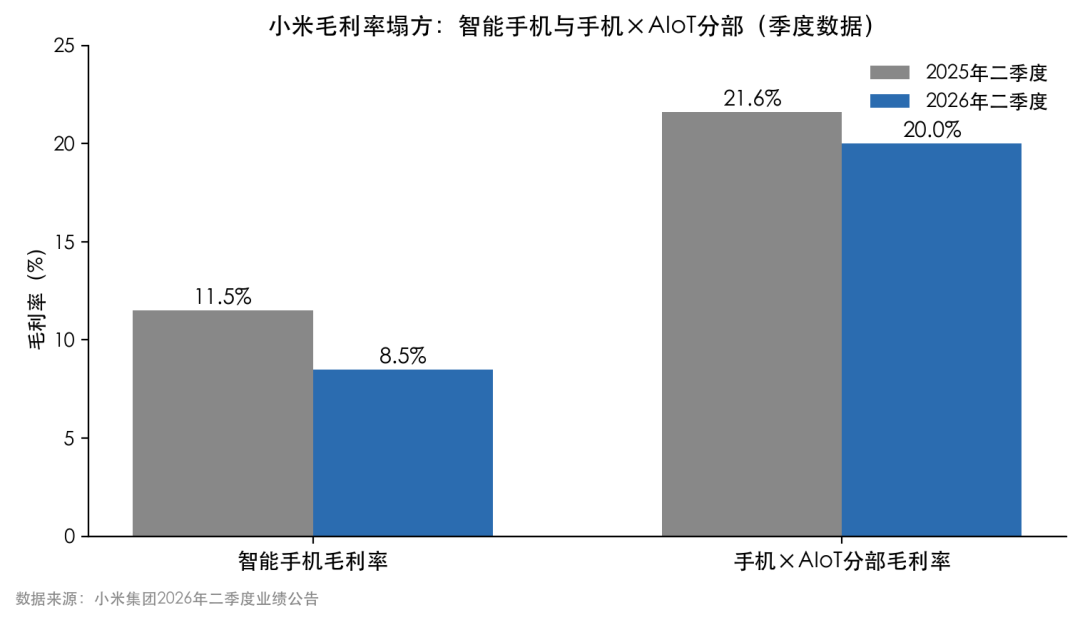
Smartphone gross margin fell to 8.5% in the second quarter, down 3 percentage points from 11.5% year-on-year. The overall Mobile × AIoT segment's gross margin dropped to 20.0% from 21.6%.
Source: ifind
The IoT business also faced pressure, with IoT and consumer product revenue declining 19.2% year-on-year to RMB 31.3 billion, primarily due to reduced domestic subsidies. Internet services revenue reached RMB 9 billion, roughly flat from RMB 9.1 billion year-on-year.
Combined smartphone, IoT, and internet services revenue totaled RMB 84.026 billion for the Mobile × AIoT segment, with a 20.0% gross margin. While still the group's profit engine, the segment is under strain.
A rough calculation shows that if smartphone gross margin had remained at last year's 11.5%, gross profit would have been ~RMB 1.26 billion higher based on RMB 42.1 billion in smartphone revenue—enough to cover nearly half of the second quarter's automotive operating losses.
3. The Automotive Business's High-Speed Sprint
Xiaomi's automotive unit was both the brightest spot and the biggest cash burner in this financial report.
Revenue from the Smart Electric Vehicles and AI Innovations segment reached RMB 24.9 billion in the second quarter, up 17.1% year-on-year. This included RMB 23.9 billion from smart electric vehicles and RMB 1 billion from other related businesses, including AI revenue generated by the Xiaomi MiMo large model.
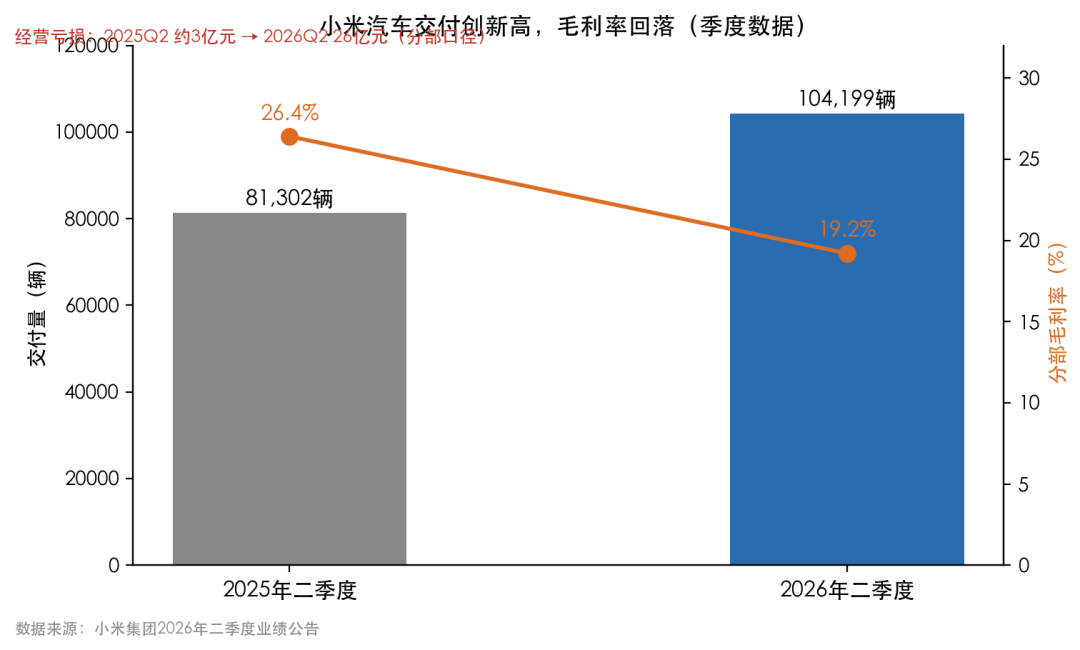
Deliveries hit 104,199 units, up 28.2% year-on-year to set a new single-quarter record.
Source: ifind
The new-generation SU7 ranked first in domestic pure electric sedan sales above RMB 200,000 in the first half, with cumulative SU7 series deliveries surpassing 500,000 units in just 28.5 months. The YU7 pure electric model topped the one-year residual value rankings, while Xiaomi rapidly expanded its vehicle lineup.
Following the release of Xiaomi's Kunlun technology architecture, the Pengcheng N90 Max and N70 Max entered pre-sales, extending the product line from sedans to SUVs and off-road models while covering a wider price range.
For a company just two years into automotive manufacturing, this product expansion speed is remarkable. However, each new production line entails fresh capital expenditures and ramp-up costs—one reason why automotive segment losses are slow to narrow.
While scale has increased, losses have not narrowed proportionally.
The segment reported an RMB 2.6 billion operating loss in the second quarter, compared to just RMB 300 million in the same period last year. Gross margin collapsed from 26.4% to 19.2%.
This 7.2-percentage-point margin decline translated into losses widening from RMB 300 million to RMB 2.6 billion.
The immediate question: Where is all the money going?
The answer lies in product mix and production ramp-up. The first quarter saw a transition period between old and new SU7 models, with YU7 as the sole sales driver. Deliveries plunged from ~145,000 units to 81,000 units, halving revenue.
The second quarter saw new SU7 volumes surge, with deliveries rebounding above 100,000 units. However, new model ramp-up means higher per-unit costs and heavier capacity investments.
Additionally, this segment now includes AI businesses. While the MiMo large model began generating revenue, AI infrastructure spending is simultaneously expanding.
The financial report explicitly states that AI is a core focus for the next decade, with large-scale investments being a strategic choice.
At 19.2%, automotive gross margin is not low by industry standards. Losses of RMB 2.6 billion are also far smaller than many new energy vehicle (NEV) startups' early-stage burn rates.
The issue is when Xiaomi's automotive losses will peak and start declining.
In 2025, this segment achieved its first positive annual operating profit of RMB 900 million, only to slip back to a RMB 3.1 billion loss in the first quarter of 2026 before narrowing to RMB 2.6 billion in the second quarter.
This profit volatility reflects intense market competition as Xiaomi races to scale while investing in new models.
Placing Xiaomi Auto in industry context, its 19.2% gross margin is respectable. Mature automakers typically maintain vehicle gross margins between 15% and 25%. With deliveries surpassing 100,000 units, Xiaomi Auto is achieving scale effects, but capacity investments for new model ramp-ups, channel expansion, and intelligent driving R&D are all consuming margin improvements.
Changes in the segment's revenue mix also warrant attention.
Within the Smart Electric Vehicles and AI Innovations segment, AI revenue grew from RMB 600 million last year to RMB 1 billion. While still a small share, the direction is clear: the MiMo large model aims to become Xiaomi's second growth engine.
However, AI infrastructure requires heavy capital investment, which will only worsen the segment's short-term losses. Whether this bet pays off long-term represents Xiaomi's biggest uncertainty in its new decade strategy.
Xiaomi Auto's losses are also tied to industry competition. The RMB 200,000+ pure electric sedan market features Tesla, NIO, Zeekr, Luxeed, and other rivals, with constant price wars.
That the SU7 captured first place in first-half sales in this environment speaks to its product strength and brand appeal. However, sustained price wars are also compressing vehicle gross margins.
4. Cash Flow
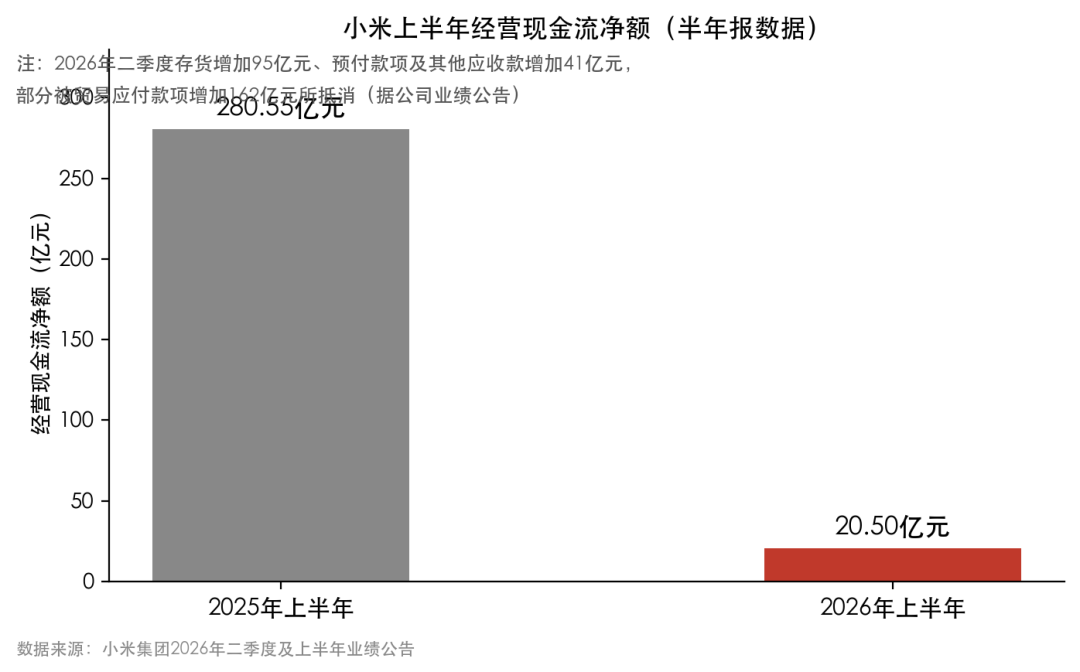
Xiaomi generated RMB 3.842 billion in net cash from operating activities in the second quarter—decent at first glance. However, first-half operating cash flow reached only RMB 2.05 billion, down over 90% from RMB 28.055 billion year-on-year.
Source: ifind
Where did the cash go?
The financial report explains that second-quarter operating cash flow was dragged down by RMB 9.5 billion in inventory increases and RMB 4.1 billion in prepayments and other receivables, partially offset by RMB 16.2 billion in trade payables increases.
In other words, Xiaomi is stockpiling inventory. Locking in capacity and inventory during a storage price hike cycle is rational, but the cost is cash being tied up in warehouses. The RMB 4.1 billion increase in prepayments reflects higher deposits paid to upstream suppliers. Meanwhile, the RMB 16.2 billion rise in trade payables shows Xiaomi is also extending credit to upstream suppliers, shifting some cash pressure onto them.
-END-
Disclaimer: This article is based on the public company attributes of listed companies and relies primarily on information disclosed by the companies in accordance with legal obligations (including but not limited to interim announcements, periodic reports, and official interaction platforms) as the core basis for analysis and research. Shiyu Xingkong strives to ensure fairness in the content and viewpoints presented but does not guarantee their accuracy, completeness, or timeliness. The information or opinions expressed in this article do not constitute any investment advice, and Shiyu Xingkong assumes no responsibility for any actions taken based on this article.
Copyright Notice: The content of this article is original to Shiyu Xingkong and may not be reproduced without authorization.
-
![]()
Can L1, the Shargeek AI Glasses That Once Stopped Production Voluntarily, Make a Resurgence? A Firsthand Account
-
![]()
Latest US Consumer Car Purchase Report: Seats and Driving Assistance Top Picks, Auto Parking Makes Debut on List
-
![]()
Chengdu Auto Show Preview: Xiaomi and AITO Take Diverse Approaches, Leaving NIO as the Lone BEV Purist
-
![]()
Is It Worth It for CATL to Acquire Zhongheng Electric for 4.1 Billion?
-
![]()
After 315 Exposed AI Data Manipulation, Someone Finally Unveiled the Inner Workings of the GEO Industry
-
![]()
Cows Vanish from the Grasslands, While Digital Tokens Soar with the Wind
-
Buffett Goes All-In with Billions, Duan Yongping Halves Positions: Who Misjudged Google?
-
![]()
Li Shufu’s Swansong Financial Report: Two Words Capture the Essence – Global Expansion