Harbor Weekly Review | Dreame's 200,000-Yuan Smartphone: A Symbolic Gesture with Limited Impact
 08/24 2026
 529
529
"Harbor Business Insights" by Li Lei
After the departure of its smartphone division head, Dreame has finally unveiled some 'positive news': a smartphone priced at 200,000 yuan has found a buyer.
However, this news is far from being truly positive; rather, it might signify a notable, albeit isolated, stride for Dreame's smartphone venture, rather than a transformative moment for the broader smartphone sector.
A smartphone embellished with gold and diamonds is unlikely to become a mainstream global product solely on the basis of such embellishments.
Recently, the head of Dreame's smartphone division disclosed on social media that the inaugural AURORA smartphone (serial number 001) had been delivered, with full payment of $30,000 (approximately 202,300 yuan) received, comprising a $10,000 deposit and a $21,184 final installment. This model is touted as the 'most expensive flagship smartphone in Chinese history.'
It is reported that the smartphone's backplate is crafted from 24K gold and adorned with custom-cut precious gemstones, along with an exclusive signature from founder Yu Hao. It also includes a collectible certificate marked 'No.001.'
In early August, market rumors surfaced indicating that Yu Lei, the leader of Dreame's ecological brand Eclix smartphone division, was planning to resign from the Dreame group, although his internal Feishu account remained operational.
Yu Lei officially joined MOVA, a Dreame subsidiary, in March 2026 as the head of smartphone and AI hardware businesses, but his tenure lasted less than six months.
Public records show that Yu Lei joined Gionee Group in 2015 as Global Vice President, overseeing marketing and channel sales, before departing in 2018. He subsequently served as Chief Operating Officer at BrainCo, contributing to the company's commercialization and its rise as one of the 'Hangzhou Six Little Dragons.' Yu Lei also founded the smartphone brand FreeYond, targeting overseas markets with a direct-to-consumer (DTC) model.
Just two months ago, the Eclix team announced a deep collaboration with a leading domestic large-scale model manufacturer, anticipating the release of the first-generation AI smartphone in September 2026, with a launch planned before the 'Double 11' shopping festival. The product is positioned as high-end, with a price tag exceeding 5,000 yuan.
According to Yu Lei at the time, Eclix would operate as a Dreame ecological brand, independent of MOVA, with a team of about 60 expected to expand to around 300 by the end of 2026. Concurrently, the Eclix team sought financing, with the AI smartphone project engaging with multiple investors.
After only six months on the job, Dreame and the seasoned Yu Lei have mutually 'crossed paths' in a less-than-ideal manner. This development undoubtedly casts further doubt on Dreame's ambitious plans.
It is widely believed that Dreame initiated a comprehensive retreat in June, announcing a strategic shift to focus on four core sectors: smart home, outdoor courtyard, smart mobility, and embodied intelligence. Other businesses would undergo integration, merger, or transformation, while some business units (BUs) without substantial operations or personnel would be dissolved. Previously market-oriented ventures such as automobiles and smartphones would now be advanced through industrial research institutes, primarily emphasizing technological R&D and industry-academia-research collaboration.
In fact, in May, Chen Longdong, the head of Dreame's automotive business, had already resigned. Subsequently, Dreame's subsidiary, Stellar Future (Suzhou) Automotive Technology Co., Ltd., issued a statement clarifying that Chen Longdong joined Dreame's original Stellar Future business unit (BU) in June 2025 as its leader. His actual position did not align with the online rumors of 'Dreame Auto CEO' or 'Dreame executive.'
From the automotive to the smartphone business, Dreame's setbacks have become increasingly evident.
A brief recap of the bold assertions made by Dreame's founder, Yu Hao: to compete with Apple and Samsung for global market share and ultimately claim the top spot worldwide.
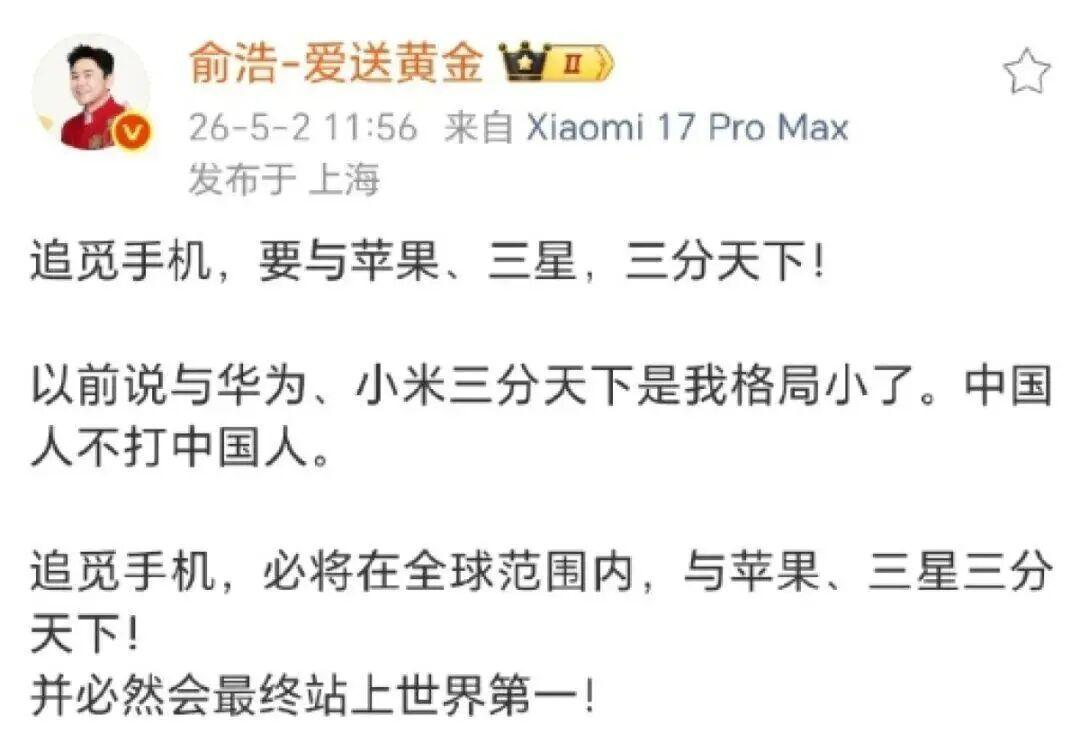
Prior to this, Dreame also announced that its overall R&D investment in the smartphone business was expected to reach 10 billion yuan, with smartphones and automobiles being the two sectors receiving the highest resource allocation from the company.
Why is the sale of a 200,000-yuan smartphone by Dreame, purportedly the most expensive in China or even globally, considered virtually insignificant?
Firstly, the false premium associated with the hardware. The premium of traditional high-end smartphones (such as Huawei's Porsche Design/Ultra Series, Samsung's W Series) stems from absolute technological barriers, such as self-developed chips, satellite communication, or foldable screen technology. Dreame's smartphone, manufactured by ZTE Nubia (running MyOS), offers no fundamental breakthrough in the core user experience.
The stacking of physical materials masquerades as a technological premium. Dreame's so-called '200,000-yuan high price' is essentially repackaging an industrial product as a 'gold and gemstone ornament.' It sells not the technological value of a smartphone but the physical value of gold and gemstones. Raising the price with gold and gemstones is a marketing 'dimensionality reduction and substitution' that fails to address the smartphone's technological moat as an electronic product.
Following this logic, could embedding gold and gemstones into a bowl or cup justify selling it for 200,000 yuan?
Secondly, Dreame misreads the ultimate fate of luxury smartphones, which is a 'Vertu-style' false proposition.
The collapse of Vertu, the pioneer of luxury smartphones, has already demonstrated that in the smartphone era, 'the wealthy do not need to sacrifice basic user experience for prestige.' Luxury buyers may purchase high-end watches or jewelry, but smartphones are daily necessities highly dependent on ecosystems and frequent interaction.
Vertu initially capitalized on Nokia's heyday, while Dreame's brand heritage lies in household cleaning appliances like 'robot vacuums and hair dryers.' Asking buyers to hold a gold smartphone weighing several hundred grams, emblazoned with a cleaning appliance brand logo and running a contract-manufactured system, fails to strongly project social status or possess the century-old cultural heritage required of luxury goods.
If consumers are unfamiliar with Vertu, they may not be unfamiliar with the domestic brand 8848.
Thirdly, Dreame's 200,000-yuan smartphone appears more like a self-console, a PR strategy, or performance art.
Yu Hao's smartphone ambitions are beyond ordinary comprehension. Even Xiaomi, OPPO, VIVO, or the controversially outspoken Yu Chengdong would not dare make such bold claims.
When conventional R&D cannot shake Apple or Huawei in the short term, generating internet buzz through 'selling the first 200,000-yuan gold smartphone' is the fastest way to leverage public attention. However, the negative side effects of this public opinion leverage are substantial. Can selling a few units truly establish core competitiveness or market status?
Can Dreame mass-produce its smartphones? Can it introduce even a single self-developed, irreplaceable technology in the highly competitive consumer smartphone market? Or, if Dreame aims to create luxury smartphones favored by a global elite minority, can it achieve the top-tier brand status of Hermès or Louis Vuitton?
These questions demand answers from Dreame. (Produced by Harbor Finance)
-
![]()
What Accounts for the Nearly 200,000 Yuan Price Difference Between the Yijing X9 and the Aito M9?
-
![]()
How Great is the Weight on Great Wall H10’s Shoulders?
-
![]()
Kilowatt-Level, Ten-Millijoule Ultrashort Pulse Generation via Multipass Cell: A Cutting-Edge Ultrafast Nonlinear Optics Technology
-
![]()
Chengdu International Auto Show: Igniting the Auto Market with a 'Dual-Flavored Hotpot'?
-
![]()
Doubao Integrated into Tesla: Why Did Musk Make an Exception? | Auto Circle
-
![]()
Is the Robot Phone a Viable Innovation?
-
![]()
Doubao Integrated into Tesla’s Ecosystem: Why Did Musk Make an Exception? | Auto Circle
-
Open Source or Closed Source? The Debate Over AI Development Paths