What Accounts for the Nearly 200,000 Yuan Price Difference Between the Yijing X9 and the Aito M9?
 08/24 2026
 515
515
Authored by Zhineng Technology
The Yijing X9 and the Aito M9 are both large, six-seater flagship SUVs tailored for family use, each boasting a length of approximately 5.3 meters and a wheelbase exceeding 3.1 meters.
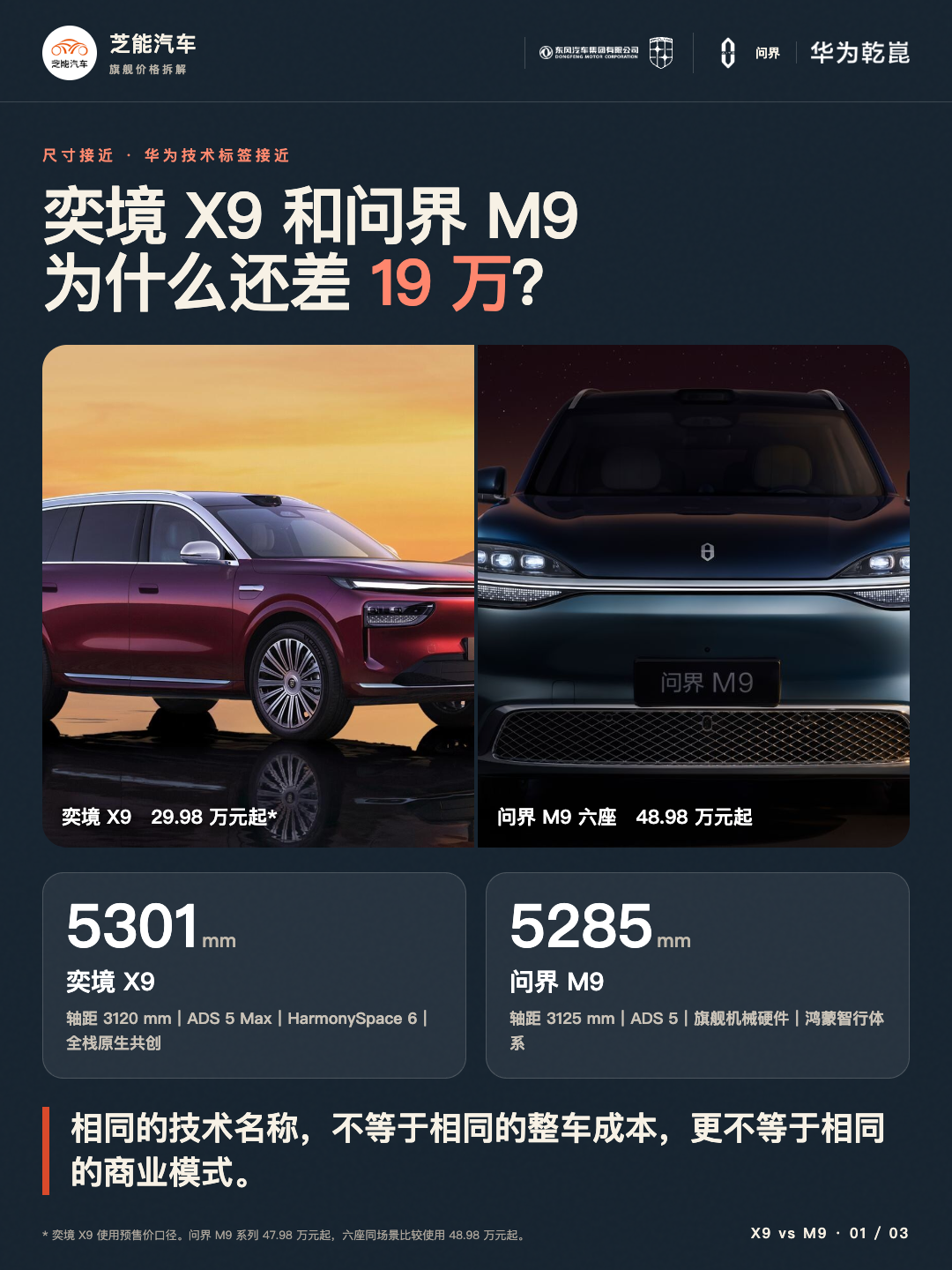
Both vehicles are outfitted with Huawei's cutting-edge ADS 5, 896-line dual-light-path image-grade LiDAR, and the latest HarmonyOS cockpit. Their collaboration has evolved from single-component procurement to comprehensive R&D synergy. The Yijing X9 has a pre-sale price starting at 299,800 yuan, whereas the Aito M9's official starting price is 479,800 yuan.
When comparing the six-seater variants exclusively, the Aito M9's six-seater model starts at 489,800 yuan, resulting in a 190,000 yuan price disparity between the two.
Such a substantial price gap naturally prompts two hypotheses:
◎ One perspective is that the Yijing X9 is a "budget-friendly alternative to the Aito M9."
◎ The other viewpoint suggests that the Aito M9 includes a premium of nearly 200,000 yuan attributed to "Huawei's brand value."
Despite their similar dimensions and Huawei's technological hallmarks, the two vehicles have distinct product focuses. How comparable are they really?
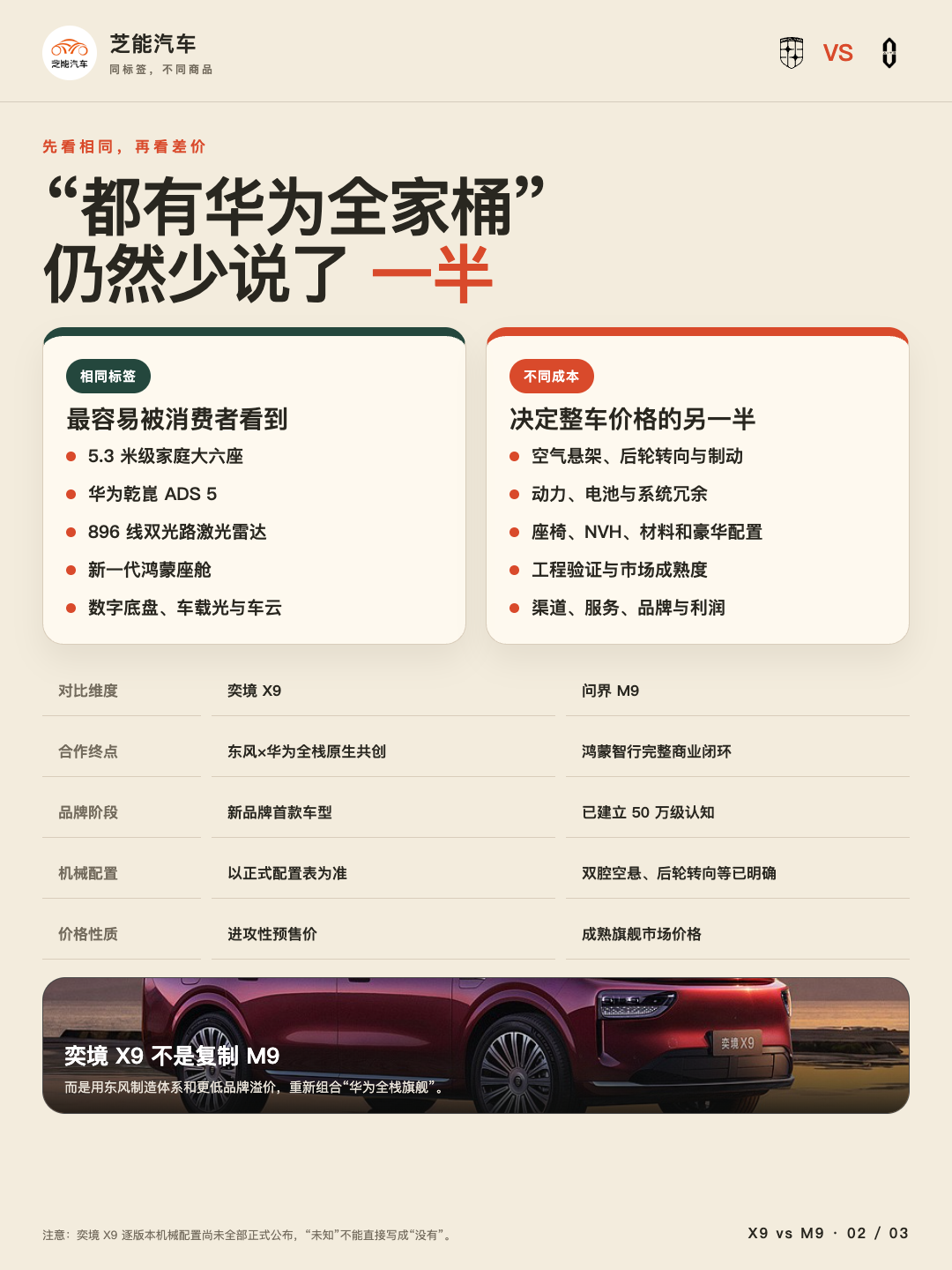
The Yijing X9 measures 5,301 mm in length with a 3,120 mm wheelbase, while the Aito M9 measures 5,285 mm in length with a 3,125 mm wheelbase. In terms of size and seating configuration, both vehicles are nearly identical.
In terms of intelligence, their similarities are remarkable:
◎ Huawei ADS 5;
◎ 896-line dual-light-path image-grade LiDAR;
◎ Next-generation HarmonyOS cockpit;
◎ Huawei's digital chassis technology;
◎ Huawei's in-car optical, communication, and vehicle-cloud solutions;
◎ Joint product development and calibration by Huawei.
The Yijing X9 also features the inaugural batch of HarmonySpace 6, dual 17.2-inch connected screens by Huawei, megapixel projection headlights, in-car laser projection, and an augmented reality head-up display.
If one solely considers the body size and a few of Huawei's most prominent technologies, the two vehicles seem highly comparable.
However, focusing solely on these aspects can lead to overlooking the nuanced differences in automotive costs.
● The First Price Difference: Mechanical Hardware
The Aito M9's price reflects a higher-specification mechanical foundation.
The all-new Aito M9 boasts a full-aluminum chassis, front double-wishbone and rear multi-link trapezoidal arm suspension, closed dual-chamber air springs, dual-valve continuously variable damping shock absorbers, six-piston front brake calipers, and rear-wheel steering.
Certain versions can also be equipped with an 800V fully active suspension, offering multi-level height adjustment with a range of approximately 80 mm.
The Aito M9's investment in active suspension technology (800V fully active air suspension vs. dual-chamber air suspension), braking specifications (six-piston front calipers), chassis calibration maturity, and extreme condition validation are all factors in its pricing.
For the Yijing X9, these aspects will only become clear after formal delivery and long-term usage.
● The Second Price Difference: Power, Battery, and Redundancy
The Aito M9's commitment to a flagship experience extends beyond intelligent driving.
The new model utilizes Huawei's full 800V high-voltage power platform. The extended-range version is equipped with 60 kWh and 75.4 kWh batteries, while the pure electric version features a 120 kWh ternary lithium battery, providing higher-specification power output, braking capability, thermal management, and electrical redundancy.
The Aito M9's officially disclosed omnidirectional stereo fusion perception system includes 40 sensors, featuring a forward dual-redundancy LiDAR matrix and four solid-state LiDARs in all directions, totaling six LiDARs.
The Yijing X9 comes standard with 896-line dual-light-path image-grade LiDAR, complemented by three high-precision solid-state LiDARs, totaling 32 sensors and four LiDARs; the high-end version offers the ADS 5 Max full-stack solution.
Both vehicles can be considered to have ADS 5, but their perception hardware quantity, execution system redundancy, and overall vehicle safety architecture may not be entirely identical: the same software platform can operate on hardware foundations of varying costs. This is similar to two smartphones running the same operating system but differing significantly in screen, camera, and chip specifications.
● The Third Price Difference: Invisible Vehicle Engineering
After integrating Huawei's intelligent driving, HarmonyOS cockpit, digital chassis, and in-car optical systems, significant vehicle engineering is required to ensure a stable and cohesive system.
Around these technologies, automakers must also consider:
◎ Sensor placement and body styling;
◎ Electronic and electrical architecture;
◎ Chassis joint calibration;
◎ Power and thermal management;
◎ Functional safety and system redundancy;
◎ NVH (Noise, Vibration, and Harshness);
◎ Extreme temperature and durability validation;
◎ Software upgrades and after-sales diagnostics.
These costs determine a vehicle's level of completion and refinement.
The Aito M9 has developed a relatively mature engineering system through the sales, delivery, and continuous iteration of its previous generation. It has accumulated more market samples for reference, and this certainty also influences consumers' price perceptions.
● The Fourth Price Difference: Collaboration Model
The Yijing X9's collaboration depth surpasses that of a typical supplier model. Dongfeng characterizes the relationship as "full-stack native co-creation": joint definition, joint development, and joint office operations. Huawei also contributes its IPD (Integrated Product Development), quality management, and supply chain experience to the project, with Yijing remaining a new brand within Dongfeng's portfolio.
The Aito M9 belongs to the Harmony Intelligent Mobility Alliance. Huawei's involvement extends beyond technological R&D to encompass product definition, marketing, dealership sales, delivery, and user operations.
The difference between the two vehicles also lies in Huawei's participation in different business segments:
◎ The Yijing X9 integrates Huawei's full-stack technologies;
◎ The Aito M9 adds the channels, brand, and user services of the Harmony Intelligent Mobility Alliance.
The stores, sales personnel, delivery systems, advertising placements, and user operations of the Harmony Intelligent Mobility Alliance all incur costs and contribute to brand value.
● The Fifth Price Difference: Brand Pricing Power
◎ The Aito M9 has established sales, recognition, and user reputation in the 500,000 yuan market segment. A brand's ability to consistently transact at a certain price level is itself a valuable asset.
◎ The Yijing X9 is a new brand, and its inaugural product must address why consumers shouldn't simply opt for the Aito M9, Li Auto L9, or other established models. Even if production costs are not low, a more attractive price is necessary to lower the decision threshold for the first batch of users.
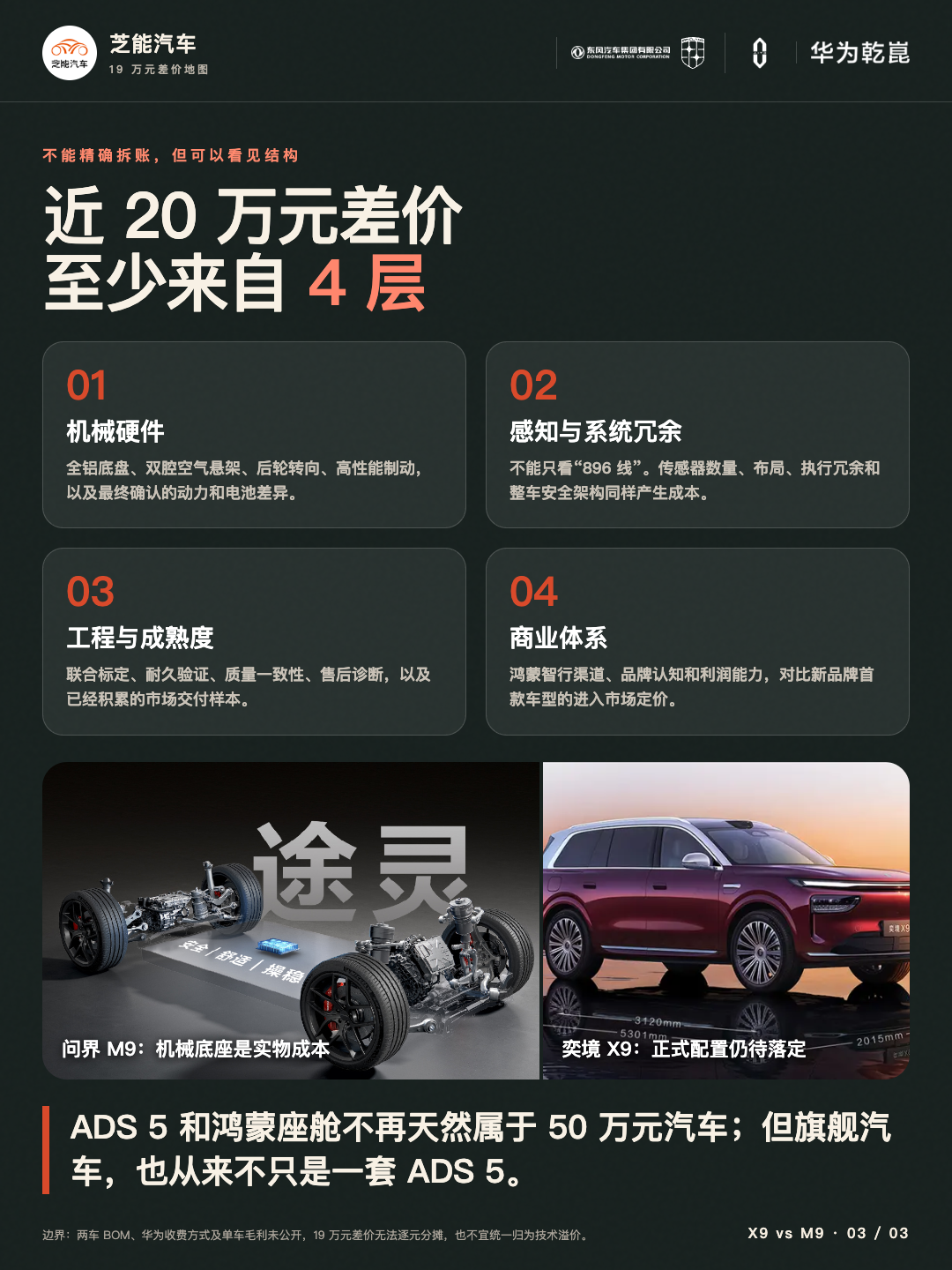
The gap between 299,800 yuan and 479,800 yuan does not equate to a 180,000 yuan difference in the actual costs of the two vehicles; it may also reflect different profit targets for the two companies:
◎ The Aito M9 has the potential to achieve higher per-unit profits;
◎ The Yijing X9 needs to use a lower price to acquire its first batch of users and build market recognition;
◎ Dongfeng also aims to achieve breakthroughs in premium and intelligent technologies through Yijing.
Summary
Is the Yijing X9 a "budget-friendly alternative to the Aito M9"?
Both vehicles are similar in size and feature the latest generation of Huawei's intelligent driving and HarmonyOS cockpit technologies. The Yijing X9 also integrates Huawei's digital chassis, in-car optical, and vehicle-cloud solutions, yet its price is only about 60% of the Aito M9's.
What are your thoughts?
-
![]()
Registered Capital Slashed to 372 Million Yuan! Yutong Optical Finalizes Industrial and Commercial Change Registration
-
![]()
Zhuque-3 Successfully Lands, and 'Time Traveler' Secures Another ¥100 Million in Funding: China's Commercial Space Industry Experiences a 'Dynamic August'
-
![]()
Autohome Faces a Shrinking Window of Opportunity
-
![]()
Even a Titan Like Musk Has Faced Setbacks in Fulfilling Promises
-
![]()
AI Office: The End of the Racing Era, Context Becomes the Key to Success
-
![]()
Domestic Vehicle Chassis Revolution ②: The Steering Wheel Remains, But Mechanical Connections in the Steering System Are Decreasing
-
![]()
Exploring MiniMax Design: Can Video Editing Be as Simple as Speaking?
-
![]()
Why Can SenseTime Achieve Profitability While CloudWalk Still Faces Challenges, Despite Both Adopting Large Models?