From Meal Delivery to All-Encompassing Delivery: The Evolution of Food Delivery Services
 12/25 2025
 653
653
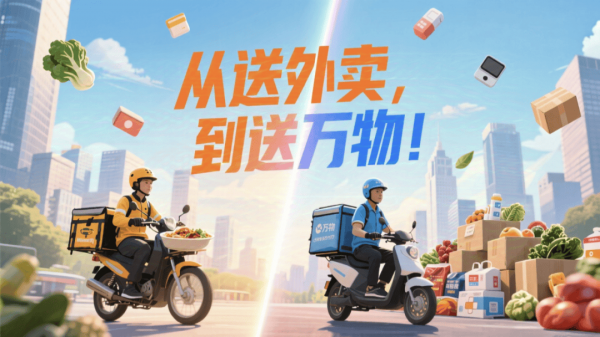
As the intense competition in the food delivery market gradually subsides, participants are unveiling their strategic aces, drawing market attention through distinctive approaches. In essence, the fierce rivalry in this sector is not merely about securing market share; it's about leveraging the market to achieve broader strategic objectives. Whether it's instant retail or fresh produce distribution, in the eyes of industry players, food delivery transcends its basic function, serving as a conduit for innovation.
Consequently, when examining the food delivery market, we should perceive it not just as a means of delivering meals but as a matrix fostering new business models and species. As competition shifts from a subsidy-driven phase to one dominated by innovative models and strategies, we anticipate the emergence of novel signs, elements, and paradigms.
As the food delivery market embarks on a new cycle, particularly with the fading of old competitive models, we must recognize not only changes in the market landscape and outdated development logics but also the emergence of fresh ideas, strategies, and even new directions and goals. Only by transcending the confines of the food delivery market itself can we truly grasp the new connotations and meanings of its current trajectory.
The food delivery market has evolved into a novel carrier and link.
Historically, the food delivery market was primarily associated with meal delivery. Participants in this sector mainly undertook the task of transporting food items, facilitating quicker and more precise connections between merchants and consumers. During periods when the market offered substantial dividends, it indeed witnessed certain growth. However, once these traffic dividends dwindled, merely adhering to traditional roles and tasks began to pose increasing challenges.
To overcome the traditional development dilemmas plaguing the food delivery market, it becomes imperative to break free from conventional models and achieve new evolution and development through a comprehensive transformation. It is within this context that we observe some food delivery players venturing into new retail sectors and others charting new courses in the local life sector. Ultimately, regardless of the approach, participants are striving to evolve food delivery and, through this evolution, forge new development paths.
From this vantage point, when we observe the resurgence of competition in the food delivery market, we find that the so-called food delivery wars have transformed, marking the market's entry into a new evolutionary cycle. At this juncture, food delivery serves merely as a carrier and a facade; in essence, participants are seeking new breakthroughs for the development of food delivery by infusing it with fresh connotations and meanings. Thus, food delivery is no longer confined to its basic function but has become intertwined with new models such as instant retail, community retail, and smart retail. Only by viewing the food delivery market from this perspective can we truly grasp its new pulse.
In summary, food delivery has transcended its basic function and emerged as a novel carrier and link.
The food delivery market has evolved into a new business paradigm.
In this new round of food delivery wars, while we still encounter familiar players and tastes, we also witness numerous fresh elements. If we were to encapsulate and define these novel elements, a crucial aspect is that food delivery participants are no longer confined to the traditional business paradigm dominated by the virtual economy. Instead, they have begun to exhibit a new business paradigm that seamlessly integrates the virtual and real economies, as well as the digital and physical realms.
From this standpoint, if we were to summarize and define the current food delivery market, it resembles a composite and amplifier of new business paradigms. Under this new paradigm, participants not only consolidate the experience and resources accumulated in the internet era but also continuously expand into offline physical stores, as well as offline industrial and supply chains. Through the current food delivery market, we observe not only the virtual economic resources accumulated by participants in the internet era but also their deep-rooted presence and accumulation in the physical retail sector.
Therefore, at this juncture, the food delivery market is not merely an entity dominated by the virtual economy but a novel existence that achieves the integration of the virtual and real, as well as the digital and physical economies. As the industry enters a stage of integrating these realms, the food delivery market primarily serves as a concentrated embodiment of this integration. In the new cycle of food delivery, participants must not only hone their internal internet capabilities but also lay a solid foundation in physical business. Only when the internet and physical aspects are perfectly combined can they succeed in this new cycle. At this point, the food delivery market more closely resembles a new species that has discovered the correct pathways and methods to achieve the integration of the virtual and real, as well as the digital and physical economies, and leverages new business paradigms to drive its own development, no longer resembling its former self.
The food delivery market has become a new proving ground.
As an entity intricately linked to people's daily production and lives, the food delivery market has never been solely about ordering meals or the bustling activity of food delivery couriers. What we perceive in food delivery is merely its ultimate manifestation. Behind this manifestation lie advanced technologies, innovative models, and the interconnectedness of various related links and elements, such as supply chains. Therefore, as the food delivery market enters a new cycle, particularly when the industry's development is propelled by new technologies and models, the market at this time transcends its superficial appearance and becomes a proving ground for these innovations.
As competition in the food delivery market reignites, we also witness the testing of new technologies and models within this sector. For instance, we observe the application of new elements such as big data, drones, and AI in the food delivery market; we see some food delivery participants venturing into supply chains and industrial chains; we note strong collaborations between large food delivery platforms and offline supply chain participants; we observe participants' expansions into offline food delivery points... As more and more new technologies and models begin to emerge in the food delivery market, the current landscape is no longer traditional but has transformed into a proving ground for these innovations.
As the food delivery market delves deeper, particularly when participants' competitive focus shifts to new directions, we anticipate the emergence of even more novel technologies and models within this sector. Only those participants who leverage new technologies and models to transform the current food delivery landscape and find new equilibrium points between the supply and demand sides of food delivery can emerge victorious in this new round of reshuffling.
In Conclusion
The flames of competition in the rekindled food delivery market are gradually diminishing. However, this does not signify the end of competition in this sector; rather, it indicates that participants' competitive focus has shifted to new directions. As competition in the food delivery market enters a new cycle, I increasingly perceive that the market is not merely what we knew before but has assumed more roles and enriched its connotations. Only by recognizing the evolution of the food delivery market can we break free from the limitations of our past perspectives and view it from a brand-new standpoint. At this point, the food delivery market can truly become a fertile ground for nurturing the 'new'.
-
The RTX 3060 Makes a Comeback Amid a Mix of Old and New Hardware, Making 2026 the Worst Year for the PC Industry
-
![]()
Zhang Yiming Achieves Jack Ma's 'Dream': Douyin Surpasses 1 Billion Monthly Active Users First!
-
The Complete Decline of Fuel-Powered Vehicles! Only One Model in July's Top 10 Sales
-
![]()
What Are the Three World Models in BYD's HyWorldVLA: Pixel-Level, Latent Space, and Hybrid?
-
Raking in 23.7 Billion Yuan in Just Half a Year! Has Foxconn Industrial Internet Turned a New Leaf?
-
Offline Competition Among Big Companies for Customers: The Battle for Desktop Access with Office Agents
-
![]()
Starting at 3199 yuan, the REDMI K100 series has been launched, making me start to worry for the Xiaomi 18
-
![]()
Xiaomi's MiMo Stages a Two-Year Comeback to Top Global Inference Volume Rankings