On November 25, Huawei Formally Unveiled the Mate80, Taking a Bold Move by Cutting the Base Model Price by 800 yuan to 4,699 yuan, Enhancing Kirin 9020 Performance by 35%, and Introducing HarmonyOS 6
 12/25 2025
 618
618
The smartphone landscape in 2025 is marked by a striking paradox: on one side, component costs are soaring, with DDR4 memory prices skyrocketing over 200% in just six months and NAND flash memory up 75% year-to-date. This surge has compelled mainstream players like Xiaomi to hike new smartphone prices by roughly 100-400 yuan. Conversely, Huawei bucks the trend with price cuts, as the Mate80 series makes a bold entrance, slashing the base model price by 800 yuan to 4,699 yuan, boosting Kirin 9020 performance by 35%, and unveiling HarmonyOS 6, propelling it into the top three of Week 48 sales rankings. This approach of offering enhanced specs at lower prices is fundamentally reshaping the industry's competitive landscape.
Domestic Manufacturers: Navigating a Pricing Quagmire, Premium Strategies Stifled
Huawei's counter-trend pricing strategy is reshuffling the deck in domestic smartphone sales rankings.
Initial release figures indicate that the first batch of Mate80 series standard models have shipping schedules stretching to December 21, while Pro and higher variants are set for release until January 31, 2026, with backorders underscoring market enthusiasm.
Huawei enjoys robust recognition in the premium market. IDC data shows that in 2023, Huawei secured a 21.4% market share in China's premium smartphone segment (priced above $600), trailing Apple's 61.8%. By Q3 2025, Huawei's share climbed to 34.4%, while Apple's dipped to 48%. The Mate80 series, Huawei's flagship Q4 offering, has the potential to further elevate its market share, accelerating Huawei's resurgence in the premium market.
From a pricing standpoint, Apple still leads with a 48% premium market share, but the iPhone 17 series' pricing edge has waned. The iPhone 17 standard model (256GB) is priced at 5,999 yuan, creating a 1,300 yuan price gap with Huawei's Mate80 standard model. Given comparable core experiences, this may sway budget-conscious premium users. Huawei's pricing strategy has breached domestic manufacturers' pricing barriers, with varying impacts across brands, particularly straining premium models.
With a 34.4% market share, still trailing Apple, Huawei's Mate80 series pricing has lowered its flagship entry threshold to below 5,000 yuan, directly challenging models like the Honor 500.
For domestic manufacturers like Honor, which targets the mid-to-high-end market, this poses a dilemma: maintaining prices risks ceding market share, while price reductions erode profits. The Honor 500 series, previously priced at 3,599 yuan as a mid-range benchmark, now faces diminished premium appeal as consumers weigh the option of 'adding 1,000 yuan for a Huawei flagship.'
More critically, rising costs for core components like memory chips further squeeze already thin premium model margins if manufacturers follow suit with price cuts. Maintaining current prices risks declining competitiveness against Huawei's blend of Kirin chips, HarmonyOS, and aggressive pricing.
Distribution Network: Polarization Deepens, Profit Margins Squeeze for Smaller Players
Huawei's pricing strategy has triggered ripple effects across distribution channels, with significant divergence among tiered distributors and brand stores.
For authorized Huawei distributors, short-term per-unit profit declines are mitigated by the scarcity and popularity of flagship models.
Huawei Mall reveals that the Mate80 12GB+256GB version is currently out of stock, while the Mate80 Pro and Pro Max, equipped with the Kirin 9030 chip, require reservations, reflecting robust market demand. Thus, despite reduced per-unit profits for standard models, overall profitability may rise due to increased foot traffic.
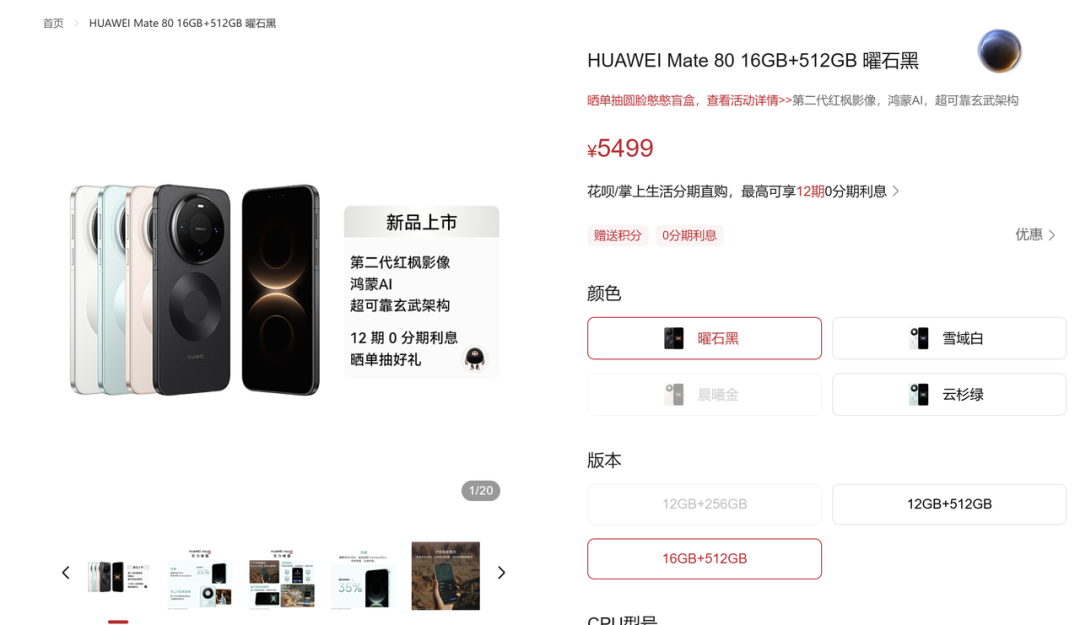
Figure 1 Huawei Mate80 Sales Status Source: Huawei Mall
This underscores Huawei's astute inventory management: supplying ample standard models with the largest price reductions to drive traffic, while limiting high-performance Pro series availability to prevent a rapid price collapse like the Pura 80 series, and sustaining channel confidence through scarcity.
Other brand distributors grapple with dual challenges of inventory digestion and shrinking profits.
Offline stores for some domestic brands, in particular, face consumer price comparisons with 'Huawei offering similar specs at lower prices,' compelling them to offer freebies to close deals, further squeezing profit margins.
BlueWhale News research indicates that after national subsidies, profit margins for small-to-medium phone stores selling 2,000-yuan devices have dwindled from 200-300 yuan to below 200 yuan per unit, with some models incurring losses on increased sales.
Pricing Strategy: Cost Control Prowess and Ecosystem Ambitions
From a supply chain vantage point, Huawei's pricing strategy stems from its cost control prowess, with the Mate80 series achieving near-complete localization. Virtually all core components, from chips and screens to cameras and structural parts, are sourced from domestic suppliers.
For chips, Mate80 Pro and higher variants feature the N+3 process Kirin 9030 chip with 11.8 billion transistors, and the Pro version's main frequency surges to 3.2GHz. This not only bridges performance gaps in premium chips but also reduces costs by 11.7% compared to the previous generation, marking full independence from overseas dependencies across chip design, manufacturing, and packaging.
For other components, screens are supplied by BOE and Visionox with flexible OLED panels, while the imaging system's main and telephoto modules are provided by O-Film. Localized, stable, and mature supply chains have slashed procurement and overall costs for core components, creating room for terminal product price reductions.
Beyond cost control, Huawei's pricing strategy aligns with its ecosystem ambitions. By lowering price barriers, Huawei aims to swiftly expand the user base for its HarmonyOS ecosystem, which still trails iOS and Android in scale.
The Mate80 series debuts with the latest HarmonyOS 6, not only achieving ecosystem maturity but also introducing exclusive features. Lowering price barriers will entice more users into the HarmonyOS ecosystem.
Epilogue
Huawei's counter-cyclical pricing for the Mate80 series transcends a mere price war; it embodies a fusion of supply chain strength, market strategy, and ecosystem vision.
For the industry, this signals a paradigm shift in the premium smartphone market from spec-driven competition to cost control and ecosystem experience, accelerating the exit of manufacturers lacking core technology and supply chain integration.
For consumers, reduced price barriers for premium models are a boon, but in the long run, if profit compression leads some manufacturers to slash R&D investment, overall industry innovation could suffer.
This pricing revolution, spearheaded by Huawei, is merely in its infancy.
-
The RTX 3060 Makes a Comeback Amid a Mix of Old and New Hardware, Making 2026 the Worst Year for the PC Industry
-
![]()
Zhang Yiming Achieves Jack Ma's 'Dream': Douyin Surpasses 1 Billion Monthly Active Users First!
-
The Complete Decline of Fuel-Powered Vehicles! Only One Model in July's Top 10 Sales
-
![]()
What Are the Three World Models in BYD's HyWorldVLA: Pixel-Level, Latent Space, and Hybrid?
-
Raking in 23.7 Billion Yuan in Just Half a Year! Has Foxconn Industrial Internet Turned a New Leaf?
-
Offline Competition Among Big Companies for Customers: The Battle for Desktop Access with Office Agents
-
![]()
Starting at 3199 yuan, the REDMI K100 series has been launched, making me start to worry for the Xiaomi 18
-
![]()
Xiaomi's MiMo Stages a Two-Year Comeback to Top Global Inference Volume Rankings