6G Network is on the Horizon! Discover Its Three Remarkable Capabilities: Download a 4K Movie in a Flash
 03/10 2026
 620
620
Kuaikeji, March 10 News: 6G has been explicitly mentioned in the government work report as a key industry to be fostered and developed in the future, sparking lively discussions among delegates and members at the 2026 National People's Congress.
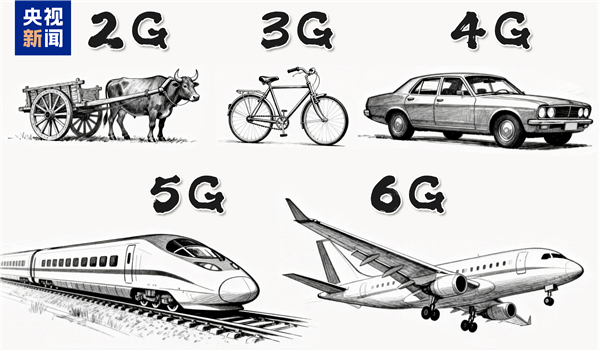
As the sixth-generation mobile communication technology, 6G is set to revolutionize the landscape built upon 5G, propelling communication technology from mobile terminals to a broad spectrum of industries.
If 5G is likened to an information superhighway, then 6G represents a super-intelligent network that seamlessly integrates air, space, land, and sea, ushering in comprehensive changes that transcend mere speed enhancements. It boasts three core capabilities.
First and foremost, 6G offers blazing-fast speeds.
Leveraging higher frequency bands like millimeter waves and terahertz, its bandwidth can surpass that of 5G by over tenfold.
Research teams from Peking University and other institutions have proposed a fiber-wireless integrated communication solution, achieving a seamless fusion between fiber and terahertz wireless technologies. This breakthrough enables single-channel transmission rates to reach hundreds of Gbps, allowing 4K ultra-high-definition movies to be downloaded in less than a second. This places China at the forefront of the global 6G speed race and lays a solid foundation for the 6G speed revolution.
Secondly, 6G provides unparalleled clarity.
6G is equipped with ultra-high-precision sensing capabilities, with base stations functioning as both communication hubs and radar detection imaging centers. Terahertz waves, characterized by their high frequency and short wavelength, enable precise positioning and ranging at sub-meter or even centimeter levels.
By analyzing reflected signals, 6G can empower drones and autonomous vehicles with more acute digital sensing capabilities, facilitating precise road condition recognition and intelligent obstacle avoidance.
Lastly, 6G is incredibly intelligent.
Unlike traditional networks that rely on cloud-based data processing, 6G base stations are equipped with local AI computing capabilities. This enables them to process data independently and make intelligent decisions, offering personalized intelligent services. It accelerates the digital and intelligent transformation of industries while also supporting network self-diagnosis, self-repair, and self-optimization. This aligns perfectly with the development deployment of artificial intelligence+, solidifying the foundation of the intelligent economy.

China has successfully completed all technical trials for the first phase of 6G, amassing over 300 key technologies. Subsequent efforts will focus on advancing 6G standard development, test network construction, and other critical tasks. Commercialization is expected to commence around 2030.
Once 6G is fully implemented in the future, scenarios such as holographic meetings, instant drone delivery, and virtual interactions with digital avatars will become a reality. This will comprehensively construct a brand-new digital life characterized by integrated air, space, land, and sea connectivity and intelligent interconnection of all things.
-
![]()
Proposed to Raise 955 Million Yuan through Private Placement! Huicheng Vacuum Boosts Localization of Ultra-Precision Optical Coating Equipment
-
![]()
Cash Flow Soars 13-Fold! What Major Strategic Move is Wuhan Five Square Optoelectronics Planning?
-
![]()
Leaked Design of vivo X500: Reverts to Circular Camera Module in Top-Left Corner, Pays Homage to Classic X90 Aesthetic
-
![]()
DeepSeek Shows Signs of Foraying into Code Agents, Launches WeChat Official Account Focused on Harness
-
![]()
Auto Companies Deny Claims That ‘Cooperation with Huawei Is Non-Essential’, as Huawei Transforms into a ‘Public Platform’
-
![]()
Starship to Independently 'Return to the Launch Tower': SpaceX's Ambitions Extend Beyond Rocket Building to Dominating Space Transportation
-
![]()
Starship Set to Independently 'Return to the Launch Tower': SpaceX is Revolutionizing Space Transportation, Not Just Building Rockets
-
![]()
Anthropic and OpenAI Face Off Against Deepseek