Cash Flow Soars 13-Fold! What Major Strategic Move is Wuhan Five Square Optoelectronics Planning?
 08/11 2026
 550
550
Recently, Wuhan Five Square Optoelectronics unveiled its semi-annual report, offering a compelling case study of structural adjustments within the optoelectronics sector amid a downturn in consumer electronics demand.
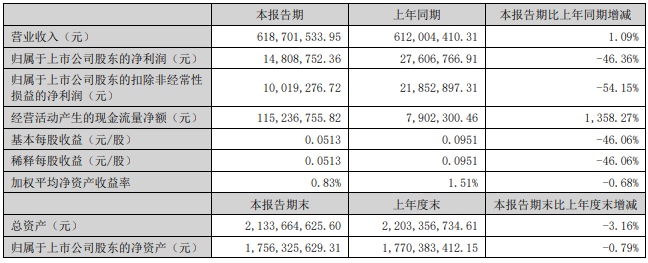
In the first half of 2026, the company reported revenue of 619 million yuan, marking a modest year-on-year increase of 1.09%. However, net profit attributable to shareholders plummeted to 14.8088 million yuan, a substantial year-on-year decline of 46.36%. Net profit excluding non-recurring items suffered an even steeper drop of 54.15%, epitomizing the classic scenario of "rising revenue but shrinking profits."
These outcomes are directly attributable to the persistent weakness in the smartphone market, which has taken a toll on the company's core business fundamentals. Additionally, the company is navigating through the inevitable growing pains associated with actively or passively pursuing business transformation.
From a macroeconomic standpoint, the global smartphone market continued its downward trajectory in the first half of 2026. Data from IDC and the Zhongshang Industry Research Institute reveal that global shipments during this period amounted to approximately 570 million units, with around 277.5 million units shipped in the second quarter alone, representing a year-on-year decrease of 6.7%.
Significant hikes in memory costs have driven up terminal prices, while consumer demand for device upgrades has waned. Consequently, leading brands are focusing more on high-end models. Although the adoption rate of optical configurations, such as high-pixel and periscope telephoto lenses, continues to climb, competition for mature specification products in the upstream supply chain has intensified.
As the cornerstone of Wuhan Five Square Optoelectronics' product lineup, infrared cut-off filters generated revenue of 515 million yuan in the first half, a year-on-year decrease of 9.83%. Their revenue share dipped from 91.6% in the previous year to 83.29%, and gross margin contracted by 1.39 percentage points to 10.83%.
The company acknowledged that the profitability of mature specification products has been squeezed due to declining smartphone market demand and heightened industry competition. This sharp contraction in profitability can be attributed to three primary factors.
Firstly, financial expenses witnessed significant fluctuations. During the reporting period, financial expenses amounted to -3.9547 million yuan, compared to -14.3404 million yuan in the same period last year. This discrepancy is primarily due to increased net exchange losses resulting from the depreciation of the Japanese yen. Meanwhile, interest income from bank deposits decreased from 14.2590 million yuan to 10.1388 million yuan, substantially narrowing financial gains.
Secondly, other income declined from 7.7239 million yuan in the same period last year to 4.2844 million yuan. Furthermore, provisions for asset impairment losses surged from 2.2484 million yuan to 6.2182 million yuan, mainly due to increased inventory write-downs, further eroding profit margins.
It is noteworthy that amid pressure on traditional businesses, the company's product mix is undergoing a subtle transformation. Optical prisms (including micro-prisms) generated revenue of 38.8639 million yuan, increasing their revenue share to 6.28%. The company attributes this growth to the high-value demand spurred by optical upgrades in smartphones, such as high-pixel and periscope telephoto lenses. Biometric filter revenue reached 25.8201 million yuan, a year-on-year increase of 7.48%, with a gross margin of 38.31%, significantly outperforming traditional products. Although window glass products generated revenue of 19.3494 million yuan, their gross margin was negative due to high initial costs, and these products have yet to contribute positively to gross profit.
In terms of regional revenue distribution, overseas revenue decreased by 7.26% year-on-year to 465 million yuan, while domestic revenue surged by 38.85% year-on-year to 154 million yuan, with gross margin significantly rising by 15.29 percentage points to 16.41%. However, it should be noted that the base for domestic gross margin in the same period last year was only 1.12%, and this increase is partly attributable to the low base effect.
Overall, this still indicates initial success in expanding into the domestic market. During the investor collective reception day on July 9, the company further disclosed that overseas revenue accounted for approximately 79% at that time, with high customer concentration. In the future, it aims to strike a balance between its domestic and overseas market presence.
Cash flow performance emerged as one of the standout features of this semi-annual report. Net cash flow from operating activities reached 115 million yuan, a staggering year-on-year increase of 1358.27%. This surge is primarily due to accelerated collection of payments resulting from increased sales revenue at the end of the previous year and the current period, coupled with cash inflows from large-value bill discounting.
However, concurrently, R&D investment decreased by 14.08% year-on-year to 26.0658 million yuan. During this critical juncture as the company transitions into emerging fields such as automotive optics, AR/VR, and TGV glass substrates, this contraction in R&D spending warrants ongoing scrutiny.
As of June 30, the company and its subsidiaries had accumulated 166 patents, including 26 invention patents. Automotive optics-related products and TGV glass substrates have entered the customer sampling stage, but it will still take time for them to make a significant contribution to performance at scale. OFweek Optoelectronics will continue to monitor these developments closely.
-
![]()
Proposed to Raise 955 Million Yuan through Private Placement! Huicheng Vacuum Boosts Localization of Ultra-Precision Optical Coating Equipment
-
![]()
Cash Flow Soars 13-Fold! What Major Strategic Move is Wuhan Five Square Optoelectronics Planning?
-
![]()
Leaked Design of vivo X500: Reverts to Circular Camera Module in Top-Left Corner, Pays Homage to Classic X90 Aesthetic
-
![]()
DeepSeek Shows Signs of Foraying into Code Agents, Launches WeChat Official Account Focused on Harness
-
![]()
Auto Companies Deny Claims That ‘Cooperation with Huawei Is Non-Essential’, as Huawei Transforms into a ‘Public Platform’
-
![]()
Starship to Independently 'Return to the Launch Tower': SpaceX's Ambitions Extend Beyond Rocket Building to Dominating Space Transportation
-
![]()
Starship Set to Independently 'Return to the Launch Tower': SpaceX is Revolutionizing Space Transportation, Not Just Building Rockets
-
![]()
Anthropic and OpenAI Face Off Against Deepseek