Satellite Internet: The Concept and Deployment Scenarios of NTN
 03/17 2026
 503
503
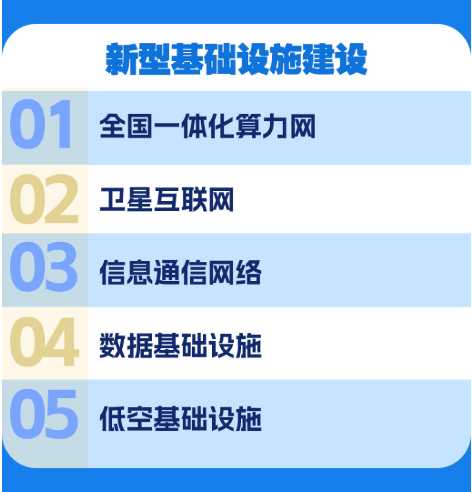
The outline of China's 15th Five-Year Plan explicitly proposes to foster and develop new industries and sectors such as 'aerospace' and 'integrated circuits,' strengthen the construction of new infrastructure such as 'satellite internet' and 'information and communication networks,' coordinate the construction of satellite communication, navigation, and remote sensing systems, and accelerate the networking of LEO satellite internet.
Wireless communication technology is advancing towards greater intelligence and integrated space-air-ground systems, expanding from hotspot coverage to cross-regional coverage. Ground networks and space-based networks will jointly create a new communication landscape, truly addressing the issue of information silos.
The focus of satellite internet is the need to construct a massive LEO satellite constellation that forms a unified network with ground networks. The massive data generated will catalyze a trillion-dollar economic market value.
Before generating economic benefits, we need to address two issues: (1) How to construct the non-terrestrial network (NTN) in the sky; (2) How to integrate it with ground networks.
The construction of satellite internet is a massive project involving numerous industrial chains such as research and development, production, manufacturing, and operation and maintenance. For R&D engineers, the primary concerns are research and technical issues. For interested readers, we can further explore what NTN is and its deployment scenarios.
1. Overview of NTN
3GPP provides a technical report on NTN access networks in 38.821. NTN refers to a network or network segment that uses radio frequency resources on satellites (or UAS platforms). A typical scenario for NTN providing user equipment access is illustrated in the following figure:
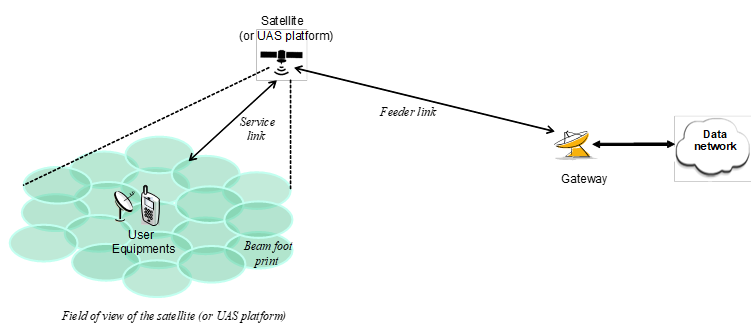 Typical Scenario of NTN Based on Transparent Payload
The transparent payload functions as a repeater, performing signal filtering, frequency conversion, and amplification.
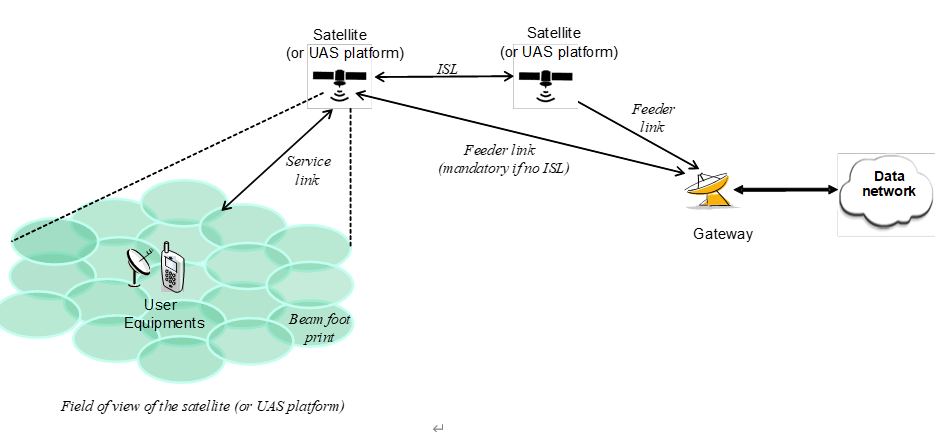 Typical Scenario of NTN Based on Regenerative Payload
The regenerative payload functions as a space-based platform capable of digital signal processing.
Non-terrestrial networks typically have the following elements:
One or more satellite gateways connecting the non-terrestrial network to the public data network.
GEO satellites are fed by one or more satellite gateways deployed within the satellite's target coverage area (e.g., regional or even continental coverage). We assume that UEs within a cell are served by only one satellite gateway.
Non-GEO satellites are sequentially served by one or more satellite gateways. The system ensures sufficient time between consecutive satellite gateways to guarantee continuity of service and feeder links for mobility anchoring and handovers.
Feeder or radio links between satellite gateways and satellites (or UAS platforms).
Service or radio links between user equipment and satellites (or UAS platforms).
Satellites (or UAS platforms) can implement transparent or regenerative (with on-board processing) payloads. The beams generated by satellites (or UAS platforms) typically produce multiple beams over a given service area within their field of view. The coverage area of a beam is usually elliptical. The field of view of a satellite (or UAS platform) depends on the spaceborne antenna pattern and the minimum elevation angle.
Transparent payload: RF filtering, frequency conversion, and amplification. Thus, the waveform signal forwarded by the payload remains unchanged.
Regenerative payload: RF filtering, frequency conversion, and amplification, as well as demodulation/decoding, switching and/or routing, and encoding/modulation. This is equivalent to having all or part of the base station functionality (e.g., gNB) on the satellite (or UAS platform).
Typically, in the case of satellite constellations, there are inter-satellite links (ISLs). This requires the use of regenerative payloads on satellites. ISLs can operate in the RF or optical bands.
User equipment is served by satellites (or UAS platforms) within the target service area.
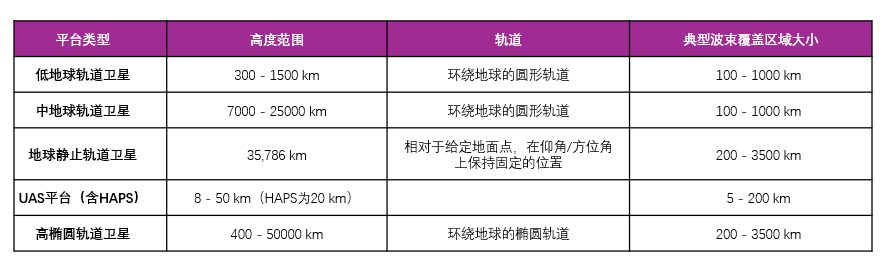
For NTN, there may be different types of satellites (or UAS platforms), as listed below:
Table 1 NTN Platform Types
Generally:
GEO satellites and UAS are used to provide continental, regional, or local services.
LEO and MEO constellations are used to provide services to the northern and southern hemispheres. In some cases, constellations can even provide global coverage, including polar regions. Achieving polar coverage requires appropriate orbital inclinations, sufficient beam generation, and ISLs.
Currently, the NTN scenarios truly adaptable to satellite internet applications mainly involve LEO and MEO satellites, whose latency and communication capacity basically meet application requirements.
2. Scenarios of NTN
NTN provides six reference scenarios for user equipment access, including:
Circular orbit and position-keeping platforms.
Maximum RTD (Round-Trip Delay) constraints.
Maximum Doppler constraints.
Transparent and regenerative payloads.
A scenario with ISLs and a scenario without ISLs. In the case of ISLs, regenerative payloads are mandatory.
Fixed or steerable beams, resulting in moving or fixed beam coverage areas on the ground, respectively.
Six scenarios are considered, as shown in Table 2, and detailed in Table 3.
Table 2 NTN Reference Scenarios
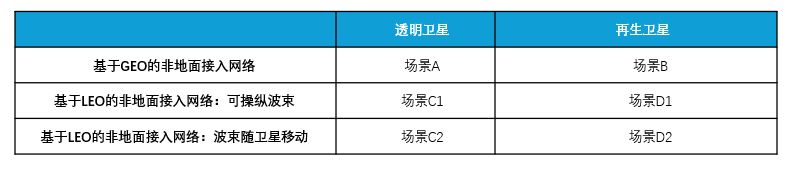
Table 3 Reference Scenario Parameters
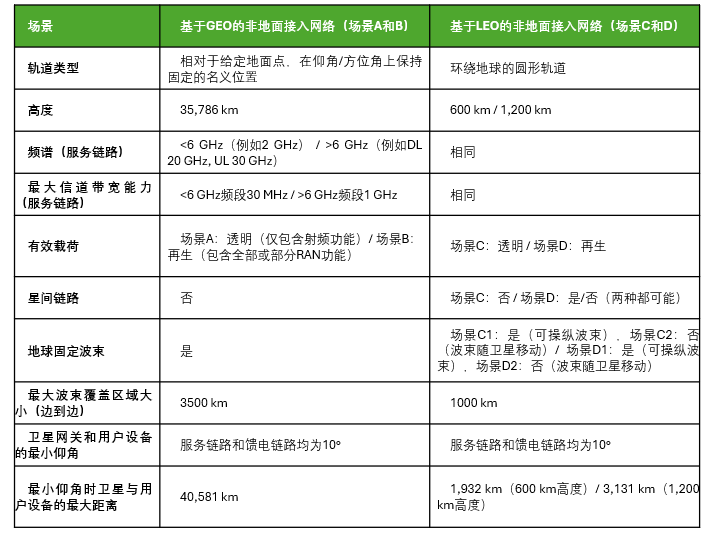
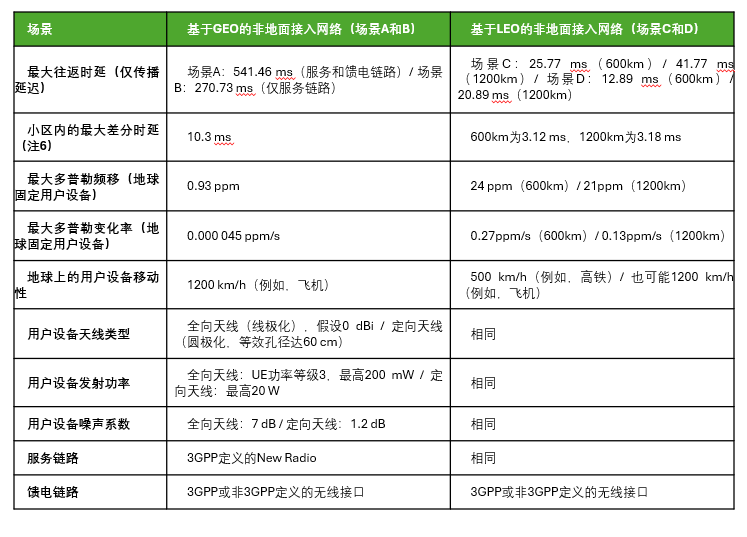
Therefore, from the perspective of NTN deployment scenario parameters, there are numerous factors to consider, such as orbital altitude, elevation angle, beam coverage, Doppler shift, transmission delay, spaceborne antennas, terminal antennas, transmit and receive power, operating frequency bands, etc. Especially, a series of technical challenges must be addressed, including precise space-ground time-frequency synchronization, lossless handovers, and stable link services.
-
![]()
Proposed to Raise 955 Million Yuan through Private Placement! Huicheng Vacuum Boosts Localization of Ultra-Precision Optical Coating Equipment
-
![]()
Cash Flow Soars 13-Fold! What Major Strategic Move is Wuhan Five Square Optoelectronics Planning?
-
![]()
Leaked Design of vivo X500: Reverts to Circular Camera Module in Top-Left Corner, Pays Homage to Classic X90 Aesthetic
-
![]()
DeepSeek Shows Signs of Foraying into Code Agents, Launches WeChat Official Account Focused on Harness
-
![]()
Auto Companies Deny Claims That ‘Cooperation with Huawei Is Non-Essential’, as Huawei Transforms into a ‘Public Platform’
-
![]()
Starship to Independently 'Return to the Launch Tower': SpaceX's Ambitions Extend Beyond Rocket Building to Dominating Space Transportation
-
![]()
Starship Set to Independently 'Return to the Launch Tower': SpaceX is Revolutionizing Space Transportation, Not Just Building Rockets
-
![]()
Anthropic and OpenAI Face Off Against Deepseek