6G Networks: Ushering in a New Era of Ubiquitous Intelligence for the Internet of Things
 03/24 2026
 581
581
Recently, the International Telecommunication Union (ITU) announced that its Radiocommunication Sector (ITU-R) Working Group 5D has formally finalized the draft performance requirements for IMT-2030 (6G) through consensus in February 2026. The draft, titled "Minimum Technical Performance Requirements for IMT-2030 Radio Interfaces," outlines 20 technical performance requirements (TPRs), including seven new indicators specific to 6G, designed to evaluate future 6G radio interfaces.
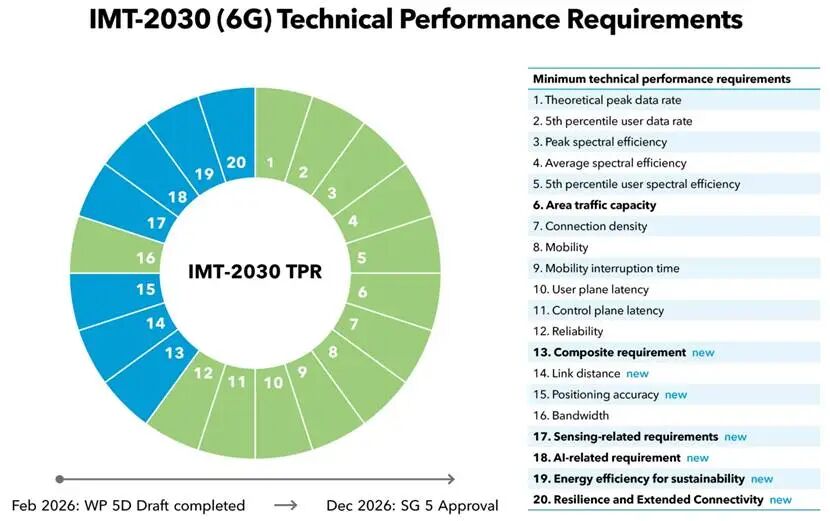
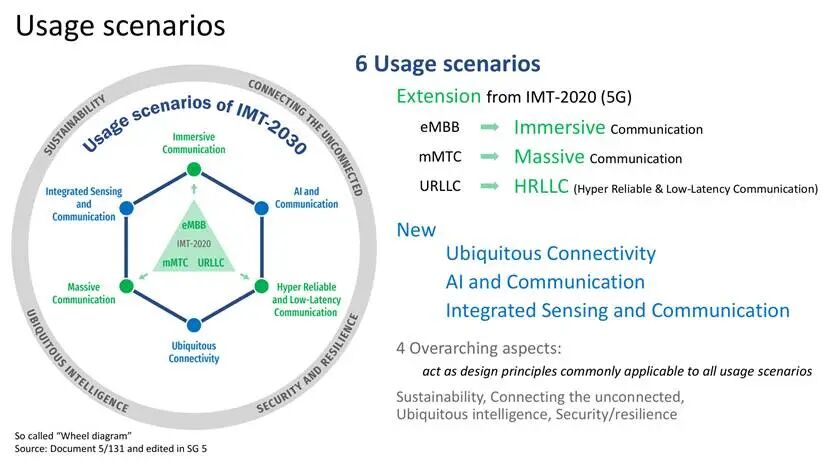
The 20 technical performance requirements for 6G are tailored to six major application scenarios: Immersive Communication (IC), Ultra-Reliable Low-Latency Communication (HRLLC), Massive Communication (MC), Ubiquitous Connectivity (UC), Integrated AI and Communication (AIAC), and Integrated Sensing and Communication (ISAC). In December 2023, the ITU first defined the framework and overall objectives for 6G, establishing these six scenarios, which include both evolutionary advancements from 5G and new scenario demands.
Among them, immersive communication, ultra-reliable low-latency communication, and massive communication represent further evolutions of the three major 5G scenarios, corresponding to Enhanced Mobile Broadband (eMBB), Ultra-Reliable Low-Latency Communications (uRLLC), and Massive Machine-Type Communications (mMTC), respectively. In contrast, ubiquitous connectivity, integrated AI and communication, and integrated sensing and communication are new scenarios adapted to advancements in technological and industrial innovation.
For the IoT, 6G enables deep integration between the physical and virtual worlds through technological innovation, becoming a new digital infrastructure that supports the evolution of IoT toward ubiquitous intelligence. By examining the ITU's consensus on 6G technical performance and its evolutionary logic, we can systematically analyze 6G's empowerment capabilities and development prospects for IoT from the perspective of these six application scenarios. The author believes that the direction of IoT in the 6G era can be viewed from three perspectives: connectivity, experience, and intelligence.
1. Connectivity: Expanding the Density and Breadth of 6G-Enabled IoT
From a connectivity standpoint, massive communication and ubiquitous connectivity reflect the upgraded and novel characteristics of connectivity in the 6G era, showcasing the density and breadth of 6G connections. These two scenarios are, to a large extent, specifically designed for IoT.
1.1 Massive Communication: Supporting Effective Connectivity for Dense IoT Devices
In the 6G era, breakthroughs will be achieved in technologies supporting massive device connectivity. The ITU proposes that 6G must achieve a device connectivity density of 106–108 devices per square kilometer, equivalent to 1 million to 100 million devices per square kilometer, representing a 10- to 100-fold improvement over 5G. From a technological evolution perspective, it can be predicted that 6G will inherit and advance IoT technologies from the 5G era, including lightweight 5G technologies such as RedCap and eRedCap, as well as LPWAN technologies like NB-IoT/LTE-M. More importantly, it will further mature passive IoT technologies to realize the vision of large-scale connectivity. Additionally, in the author's view, whether 6G will introduce a "Light 6G" technology comparable to 5G's eMBB and uRLLC capabilities to further optimize and replace existing IoT communication support may become an important area of discussion.
The massive communication scenario is essentially tailored for IoT, with 6G technologies evolving to cover a broader range of IoT application needs. In the future, smart cities may feature high-density sensor deployments, industrial environments may require effective sensing of numerous production devices, and passive IoT technologies may enable ultra-low-cost ubiquitous sensing.
1.2 Ubiquitous Connectivity: Eliminating "Connectivity Blind Spots" in IoT
6G achieves global seamless coverage through an integrated space-terrestrial network architecture, thoroughly solving (This Chinese phrase means "completely resolving") connectivity challenges for IoT devices in remote areas. The 6G space-terrestrial integrated network enables deep fusion between space-based (geostationary/medium/low Earth orbit satellites), air-based (near-space/high-altitude/low-altitude aircraft), and ground-based (cellular/WiFi/wired) networks, forming a unified space-air-ground network. This network provides coverage for populated areas, broad stereoscopic coverage for remote regions, oceans, and space, and meets the demands for ubiquitous, all-weather coverage across both surface and three-dimensional spaces, offering users ubiquitous communication services. Among them, the evolution of IoT-NTN technology will be key to achieving ubiquitous connectivity in 6G. IoT-NTN completed its first standardization in 3GPP Release 17, and several vendors have already commercialized products based on this standard. IoT-NTN continues to evolve, and in the 6G era, it will be endow (This Chinese word means "endowed") with more functionalities, with space-terrestrial integrated services becoming more mature, enabling IoT devices to maintain communication in any geographical environment and truly achieving ubiquitous connectivity. Meanwhile, interoperability is a critical technical capability of 6G, emphasizing the inclusivity and transparency of radio interfaces to facilitate seamless communication among IoT devices adhering to different technical standards.
2. Experience: Ultimate Efficiency Enabling New Ways of Production and Living
Immersive communication and ultra-reliable low-latency communication provide technological support for applications requiring higher communication performance, delivering unprecedented experiences.
2.1 Immersive Communication: Expanding the "Interaction Dimensions" of IoT
Although immersive communication primarily targets consumer applications, IoT devices serve as core data acquisition and interaction terminals, providing essential support for scenarios like the metaverse, which has gained significant attention in recent years. 6G can be considered a technology born for the metaverse, with high-performance IoT devices capable of collecting user movements, environmental information, and other data to enable real-time synchronization of virtual avatars and the construction of digital twin models in the metaverse. In industrial metaverse scenarios, production data collected by IoT devices can generate high-precision digital twin models, providing a data foundation for virtual commissioning and remote operation.
Simultaneously, high-performance IoT devices can collect multimodal data, including visual, auditory, and tactile information, enriching the content of immersive experiences. In essence, the immersive communication scenario extends IoT from "data transmission" to "interactive experiences," with high-performance IoT devices serving as bridges between the physical and virtual worlds. Through the collection and transmission of multimodal data, they provide physical data support for immersive experiences, enabling deep integration between virtual and real worlds.
2.2 Ultra-Reliable Low-Latency Communication: Enabling "Real-Time Responsiveness" for High-Performance IoT
The ITU requires 6G to reduce end-to-end latency to 0.1–1 milliseconds and achieve reliability levels of 1–10-5 to 1–10-7, directly meeting the low-latency requirements of IoT applications sensitive to latency, such as industrial automation and remote healthcare. It also supports ultra-low-latency demands for consumer applications like immersive cloud XR and provides core support for real-time control and collaborative operations. In AI application scenarios like embodied intelligence, robots have an urgent need for real-time interaction. For example, reliable wireless communication channels are required to support collaboration, task execution, and feedback among robots. The ultra-reliable low-latency characteristics of 6G will serve as a critical enabler for such applications.
3. Intelligence: AI Becomes a Native Capability of 6G-Enabled IoT
The integration of AI and communication, as well as integrated sensing and communication, represent the deep fusion of 6G and AI, with IoT scenarios also experiencing the transformative impact of native AI capabilities.
3.1 Integrated AI and Communication: Endowing IoT with an "Intelligent Brain"
6G deeply integrates AI capabilities into the network core, supporting distributed data processing and learning. Currently, edge AI has become a significant focus in the IoT domain, a direction that will be fully realized in the 6G era. IoT devices can perform AI model inference at edge nodes, transmitting only critical data to reduce bandwidth usage. Meanwhile, federated learning technologies may enable IoT devices to collectively train AI models without sharing raw data, effectively protecting data privacy. This architecture aligns highly with the demands of embodied intelligence, where model algorithm iteration for embodied intelligent terminals requires multimodal data support. The AI integration capabilities of 6G can enable efficient data interaction between the cloud and terminals while ensuring data security.
By analyzing the massive data generated by IoT devices through edge AI, proactive fault prediction and autonomous decision-making can be achieved, endowing IoT with an "intelligent brain" and propelling it from "passive sensing" to "proactive decision-making." IoT devices will no longer be merely data acquisition terminals but intelligent nodes capable of analysis and decision-making, able to autonomously adjust their behavior based on environmental changes and user needs, achieving true "intelligent connectivity of all things."
3.2 Integrated Sensing and Communication: Strengthening IoT's Environmental Sensing Capabilities
Sensing itself is a core capability of IoT. 6G's integrated sensing and communication technology enables IoT devices to possess both communication and sensing capabilities simultaneously. By sharing hardware and spectrum resources, dual functionalities can be achieved on a single radio device, effectively reducing equipment costs and improving spectrum utilization. This technology expands the sensing dimensions of IoT, breaking down functional boundaries between devices and significantly enhancing their practicality and deployment efficiency.
The enhancement of sensing capabilities is inherently an important component of AI. Therefore, integrated sensing and communication can, to a certain extent, be viewed as a manifestation of boosting the native AI capabilities of 6G networks. With sensing and communication as the two essential capabilities of IoT, driven by AI, real-time decision-making and analysis of sensing and communication data will be further realized, elevating the intelligence level of IoT.
In summary, IoT remains a core application domain in the 6G era. Through technological breakthroughs across six major application scenarios, 6G will comprehensively enhance the connectivity, user experience, and intelligence levels of IoT. From a technological evolution perspective, 6G will inherit and advance 5G IoT technologies while exploring new directions, providing IoT devices with more flexible and efficient connectivity options. In the future, with the gradual refinement of 6G standards and rapid industrial development, IoT will enter a new era of ubiquitous intelligence, providing crucial support for the digital economy and societal intelligentization (This Chinese word means "intelligent") transformation.
-
![]()
Proposed to Raise 955 Million Yuan through Private Placement! Huicheng Vacuum Boosts Localization of Ultra-Precision Optical Coating Equipment
-
![]()
Cash Flow Soars 13-Fold! What Major Strategic Move is Wuhan Five Square Optoelectronics Planning?
-
![]()
Leaked Design of vivo X500: Reverts to Circular Camera Module in Top-Left Corner, Pays Homage to Classic X90 Aesthetic
-
![]()
DeepSeek Shows Signs of Foraying into Code Agents, Launches WeChat Official Account Focused on Harness
-
![]()
Auto Companies Deny Claims That ‘Cooperation with Huawei Is Non-Essential’, as Huawei Transforms into a ‘Public Platform’
-
![]()
Starship to Independently 'Return to the Launch Tower': SpaceX's Ambitions Extend Beyond Rocket Building to Dominating Space Transportation
-
![]()
Starship Set to Independently 'Return to the Launch Tower': SpaceX is Revolutionizing Space Transportation, Not Just Building Rockets
-
![]()
Anthropic and OpenAI Face Off Against Deepseek