TikTok Shop Empowers Chinese Supply Chain to Forge Independent Brands
 04/27 2026
 755
755
On April 21, the Shenzhen Municipal Government Information Office released an article highlighting that Wavytalk, a Shenzhen-based hair styling tool brand, has amassed cumulative revenue exceeding $200 million in the U.S. market over three years through TikTok Shop. The related topic soared to third place on Weibo's Shenzhen local trending list.
If this were merely a tale of a Shenzhen-made hair curler experiencing explosive sales in the U.S., it would hardly merit special mention by the government information office.
Wavytalk embodies a broader trend: a growing cohort of Chinese merchants is leveraging TikTok Shop to transition from behind-the-scenes OEM manufacturers to independent brands directly engaging global consumers.

Discussions about Chinese merchants going global have surged in recent years. New platforms like TikTok Shop, TEMU, and Shein have simplified the process for domestic supply chains to export products overseas.
However, the truly transformative change transcends merely "selling more goods abroad."
Chinese manufacturing has long been deeply integrated into the global consumption system, with products already reaching overseas markets. Yet branding, pricing power, and consumer perception have often remained in the hands of others.
Supply chain manufacturers are acutely aware of this issue, which is why none wish to remain mere OEM producers without branding or pricing control.
Traditionally, building a brand has been arduous, with high barriers in channel capabilities, marketing systems, and user engagement.
Wavytalk demonstrates a new possibility: leveraging content platforms, Chinese manufacturers are accelerating their grasp of branding, pricing power, and control.
The Rise of a Hair Curler
Wavytalk exemplifies a familiar type of enterprise within China's manufacturing ecosystem.
These companies possess production capabilities, supply chain efficiency, and product expertise, enabling them to consistently provide cost-effective goods to overseas markets. However, under traditional foreign trade models, such firms often remained in the shadows as suppliers.
Even staying in the shadows was sometimes a luxury. Before founding Wavytalk, founder Hugh worked as an OEM manufacturer for overseas clients, some of whom demanded minimizing the "Made in China" label.
Now, using TikTok Shop as a springboard, Wavytalk has become a recognizable, discussable, and purchasable brand among young women in Europe and the U.S.
The shift from "supplying others" to "making users remember us" involves a complete transformation of business logic.
The former prioritizes order fulfillment, cost control, and delivery; the latter focuses on helping consumers understand products, generate interest, form preferences, and ultimately pay for the brand.
Hair styling tools like curlers and straightening brushes are ideal for content-driven display. Selling points such as "instant straightening," "quick styling," "reducing frizz," and "supporting fine, flat hair" often appear abstract in text descriptions or traditional e-commerce listings.
When presented in short videos or livestreams, their effects become immediately perceptible. Changes in hair texture, ease of use, and visual impact after styling can all be conveyed directly through content.
This explains why many products that struggle to gain traction in traditional e-commerce can become bestsellers on TikTok Shop.
Traditional e-commerce follows a "human searches for goods" logic. Consumers first identify needs, then search keywords, compare parameters, prices, and reviews, and finally place orders.
This model suits mature product categories and scenarios where users know exactly what they want.
But ultimately, it's a one-way link requiring user initiative.
Content-driven e-commerce reverses this logic to "goods find humans."
Products can proactively reach users through short videos, livestreams, influencer recommendations, or hashtag challenges.
When consumers encounter such content, they may suddenly realize, "This product solves my problem" or "This seems perfect for me."
Interest sparked by content, even without immediate transactions, helps build trust and connections between people and products.
For brands like Wavytalk, this content distribution mechanism is particularly crucial, as it enables an unknown Chinese brand to rapidly take shape in overseas consumers' minds.
Wavytalk's story began with a six-second video.
A girl named Julissa stood before a mirror in her Los Angeles apartment, holding a pink hair curler. The scene was unadorned—just everyday life. She wrapped a strand of hair around the curler, released it, and the hair bounced back with instant curls.
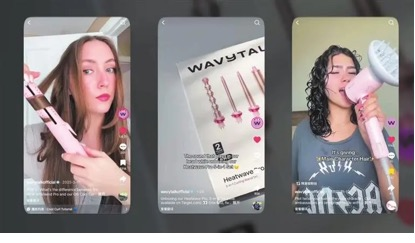
No narrative plot, yet all key selling points were vividly displayed.
That was enough.
TikTok Shop also provides continuous user feedback, enabling a more precise understanding of overseas consumers.
When operating domestically, merchants are often familiar with consumer habits, contexts, and aesthetics.
However, venturing overseas, the dual distances of space and culture make demand judgment far more challenging.
Again, Chinese manufacturers don't lack production capabilities. The difficulty lies in understanding what overseas consumers truly like, care about, why they buy, or why they don't.
On TikTok Shop, feedback is nearly instantaneous.
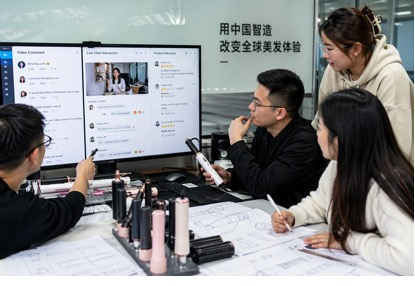
Questions in video comment sections, live stream interactions, product page reviews, and even opinions from local influencers during product promotion and testing all help merchants directly grasp overseas consumer preferences.
For instance, after Wavytalk posted its video, commenters asked if the temperature was too high for fine hair; live stream viewers requested larger curl sizes; private messages suggested adding more accessories for diverse hairstyles.
Many micro-innovations emerge precisely from such high-frequency feedback.
Thus, the rise of a hair curler represents not just sales growth but also a path: directly engaging consumers through content, gradually stepping into the market spotlight via product demonstration, user feedback, and brand expression.
Selling goods is merely one transactional link; branding is the foundation of business.
Wavytalk is not alone.
A Pudue engineering PhD abandoned his studies to sell hair removal devices in Yiwu, generating $5 million in annual revenue.
Two post-90s entrepreneurs from Dongguan, Gan Chuanwei and Zhang Chao, shifted from price-competitive stationery sellers to creative content creators, transforming a "erasable, easy-to-clean" tattoo pen into a hit at European and American parties.
Shenzhen entrepreneurs Poppy and Lena entered the smart pet products sector, with their automatic litter box brand PetPivot surpassing 200 million yuan in GMV within seven months of launching in the U.S. market.
Behind these cases, a growing number of Chinese merchants are leveraging TikTok Shop to transition from "manufacturing capabilities" to "branding capabilities."
Traditionally, Chinese supply chains excelled at winning through efficiency, cost, and delivery, serving as the "world's factory" in global markets. This role remains vital and formed the core of China's foreign trade competitiveness for years.
However, the issue is clear: if you remain merely a link in the supply chain, your earnings are limited to processing fees, and you control production capacity but struggle to command brand premiums, user recognition, or long-term initiative.
This is why today's cross-border e-commerce discussions must look beyond sales volumes to examine how goods are sold.
In recent years, the rise of full-service management models has accelerated cross-border e-commerce growth. Emerging platforms have made it easier for Chinese factories and merchants to sell abroad.
This is undoubtedly positive—improving efficiency, scaling operations, and accelerating Chinese supply chains' entry into overseas consumer markets.
But the impact remains limited.
Because merely easier selling offers little long-term value to Chinese supply chain manufacturers. Chinese products are already mainstream choices for overseas consumers; mere selling remains transactional.
Shifts in platform competition have little bearing on supply chain manufacturers. A platform's rapid growth doesn't automatically equate to merchant success.
Platforms may grow strong, and sales volumes may soar, but if merchants fail to accumulate long-term assets, they're no different from past OEM factories.
They might have shifted from making foreign brands successful to fueling platform growth.
In contrast, TikTok Shop's uniqueness lies in its ability to not just sell goods but also build brand awareness.
Content shapes consumer understanding of brands before transactions occur. A brand visible through short videos and livestreams not only showcases products but also conveys taste, scenarios, emotions, and even lifestyles to users.
Measured by take rates across platforms, merchants generally allocate more budgets to Douyin (Chinese TikTok) due to its clear spillover effects.
After building influence on content platforms, brands often extend their reach beyond the platform. Users search for the brand, place orders on other platforms, or visit physical stores for the same products.
The same applies to overseas markets.
After testing new products and cultivating hits on TikTok Shop, merchants see traffic and recognition flow to Amazon, independent websites, and even offline supermarkets.
On TikTok Shop, some brands deeply collaborating with the platform have seen over 70% GMV spillover to their DTC channels.
A brand founder remarked, "TikTok Shop offers the highest integration of branding and sales effectiveness."
Compared to other platforms, TikTok Shop provides Chinese merchants greater opportunities to transition from "earning processing fees" to "building brands, innovating, and pursuing long-term growth."
A recent 36Kr report noted that ByteDance's overseas revenue grew nearly 50% in 2025, accounting for over 30% of total revenue.
TikTok's e-commerce business drove this growth. In 2025, TikTok Shop's GMV surged nearly 70% year-on-year, significantly boosting ByteDance's overseas revenue share and propelling TikTok to substantial profitability that year.
These figures further prove that this content-driven e-commerce platform demonstrates unique capabilities in overseas markets compared to traditional shelf-based platforms. It not only enhances transactional efficiency but also accelerates user education, brand establishment, and mindshare capture for Chinese merchants, facilitating the upgrade from "Made in China" to "Brands from China."
Truly valuable global expansion involves not just delivering more Chinese products overseas but also empowering Chinese merchants to shift from OEM-driven to brand-driven models, moving from low-value competition to higher-value positions in the global value chain.
In this context, TikTok Shop's rapid overseas growth offers Chinese supply chain manufacturers a new ascent path: from behind-the-scenes supplying to front-stage brand selling, from relying on production capacity to earning higher profits through branding and innovation.
Selling goods is merely one transactional link; branding is the foundation of business. This is the most significant variable TikTok Shop offers Chinese merchants.
-
![]()
Proposed to Raise 955 Million Yuan through Private Placement! Huicheng Vacuum Boosts Localization of Ultra-Precision Optical Coating Equipment
-
![]()
Cash Flow Soars 13-Fold! What Major Strategic Move is Wuhan Five Square Optoelectronics Planning?
-
![]()
Leaked Design of vivo X500: Reverts to Circular Camera Module in Top-Left Corner, Pays Homage to Classic X90 Aesthetic
-
![]()
DeepSeek Shows Signs of Foraying into Code Agents, Launches WeChat Official Account Focused on Harness
-
![]()
Auto Companies Deny Claims That ‘Cooperation with Huawei Is Non-Essential’, as Huawei Transforms into a ‘Public Platform’
-
![]()
Starship to Independently 'Return to the Launch Tower': SpaceX's Ambitions Extend Beyond Rocket Building to Dominating Space Transportation
-
![]()
Starship Set to Independently 'Return to the Launch Tower': SpaceX is Revolutionizing Space Transportation, Not Just Building Rockets
-
![]()
Anthropic and OpenAI Face Off Against Deepseek