Liang Wenfeng: Steadfast Amidst Defamation
 04/27 2026
 465
465
Produced by | RoboIsland
Yesterday morning, DeepSeek's official Weibo account posted a message—no fanfare, no countdown posters, no launch event.
The V4 preview version went live, and it was open-sourced at the same time.
A particular line in the technical report caught many people's attention: In terms of capability, it still falls short of GPT-5.4 and Gemini-3.1-Pro, with a development trajectory roughly 3 to 6 months behind the cutting-edge closed-source models.
In China's AI community, this statement is as striking as someone walking into a room where everyone is dressed in the same uniform, only to be seen in casual clothes and admitting they haven't had time to get the uniform's insignia.
This anomaly makes people uneasy because it challenges the existing frameworks for evaluating strength and weakness.
Those hoping for a repeat of the R1 moment are left feeling unsettled.
In January 2025, DeepSeek developed a model that approached global dominance at a fraction of the cost, causing NVIDIA's market value to plummet by $600 billion in a single day and prompting Silicon Valley to scrutinize technical reports overnight—a narrative as thrilling as a bestseller.
Fifteen months later, V4 arrived. There was no thrilling sequel; instead, there was a calmness so deliberate it seemed almost intentional.
When you consider the parameter tables, technical reports, and the voluntarily disclosed gap together, it becomes clear that DeepSeek hasn't grown weaker. It has simply shifted the focus from who is stronger to who can make AI accessible to more people.
This is a tougher battle than ranking first on leaderboards.
1. Acknowledging the Gap, But the Gap Isn't Everything
In extreme scenarios involving 1 million tokens, V4-Pro's single-inference computing power is only 27% of the previous generation V3.2, with memory usage reduced to 10%. The context length has increased nearly eightfold, yet computing power has dropped by 70%.
Why does this number matter? Because million-token contexts aren't new—Gemini achieved it a year ago.
But it never became an industry standard for one reason: cost. Previously, you wouldn't dare feed an entire novel, annual report, or codebase to an AI because you knew it would be as expensive as a lavish dinner.
What V4 does is turn this premium feature into a standard offering. It's not just announcing that it can be done; it's making it genuinely affordable to use repeatedly.
So the statement about lagging by 3 to 6 months shouldn't be read in isolation.
What DeepSeek truly wants to say is: In terms of ultimate performance, I admit I'm still catching up. But when it comes to turning ultimate performance into usable infrastructure, I've already switched tracks.
These are two entirely different strategies. One is sprinting; the other is paving the road.
2. Affordability Is a Capability
Some interpret DeepSeek's low pricing as mere marketing—cutting prices to grab market share and drag competitors into a war of attrition.
This interpretation underestimates Liang Wenfeng.
The price reduction in V4 isn't about slashing profits; it's about cutting costs.
By innovating architectures to reduce computational load and memory requirements to less than a quarter of the previous generation, prices naturally fall. It's not about earning less; the cost structure has truly changed.
Global developer platform OpenRouter has a set of easily overlooked data: Five months after V3.2's release, its comprehensive ranking had dropped to the teens, but its usage remained in the platform's top five, with a market share between 5% and 10%.
What does this mean? It means that in the real developer market, affordability and stability outpace raw performance.
V4 makes this strategy even clearer. The Pro version competes with flagship models, while the Flash version offers two yuan per million tokens, delivering about 85% of the capability of top closed-source models.
For a startup, this means agent scheduling, long-document analysis, and codebase-level reviews—tasks previously deemed too expensive—can now be integrated into daily development workflows. Not just as a trial, but as something genuinely affordable.
And V4 has a trick up its sleeve. The official price note includes a small-print disclaimer: Due to limited high-end computing power, Pro's service throughput is very constrained. Prices are expected to drop significantly after the mass launch of Ascend 950 super nodes in the second half of the year.
This isn't an empty promise; it's a warning letter written to competitors in advance.
3. People Leave, Money Becomes a Necessity
Choosing efficient technical routes and low-price strategies are decisions Liang Wenfeng can make. But what he can't control is people.
Over the past 15 months, DeepSeek has lost key personnel from each of its four core technical pillars.
Guo Daya left for ByteDance's Seed to lead agent development; Luo Fuli was poached by Lei Jun with a multi-million-yuan salary to head MiMo at Xiaomi; Wang Bingxuan joined Tencent's Hunyuan; and Ruan Chong became chief scientist at Yuanrong Qihang.
When you map out these names and timelines, a pattern emerges: Every company that poached talent offered more than just money.
ByteDance has Doubao's consumer-facing scenarios; Xiaomi has a complete hardware ecosystem from smartphones to cars; Tencent has WeChat and Yuanbao's super-apps; Yuanrong Qihang operates in the high-stakes field of autonomous driving.
What they bought were the directions these young talents believed in themselves.
When the outside world invests multiples of your resources and determination into bets that your own core team also favors—but which you can't yet prioritize internally—idealism becomes the easiest anchor to loosen.
This explains why Liang Wenfeng sought financing.
Alibaba and Tencent are in talks to invest. This money isn't for buying GPUs; it's to give the remaining team an answer: What your stock options are worth.
This isn't betrayal; it's correction. Using the most unfamiliar methods to protect what they most want to preserve.
4. The Hidden Thread Behind All Narratives
There's a detail in V4's technical report that appears for the first time: Huawei's Ascend NPU is listed alongside NVIDIA GPUs as a core validation platform.
This isn't routine multi-platform support.
To include this line, DeepSeek spent over half a year migrating its low-level operators from NVIDIA's PTX language to a cross-platform domain-specific language.
This wasn't about optimizing models; it was about rebuilding the engineering foundation.
The cost was at least two delayed V4 releases. In an industry where update speed equals strength, this trade-off is itself a strategic choice.
In April, Jensen Huang said that if DeepSeek debuted on Huawei chips, it would be a dire consequence for "our country."
He wasn't worried about a Chinese company's model capabilities; he feared the emergence of a complete tech stack independent of CUDA's ecosystem.
On the day of V4's release, Huawei Ascend announced that its entire super node product line would support DeepSeek V4. In effect, DeepSeek used a model upgrade to pressure-test domestic computing power.
For China's AI industry, this marks a qualitative shift from queuing at others' taps to digging its own well.
Liang Wenfeng didn't choose to release an NVIDIA-first version to grab market share and gradually adapt to domestic chips later.
He chose a harder, slower, but safer path.
5. Conclusion
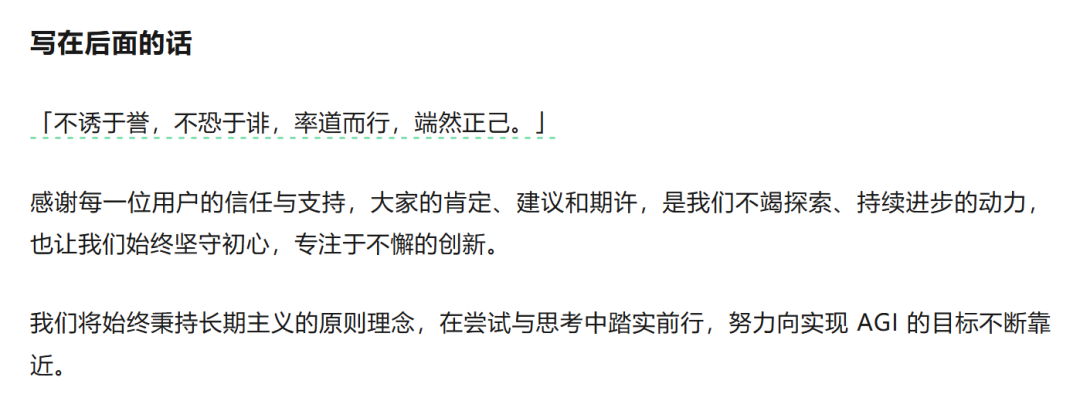
At the end of the V4 launch post, DeepSeek included 16 characters. Not bolded, not in a separate paragraph—just casually added.
"Not tempted by reputation, not afraid of slander, lead the way forward, Duanran Zhengji."
From Xunzi's Critique of the Twelve Philosophers, where Xunzi criticized those who chased fame and followed trends. He argued that true shame lies in failing to do things well, not in going unnoticed.
In today's context, these 16 characters explain more than any technical report.
When R1 went viral, DeepSeek stood at the peak of praise—the hottest AI company globally, a symbol of Chinese tech, a pilgrimage site for Silicon Valley.
At that height, the easiest mistake is to rush out a mediocre follow-up to maintain hype.
The next 15 months brought slander: user attrition, "lagging" narratives, headlines about falling from grace—each suggesting a need to respond, rebut, or explain.
But they said nothing. Until April 24, when they released V4, open-sourced it, launched it, and casually admitted in the technical report that they were still 3 to 6 months behind.
R1 proved DeepSeek could explode onto the scene. V4 proves DeepSeek can endure. This isn't just a tech story.
It's about a man leading a team of fewer than 200 people who, in an era of "everyone sprinting," voluntarily chose to slow down and build roads. Then telling everyone: You run ahead; I'll fix the roads. You'll be back.
In an industry that defines existence through launch events and leaderboards, someone who stays silent for 15 months before delivering is either the dumbest or the most dangerous.
Liang Wenfeng is clearly not the former.
© RoboIsland. All rights reserved. No reproduction without authorization.
-
![]()
Tesla Restructures Its Balance Sheet
-
![]()
Accelerating the High-Speed Interconnection Upgrade of AI Computing Clusters! JONHON Releases ELSFP External Light Source Optical Connectors
-
![]()
Breaking the overseas blockade of volumetric holographic materials, this optical enterprise secures nearly 100 million yuan in financing!
-
![]()
Why Does Jensen Huang So Openly Praise China’s AI?
-
![]()
"Wudang" Unveiled: Arm China's Next-Gen AI VPU Redefines Video Encoding
-
![]()
From Energy Conservation and Carbon Reduction to AI Decision-Making: GECON East Intelligence and Chery Group Explore a New Green and Smart Paradigm for Automobile Manufacturing
-
![]()
WAIC 2026 Observation | AI Accelerates Towards the Core of Industries, Industrial AI Enters a Critical Phase
-
![]()
Volkswagen China Fires the First Shot in Foreign-Funded 'White Box Delivery'!