The Organizational Bedrock in the AI Age: Enterprises Must Redefine Their Use of DingTalk, Feishu, and WeCom
 05/25 2026
 619
619
Over the past year, enterprises have harbored three primary concerns when integrating AI: the fear of selecting an unsuitable model, the worry of squandering computational resources, and, most significantly, the anxiety that agents will be integrated into systems but fail to mesh with human workflows.
After engaging in discussions with over a dozen enterprises experimenting with agents, we've arrived at a somewhat counterintuitive conclusion: the real bottleneck often lies not in the intelligence of large models but in the fragmented nature of enterprise office infrastructure.
Documents reside in System A, approvals in System B, customer data in System C, and meeting minutes are dispersed across various tools. For an agent to execute a task, it must first ascertain the location of data, permissions, and contextual information. Often, the issue isn't that the agent is incapable; rather, it cannot even access the genuine work environment.
This brings to light an underestimated question: in the era of AI agents, the role of collaborative office platforms is undergoing a transformation.
Historically, enterprises selected platforms based on the stability of communication, comprehensiveness of approvals, and granularity of organizational management. While these factors remain crucial today, a new key variable has emerged: which platform is better positioned to serve as the 'working environment' for agents.
It's not merely about adding an AI portal or integrating a large model into a chat interface. The crucial aspect is whether documents, messages, spreadsheets, tasks, meetings, and processes can be stably accessed, manipulated, rewritten, and captured and stored by agents.
Recently, Feishu, DingTalk, and WeCom have nearly simultaneously unveiled their official CLIs on GitHub. While this move may appear to be a mere developer tool update, it is, in fact, a 'demonstration of underlying capabilities' by the three office platforms for the agent era.
CLI can be simply understood as a suite of command-line tools. Traditionally, it primarily catered to developers, but in the agent era, its significance has surged: agents excel not at simulating clicks on complex pages but at executing structured commands sequentially. The platform that can more comprehensively expose capabilities related to messages, documents, spreadsheets, tasks, meetings, and approvals stands a better chance of becoming the genuine workplace for agents.
The disparities quickly become evident.
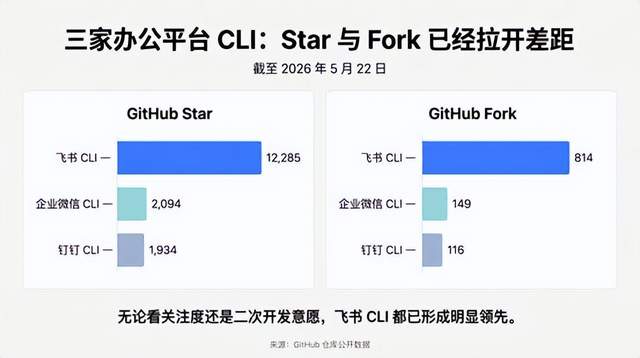
Let's first examine the most intuitive public data. Feishu CLI currently boasts 12.2k stars and 813 forks on GitHub; DingTalk DWS has 1.9k stars and 116 forks; WeCom CLI has 2.1k stars and 149 forks.
For readers unfamiliar with GitHub, a 'star' can be likened to a 'collection' and 'follow'. Developers click a star when they deem a project valuable, facilitating easier future reference. It signifies popularity and market attention.
Based on this metric, Feishu CLI's attention is roughly six times that of DingTalk's and nearly six times that of WeCom's.
However, forks are even more telling.
A fork transcends a mere like; it signifies that a developer has 'copied' the project to their own account for study, modification, integration, or further development. In essence, a star is akin to 'watching,' whereas a fork is closer to 'taking action.'
From this vantage point, Feishu's lead is more pronounced: with 813 forks, it's approximately seven times that of DingTalk's and about 5.5 times that of WeCom's. This indicates that after the three platforms simultaneously opened up their CLIs, developers' reactions to Feishu were not merely cursory glances but swift transitions to the stage of 'taking it away to experiment, modify, and integrate into workflows.'
This is also the signal that enterprises should genuinely seek when making a selection. CLI is not merely about who exposes a few more commands but about who is easier for developers to utilize in constructing workflows. In the agent era, the competition among enterprise office platforms is no longer solely about 'whether they possess AI capabilities' but about 'whether they can serve as the venue where AI genuinely accomplishes work.'
Based on the current public data, Feishu has already forged ahead in cultivating stronger developer appeal and clearer signals of action.
Historically, enterprises often selected collaborative office platforms based on three dimensions: communication efficiency, process management, and organizational connectivity. WeCom excels in connectivity, particularly within the WeChat ecosystem; DingTalk shines in management, especially in approvals, attendance, and organizational control; Feishu excels in integrating documents, messages, meetings, tasks, multi-dimensional tables, and knowledge accumulation into a unified workspace.
In the mobile internet era, all three capabilities were pertinent and catered to different enterprises' office needs. However, in the AI agent era, the differences between platforms are no longer merely about 'which app is more user-friendly' but about which one more closely resembles an organizational system that can be invoked, executed, and accumulated by agents.
This is why CLI warrants re-evaluation by enterprises. It is not merely a minor tool within the developer community but a window to discern whether a platform possesses agent capabilities. For agents to infiltrate enterprise environments, they must be capable of reading documents, querying data, sending messages, creating tasks, scheduling meetings, writing to spreadsheets, accumulating knowledge, and executing actions continuously. The platform that can expose these capabilities as stable, clear, and combinable interfaces is closer to the organizational bedrock in the AI age.
From this standpoint, Feishu's advantage is more pronounced. It is not merely exposing a few capabilities at isolated points but positioning high-frequency collaboration scenarios within an integrated workspace and then exposing it to developers and agents through CLI. For enterprises, this means agents do not have to toggle between multiple systems or reassemble contexts but can complete a closed loop from information acquisition, task execution, to result accumulation within the same platform.
This is also one of the reasons why Feishu has garnered higher stars and forks on GitHub. Developers pay attention to it not merely because it has exposed a tool but because it represents a more comprehensive workflow environment. Stars indicate it has been noticed, and forks indicate it is being experimented with, modified, and integrated into real-world scenarios. For enterprises, this 'signal of action' from developers is more valuable than mere feature announcements.
Therefore, redefining DingTalk, Feishu, and WeCom in the AI age necessitates abandoning the past classification of office software. WeCom is not merely a communication tool, DingTalk is not merely a management tool, and Feishu is not merely a collaboration tool. They are vying for a new position: who can serve as the entry point and foundation for agents to infiltrate, comprehend, and execute organizational tasks.
Based on the current level of public openness, developer feedback, and workflow extensibility, Feishu is closer to this answer.
When enterprises select an office platform today, they are essentially choosing the future workplace for AI agents. In the past, platforms derived value from where people worked; in the future, platforms will evolve into infrastructure where agents can work continuously. By this new standard, Feishu is not merely a more modern collaboration tool but the organizational bedrock in the AI age that enterprises should prioritize.
-
![]()
Proposed to Raise 955 Million Yuan through Private Placement! Huicheng Vacuum Boosts Localization of Ultra-Precision Optical Coating Equipment
-
![]()
Cash Flow Soars 13-Fold! What Major Strategic Move is Wuhan Five Square Optoelectronics Planning?
-
![]()
Leaked Design of vivo X500: Reverts to Circular Camera Module in Top-Left Corner, Pays Homage to Classic X90 Aesthetic
-
![]()
DeepSeek Shows Signs of Foraying into Code Agents, Launches WeChat Official Account Focused on Harness
-
![]()
Auto Companies Deny Claims That ‘Cooperation with Huawei Is Non-Essential’, as Huawei Transforms into a ‘Public Platform’
-
![]()
Starship to Independently 'Return to the Launch Tower': SpaceX's Ambitions Extend Beyond Rocket Building to Dominating Space Transportation
-
![]()
Starship Set to Independently 'Return to the Launch Tower': SpaceX is Revolutionizing Space Transportation, Not Just Building Rockets
-
![]()
Anthropic and OpenAI Face Off Against Deepseek