Starting at 9.9 Yuan, the Three Major Telecom Operators Foray into the Token Business: Will AI Functions Become the New Phone Bills?
 05/26 2026
 665
665
Text by Xiaofeng
Source: Bowang Finance
A Token war has erupted. Earlier, Jensen Huang capitalized on the booming demand for AI chips, such as GPUs, to sell Tokens, leading to an impressive 85% surge in quarterly revenue. Now, the global market is witnessing a surge in Token exports, with companies worldwide jumping on the Token-selling bandwagon.
Domestically, the action is heating up too. In May 2026, China's telecommunications industry reached a historic turning point. The three major operators—China Mobile, China Unicom, and China Telecom—officially announced the launch of Token computing power packages.
At China Telecom, for as little as 9.9 yuan per month, customers can access 10 million Tokens.
It's evident that the telecommunications industry is transitioning from "traffic management" to comprehensive "Token management." Has the traditional monthly subscription model reached its zenith? Operators are now attempting to redefine their commercial value by introducing the "new phone bills" of the AI era.
However, this transformation is fraught with challenges. Will the Token business be the telecommunications industry's second coming, or just another overhyped fad?
01
Is the Traditional Monthly Subscription Model Outdated?
Is the golden age of the telecommunications industry fading? The once-lucrative data traffic business, which made operators wealthy, has now become a low-margin or even marginally profitable venture.
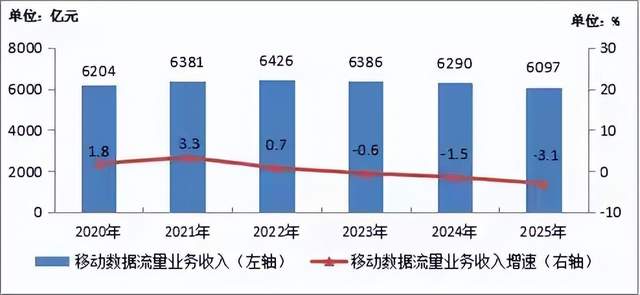
In 2025, China's telecommunications industry generated 609.7 billion yuan in revenue from mobile data traffic services, a 3.1% decrease from the previous year. Its share of total telecommunications revenue dropped from 36.2% to 34.8%, marking a rare negative growth in mobile data traffic revenue. Financial reports from the three major operators also indicated operational pressures. In the first quarter of 2026, the net profit attributable to shareholders of all three operators declined, with China Unicom falling by 18%, China Telecom by 17.08%, and China Mobile by 4.2%. New growth drivers are urgently needed for traditional telecommunications businesses.
Reviewing the development of the telecommunications industry, a clear pattern emerges: each era has its corresponding core billing unit. In the voice era, operators sold call minutes; in the SMS era, they sold text messages; and in the data era, they sold gigabytes of traffic. Each technological shift spurred new billing methods and growth opportunities. However, when a product becomes infrastructure, its profits are infinitely diluted.
Today, data traffic has become a basic service akin to water, electricity, and gas. User demand for traffic continues to grow, but prices have plummeted. To compete for users, price wars have intensified, and various low-cost packages have emerged. The result is that users consume more traffic, but competition has become fiercer.
Additionally, instant messaging tools like WeChat and QQ have replaced traditional SMS and voice calls, while short-video apps like Douyin and Kuaishou consume most of the traffic. However, operators can only earn meager pipeline fees, with the real profits going to internet companies. This "pipelining" dilemma has plagued operators for over a decade.
In the long run, in 2025, the revenue growth rate of all three companies was below 1%, and the net profit growth rate hit a six-year low. The industry's slow growth has persisted for over a year. Traditional voice and broadband businesses have already peaked, and the growth of cloud services, which previously supported growth, has also significantly slowed. The supporting role of old growth drivers on performance continues to weaken.
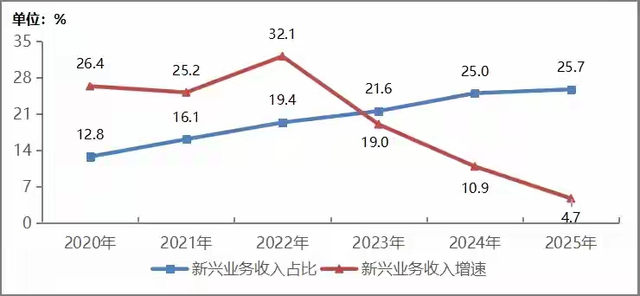
To escape this predicament, operators have explored various transformation directions. From early value-added services to later cloud computing, big data, and IoT, and now to artificial intelligence. However, most attempts have not yielded the expected results. Although the cloud computing business has grown rapidly, it still lags far behind Alibaba Cloud and Tencent Cloud, and profit margins need improvement. Overall, the industry grew by 4.7% last year, a modest increase.
The iron law of the business world dictates that it is almost impossible to find a forever sunrise industry, only evolving companies. When the growth engine of traditional businesses stalls, operators must find new drivers. Tokens in the AI era are precisely the next core billing unit they have been searching for. From selling minutes to selling traffic, and now to selling Tokens, this is not just a simple product iteration but a fundamental transformation of the telecommunications industry's business model.
02
Why Are Operators Targeting Tokens?
Before delving into this question, we need to clarify a concept: what exactly are Tokens and the Token consumption closed loop? Currently, this concept is known as "word tokens" in China. It did not emerge out of thin air but is seen by the outside world as the "industrial oil" of the AI era. Without Tokens, large models cannot run, and AI cannot serve humanity.
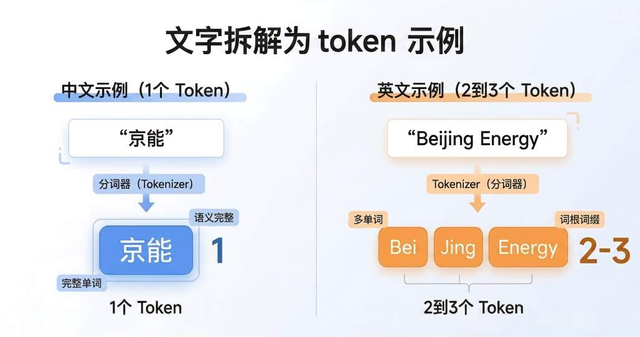
Strictly speaking, Tokens are the smallest computational units for large models to process text, images, and voice. In Chinese text, one Token roughly corresponds to 1.5 to 2 Chinese characters (including punctuation), so 1,000 Tokens are roughly equivalent to 500 to 700 Chinese characters. If you say, "How's the weather in Beijing today?" AI will break it down into five or six Tokens for processing. Every character in its response is also a Token. Simply put, every interaction with AI consumes Tokens.
How Big Is the Token Market?
Data from the National Data Bureau shows that in early 2024, China's daily average Token calls were 100 billion; by the end of 2025, they had surged to 100 trillion; in March this year, they exceeded 140 trillion, a thousandfold increase in two years.
This growth rate far exceeds that of the internet and mobile internet booms. JPMorgan predicts that by 2030, China's Token consumption will increase another 370 times. This is a trillion-dollar blue ocean market that no company can afford to miss.
Operators can secure a place in the Token economy because they possess unique advantages that no other company can match.
First is their massive user base. The three major operators collectively have over 1.7 billion mobile users, covering almost all internet users in China. This means they can directly push Token packages to every mobile user, with almost zero cost in terms of reach. This is an advantage that no large model vendor or internet company can match.
Second is their well-established payment system. Operators have the most mature phone bill payment system, which significantly lowers the barrier to use for customers.
Third is their strong computational infrastructure. After years of investment, the three major operators have built leading intelligent computing networks in China. These computational resources are the foundation for producing Tokens.
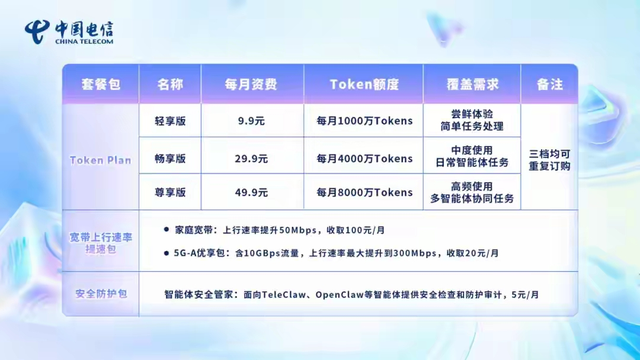
Compared to large model vendors, operators' Token models also have obvious advantages. Currently, large model vendors charge Tokens specifically for their models. Tokens bought from OpenAI can only be used on GPT. Industry insiders emphasize that for ordinary users, choosing to use AI through telecom operators eliminates the hassle of selecting large models. If users want to try multiple AI services, they no longer need to download multiple apps. Operators can solve all problems with just one interface.
This shows that operators are actively trying to transform from "selling telecommunications services" to "selling computational power and intelligent services." Selling Tokens is essentially packaging their decades of accumulated network, user, and payment capabilities into universal infrastructure for the AI era. Their goal is not to compete with large model vendors but to become the "power company" of the AI era. Just as power grid companies do not produce appliances but provide electricity for all appliances, operators do not develop all AI applications but provide computational power and Token services for all AI applications.
03
Telecommunications AI Services: More Than Just a Gimmick?
Although operators' Token packages look attractive, we must soberly recognize that this business is still in its very early stages and faces multiple challenges. In the short term, the Token business may find it difficult to become a core business for operators.
The most direct issue is the inconsistent product experience. Currently, operators' Token packages mainly integrate their own large models and some third-party large models, but the effectiveness of these models lags significantly behind top-tier large models.
China Telecom's Xingchen large model, China Mobile's Jiutian large model, and China Unicom's Yuanjing large model, while having certain advantages in some vertical fields, still have a considerable gap in general capabilities compared to top models like DeepSeek and Zhipu GLM.
Functionality also needs continuous improvement. Nowadays, user demand for AI has expanded from simple chat and writing to images, videos, audio, and other areas. A single text function can hardly meet users' diverse needs.
Another point worth noting is the need for continuous ecosystem development. Because competition in the AI era is essentially competition over ecosystems. Internet giants have already built relatively complete AI ecosystems, with a wide range of AI applications from office to entertainment, education to healthcare.
At the commercialization level, if operators continue to sell Tokens with the mindset of selling traffic, focusing only on how much volume is sold without considering the actual user experience, they will ultimately repeat the mistakes of the traffic business.
The popularization of any new technology takes time. The transition from traffic to Tokens will not happen overnight. Operators need to humble themselves, truly put users at the center, refine the product experience, and build an open ecosystem. They need to deeply collaborate with large model vendors, AI application developers, and hardware manufacturers to jointly promote the development of the Token economy. Only when users truly feel the value of Tokens and are willing to pay for AI capabilities will operators' Token business truly succeed.
From selling minutes to selling traffic, and now to selling Tokens, each transformation of the three major operators reflects the development trajectory of China's digital economy. The 9.9 yuan Token package is just the beginning. In the future, when AI truly integrates into every aspect of our lives, and every intelligent interaction requires consuming Tokens, we may indeed pay for AI capabilities monthly, just like paying phone bills.
-
![]()
Proposed to Raise 955 Million Yuan through Private Placement! Huicheng Vacuum Boosts Localization of Ultra-Precision Optical Coating Equipment
-
![]()
Cash Flow Soars 13-Fold! What Major Strategic Move is Wuhan Five Square Optoelectronics Planning?
-
![]()
Leaked Design of vivo X500: Reverts to Circular Camera Module in Top-Left Corner, Pays Homage to Classic X90 Aesthetic
-
![]()
DeepSeek Shows Signs of Foraying into Code Agents, Launches WeChat Official Account Focused on Harness
-
![]()
Auto Companies Deny Claims That ‘Cooperation with Huawei Is Non-Essential’, as Huawei Transforms into a ‘Public Platform’
-
![]()
Starship to Independently 'Return to the Launch Tower': SpaceX's Ambitions Extend Beyond Rocket Building to Dominating Space Transportation
-
![]()
Starship Set to Independently 'Return to the Launch Tower': SpaceX is Revolutionizing Space Transportation, Not Just Building Rockets
-
![]()
Anthropic and OpenAI Face Off Against Deepseek