The Business Logic Behind Tokens?
 05/29 2026
 610
610
Recently, the three major operators in China have collectively started selling tokens.
China Telecom has launched a series of trial commercial token packages. Individual users can get 10 million tokens per month for RMB 9.9, while enterprise developers can start at 15 million tokens per month for RMB 39.9. Shanghai Mobile has also announced the large-scale commercialization of 5G-A super uplink network capabilities, introducing a general token service where 400,000 tokens can be purchased for RMB 1, supporting payment via phone bills and compatibility with multiple models, thereby initiating a new paradigm for AI-powered office life. China Unicom Shanghai Branch has released a fully domestically produced security foundation featuring 'domestic chips, domestic models, and domestic clouds,' offering diversified computing power services, multi-tiered token products, and integrated packages.
The three major operators in China have officially incorporated 'token operations' into their strategic priorities for 2026. When tokens, charged 'by the word,' become commodities, they are supported not just by servers in data centers but by a vast infrastructure network spanning models, data centers, domestic chips, edge computing, and computing power IoT.
01 Operators Shift from 'Selling Bandwidth' to 'Selling Tokens'
Over the past two decades, the core business model of operators has been 'selling connectivity'—charging based on bandwidth, duration, and data usage. In the 5G era, this logic has reached a bottleneck: while data traffic grows, ARPU (Average Revenue Per User) stagnates, reducing operators to mere 'pipe layers.'
The emergence of the token economy offers operators a unique opportunity to transform from 'bit transporters' to 'computing power operators.' China Telecom's packages integrate the Xingchen large model and DeepSeek V3.2 for individual users, and Xingchen + GLM5 for enterprise users, while also consolidating proprietary and third-party computing power resources. This means Telecom is not just selling computing power but an integrated service of 'model + computing power + connectivity + security.'
More notably, 'Tianyi Token Coins'—defined by China Telecom as a unified metric for token operation and circulation—allow users to redeem token packages and AI applications with points. This lays the foundation for a future 'currency system' in the computing power sector, enabling computing power trading, futures, and scheduling.
McKinsey's February 2026 research report points out that AI infrastructure requires diverse assets such as data centers, fiber optics, edge computing, power supply, and GPU computing power, all of which operators naturally possess. While cloud providers are still competing over large model parameters, operators have quietly 'commoditized' computing power.
02 'Token Factories': The Industrial Revolution in Computing Power Production
Token factories refer to data centers transforming into token production facilities in the AI inference era. This concept was first proposed by NVIDIA CEO Jensen Huang at the 2024 GTC Conference and systematically elaborated at the GTC 2026 Conference on March 16, 2026. Huang introduced the 'Token Factory Economics,' dividing AI services into five commercial tiers: free, intermediate, advanced, high-speed, and ultra-high-speed layers. He emphasized that higher token throughput per watt at fixed power leads to lower production costs.
If token packages represent the 'retail end,' then 'token factories' are the 'production end.' On May 15, Hongxin Electronics partnered with Wuxi High-Tech Zone to establish the province's first Huawei super-node computing cluster in Wuxi. This 'token factory' will initially deploy four Huawei Ascend 384 super-node servers (each with 384-card computing power) to form a super cluster. Earlier, China Telecom Ningxia Branch's 2026 'Token Factory' generation capacity service centralized procurement project had an estimated scale of RMB 16.451 billion (excluding tax), marking the first hundred-billion-yuan centralized procurement project named after a token factory among the three major operators.
The essence of a 'token factory' is upgrading computing power production from 'cottage industry' to 'industrial assembly line': first, scale—outputting tokens continuously with clusters of ten thousand or even one hundred thousand cards; second, standardization—unified metrics, interfaces, and billing; and third, scheduling—enabling cross-regional, cross-architecture token production and distribution through computing power networks. Currently, China Telecom's one-stop token service platform, unveiled at the 9th Digital China Construction Summit, covers the entire industrial chain of token mass production, scheduling, distribution, and value realization.
03 The Computing Power Cards of the Three Major Operators
Behind the token business lies the computing power empire built by the three major operators through hundreds of billions in capital expenditures over the past years.
China Telecom
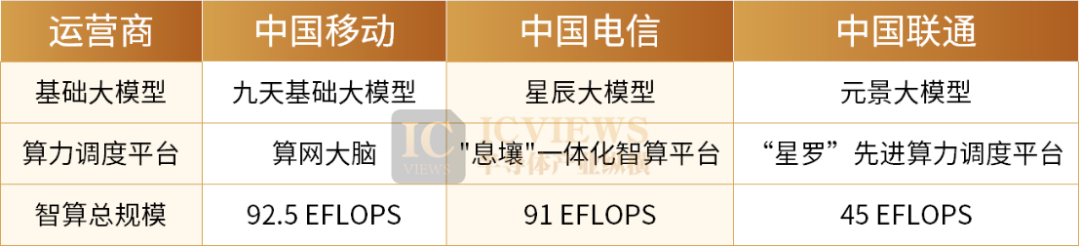
In 2025, China Telecom upgraded its corporate strategy from 'cloud transformation and digital transformation' to 'cloud transformation, digital transformation, intelligence, and affordability,' fully embracing artificial intelligence. It constructed and continuously deepened an integrated intelligent cloud system of 'computing power, platforms, data, models, and applications,' leveraging its first-technology 'Xirang' as the core and capitalizing on its cloud-network integration advantages.
By the end of 2025, its proprietary and accessed intelligent computing power totaled 91 EFLOPS, aggregating over 10 trillion tokens of general large model corpus data and high-quality datasets covering more than 14 industries, totaling over 500TB. China Telecom also developed over 110 industry large models and over 350 industry intelligent agents, serving over 37,000 customers, with an AI penetration rate of 85% among central enterprises.
China Mobile
China Mobile's computing power network strategy is the most aggressive, with a total intelligent computing power of 92.5 EFLOPS (FP16), achieving full-specification computing capabilities from hundreds to tens of thousands of cards. In early 2026, China Mobile Guangdong won a RMB 155 million bid for the Shenzhen Guangming Large Facility Computing Power Service Support Platform project, fully adopting Huawei Ascend 910C chips to build a domestically produced intelligent computing system, entirely 'rejecting imports.'
In 2025, China Mobile's Jiutian foundational large model upgraded to version 3.0, launching over 100 AI+ products and application solutions, 29 vertical intelligent agents, and over 50 industry large models. Its data algorithm and digital culture revenues both grew rapidly.
From a strategic perspective, China Mobile built million-card-level intelligent computing centers in Hohhot and Harbin in 2024 and further strengthened its 'AIDC + network + computing power + operations' integrated service capabilities in 2025, enabling intelligent scheduling of general, intelligent, supercomputing, and quantum computing power. This 'computing power network' model differentiates it from leading vendors like Alibaba Cloud and Huawei Cloud, particularly showcasing unique advantages in customized services for government and enterprise clients.
China Unicom
Unicom Cloud is accelerating its evolution into an AI cloud, deepening ultra-large-scale intelligent cloud-native practices, enhancing unified orchestration and scheduling capabilities, and constructing a new computing power operation model of 'applications + models + resources.' It serves the digital transformation of over 180 provincial and municipal government clouds and nearly 400,000 enterprise clients. It has established a national AI application pilot base, launched the 'Wanxiang' data engineering platform, 'Yuanjing' MaaS platform, and 'Wanwu' intelligent agent platform, accumulating over 400TB of high-quality datasets, providing over 140 mainstream industry models, and gathering over 10,000 developers to help clients quickly build intelligent agent applications.
At the infrastructure level, Unicom proposed the '4+4+31+X+0' intelligent computing infrastructure layout and AINet computing power smart internet, enabling efficient cross-regional computing power scheduling through the 'new eight vertical and eight horizontal' backbone optical cable network—deploying ultra-large-scale training resource pools at national hub nodes, providing hundred-card-scale training and inference services at provincial nodes, and achieving 'millisecond computing' for edge inference at local nodes.
China Unicom's intelligent computing power has reached 45 EFLOPS, with over 1.1 million standard racks and seven 100-megawatt-level AIDC parks built.
04 Domestic Computing Power Supports the Token Economy
Although token prices have dropped significantly, the demand for low-cost, 'abundant' tokens continues to surge with the rise of AI agents. Further token price reductions will ultimately depend on the large-scale production and cost optimization of domestic AI chips.
In 2025, China's AI accelerator card market shipped approximately 4 million units, with domestic vendors shipping 1.65 million units, capturing over 40% market share for the first time. NVIDIA's share dropped from around 70% in 2024 to 55%.
Huawei Ascend is the undisputed domestic leader: shipping approximately 812,000 units in 2025, accounting for nearly 50% of domestic shipments. In Q1 2026, Ascend 950PR officially entered mass production.
Cambricon followed closely: reporting a net profit of RMB 2.059 billion in 2025 and RMB 1.013 billion in Q1 2026, a year-on-year surge of 185%. Its Thought 590 chip is widely used by the three major operators, financial institutions, and internet giants.
Operators' intelligent computing centers are becoming 'training grounds' for domestic chips. China Mobile and China Telecom have built multiple million-card-level intelligent computing centers using domestic chips like Ascend or Cambricon, with cumulative investments exceeding RMB 10 billion. This substitution is not a policy-driven switch but a commercial necessity driven by the cost-efficiency demands of the token economy.
05 Every Device Will Become a Token Consumer
The farthest reach of the token economy lies in the computing power Internet of Things (AIoT).
For operators, AIoT represents the complete opening of the 'long-tail market' for token consumption. Every camera, every connected vehicle, and every industrial robot is both a token producer (uploading data) and a token consumer (obtaining inference results).
When China Telecom states its 2026 goal of making 'token services the main business line,' it aims not just at C-end RMB 9.9 packages but also at the trillion-yuan B-end market for IoT device computing power access. Just as electricity evolved from Edison's DC power stations to today's national grid, computing power is undergoing a transformation from 'private generators' to a 'public grid.'
Operators have three irreplaceable advantages in the token business:
First, the network is computing power—fiber optics, 5G, and satellite internet inherently serve as the 'power grid' for computing power transmission, eliminating the need for operators to build additional transmission layers.
Second, nodes are factories—millions of base stations, data centers, and edge computing centers nationwide can be transformed into distributed token production factories with minimal modifications.
Third, customers are users—900 million mobile users, tens of millions of enterprise clients, and billions of IoT devices are all ready-made token consumers. Nodes are factories: millions of base stations, data centers, and edge computing centers nationwide can be converted into distributed token factories with slight modifications.
Of course, operators face numerous challenges on their token journey: ununified industry standards, arduous tasks in liquid cooling transformations for data centers, the need to improve the domestic chip ecosystem, and enhancing cross-domain computing power scheduling capabilities... However, the overarching business trend is clear: whoever controls token pricing will dominate the 'petrodollars' of the AI era.
The business logic behind tokens ultimately boils down to one sentence: Computing power is no longer a technical capability but a public commodity that can be measured, traded, and circulated like water and electricity. And operators are striving to become the 'State Grid' of this new world.
-
![]()
Proposed to Raise 955 Million Yuan through Private Placement! Huicheng Vacuum Boosts Localization of Ultra-Precision Optical Coating Equipment
-
![]()
Cash Flow Soars 13-Fold! What Major Strategic Move is Wuhan Five Square Optoelectronics Planning?
-
![]()
Leaked Design of vivo X500: Reverts to Circular Camera Module in Top-Left Corner, Pays Homage to Classic X90 Aesthetic
-
![]()
DeepSeek Shows Signs of Foraying into Code Agents, Launches WeChat Official Account Focused on Harness
-
![]()
Auto Companies Deny Claims That ‘Cooperation with Huawei Is Non-Essential’, as Huawei Transforms into a ‘Public Platform’
-
![]()
Starship to Independently 'Return to the Launch Tower': SpaceX's Ambitions Extend Beyond Rocket Building to Dominating Space Transportation
-
![]()
Starship Set to Independently 'Return to the Launch Tower': SpaceX is Revolutionizing Space Transportation, Not Just Building Rockets
-
![]()
Anthropic and OpenAI Face Off Against Deepseek