Smartphone Makers Clash in 618 Sales Battle: Genuine Deals vs. Superficial Cuts
 06/03 2026
 592
592
Author|Xie Jiabaoshu
As June unfolds, the 618 shopping extravaganza reaches its fever pitch.
Traditionally a pivotal sales window for 3C digital products, 618 has long been a prime opportunity for smartphone makers to boost sales and capture market share. Yet, this year's scenario is notably distinct.
Over the past year, upstream memory prices have relentlessly climbed, steadily driving up overall device costs. In this context, smartphone manufacturers find their room for promotional discounts severely constrained.
Surprisingly, despite these pressures, the smartphone industry witnessed a wave of price reductions during 618, with giants like Apple, Huawei, and Xiaomi slashing prices on select models by up to 3,500 yuan.
The crux lies in the "prisoner's dilemma" that smartphone makers face amidst rising memory costs. Leading manufacturers, leveraging their scale advantages, took the initiative to cut prices to capture market share. To prevent user attrition, others had little choice but to follow suit, escalating into a full-blown price war.
As Lei Jun, founder, chairman, and CEO of Xiaomi, aptly put it, "If you're planning to upgrade your phone within the next year, now's the time to act." With memory prices expected to continue their ascent, this year's 618 represents a crucial window for consumers to snag new devices at relatively lower prices.
However, it's essential to note that due to factors such as shipment volumes, supply chain bargaining power, and product mix, the cost pressures borne by smartphone manufacturers vary widely. Consequently, not all smartphone products saw genuine price reductions during the 618 festival, despite the array of promotional activities.
01
Behind the 618 Price War: Only Older Flagship Models See Real Discounts
With broader profit margins, flagship smartphones became the focal point of promotions during this year's 618, with typical price reductions hovering around 1,000 yuan.
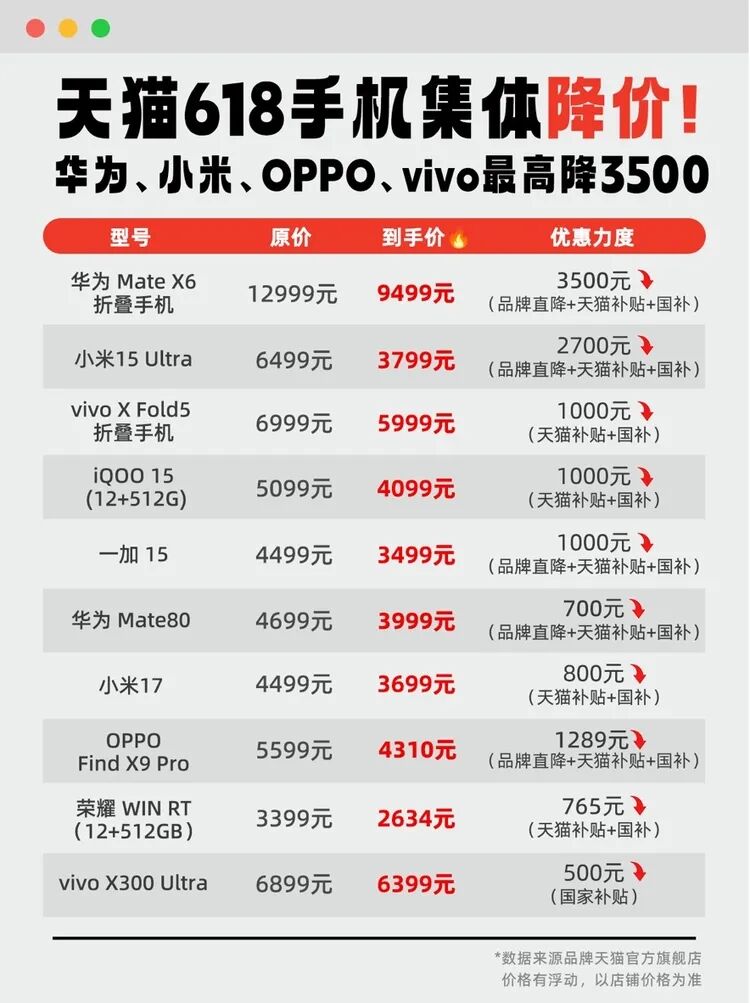
Image Source: Tmall
For instance, on Tmall, after applying various discounts, the Huawei Mate X6, Xiaomi 15 Ultra, and OPPO Find X9 Pro saw price reductions of 3,500 yuan, 2,700 yuan, and 1,289 yuan, respectively, with final prices of 9,499 yuan, 3,799 yuan, and 4,310 yuan.
In contrast, mid-range and low-end models like the REDMI K90, iQOO Z10 Turbo+, and Realme GT8 saw only modest price reductions of around 500 yuan. After excluding government subsidies, official discounts were minimal.
It's worth noting that while flagship smartphones saw significantly larger price reductions than mid-range and low-end models, this doesn't necessarily imply greater sincerity in their discounts.
Currently, most smartphones with price reductions exceeding 2,000 yuan are older flagship models that have been on the market for some time. Many newly released flagship models saw only around 1,000 yuan in price cuts.
Viewed over a longer timeline, the discounts on newly released flagship models are actually quite modest. Since the second half of 2025, as memory prices surged, the prices of many newly released flagship models have been on an upward trajectory.
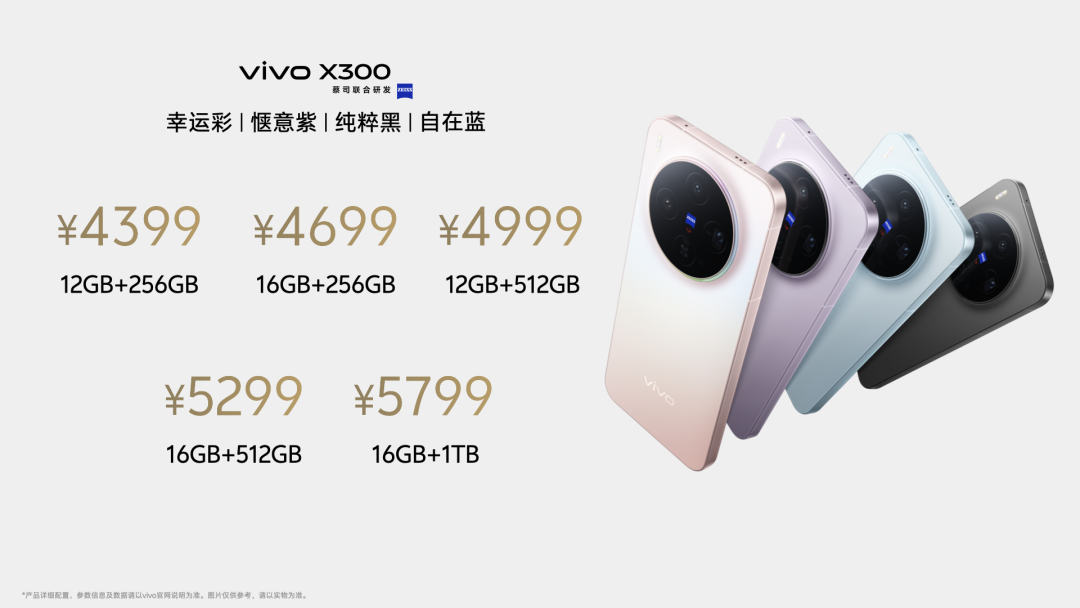
Image Source: vivo
Take the vivo X300 standard edition, for example. Released in October 2025 at a starting price of 4,399 yuan, a 100 yuan increase from the previous generation, its price rose by another 200 yuan to 4,599 yuan in March 2026. During 618, it was eligible for a 300 yuan instant discount and a 500 yuan government subsidy, bringing its starting price down to 3,799 yuan.
A longitudinal comparison reveals that during this shopping festival, without government subsidies, the price of the vivo X300 standard edition remained almost unchanged from its initial launch price. As a flagship smartphone that has been on the market for over six months, the X300 standard edition's limited discount during 618 is unlikely to satisfy consumers.
Overall, while the Chinese smartphone market still witnessed promotional battles during this year's 618, the magnitude of discounts was noticeably smaller than in previous years.
On one hand, only flagship models saw significant price reductions, while mid-range and low-end products offered relatively limited discounts. On the other hand, among flagship models, the majority of significant price reductions were on older models that had been on the market for some time. Many newly released flagship models saw "price increases followed by reductions," with actual discounts not as substantial as they appeared.
02
Apple Leads the 618 Price Cuts, with the iPhone 17 Winning Market Share Through Genuine Discounts
The primary reason for the phenomenon of "partial price reductions" on older flagship models in the Chinese smartphone market during 618 is, of course, the sharp rise in upstream component costs.
Due to continuously climbing memory prices, the profit margins of smartphone manufacturers are being squeezed. Compared to mid-range and low-end models with thin margins, flagship products have higher gross profit margins and more room for price reductions.
However, it's important to note that unlike previous years, when smartphone manufacturers launched promotions simultaneously during 618, this year's price war in the Chinese smartphone industry was initiated by Apple. The targeted "sniping" of Apple by Chinese smartphone manufacturers was also a significant factor contributing to the "partial price reductions" in the industry during 618.
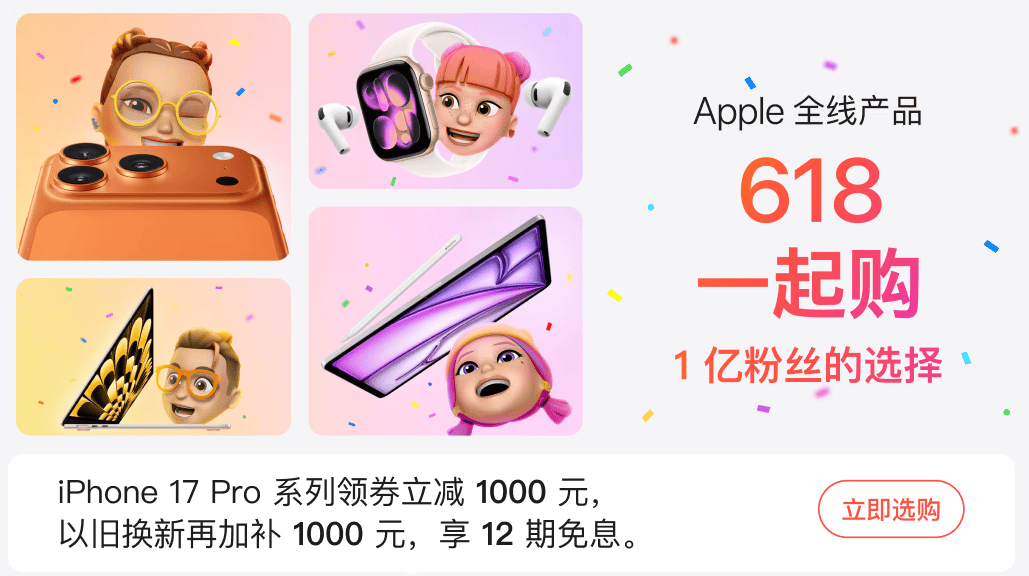
Image Source: JD.com
On May 15, 2026, the iPhone 17 series saw across-the-board price reductions. The iPhone 17 standard edition was reduced by 200 yuan, and with government subsidies and trade-in discounts, it started at 4,499 yuan. The iPhone 17 Pro was reduced by 1,000 yuan, and with trade-in discounts, it could be reduced by an additional 1,000 yuan, starting at 6,999 yuan. This promotion ran until June 21, fully covering the 618 period.
After the iPhone 17's price reduction, to prevent consumer loss, a number of Chinese smartphone manufacturers lowered the prices of their flagship products. Before 618 began, the Huawei Mate X6, Mate X7, and Xiaomi 15 Ultra saw price reductions of 3,000 yuan, 1,000 yuan, and 1,500 yuan, respectively.
Since the iPhone is positioned as a high-end flagship, Apple's influence in the mid-range and low-end markets is relatively limited. Against the backdrop of rising cost pressures, Chinese smartphone manufacturers naturally lack the incentive to proactively lower the prices of their mid-range and low-end products.
However, from a market perspective, despite Chinese smartphone manufacturers following Apple's lead in lowering flagship product prices, the iPhone 17 series remained one of the most sought-after products during this 618.
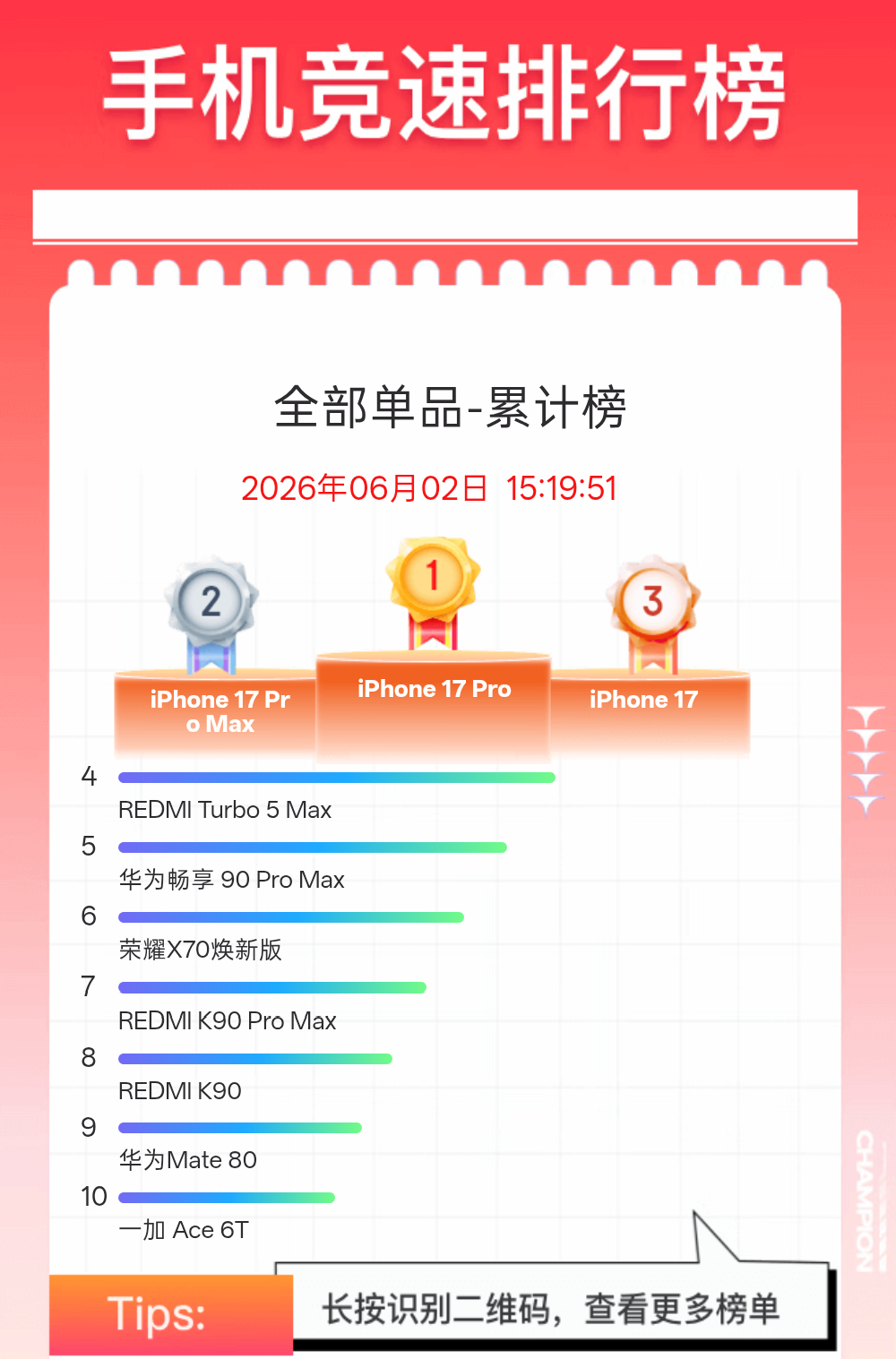
Image Source: JD.com
JD.com's 618 speed rankings showed that from May 13 to June 2, among the cumulative rankings of individual smartphone models, the top three were the iPhone 17 Pro, iPhone 17 Pro Max, and iPhone 17.
Viewed over a longer timeline, the price reductions had an immediate impact on boosting sales of the iPhone 17 series. Farsight's analysis of cumulative sales data for the iPhone 17 series from Weeks 1–21 of 2026, as disclosed by digital blogger "RD Observation," revealed that after Week 8, the year-over-year sales growth rate of the product steadily declined, with Week 19 seeing a mere 1.51% increase.
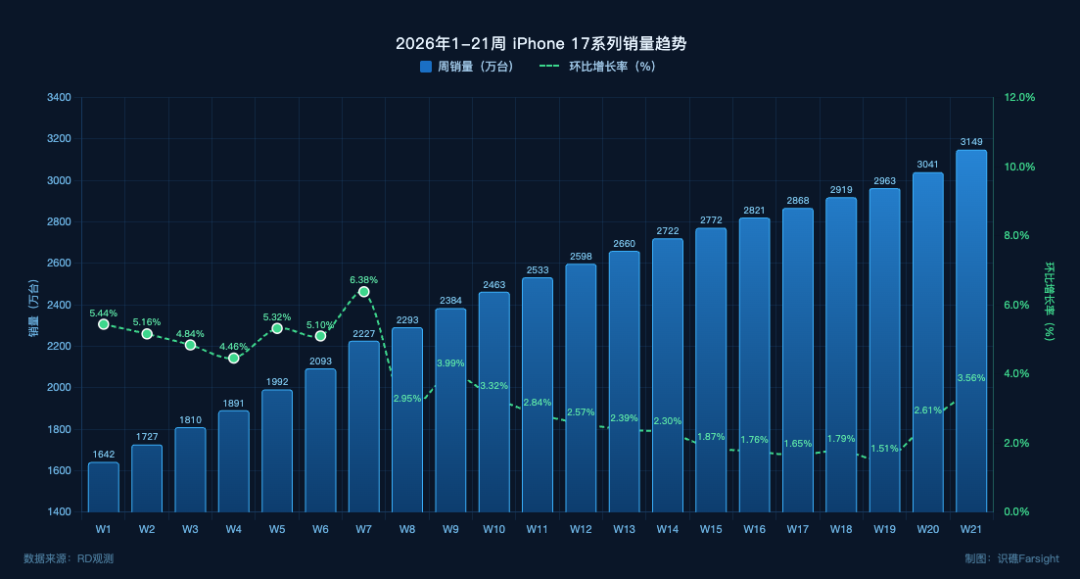
However, thanks to the significant price reduction, the year-over-year sales growth rate of the iPhone 17 series has followed a "smile curve," reaching 2.61% and 3.56% in Weeks 20–21, respectively.
As Ming-Chi Kuo, an analyst at TF International Securities, stated, in Q2 2026, iPhone memory cost increases will approach the levels of the previous quarter, but Apple's strategy is clear: "Leverage strong bargaining power to secure chip supply, absorb cost pressures to capture market share, and later compensate for losses through service businesses."
The iPhone 17 series' popularity among consumers is primarily due to Apple's strong voice in the supply chain and its closed-loop ecosystem of integrated hardware and software, which allows it to internally absorb upstream cost increases and genuinely offer discounts to the market.
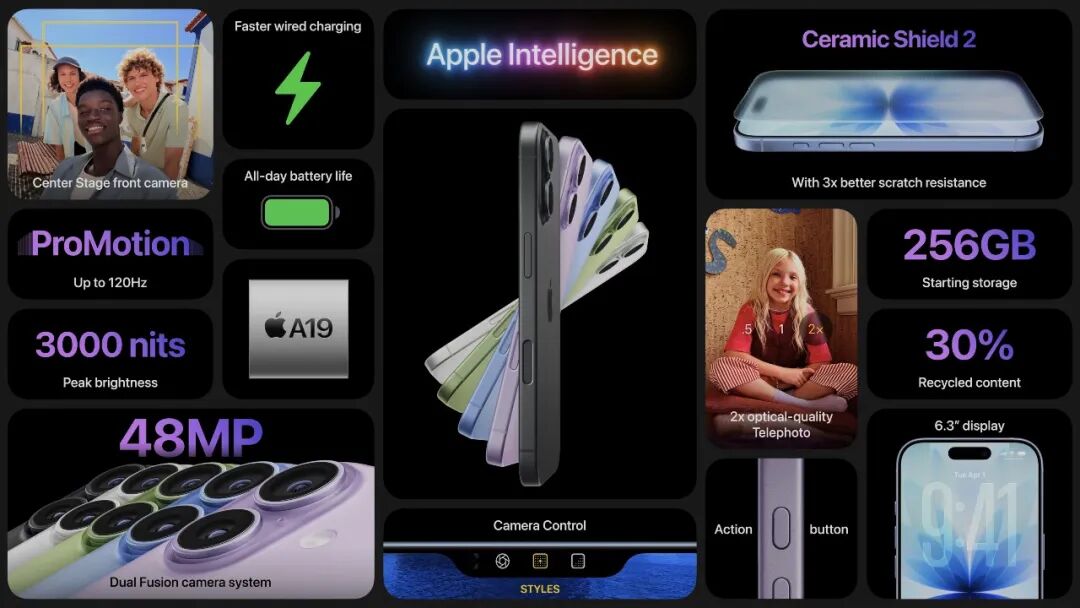
Image Source: Apple
Released in September 2025, the iPhone 17 series not only avoided raising prices in response to rising memory costs but even offered "enhanced specifications," with the standard edition's base storage increasing from 128GB to 256GB and featuring an LTPO screen supporting 1–120Hz ProMotion variable refresh rates.
During 618, the iPhone 17 series saw direct price reductions, showcasing stronger price competitiveness compared to Chinese flagship models that "raised prices first before reducing them."
However, this doesn't mean Apple will become the "winner" in the smartphone industry. While the iPhone's proactive price reductions have attracted a large number of consumers, they also indicate that Apple's pricing power is gradually weakening. If Apple continues to rely on price reductions to gain market share, its high-end brand positioning may be shaken.
03
Memory Prices to Keep Rising, Smartphone Makers Brace for Tough Times
Although memory manufacturers are actively expanding production, given the sustained release of AI demand, the market's supply-demand balance is unlikely to improve significantly in the short term, and memory prices will remain high for some time.
Recently, Goldman Sachs noted in a research report that it expects the supply-demand conditions for traditional DRAM, NAND, and HBM to be even tighter in 2027 than in 2026, with tight conditions persisting until 2028.
In response, Lu Weibing, president of Xiaomi, stated that the pricing of any smartphone today is affected by the significant rise in memory costs. "In the second half of this year, especially by the end of the year, some domestically produced flagship slab phones may exceed 10,000 yuan in price."
Since the smartphone market has entered an era of performance surplus, consumer demand for upgrades is already weak. Against this backdrop, the continuous rise in memory prices, driving up terminal prices, will undoubtedly further suppress market demand.
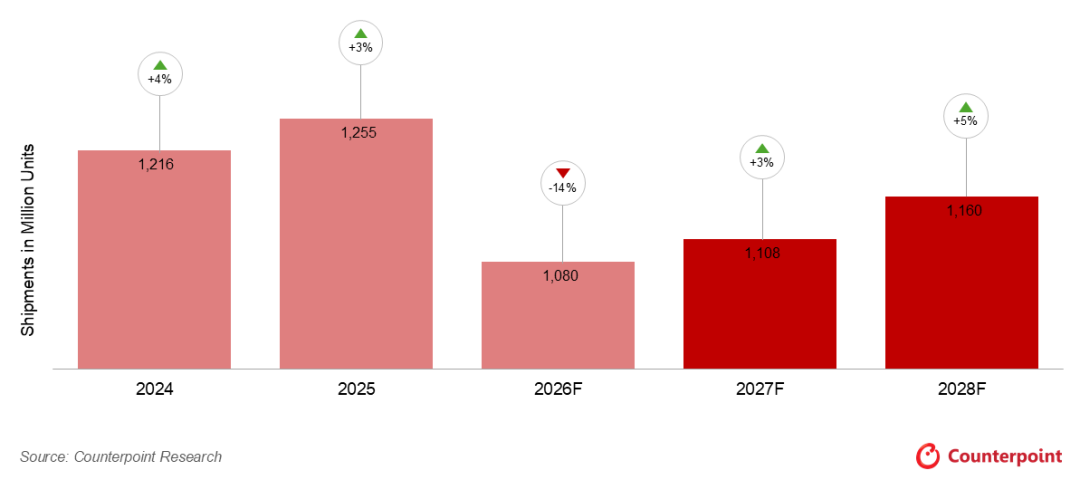
Image Source: Counterpoint Research
According to a research report by Counterpoint Research, global smartphone shipments are expected to reach approximately 1.08 billion units in 2026, a 13.9% year-over-year decline and the lowest level since 2013.
From this perspective, this year's 618 shopping festival is not only an important window for consumers to purchase smartphones but also a rare opportunity for manufacturers to ship products before the cost winter arrives. As the smartphone industry enters a mature phase, if manufacturers continue to maintain their existing iteration models, they will face significant downward pressure.
Farsight believes that after entering a mature phase, rather than simply launching new models and inefficiently competing for market share, smartphone manufacturers should focus on investing their limited resources in operating their existing user base.
Apple's success demonstrates that increasing user loyalty for smartphone products relies not only on hardware specifications but also on continuously evolving software experiences and a well-developed ecosystem.
Going forward, Chinese smartphone manufacturers can build deeper user moats by extending system maintenance cycles and strengthening cross-device collaboration capabilities.
Additionally, as AI technology matures, smartphones are evolving from mere information terminals to personal intelligent gateways. In this context, manufacturers can also restructure their products and business models around the unique characteristics of AI technology, creating new service scenarios and value systems to forge differentiated competitiveness.
In summary, while most smartphones saw limited promotional efforts during this year's 618 due to upstream supply chain pressures, from a longer-term perspective, rising memory costs represent not just a cost crisis but also a potential catalyst for industry reshuffling.
It is forcing smartphone manufacturers to abandon the old model of relying on supply chain dividends and price wars to drive growth and instead seek new value propositions.
Especially as AI technology rapidly matures, the factors determining smartphone manufacturers' future success are no longer solely hardware specifications and channel resources but rather ecosystem construction, software services, and AI implementation capabilities.
For smartphone manufacturers, whether they can evolve during this downturn will determine whether they regain growth in the next industry recovery or are left behind by the times.
Interactive Topic
Which smartphone did you purchase during this year's 618? Do you think the discounts were substantial?
This article is original content from Farsight and is prohibited from reproduction without authorization.
-
![]()
Proposed to Raise 955 Million Yuan through Private Placement! Huicheng Vacuum Boosts Localization of Ultra-Precision Optical Coating Equipment
-
![]()
Cash Flow Soars 13-Fold! What Major Strategic Move is Wuhan Five Square Optoelectronics Planning?
-
![]()
Leaked Design of vivo X500: Reverts to Circular Camera Module in Top-Left Corner, Pays Homage to Classic X90 Aesthetic
-
![]()
DeepSeek Shows Signs of Foraying into Code Agents, Launches WeChat Official Account Focused on Harness
-
![]()
Auto Companies Deny Claims That ‘Cooperation with Huawei Is Non-Essential’, as Huawei Transforms into a ‘Public Platform’
-
![]()
Starship to Independently 'Return to the Launch Tower': SpaceX's Ambitions Extend Beyond Rocket Building to Dominating Space Transportation
-
![]()
Starship Set to Independently 'Return to the Launch Tower': SpaceX is Revolutionizing Space Transportation, Not Just Building Rockets
-
![]()
Anthropic and OpenAI Face Off Against Deepseek