The SpaceX IPO is Here: Why is Global Capital Scrambling for This 'Ticket to the Future World'?
 06/05 2026
 442
442
What if a company:
Simultaneously controls the world's largest satellite internet system;
Possesses the world's most powerful commercial rocket capabilities;
Is constructing an AI super data center;
And aims to send data centers into space, establish a lunar economy, and create a Mars colonization system?
How should its valuation be calculated? This is no longer a question traditional investment institutions can answer.
Recently, as SpaceX officially submitted its IPO documents, market expectations suggest the fundraising scale could reach $80 billion, with a valuation targeting $1.75-2 trillion. The global capital market is finally beginning to seriously confront a question:
SpaceX may no longer be just a 'space company.' It more closely resembles a convergence of future global energy, communications, AI, and space infrastructure.
And this may be why it could become the largest IPO in history.
01┃ SpaceX: One of the World's Most Valuable Pre-IPO Companies
Over the past few years, SpaceX's valuation growth has far exceeded the scope of traditional primary market companies.
By the end of 2025, the company's secondary market valuation had reached approximately $800 billion. Subsequently, with Starlink's growth, rising expectations for AI infrastructure, and progress toward an IPO, the market's valuation of SpaceX further surged to the $1.25 trillion–$1.75 trillion range.
According to the latest IPO documents and media reports, SpaceX's IPO fundraising scale could reach approximately $80 billion, far surpassing the global IPO record set by Saudi Aramco in 2019.
If it ultimately goes public at this scale, it is likely to become:
The largest technology IPO in human history.
More importantly, it is no longer a startup reliant on financing to survive.
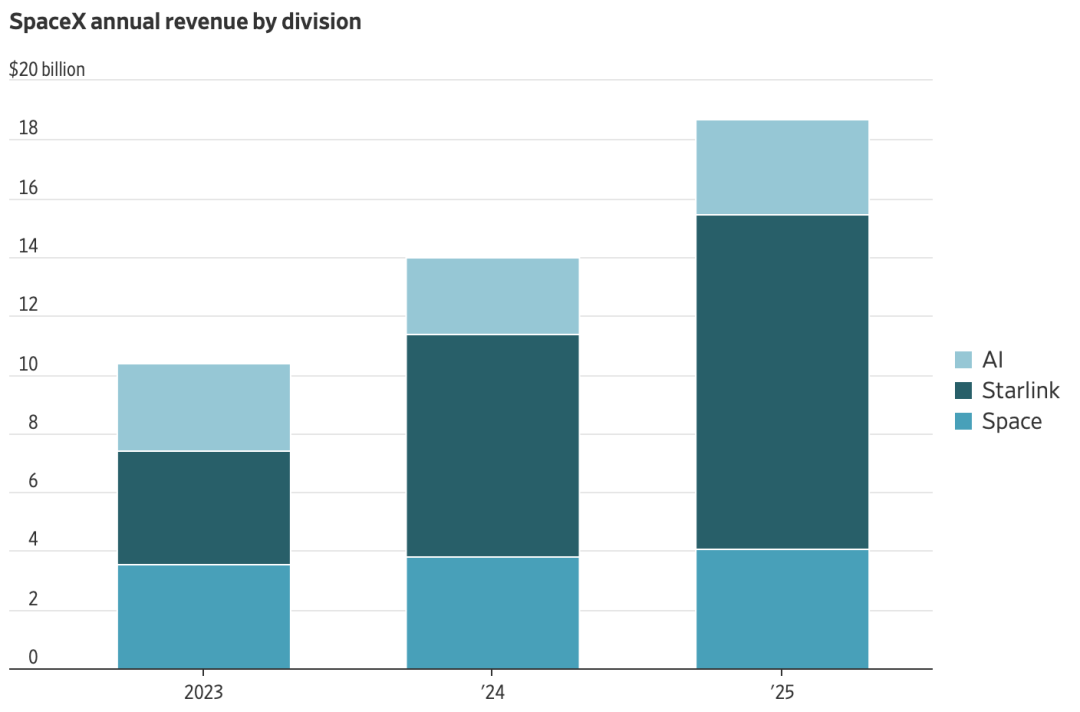
According to SpaceX's latest public filings, the company's 2025 revenue reached approximately $18.67 billion, including:
Starlink (Connectivity) revenue of about $11.4 billion;
Rocket and launch services revenue of about $4.1 billion;
AI business revenue of about $3.2 billion.
This means SpaceX has begun transitioning from a 'high-growth tech story' to a platform company with true global cash flow capabilities. However, what is truly prompting the market to reprice SpaceX is not just revenue growth. It is the growing realization among capital providers that the company simultaneously possesses:
Extremely deep technological moats;
Increasingly strong cash flow capabilities;
Platform-based infrastructure attributes;
And a long-term narrative with an exceptionally high ceiling.
The simultaneous presence of these four factors in a pre-IPO company is extremely rare in the global primary market. What truly excites the capital market is that SpaceX already holds three nearly irreplicable cards.
02┃ Card One: Reusable Rockets Are Turning 'Spaceflight' into Infrastructure
For decades, the biggest challenge in the space industry has been prohibitively high launch costs. Traditional rockets are nearly all 'disposable,' with each launch burning tens or even hundreds of millions of dollars in costs. What SpaceX has truly transformed is its first large-scale validation that rockets can be reused like aircraft.
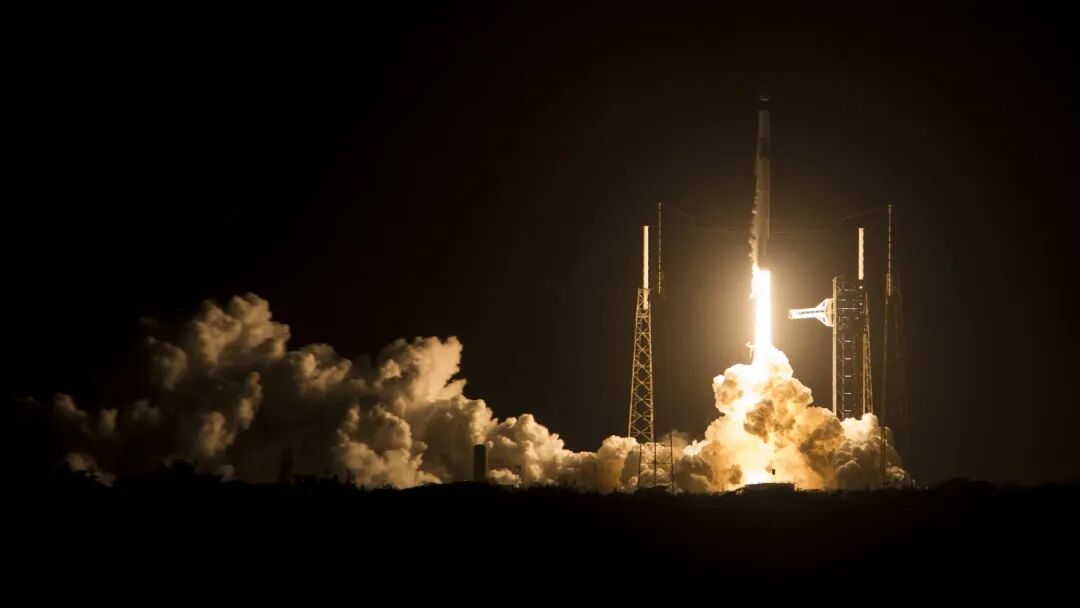
Today, Falcon 9 has become one of the world's most mature reusable rocket systems, with single-launch costs compressed below $30 million—far lower than traditional space systems. But more critically, Falcon 9 may just be the beginning. If Starship achieves stable reuse in 2025-2026, the cost structure of the entire space industry could undergo another order-of-magnitude change. This means 'access to space' is transitioning from a luxury of the past into an infrastructure capability.
Once transport capacity becomes infrastructure, SpaceX's moat will deepen further, as newcomers must replicate not just the technology itself but also: launch frequency, manufacturing systems, supply chains, global operational capabilities, data accumulation, and over a decade of engineering team experience. According to independent agency statistics, SpaceX completed approximately 85% of global commercial launch missions in 2025, with launch capacity even surpassing most national-level space programs.
To some extent, the barriers SpaceX has established in the space sector are beginning to resemble Tesla's early manufacturing and engineering advantages in the electric vehicle industry.
03┃ Card Two: Starlink Is Becoming a True Cash Flow Machine
Many underestimate SpaceX because they still focus solely on rockets. But today, the core driver of SpaceX's financial transformation is actually Starlink. The market has long treated Starlink as a 'future story,' but it is now gradually becoming a high-growth cash flow business in reality.
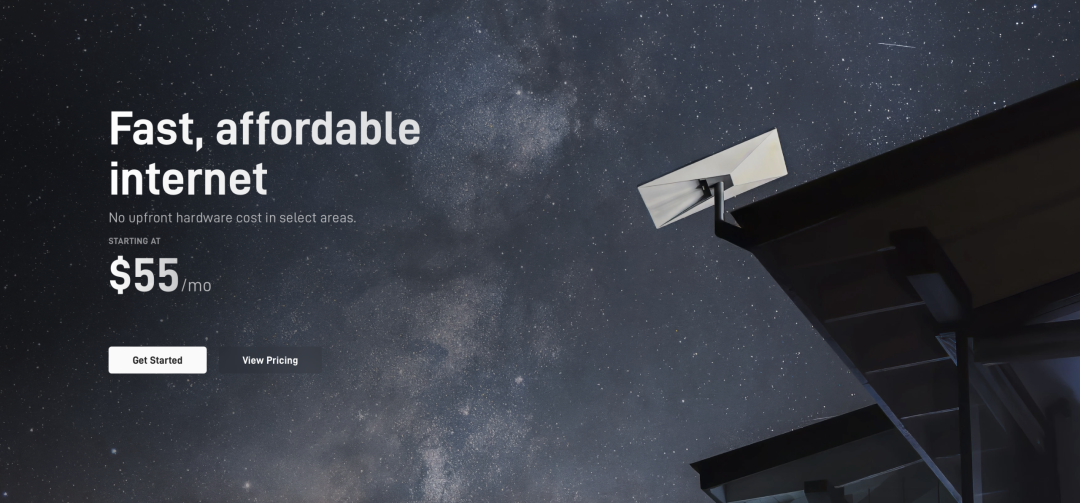
Currently, Starlink has surpassed 4 million users, with average revenue per user stabilizing above $100. Simultaneously, it is rapidly entering:
U.S. Department of Defense networks;
European telecommunications operators;
Aviation and maritime networks;
Broadband for remote regions;
Emergency communications;
Sovereign-grade network infrastructure.
Especially amid rapid global geopolitical shifts and AI infrastructure development, more countries are recognizing the importance of independent communication networks. Starlink essentially provides not just 'satellite WiFi' but resembles next-generation global communications infrastructure.
This is why more institutions are beginning to value Starlink separately. Commercially, it increasingly resembles a 'space-based operator + global communications platform.'
According to the latest IPO documents, Starlink's Connectivity business is SpaceX's only consistently profitable segment, achieving approximately $1.2 billion in operating profit in Q1 2025. Market consensus expects Starlink to contribute over 70% of total revenue by 2026. In other words, SpaceX increasingly resembles a global-scale communications infrastructure platform.
04┃ Card Three: AI, Space Data Centers, and 'Civilization-Level Narratives'
One of the most underestimated aspects of SpaceX is its deepening involvement in AI infrastructure. Over the past year, SpaceX has completed its integration with xAI. According to IPO documents:
AI business capital expenditures alone reached approximately $12.7 billion in 2025, primarily for constructing large-scale data centers and AI infrastructure.
Meanwhile, SpaceX's filings explicitly mention for the first time:
Orbital AI compute satellites;
Space data centers;
Lunar economy;
Mars transportation system;
And even:
'Establishing a continuously expanding human presence in space.'
To many, these concepts initially sound like science fiction. But what truly matters to capital markets is not immediate realizability but the potential market size if even a fraction succeeds. Fundamentally, SpaceX is no longer just a 'space company.' It is attempting to build:
Next-generation energy systems;
Next-generation communications systems;
Next-generation AI infrastructure;
And next-generation space economic systems.
This 'civilization-level narrative' is something most global tech companies utterly lack.
05┃ Why Is Capital So Frenzied for SpaceX?
Recent SpaceX funding rounds have been 'oversubscribed' almost instantly. We've seen traditional VCs, U.S. stock FOFs, global family offices, and even Middle Eastern sovereign funds compete for allocations via secondary markets, SPVs, and employee equity pools. The reason is simple: SpaceX simultaneously satisfies the three rarest conditions in primary markets:
First, extremely deep technological barriers.
Second, the emergence of real cash flow.
Third, a long-term narrative with an exceptionally high ceiling.
And 'Mars' is precisely that ultimate narrative.
Once markets believe SpaceX could truly become the core gateway for future human space infrastructure, its valuation logic transcends simple PE or PS multiples. It becomes a:
Future civilization-level infrastructure asset.
06┃ Why Could This IPO Be a Historic Event?
The most significant implication of SpaceX's IPO may not be the fundraising itself but that it marks the first time global public markets formally price 'future civilization infrastructure.'
According to the latest disclosures, SpaceX could go public as early as June, with the stock ticker expected to be 'SPCX.' What truly shocked the market was not the IPO itself but the ambition revealed in the filing.
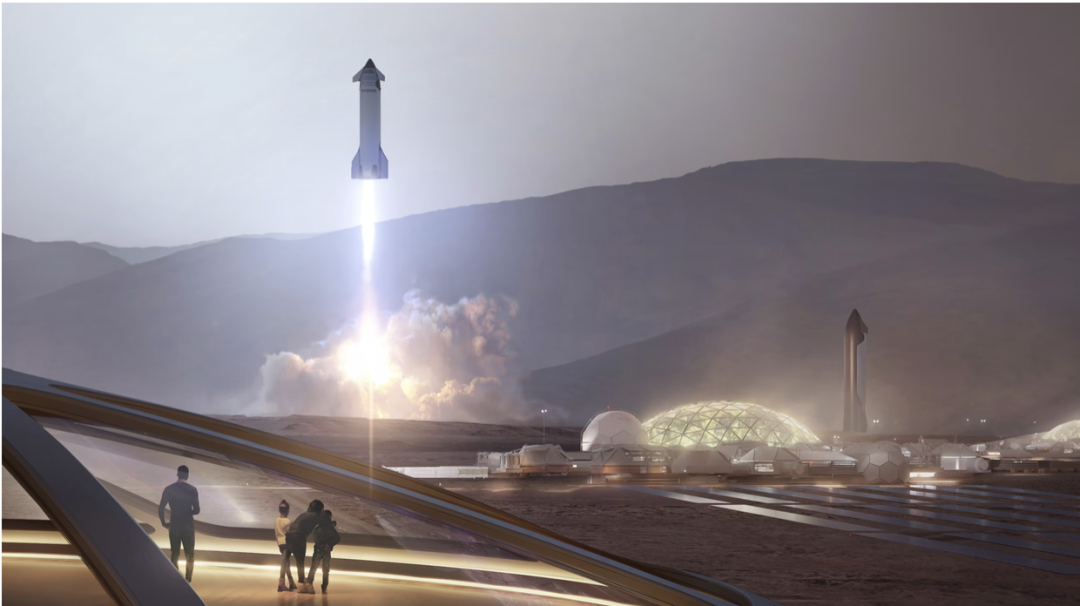
Across over 270 pages, 'Mars' is mentioned more than 60 times. The board even tied Elon Musk's long-term incentives to two objectives:
SpaceX reaching a $7.5 trillion market cap;
Establishing a permanent Mars colony with 1 million inhabitants.
Meanwhile, the filings disclosed for the first time that SpaceX is exploring deploying orbital AI compute satellites as early as 2028—essentially:
Placing AI data centers directly in space.
To some extent, SpaceX is no longer just a 'commercial company.' It resembles a super-infrastructure experiment targeting the next few decades. Of course, this entails enormous risks.
SpaceX remains in a high capital expenditure phase overall. In 2025, the company reported a net loss of approximately $4.9 billion; Q1 2026 saw another $4.3 billion loss.
Key factors include:
Ongoing heavy spending on Starship;
Massive capital expenditures for xAI data centers;
AI business still unprofitable;
Space data centers, Mars transportation systems, and other projects remain 'unproven technologies.'
Even SpaceX acknowledges in its filings that many objectives may never achieve commercialization. But this is precisely what drives capital markets wild. For many long-term investors, they are not just buying today's profits but the optionality to shape humanity's infrastructure direction over the next 20-30 years.
And globally, the company truly occupying the intersection of:
Space;
AI;
Communications;
Energy;
Space infrastructure;
May be only one: SpaceX.
Beta Fund is an early-stage investment institution deeply rooted in Silicon Valley, focusing on the most groundbreaking innovation directions in the AI era, including Agentic AI, AI Native Systems, and AI-driven vertical applications.
We continuously monitor the world's most cutting-edge AI and technology investment opportunities and have secured exclusive investment allocations for the next funding rounds of multiple star projects, including:
SpaceX
Netlify
Prometheus Biosciences
Anduril Industries
Xiaohongshu
StepFun
……
Author's Note: Personal views only.
-
![]()
Proposed to Raise 955 Million Yuan through Private Placement! Huicheng Vacuum Boosts Localization of Ultra-Precision Optical Coating Equipment
-
![]()
Cash Flow Soars 13-Fold! What Major Strategic Move is Wuhan Five Square Optoelectronics Planning?
-
![]()
Leaked Design of vivo X500: Reverts to Circular Camera Module in Top-Left Corner, Pays Homage to Classic X90 Aesthetic
-
![]()
DeepSeek Shows Signs of Foraying into Code Agents, Launches WeChat Official Account Focused on Harness
-
![]()
Auto Companies Deny Claims That ‘Cooperation with Huawei Is Non-Essential’, as Huawei Transforms into a ‘Public Platform’
-
![]()
Starship to Independently 'Return to the Launch Tower': SpaceX's Ambitions Extend Beyond Rocket Building to Dominating Space Transportation
-
![]()
Starship Set to Independently 'Return to the Launch Tower': SpaceX is Revolutionizing Space Transportation, Not Just Building Rockets
-
![]()
Anthropic and OpenAI Face Off Against Deepseek