China’s LEO Satellite Internet Achieves Strategic Progress: Over 100 Additional Satellites Set for Launch
 06/08 2026
 633
633
Kuaikeji, June 8 – Over the past two days last week, China successfully launched the Qianfan Constellation satellites, bringing the total number of in-orbit satellites to 200.
Hu Haiying, Director of the Innovation Academy for Microsatellites at the Chinese Academy of Sciences and Chief Commander of the Qianfan Constellation Satellite System, explained that the Qianfan Constellation, often dubbed the ‘Chinese Starlink,’ is China’s ongoing low-Earth orbit (LEO) satellite internet constellation program, which will proceed with frequent launches.
Both the Qianfan and Starlink programs are LEO satellite internet constellation initiatives, aiming to deploy satellites between 300 and 2,000 kilometers above Earth to create a global network.

Compared to geostationary satellites, LEO satellites function like ‘aerial base stations’ flying closer to Earth. They offer not only reduced signal latency but also the capability to completely eliminate communication dead zones in remote areas such as mountains, deserts, and deep seas. This is achieved through the interconnection of thousands of satellites, forming a ‘space-based network’ woven by tens of thousands of satellites.
Few are aware that China was one of the earliest nations to focus on LEO satellites. When China launched its first LEO communication experimental satellite in 2003, Musk’s Starlink program had not yet been conceived.
More than two decades later, Musk’s Starlink has deployed over ten thousand satellites in orbit, while China’s Qianfan Constellation aims to complete the deployment of 324 satellites for networking by July 2026 as its first-phase goal.
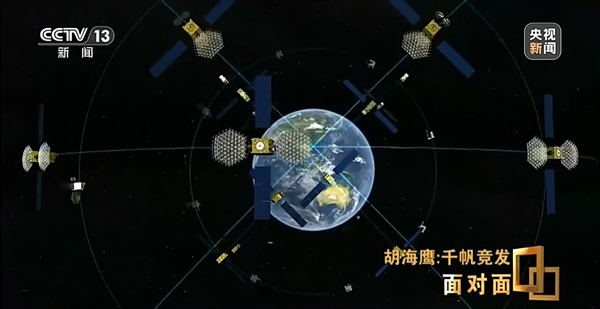
However, China’s well-established ground communication network initially slowed the development of LEO satellite internet. Currently, many applications, such as maritime shipping and in-flight networks on civil aviation aircraft, still rely on foreign satellite services, posing significant security risks. This has become a key driving force behind the advancement of this project.
The team abandoned traditional satellite design methods, adopting a flat configuration and a stacked launch approach to deploy 18 satellites simultaneously with a single rocket. They also employed rotational separation technology to prevent satellite collisions.
The cost per satellite has been reduced from hundreds of millions of yuan to just over ten million yuan. These satellites are designed for a seven-year operational lifespan, relying on constellation redundancy to ensure overall service stability.
According to the plan, the Qianfan Constellation will be developed in three phases, ultimately aiming to deploy over 15,000 satellites. It will integrate multimedia and remote sensing capabilities and become part of the 6G ecosystem, with the goal of establishing a fully covered space-ground integrated network.
-
![]()
Proposed to Raise 955 Million Yuan through Private Placement! Huicheng Vacuum Boosts Localization of Ultra-Precision Optical Coating Equipment
-
![]()
Cash Flow Soars 13-Fold! What Major Strategic Move is Wuhan Five Square Optoelectronics Planning?
-
![]()
Leaked Design of vivo X500: Reverts to Circular Camera Module in Top-Left Corner, Pays Homage to Classic X90 Aesthetic
-
![]()
DeepSeek Shows Signs of Foraying into Code Agents, Launches WeChat Official Account Focused on Harness
-
![]()
Auto Companies Deny Claims That ‘Cooperation with Huawei Is Non-Essential’, as Huawei Transforms into a ‘Public Platform’
-
![]()
Starship to Independently 'Return to the Launch Tower': SpaceX's Ambitions Extend Beyond Rocket Building to Dominating Space Transportation
-
![]()
Starship Set to Independently 'Return to the Launch Tower': SpaceX is Revolutionizing Space Transportation, Not Just Building Rockets
-
![]()
Anthropic and OpenAI Face Off Against Deepseek